
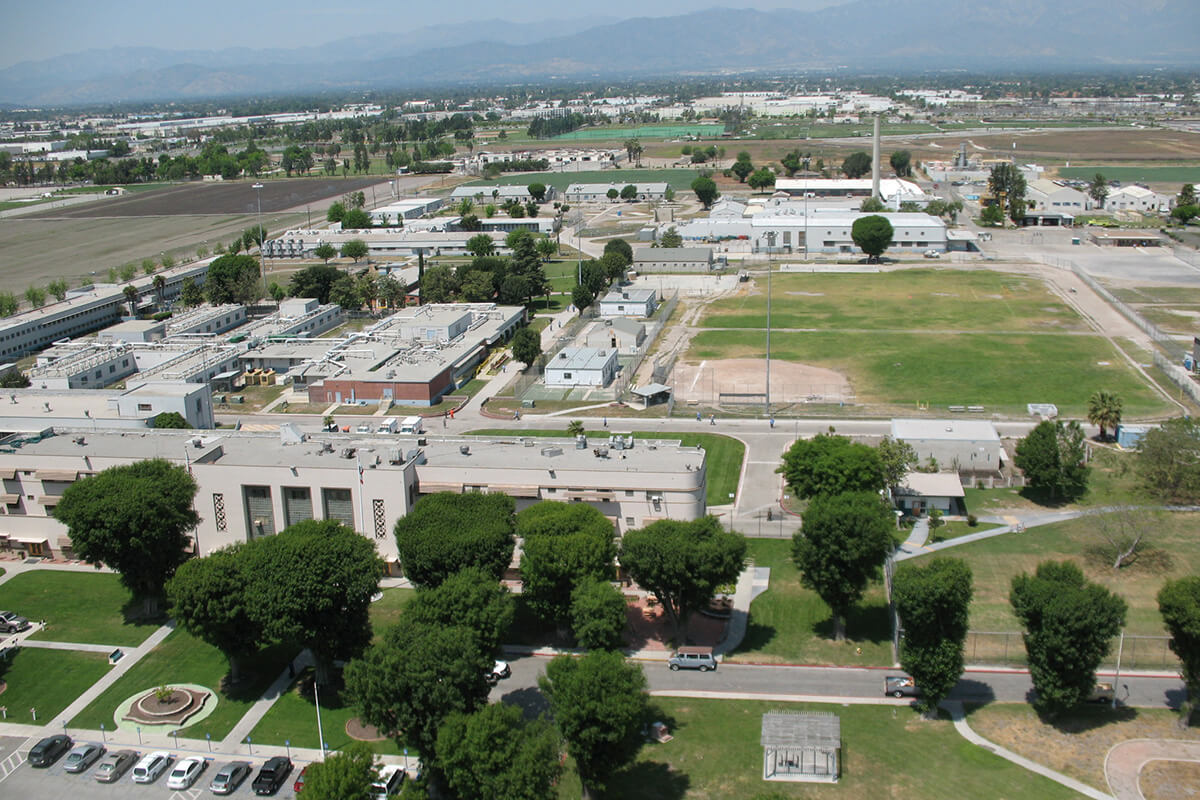
2025-110 The California Institution for Men
Its Deteriorating Infrastructure Adversely Affects Incarcerated Individuals, While Increasing the Risk of a Security Incident
Published: August 13, 2026Report Number: 2025-110
August 13, 2026
2025-110
The Governor of California
President pro Tempore of the Senate
Speaker of the Assembly
State Capitol
Sacramento, CA 95814
Dear Governor and Legislative Leaders:
As directed by the Joint Legislative Audit Committee, my office conducted an audit of the California Department of Corrections and Rehabilitation (CDCR) and its California Institution for Men (CIM). Our audit focused on CDCR’s management of CIM’s infrastructure, we determined that the CIM infrastructure is badly deteriorated, and its poor condition reduces incarcerated individuals’ access to safe housing and education and rehabilitative programs.
Located in the city of Chino and opened in 1941, CIM is one of the State’s oldest correctional institutions. However, CIM’s poor infrastructure conditions undermine CDCR’s ability to consistently meet legal requirements related to humane, safe, and medically adequate conditions for incarcerated individuals. The most recent facility condition assessments performed at CIM in 2008 and 2019 consistently found CIM’s infrastructure to be in poor condition, and the 2019 assessment identified $1.2 billion in needed repairs. Nonetheless, CDCR and CIM implemented only a fraction of the assessment’s recommendations. CIM also has a significant maintenance backlog, which CDCR and CIM do not effectively oversee, resulting in incomplete information about needed maintenance and repair work. In many instances, we found that CIM’s infrastructure issues impede incarcerated individuals’ access to functional sanitation facilities, safe and dry living areas, and education and rehabilitative programs.
CDCR provided CIM with almost $240 million for infrastructure work from fiscal years 2020–21 through 2024–25. Although that amount was between 200 percent and 680 percent of the amounts CDCR provided to other institutions we reviewed, it was still not sufficient for CIM to meet safety and habitability standards. Moreover, CDCR lacks policies and procedures for prioritizing repair projects for funding. As a result, staff could not explain why it made some repairs and not others. The amount necessary for CDCR to meet legal, regulatory, and environmental requirements reduces the amount of funding available to perform necessary maintenance and repairs.
In May 2026, CDCR published an Infrastructure Master Plan that proposes renovating or rebuilding CIM and four other institutions, and it estimates that repairs and replacements at CIM could cost as much as $2.6 billion. CDCR must work with the Legislature and stakeholders to determine appropriate next steps and obtain funding, if warranted, to repair, renovate or rebuild CIM
Respectfully submitted,
GRANT PARKS
California State Auditor
Selected Acronyms Used in This Report
| ACA | American Correctional Association |
| ADA | Americans with Disabilities Act |
| BCP | budget change proposal |
| CDCR | California Department of Corrections and Rehabilitation |
| CIM | California Institution for Men |
| CMF | California Medical Facility |
| CRC | California Rehabilitation Center |
| DOJ | Department of Justice |
| DOT | Department of Transportation |
| EPA | Environmental Protection Agency |
| LAO | Legislative Analyst’s Office |
| OIG | Office of the Inspector General |
Summary Key Findings and Recommendations
Our audit reviewed the California Department of Corrections and Rehabilitation’s (CDCR) management of the infrastructure at the California Institution for Men (CIM). During our review we identified the following key findings:
- Facility condition assessments have found that CIM’s infrastructure is in poor condition and needs significant repair or replacement. A 2008 report from the Office of the Inspector General (OIG) concluded that CIM would need dramatically increased funding for maintenance and repair to sustain the institution’s infrastructure. The most recent assessment from 2019 recommended that CDCR complete 26 projects at a cost of $1.2 billion to address CIM’s aged infrastructure, including roofing repairs, replacement of the water distribution system, and the repair and replacement of multiple housing units. However, CDCR has funded only four of the 26 projects, and it has completed none of them. In its surveys, the California Department of Public Health (Public Health) identified 38 maintenance and infrastructure issues in 2024 and 68 in 2025. CIM’s deteriorating infrastructure affects the health and safety of incarcerated individuals and staff and creates a potential security risk for the institution.
- CIM has a significant maintenance backlog, including work needed to repair clogged and leaky plumbing and leaky roofs, control temperatures, and repair windows and doors. Although CIM had fewer maintenance work orders than most other institutions whose data we reviewed, staff at CIM have closed far fewer work orders than staff at the other institutions, which leaves CIM with insufficient accurate data to understand the real extent of its maintenance backlog. This is primarily because CDCR’s plant operations policy lacks sufficient guidance on how staff at its institutions should manage their work orders. Further, CIM has not consistently implemented the policy’s existing requirements. Moreover, CDCR does not conduct sufficient oversight of CIM’s maintenance backlog by conducting audits or other reviews. CIM’s correctional plant manager estimated that CIM is unable to complete about 25 percent of work orders because it does not have the necessary replacement parts for aging systems or adequate annual funding to complete all required maintenance and repairs.
- CIM’s poor infrastructure conditions affect the habitability of the institution for incarcerated individuals and working conditions for staff, and the conditions have undermined CDCR’s ability to consistently meet legal requirements related to humane, safe, and medically adequate conditions for incarcerated individuals. In the work orders we reviewed and interviews we conducted with incarcerated individuals and staff, we encountered evidence of persistent problems with plumbing, temperature control, leaking roofs, and inoperable interior items, such as doors and equipment, all of which affected access to functional sanitation facilities, safe and dry living areas, and appropriate indoor temperatures. Failing kitchen infrastructure—such as faulty steam lines and inoperable coolers—also keeps CIM from consistently meeting standards required for hygiene, safety, and food service. CIM’s infrastructure issues impede access to education and rehabilitative programs, sometimes reducing participation in academic and vocational programs and limiting opportunities for individuals to earn rehabilitative credits. Although we did not identify any specific issues with CIM’s deteriorating infrastructure that appeared to present an imminent public safety threat, such as failures in the security perimeter, the cumulative effect of CIM’s deteriorating infrastructure increases the risk that a security incident could occur.
- CDCR provided almost $240 million to CIM for infrastructure maintenance, repairs, and upgrades from fiscal years 2020–21 through 2024–25, but that sum has not been sufficient for CIM to meet safety and habitability standards, such as standards related to safety, hygiene, and temperature control. Across its 31 institutions, CDCR had a backlog in 2025 of about $1.6 billion in requested special repair projects—projects that are not part of the standard, scheduled maintenance cycle but arise from urgent or unique needs and require CDCR’s resources to address—that it was unable to fund. The Joint Legislative Audit Committee asked us to review CDCR’s allocation of funds, the extent to which CIM has deferred any maintenance or facility upgrades, and if so, the rationale for those decisions. However, CDCR was unable to demonstrate why it chose to fund certain projects and defer others because it has not established policies and procedures governing its project prioritization. Further, CDCR and CIM generally had to fund projects necessitated by legal, regulatory, or environmental considerations, and did not have sufficient remaining funds available for other infrastructure projects or for performing maintenance and repairs.
- CDCR’s institutions need significant infrastructure investment. CDCR has published an Infrastructure Master Plan (master plan) that identifies $73 billion in necessary infrastructure investments at its institutions over the next 20 years. The master plan proposes to start by renovating or rebuilding five institutions, including CIM, over the next 10 years. As of July 2026, CDCR has selected a contractor and is negotiating a contract to start the planning process for the first institution. Although the plan identified CIM as the institution with the greatest infrastructure needs, the plan does not anticipate starting work on CIM until July 2029. The master plan also outlines CDCR’s intent to review and update its plan on a recurring basis to identify additional institutions for future upgrades or replacements. Because the costs to implement CDCR’s master plan will be substantial, CDCR must work with the Legislature and stakeholders to determine appropriate next steps and obtain necessary funding.
To address these findings, we have made recommendations to the Legislature and CDCR. We recommend that the Legislature amend state law to require CDCR to conduct regular, periodic facility condition assessments of its institutions on a rotating basis to ensure that accurate information is available about its institutions’ infrastructure conditions. In addition, CDCR should provide its institutions with specific guidance for how they should manage work orders in its data systems and conduct periodic audits to ensure that institutions follow this guidance and that the data accurately reflect their maintenance backlogs. CDCR should develop policies and procedures for approving institutions’ special repair projects that include the factors CDCR uses in its prioritization process and the weight that each of those factors carries. Finally, we recommend that CDCR accelerate its timeline for repairing or replacing the deteriorated facilities at CIM by one year and begin planning this work by July 2028.
Agency Comments
CDCR agreed with our findings and recommendations.
Introduction
Background
The deteriorating facilities at some of CDCR’s oldest institutions have created concerns that such infrastructure deficiencies limit CDCR’s ability to meet the State’s goals and perform its mission, which is to facilitate the successful reintegration of incarcerated individuals back to their communities as employable members of society. CDCR fulfills its mission by providing education, treatment, rehabilitative services, and restorative justice programs, and its intent is to do so in a safe and humane environment. As Figure 1 shows, CDCR operates 31 adult institutions statewide, including 19 institutions that are between 29 and 42 years old and 10 institutions that are between 61 and 174 years old. Figure 2 shows that most of these institutions were built during two spans of time.
Figure 1
CDCR Currently Operates 31 Adult Institutions Throughout the State
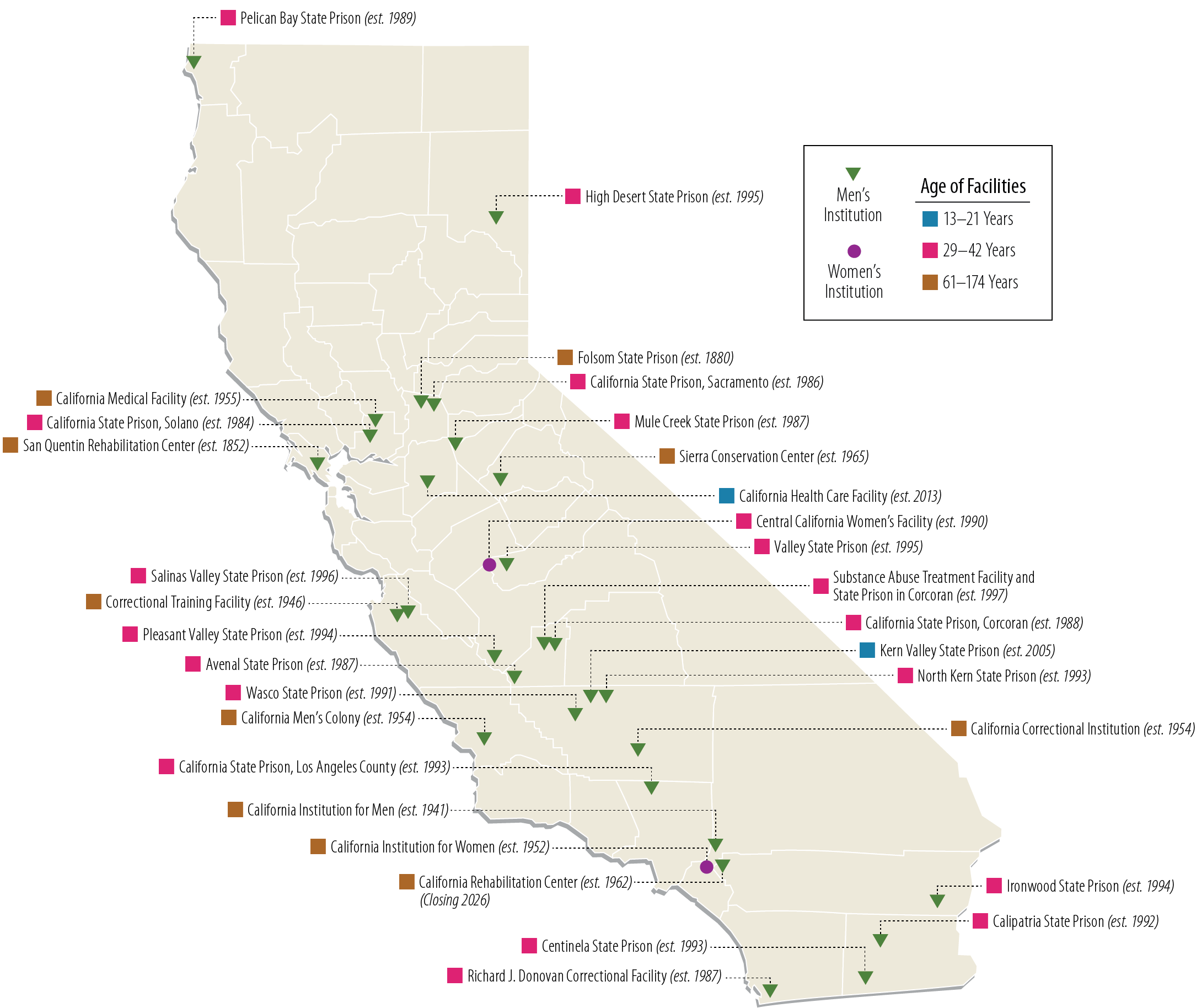
This figure shows a map of California with the 31 adult institutions CDCR operates as of August 2026. The map shows that two institutions are from 13 to 21 years old; 19 institutions are from 29 to 42 years old; and 10 institutions are from 61 to 174 years old.
From North to South, the 29 men’s institutions are:
Pelican Bay State Prison, activated in 1959.
High Desert State Prison, activated in 1995.
Folsom State Prison, activated in 1880.
California State Prison, Sacramento, activated in 1986.
California Medical Facility, activated in 1955.
California State Prison, Solano, activated in 1984.
Mule Creek State Prison, activated in 1987.
San Quentin Rehabilitation Center, activated in 1852.
Sierra Conservation Center, activated in 1965.
California Health Care Facility, activated in 2013.
Valley State Prison, activated in 1995.
Salinas Valley State Prison, activated in 1996.
Correctional Training Facility, activated in 1946.
Substance Abuse Treatment Facility and State Prison in Corcoran, activated in 1997.
California State Prison, Corcoran, activated in 1988.
Pleasant Valley State Prison, activated in 1994.
Avenal State Prison, activated in 1987.
Kern Valley State Prison, activated in 2005.
North Kern State Prison, activated in 1993.
Wasco State Prison, activated in 1991.
California Men’s Colony, activated in 1954.
California Correctional Institution, activated in 1954.
California State Prison, Los Angeles County, activated in 1993.
California Institution for Men, activated in 1941.
California Rehabilitation Center, activated in 1962. This institution is closing in 2026.
Ironwood State Prison, activated in 1994.
Calipatria State Prison, activated in 1992.
Centinela State Prison, activated in 1993.
Richard J. Donovan Correctional Facility, activated in 1987.
There are 2 women’s institutions.
Central California Women’s Facility, activated in 1990.
California Institution for Women, activated in 1952.
Source: CDCR’s website and master plan.
Note: Year shown indicates the year CDCR activated the institution.
Figure 2
California Built Most of Its Current Institutions During Two Periods of Time
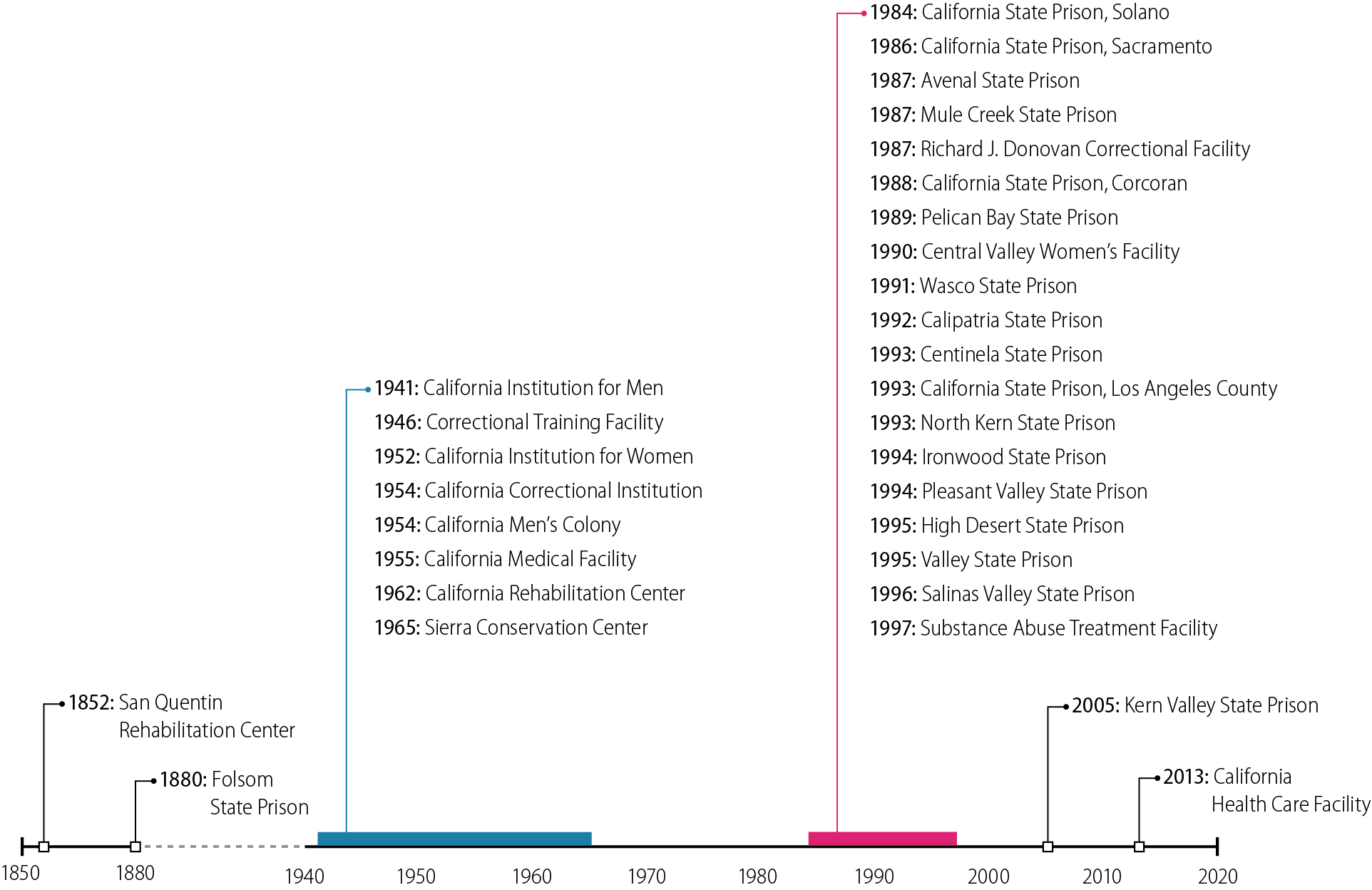
A timeline showing when CDCR’s current institutions were activated that makes clear that most were built during two specific periods of time from 1941 to 1965, and from 1984 to 1997.
Two institutions were activated from 1852 to 1880.
1852: San Quentin Rehabilitation Center
1880: Folsom State Prison
Eight were activated from 1941 to 1965, a 25-year span.
1941: California Institution for Men
1946: Correctional Training Facility
1952: California Institution for Women
1954: California Correctional Institution
1954: California Men’s Colony
1955: California Medical Facility
1962: California Rehabilitation Center
1965: Sierra Conservation Center
19 institutions were activated in the 14 years from 1984 to 1997.
1984: California State Prison, Solano
1986: California State Prison, Sacramento
1987: Avenal State Prison
1987: Mule Creek State Prison
1987: Richard J. Donovan Correctional Facility
1988: California State Prison, Corcoran
1989: Pelican Bay State Prison
1990: Central Valley Women’s Facility
1991: Wasco State Prison
1992: Calipatria State Prison
1993: Centinela State Prison
1993: California State Prison, Los Angeles County
1993: North Kern State Prison
1994: Ironwood State Prison
1994: Pleasant Valley State Prison
1995: High Desert State Prison
1995: Valley State Prison
1996: Salinas Valley State Prison
1997: Substance Abuse Treatment Facility
The two remaining institutions were activated from 2005 to 2013.
2005: Kern Valley State Prison
2013: California Health Care Facility
The dates we list are the dates CDCR activated the institutions. California Men’s Colony, California Correctional Institution, and California Rehabilitation Center were originally built for other uses before becoming CDCR institutions. We do not include closed institutions.
Source: CDCR master plan.
Note: Year shown indicates the year CDCR activated the institution. California Men’s Colony, California Correctional Institution, and California Rehabilitation Center were originally built for other uses before becoming CDCR institutions. The figure does not include closed institutions.
The population of incarcerated adults (incarcerated population) in CDCR’s institutions has declined by almost half from 173,000 in 2006 to about 90,000 in 2026, as Figure 3 shows.1 CDCR expects the population to decline further and has closed five institutions, ended contracts with privately operated facilities, and deactivated portions of several institutions since 2019. Table 1 lists the institutions and facilities that CDCR has closed or deactivated since 2019. According to the Legislative Analyst’s Office (LAO), these closures and deactivations have resulted in General Fund savings of about $1 billion annually since 2021. CDCR stated that it intends to close the California Rehabilitation Center in Norco by fall 2026.
Figure 3
California’s Incarcerated Population Declined by 49 Percent From 2006 Through 2026
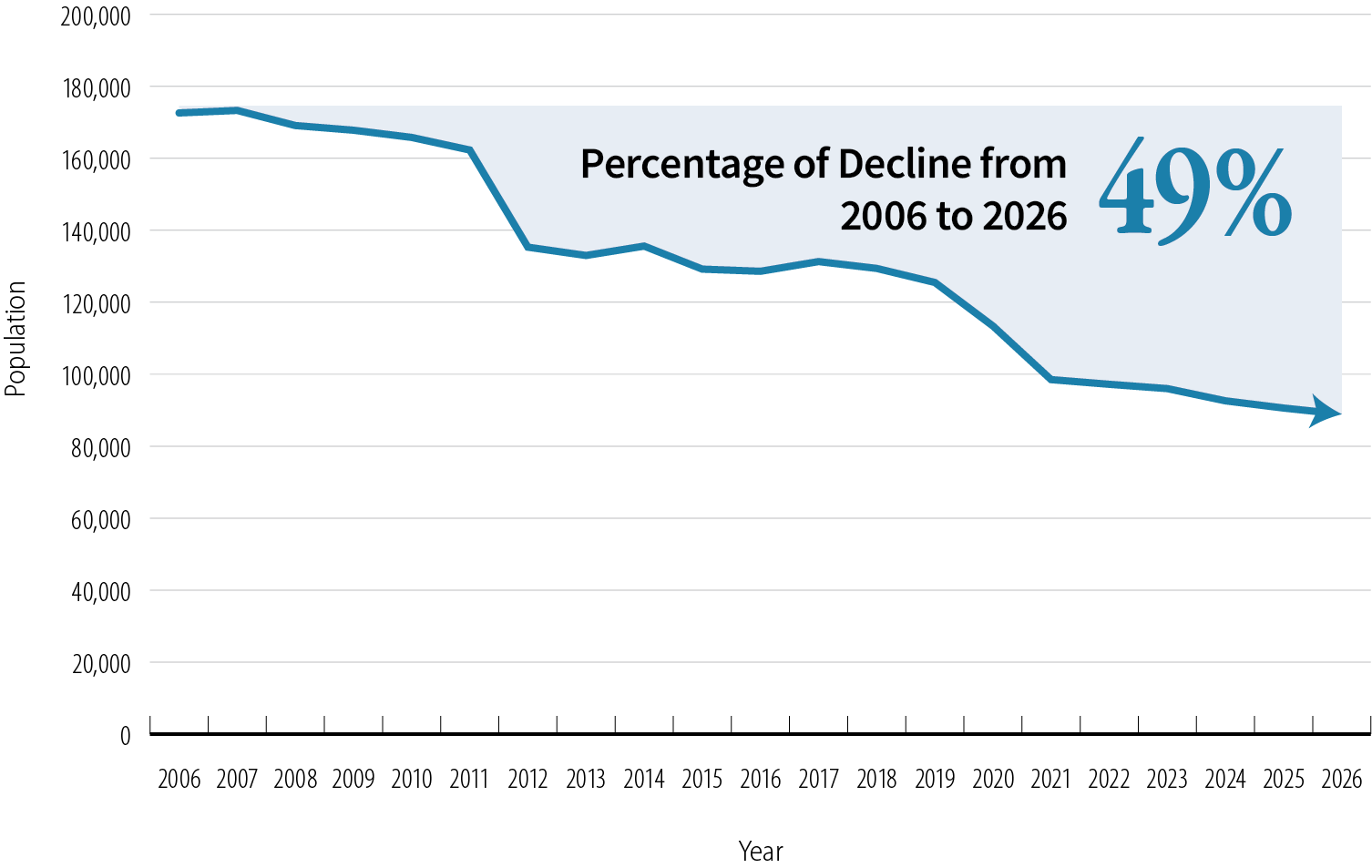
Source: CDCR population projection reports and Legislative Analyst’s Office reports.
CDCR faces competing priorities and demands for the use of its funding. The LAO reports that despite the savings CDCR realized by closing facilities and institutions, CDCR’s nominal operational spending has increased by about $5 billion since fiscal year 2006–07. However, the LAO also reports that CDCR’s share of General Fund spending has declined from 9 percent to about 6 percent and that, when adjusted for inflation, CDCR’s spending actually declined by about $1.6 billion since fiscal year 2006–07. Nevertheless, amid ongoing budget concerns, legislators and stakeholders have expressed frustration that CDCR has not done more to reduce costs. The state budget that the Legislature initially approved for fiscal year 2026–27 directed CDCR to close another institution, although the Legislature subsequently passed a bill that removed this provision. Legislators have also expressed concerns about approving funding for infrastructure projects at institutions that CDCR may decide to close within a few years and that, until recently, CDCR had not established plans to address its aging infrastructure needs. Courts have ordered CDCR to address overcrowding, health care needs, compliance with the Americans with Disabilities Act (ADA), and extreme indoor temperatures—issues that come with significant costs. At the same time, stakeholders urge CDCR to dedicate more funding and space for rehabilitation and reentry programs. These priorities create competing demands that CDCR must balance as it moves forward with its plans to manage California’s prison system and its incarcerated population.
CIM’s Role in California’s Prison System
CIM plays an important role in California’s prison system. Located in the city of Chino in San Bernardino County, as of July 2026 CIM houses nearly 3,000 incarcerated individuals, including some condemned individuals. As one of California’s oldest institutions, CIM opened in 1941 as the State’s third men’s correctional institution and the first in Southern California. CIM comprises four facilities on 1,500 acres, as Figure 4 shows. CIM’s Facility C is located more than a mile from the rest of the institution and is close to nearby residential housing. Some of the buildings in use at CIM, including its central kitchen, were constructed in 1938, and even its newer facilities are decades old, dating from 1950 to 1969. Because CIM is located on a large property, it is one of CDCR’s few institutions with significant available land for constructing new facilities.
Figure 4
CIM’s Four Facilities Were Built Over Several Decades
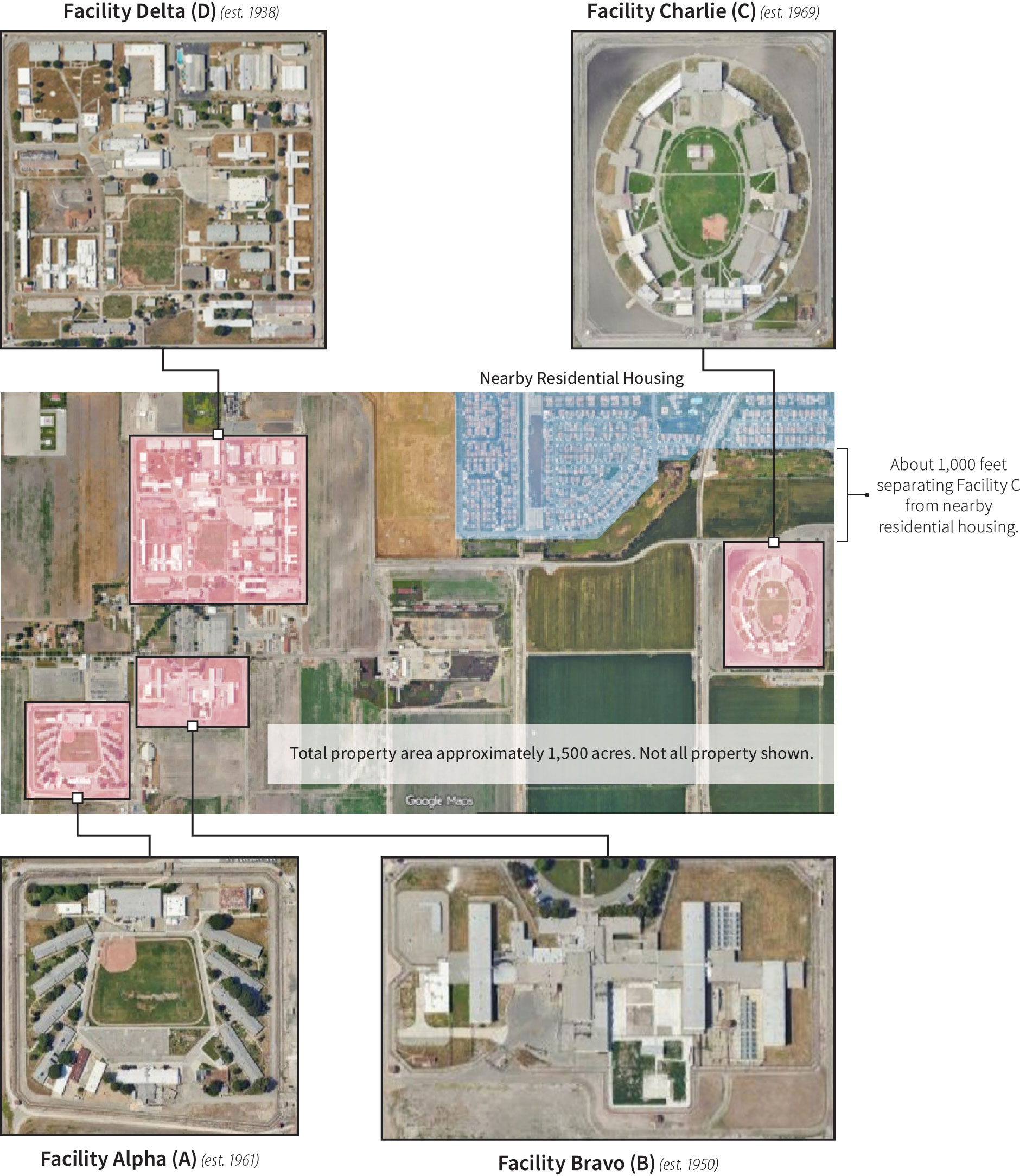
This aerial map shows the location of CIM’s four facilities on approximately 1,500 acres of land. CIM’s Facility Delta (D) was constructed in 1938. Facility Bravo (B), located just south of Facility D, was constructed in 1950. Facility Alpha (A), located adjacent to Facility B, was constructed in 1961. Facility Charlie (C), located nearly a mile east of the other facilities, was constructed in 1969. Facility C is also located about 1,000 feet from nearby residential housing. These dates reflect the initial construction dates. Each facility includes buildings constructed at later times.
The source of the data is Google Maps, a CDCR consultant’s report, and auditor observation.
Source: Google Maps, CDCR consultant’s report, and auditor observation.
Note: Initial construction years shown. Each facility includes buildings constructed in later years.
CIM’s proximity to local health care facilities allows it to care for incarcerated individuals who have significant health needs. As Figure 5 highlights, many in CIM’s population have medical risk factors, and 58 percent are over the age of 50. CIM’s four facilities provide a variety of medical services, including disability care programs, high-risk medical needs care, outpatient housing, and mental health and psychiatric care, as Figure 6 shows. CIM is also close to several hospitals and the Riverside University Health System, and it relies on local medical centers and hospitals to provide specialty medical care to incarcerated patients. CIM’s incarcerated population also benefits from its proximity to large urban centers: many incarcerated individuals have family members who live in the surrounding areas, allowing for more convenient and frequent visits. According to research from the U.S. Department of Justice and the Prison Policy Initiative—an independent research organization—incarcerated individuals who maintain contact with family members are less likely to be reincarcerated. CIM’s warden stated that CIM’s location helps promote incarcerated individuals’ successful reentry into society and reduces recidivism by keeping them near their families in Southern California.
Figure 5
More Than 80 Percent of Incarcerated Individuals at CIM Have Medical Conditions, and Nearly Half Receive Mental Health Care
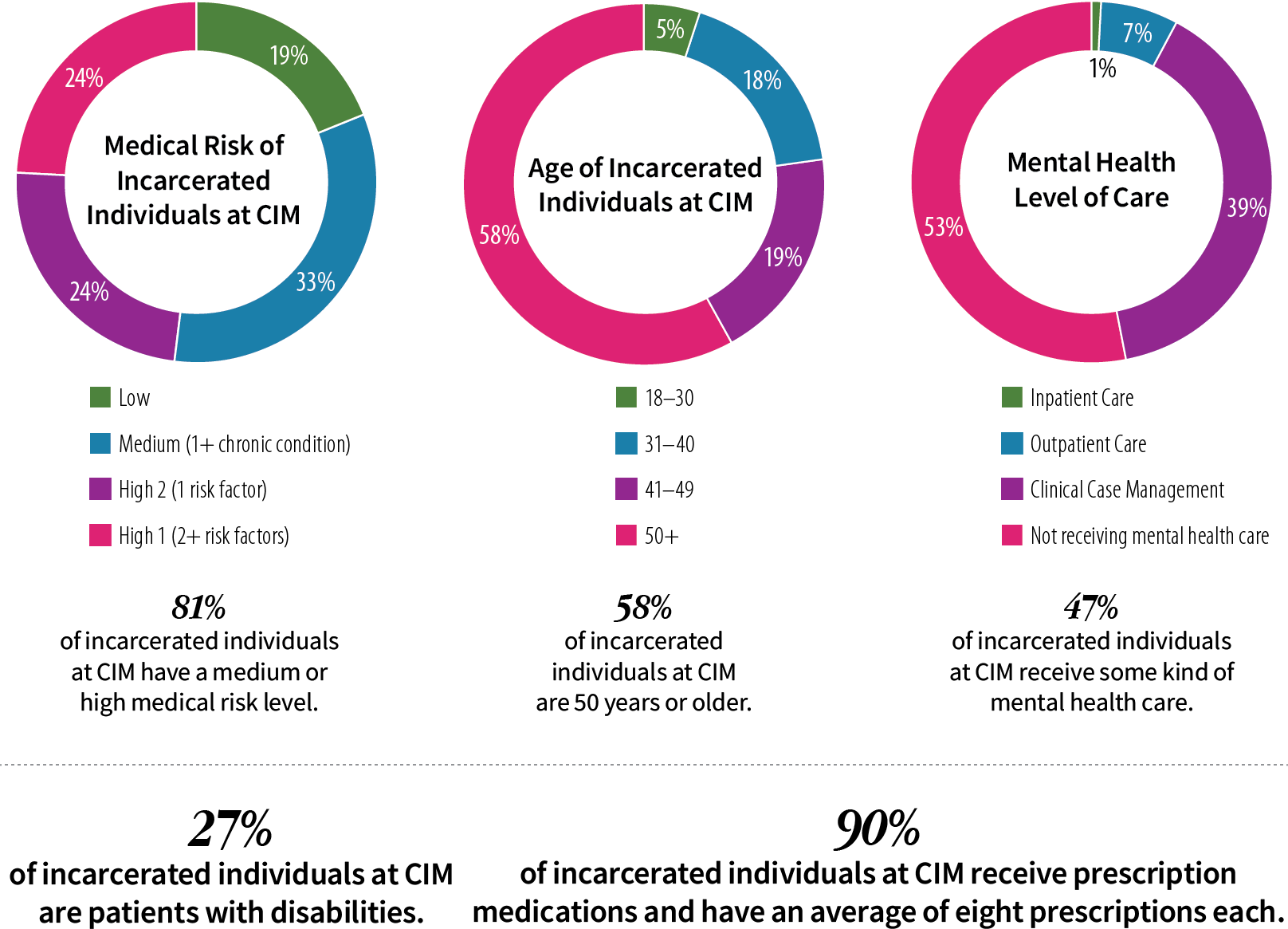
Three donut graphs indicate the percentage of incarcerated individuals at CIM that have Medical Risks, their age, and the level of mental health care that they receive.
81 percent of incarcerated individuals at CIM have a medium or high medical risk level, including: 24 percent with a high 2 medical risk level including 2 or more risk factors; 24 percent with a high 1 medical risk level and 1 risk factor; and 33 percent with a medium medical risk level indicating 1 or more chronic conditions. 19 percent of incarcerated individuals at CIM have a low medical risk level.
Regarding the age of incarcerated individuals at CIM, 58 percent are 50 years of age or older, 19 percent are between 41 and 49 years old, and 18 percent are between the ages of 31 and 40. Just 5 percent of incarcerated individuals at CIM are between the ages of 18 and 30.
47 percent of incarcerated individuals at CIM receive mental health care. This includes 39 percent who receive clinical case management, 7 percent who receive outpatient care, and 1 percent who receive inpatient mental health care. 53 percent of incarcerated individuals at CIM do not receive mental health care.
In addition, 27 percent of incarcerated individuals at CIM are patients with disabilities, and 90 percent receive prescription medications and have an average of eight prescriptions each.
Source: CIM demographic data.
Figure 6
CIM’s Four Facilities House Incarcerated Individuals With Various Medical and Mental Health Care Needs
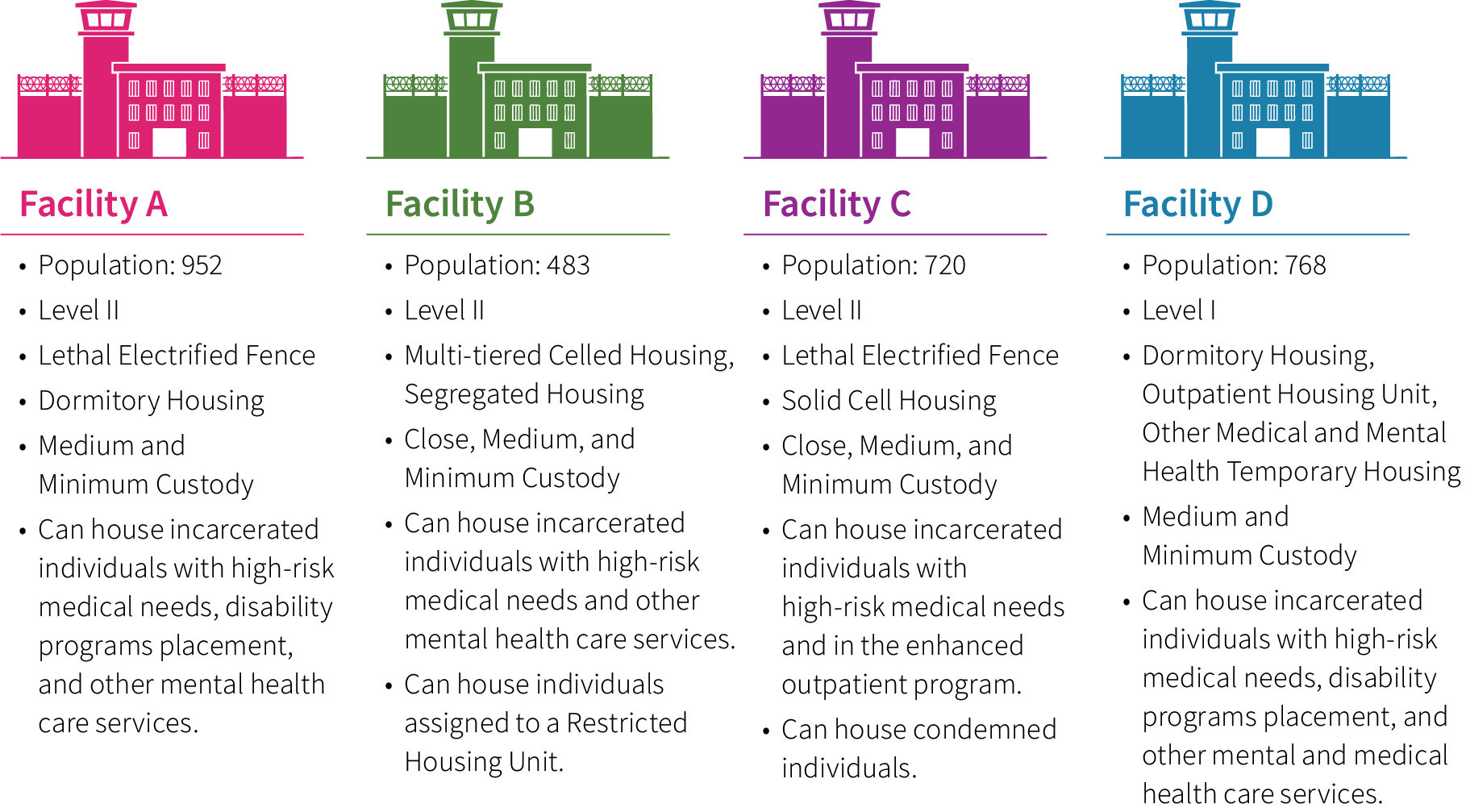
CIM’s Facility A has a population of 952 incarcerated individuals. It is a security level II facility with a lethal electrified fence. The facility has dormitory housing and can accommodate medium and minimum custody individuals. It can house individuals with high-risk medical needs, disability programs placement, and other mental health care services.
CIM’s Facility B has a population of 483 incarcerated individuals. It is a security level II facility. The facility has multi-tiered celled housing and segregated housing and can accommodate close, medium, and minimum custody individuals. It can house incarcerated individuals with high-risk medical needs and other mental health care services. It can also house individuals assigned to a Restricted Housing Unit.
CIM’s Facility C has a population of 720 incarcerated individuals. It is a security level II facility with a lethal electrified fence. The facility has solid cell housing and can accommodate close, medium, and minimum custody individuals. It can house individuals with high-risk medical needs and individuals in the enhanced outpatient program. It can also house condemned individuals.
CIM’s Facility D has a population of 768 incarcerated individuals. It is a security level I facility. The facility has dormitory housing, an Outpatient Housing Unit, and other medical and mental health temporary housing. It can accommodate medium and minimum custody individuals. It can house incarcerated individuals with high-risk medical needs, disability programs placement, and other mental and medical health care services.
CIM also houses 69 individuals in its Outpatient Housing Unit that are not included in the facility totals. CIM’s total population is 2,992. This data is as of July 2026.
Source: CIM demographic data and facility maps.
Note: As of July 2026, CIM’s total population is 2,992. CIM also houses 69 individuals in its Outpatient Housing Unit that are not included above.
CDCR also uses CIM as a hub to serve other institutions in its southern region with commodities and services such as water, transportation, and laundry. CDCR is completing the construction of a new 50-bed mental health crisis facility to satisfy court requirements and serve the needs of the incarcerated population statewide. When the nearby California Rehabilitation Center in Norco closes in fall 2026, CIM will be the only centrally located men’s institution in Southern California. CDCR also depends on CIM’s presence in Southern California to recruit correctional, rehabilitative, and health care staff. According to CDCR staff, CIM is one of the more desirable institutions for staff to work at because of its location, and CDCR has a significant waiting list of staff who have requested transfer to CIM.
Concerns Related to CIM’s Safety
Legislators, local leaders, law enforcement officials, and residents have all expressed concerns about safety and security at CIM for years. In 1983, an incarcerated individual at CIM was transferred to a minimum-security portion of the institution, and the individual escaped through a hole in the perimeter fence and walked away from the facility through an open field. Three days after the escape, four people were found murdered in a home nearby. A jury found the escaped individual guilty of the murders.
In the early 2000s, CIM experienced a series of riots, including one in 2009 that caused severe damage to its infrastructure. During the riot, more than 1,000 rioting individuals burned down a dormitory in CIM’s Facility A and rendered seven of its eight wood-frame housing units uninhabitable. According to a follow-up report by the OIG, CIM had too few correctional officers to provide security for incarcerated individuals transported for outside medical care, and personnel were unable to communicate with outside agencies because of incompatible radios. CIM also had inadequate contingency plans, resulting in it housing many of the 1,150 displaced individuals in outdoor exercise areas for up to three days following the riot. Nearly 200 incarcerated individuals sustained injuries, including 54 who needed transportation to local hospitals for treatment.
In 2018, another incarcerated individual escaped from CIM. The individual breached Facility D’s security perimeter and remained hidden in CIM’s surrounding property for several hours before he stole a vehicle. Authorities took him back into custody 94 miles away from CIM and approximately 21 hours after his escape. Collectively, these incidents have left local communities wary of CDCR’s management of CIM’s population and its aging facilities.
In 2020, CDCR began a pilot program to phase out separate housing for its population of condemned individuals (condemned row) at San Quentin Rehabilitation Center (San Quentin), and that program was made permanent in 2024. As part of that effort, CDCR began transferring condemned individuals from San Quentin to other institutions across California, including to CIM. Although the individuals CDCR transported to CIM come from condemned row, their security classification levels made them eligible for housing in CIM’s Facility C. This inclusion of condemned individuals in CIM’s incarcerated population renewed the concerns of the surrounding communities. Local leaders, including the mayors of Chino and Chino Hills, state legislators, and law enforcement officials submitted letters of opposition to the transfer of condemned individuals to CIM, citing CIM’s aging infrastructure and history of security failures. Additionally, more than 3,600 residents signed a petition calling for the removal of the condemned individuals. Community leaders expressed concern about the condition of the institution, emphasizing CIM’s history of security incidents, and expressed frustration at CDCR’s lack of transparency regarding the transfers.
Audit Results
- The Condition of CIM’s Infrastructure
- The Impact of CIM’s Deteriorating Infrastructure
- Funding Available for Infrastructure Management
- CDCR’s Plans for CIM and California’s Correctional Institutions
- Other Areas We Reviewed
The Condition of CIM’s Infrastructure
Key Points
- In 2019, the Legislature provided funding for a consultant assessment that found the condition of the California Institution for Men (CIM) to be poor and in need of $1.2 billion in repairs, but the California Department of Corrections and Rehabilitation (CDCR) and CIM implemented only a fraction of the consultant’s recommendations.
- Neither CDCR nor CIM conduct regular facility condition assessments, limiting their ability to identify infrastructure needs, and creating the risk that they will only identify deficiencies when they become problems.
- CDCR and CIM provide insufficient oversight of CIM’s maintenance backlog, resulting in both having incomplete information about the infrastructure maintenance and repair work the institution needs and about necessary work not being performed.
Objective 2:
What is the current condition of CIM’s infrastructure, its maintenance backlog, and the results of any recent facility inspections?
CIM’s Deteriorated Condition
A facility condition assessment is an evaluation of the physical condition of a building, its infrastructure, and systems, and it identifies deficiencies and recommends repairs. Past assessments have chronicled CIM’s poor condition. Specific goals of facility condition assessments include developing a long-term maintenance plan to prevent future problems, estimating the costs of repairs or upgrades to help inform capital planning decisions, and helping agencies plan, justify, and fund projects necessary to correct deficiencies. Industry sources suggest that agencies should obtain facility condition assessments regularly, typically every five to 10 years, to ensure that they understand the condition and future needs of their infrastructure. CDCR last obtained facility condition assessments for CIM in 2008 and 2019.
From 2007 to 2011, state law required the Office of the Inspector General (OIG) to assess facility maintenance as a part of its audits of prison institutions. The OIG last reported an assessment of CIM in November 2008. Although a consultant conducted the facility condition assessment, the OIG reported that the consultant found that CIM’s overall condition was beyond poor and that certain living units at CIM were far worse. Further, the OIG found that CDCR had neglected the institution and provided it with inadequate funding. Based on the consultant’s data, the OIG concluded that CIM would need dramatically increased funding for maintenance and repair to sustain the institution’s infrastructure.
CIM’s next facility condition assessment was performed in January 2018, and the 2019 report on the results found CIM’s overall condition remained poor. As part of the Budget Act of 2016, the Legislature provided CDCR with $5.4 million to hire a consultant to assess California’s original correctional institutions, including CIM. The consultant performed a facility condition assessment of CIM as part of that study and concluded that the institution was in poor condition. The consultant issued its statewide study on renovation or replacement of California’s 12 original institutions in December 2019. The consultant identified 25 critical deficiencies throughout CIM related to life safety or impending failure, such as several electrical panels with exposed wiring or missing circuit breaker covers, both of which could result in electrocution. The consultant also recommended that CDCR complete 26 repair projects, listed in Appendix A with their estimated costs, to address CIM’s aged infrastructure and ensure the ongoing reliability of building components and systems that had mostly exceeded their useful lives. Finally, the consultant recommended that CDCR completely demolish and replace Facility A.
During our visit to CIM in March 2026, we found that it had not corrected 13 of the 25 critical deficiencies the consultant identified in its 2019 assessment. For example, Figure 7 shows two panels that had exposed wiring or an empty circuit breaker socket, and we found that nine of the 13 unaddressed items were live electrical panels with exposed wiring. We also found that CIM had not addressed missing connection plates or bolts on a roof truss in Facility A, potentially rendering the trusses unsafe. Another critical deficiency that CIM had not yet addressed included unsecure catwalks that the consultant stated were not safe for the maintenance staff. As a result of our review, CIM’s facilities management staff told us that they would take immediate steps to correct many of the items. In July 2026, CIM staff provided evidence that they had corrected the deficiencies for the nine live electrical control panels we describe above. However, CIM has not yet addressed the critical deficiencies related to its roof trusses or maintenance catwalk.
Figure 7
CIM Has Not Addressed Critical Deficiencies a Consultant Identified in 2019
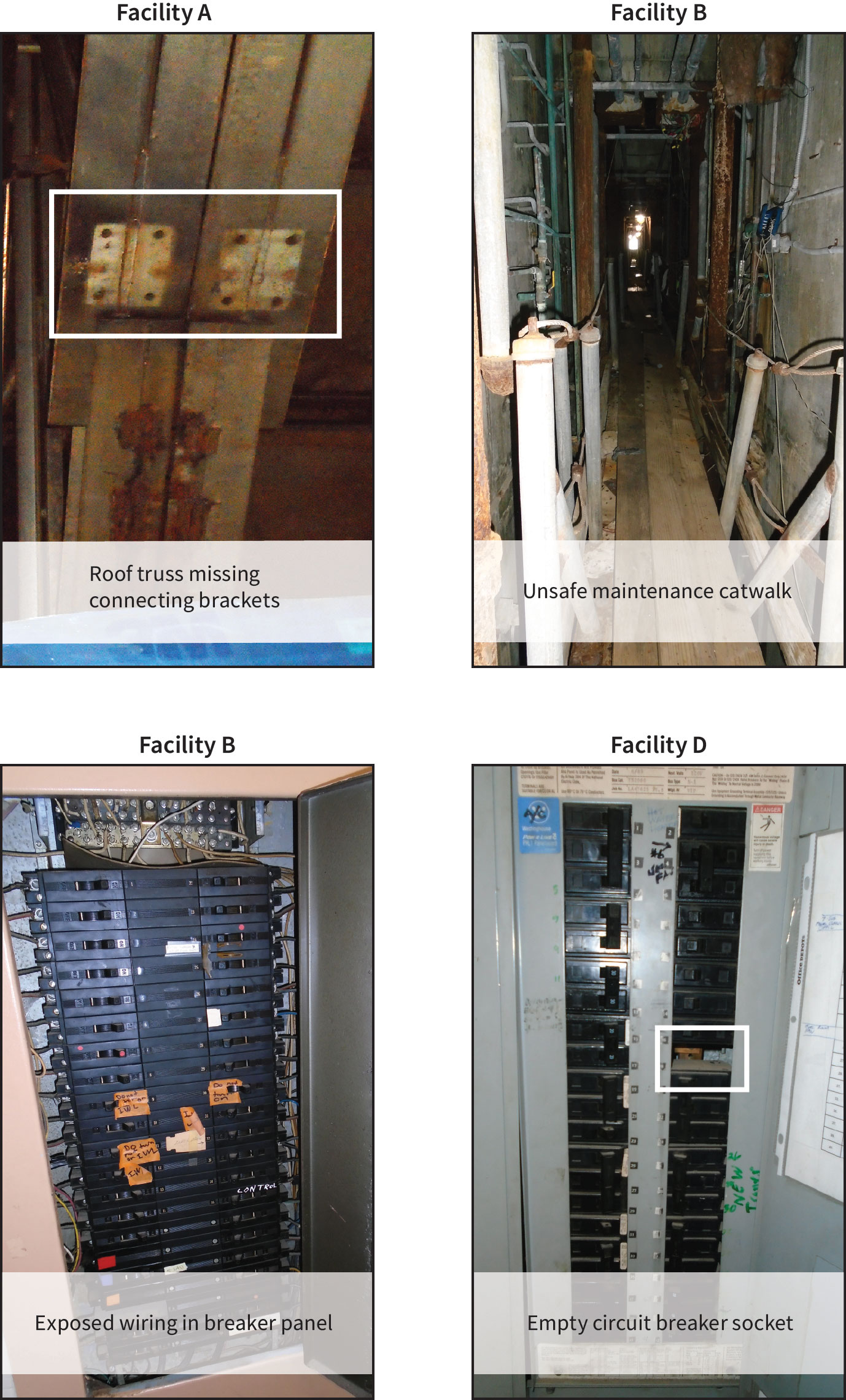
This figure shows four images of critical deficiencies in CIM’s infrastructure a consultant identified in 2019 that CIM has not addressed.
The first image shows that a roof truss is missing connecting brackets in Facility A.
The second image displays an unsafe maintenance catwalk in Facility B.
The third image shows exposed wiring in a breaker panel in Facility B.
The fourth image shows an empty circuit breaker socket in Facility D.
These photos are from the auditor’s site visit to CIM in March 2026.
Source: Auditor photos taken in March 2026.
Of the 26 repair projects the consultant recommended, CDCR has requested funding or begun work on only 11 and has obtained funding for four, including a new mental health building, a visitation trailer, and roofing repairs at one of CIM’s four facilities. However, although these projects are in progress, none is complete. The chief of the Facility Maintenance Section explained that CDCR lacks the funding for these projects and that CDCR has prioritized the projects it sees as most critical within its funding limitations. CDCR believes that CIM’s mental health facility is necessary for CDCR to exit court supervision.
CIM’s infrastructure has likely deteriorated more in the seven years since its 2019 assessment. During two visits to CIM, we observed damaged floors, walls, roofs, ceilings, windows, and doors. We also observed evidence of leaks and water intrusion, broken and leaky plumbing, damaged equipment, and crumbling roads. As we show in Figure 8, some of these conditions could be dangerous, such as broken and missing floor tiles that create tripping hazards and evidence of water intrusion in ceilings that resulted in leaks and mold. One of two storm channels, which the 2019 assessment found required repair and reconstruction to properly accommodate storm flows across the property, remains badly eroded and lacking concrete embankments. This channel runs between a series of power lines and one of the property-line fences, potentially posing a risk to both.
Figure 8
Many Aspects of CIM’s Facilities Are Severely Deteriorated
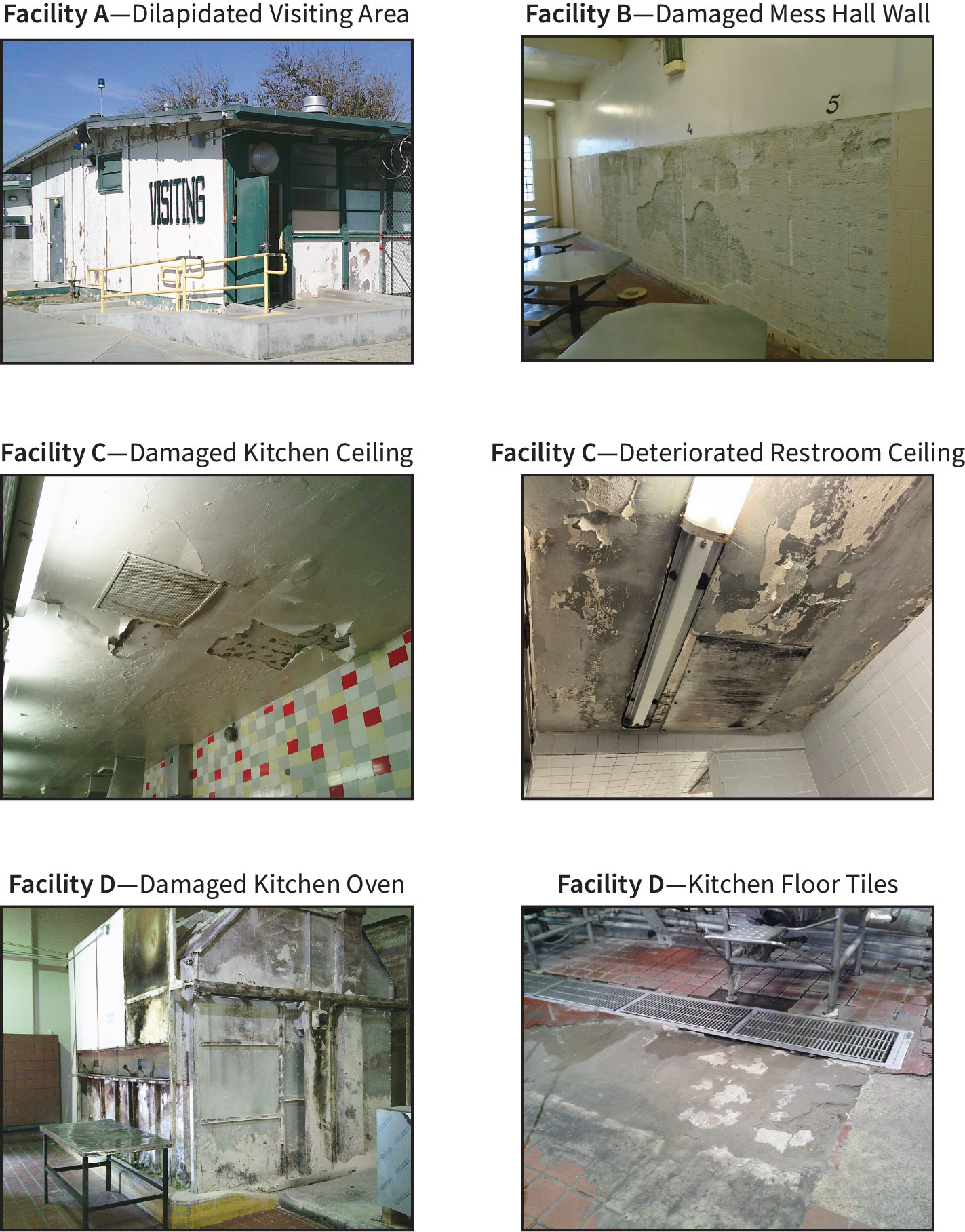
This figure displays six images of deteriorating infrastructure at CIM.
The first image shows a visiting area in Facility A in poor condition with peeling paint and peeling exterior walls.
The second image shows a damaged mess hall wall in Facility B.
The third image shows a deteriorating and peeling kitchen ceiling in Facility C.
The fourth image shows a peeling and deteriorating restroom ceiling in Facility C.
The fifth image shows a burnt and inoperable kitchen oven in Facility D.
The sixth image shows a kitchen floor in Facility D that is missing tiles and is deteriorating.
These images are from the auditor’s site visit to CIM in March 2026 and Public Health’s 2025 Environmental Health Survey report.
Source: Auditor photos taken in March 2026 and Public Health’s 2025 Environmental Health Survey report.
The California Department of Public Health (Public Health) has also found deficiencies with CIM’s maintenance and infrastructure, as the text box shows. CDCR contracts with Public Health to perform annual environmental health surveys to ensure that institutions meet correctional accreditation standards.2 Public Health identified 38 maintenance and infrastructure issues in its 2024 survey and 68 such issues in its 2025 survey. Many items in Public Health’s reports match similar findings from the previous year and appear to be long-standing issues. Deteriorating infrastructure affects not only the security of the institution and the health and safety of incarcerated individuals and staff, but it also limits access to educational and rehabilitation programs.
Public Health Identified Numerous
Infrastructure Deficiencies at CIM
- Damaged floors, ceilings, and walls.
- Peeling paint.
- Damaged sinks.
- Broken showers.
- Leaky plumbing.
- Improper drainage.
- Lack of hot water.
- Non-functioning dishwashers, refrigerators, and walk‑in coolers.
Source: Public Health Environmental Health surveys.
Assessments of CIM’s Facilities
Although we identified no legal requirement for CDCR to conduct regular facility condition assessments at CIM or its institutions in general, doing so would be a best practice. The text box lists examples of other state agencies that have legal or procedural requirements to regularly assess the condition of their institutions’ infrastructure. Additionally, Florida requires regular inspections of prison facility infrastructure, and Nevada requires periodic inspections of all buildings owned by the state. Federal agencies, such as the U.S. Department of Veterans Affairs (Veterans Affairs) and U.S. Department of Transportation (DOT), require regular facility condition assessments to be performed. As Table 2 shows, DOT requires its facility managers to conduct regular assessments to evaluate, grade, and rank the site and building systems at each of their facilities. Facility managers use this information to plan and justify capital spending and to fund projects to correct deficiencies. Veterans Affairs requires each medical facility to perform a facility condition assessment every three years. DOT requires transit agencies to update their assessments every four years at minimum. It is not clear that, without conducting regular facility condition assessments, CDCR has access to reliable information about the current and future maintenance and repair needs at CIM and its other institutions.
Requirements for Agencies Similar to
CDCR to Assess Their Facilities
- The Judicial Council is required under the California Rules of Court to consult with affected courts about the annual operations and maintenance needs assessment, develop annual priorities, and plan for the operational and maintenance needs of court facilities.
- The Penal Code requires the Board of State and Community Corrections to biennially inspect each local detention facility and those that house juveniles for more than 24 hours.
- Each county superintendent is required by the California Education Code to periodically visit each school in the county to ensure safety, cleanliness, adequacy, and good repair of school facilities.
Source: State law and California Rules of Court.
The last facility condition assessment of CIM was performed by a consultant funded by the Legislature, and CDCR does not currently have a strategy or designated staff to conduct ongoing assessments. In 2011, then-governor Jerry Brown vetoed the funding for the OIG to continue conducting audits of CDCR’s institutions and, in the message released with the veto, he charged CDCR’s Office of Audits and Court Compliance (Office of Audits) with ensuring compliance with state and federal guidelines, policies, and court mandates. The governor’s veto message did not mention facility condition assessments or whether the Office of Audits would perform them. According to CDCR’s supervising management auditor, the office does not perform facility condition assessments, nor is he aware of any other units within CDCR that perform such assessments.
According to the chief of the Facilities Maintenance Section (CDCR maintenance chief), there have been times in the past when CDCR received funding to perform point-in-time facility condition assessments of its institutions, but CDCR does not regularly perform facility condition assessments or similar reviews that would describe the current condition of a given facility’s infrastructure. The chief added that CDCR instead relies on each institution to report its infrastructure needs, such as by submitting requests for funding for special repair and capital outlay projects. Although these requests help communicate where funding is needed—an important process that we discuss later—they are not a substitute for regular facility condition assessments. According to industry sources, it is facility condition assessments that should inform the priority of projects that institutions pursue.
The CDCR maintenance chief further explained that the primary reason CDCR does not perform regular assessments is that it does not have the funding to do so. Although the Legislature may not provide CDCR with funding specifically for conducting regular facility condition assessments, we question the chief’s assertion that the agency lacks the funding to conduct them, given the relatively modest $5.4 million funding for producing the consultant’s report for 12 institutions compared to CDCR’s budget. Additionally, in its 20-year master plan, CDCR indicates that if the Legislature approves its plan, CDCR will begin conducting facility condition assessments of the institutions it has prioritized for work. In our conversation with the director of CDCR’s Facility Planning, Construction and Management Division, she acknowledged the importance of facility condition assessments and affirmed that CDCR will need them to understand the condition of its facilities and the resources necessary to address identified deficiencies.
Just as CDCR does not routinely conduct official reviews of its institutions’ infrastructure conditions, neither does CIM perform facility condition assessments.
CIM’s correctional plant manager explained that CIM primarily evaluates its infrastructure needs as they arise. The plant manager stated that rather than performing facility condition assessments, CIM communicates larger infrastructure needs to CDCR by requesting funding for special repair projects and other upgrade projects that require capital outlay. Without conducting any regular assessments to determine its infrastructure needs, CIM runs the risk of identifying deficiencies only when problems arise and misses the opportunity to proactively address needs before they become safety or habitability concerns.
CIM’s Maintenance Backlog
Without an accurate picture of its institutions’ maintenance backlog, CDCR cannot ensure that it is budgeting maintenance and repair work most effectively, which places a greater burden on its staff, increases hardships for the incarcerated population, and potentially places nearby communities at greater risk. CIM has about $140 million in unfunded projects, and our own observations from two site visits affirm that many different parts of the institution have infrastructure deficiencies that CDCR and CIM have yet to address. However, staff at CIM are not properly tracking the institution’s maintenance backlog in CDCR’s data system. This results in an unclear picture of the infrastructure maintenance and repair work the institution needs and in necessary work potentially not being performed.
CDCR uses an IBM data system called IBM TRIRIGA (Tririga) for its institutions to track all of their maintenance activities and any associated backlog. CDCR’s asset management road map, which is intended to improve CDCR’s overall business processes for its institutions’ infrastructure maintenance, states that some of the benefits of Tririga include better accountability and information capture about the work technicians performed. CIM had been using an outdated version of Tririga that IBM stopped supporting in December 2012 before CIM began using a newer version of Tririga in January 2024.
CDCR’s data show that CIM staff logged in to Tririga about 7,800 corrective maintenance and repair work orders from January 2024 to December 2025. We discuss the impact the deficiencies in these work orders have on the incarcerated population and staff later in the report. As Figure 9 shows, plumbing issues made up the largest category of work orders during these two years. The more than 2,400 plumbing issues consist of mostly leaks, line blockages, and clogs, as the text box shows. Electrical problems made up the next largest category of work orders, followed by interior issues, including accessibility features, door repair, pest control, and others. However, CIM does not ensure that staff close work orders in a timely fashion or document work orders they are unable to complete—actions necessary for CIM to fully determine its maintenance backlog.
Figure 9
CIM Staff Logged 7,810 Corrective Work Orders in Tririga From 2024 Through 2025
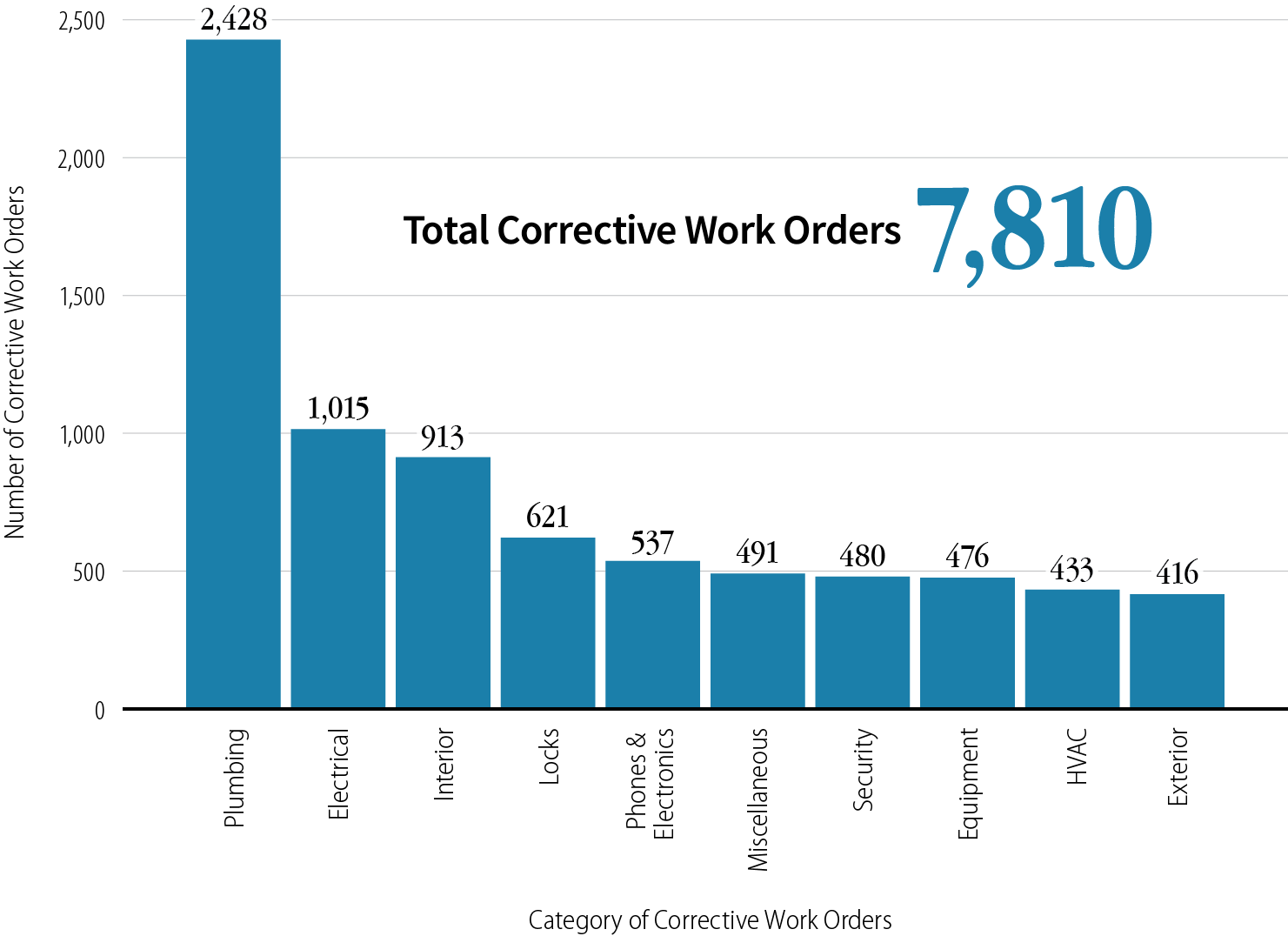
This figure shows how many of the 7,810 total corrective work orders logged by CIM staff in 2024 and 2025 fall into each of ten categories of work. From most work orders to least work orders:
1. Plumbing accounts for 2,428 of the 7,810 work orders.
2. Electrical accounts for 1,015 of the 7,810 work orders.
3. Interior accounts for 913 of the 7,810 work orders.
4. Locks account for 621 of the 7,810 work orders.
5. Phones and electronics account for 537 of the 7,810 work orders.
6. Miscellaneous accounts for 491 of the 7,810 work orders.
7. Security accounts for 480 of the 7,810 work orders.
8. Equipment accounts for 476 of the 7,810 work orders.
9. HVAC accounts for 433 of the 7,810 work orders.
10. Exterior accounts for 416 of the 7,810 work orders.
The figure notes that, although not all work orders are necessarily infrastructure related, they all contribute to the backlog of maintenance requests.
Source: CDCR’s Tririga data.
Note: Although not all work orders are necessarily infrastructure related, they all contribute to the backlog of maintenance requests.
CIM’s Tririga Data Included Over 2,400 Plumbing Issues
Percentage of plumbing issues:
- Leaks: 24%
- Line blockages: 18%
- Toilet and sink clogs: 15%
- Lack of hot, cold, or any water: 9%
- Faucet problems: 7%
- Shower issues: 3%
- Steam water leaks: 2%
- Other plumbing: 23%
Source: CIM Tririga data.
Note: Total adds to more than 100 percent because of rounding.
CIM’s data management practices limit its ability to quantify its maintenance backlog. Although CIM had fewer work orders than most other institutions we reviewed, as Figure 10 shows, staff at CIM closed many fewer work orders than did staff at the other institutions, leaving CIM without an accurate picture of its maintenance backlog. According to CDCR’s policy, maintenance technicians are responsible for completing the work orders in Tririga, and supervisors then review them and close them out after verifying that the work was completed. However, this is not always happening. As of January 2026, CIM staff had not closed more than 2,900 (37 percent) of 7,810 total corrective work orders from 2024 and 2025, a significantly higher percentage of open work orders than other institutions we reviewed. According to CIM’s plant operations analyst, the data indicating whether work orders are open or closed is not accurate, and many open work orders should have been closed. Because of this, CIM does not know the actual size of its maintenance backlog.
Figure 10
CIM Had More Open Corrective Work Orders in 2024 and 2025 Than Other Institutions We Reviewed
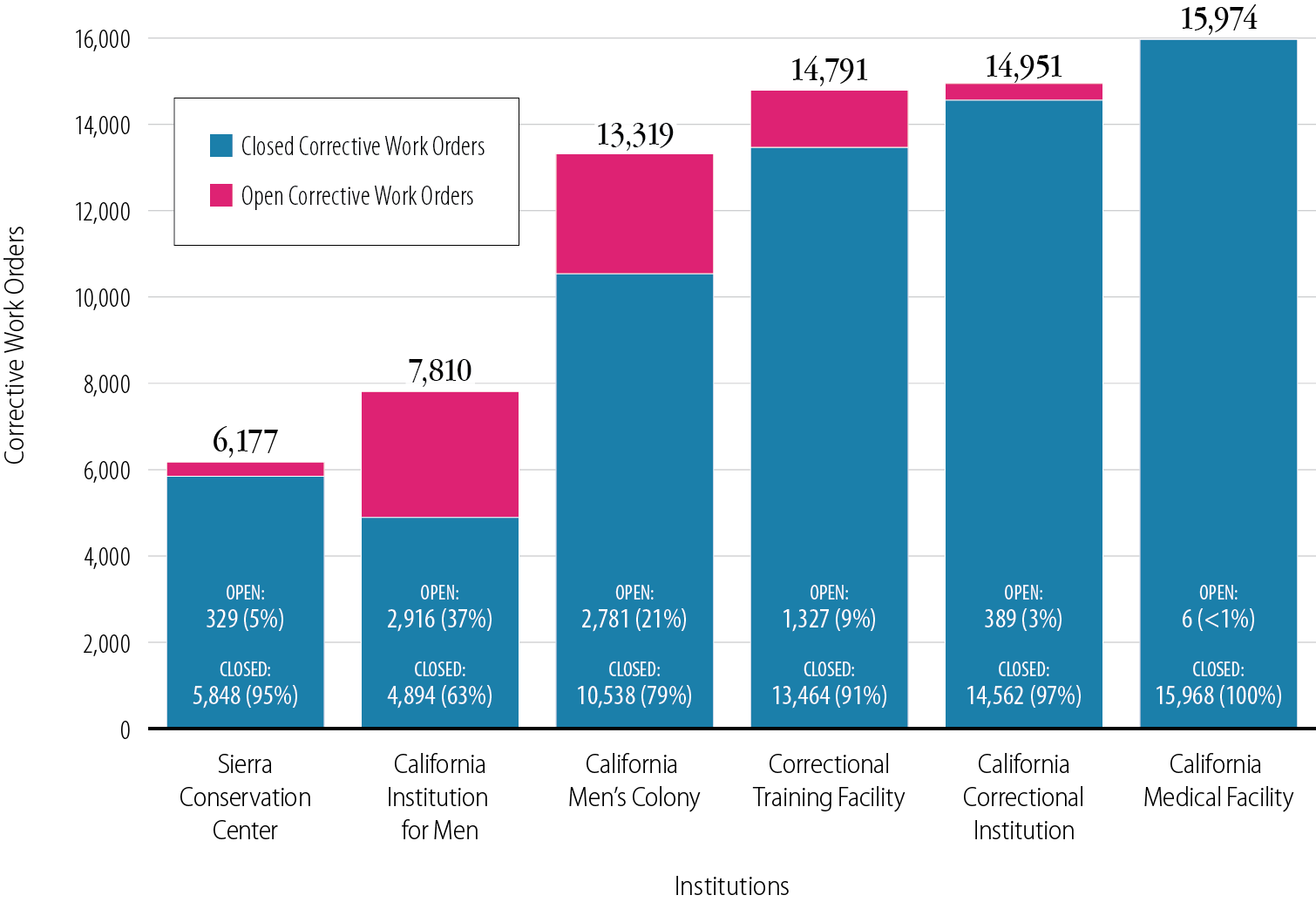
The figure shows total number of corrective work orders from 2024 and 2025 at CIM and five other institutions, along with the number and percent at each institution that were open or closed. Although not included in the figure, text in the report indicates that these are work orders that were open as of January 2026. For these six institutions, in order from fewest to greatest total work orders:
Sierra Conservation Center had 6,177 total corrective work orders in 2024 and 2025. Of those, 5 percent, or 329, were open; and 95 percent, or 5,848 were closed.
The California Institution for Men had 7,810 total corrective work orders in 2024 and 2025. Of those, 37 percent, or 2,916, were open; and 63 percent, or 4,894 were closed.
California Men’s Colony had 13,319 total corrective work orders in 2024 and 2025. Of those, 21 percent, or 2,781, were open; and 79 percent, or 10,538 were closed.
Correctional Training Facility had 14,791 total corrective work orders in 2024 and 2025. Of those, 9 percent, or 1,327, were open; and 91 percent, or 13,434 were closed.
California Correctional Institution had 14,951 total correctional work orders in 2024 and 2025. Of those, 3 percent, or 389, were open; and 97 percent, or 14,562 were closed.
California Medical Facility had 15,974 total correctional work orders in 2024 and 2025. Of those, only six were open—well under one percent of the total. The remaining 15,968 work orders, nearly 100 percent, were closed.
Source: CDCR’s Tririga data.
CIM maintenance staff are unable to complete a substantial number of work orders, yet they do not consistently or accurately document these unresolved tasks in Tririga. The analyst explained that CIM’s inaccurate data is primarily because of the large number of work orders maintenance staff are unable to resolve. According to the analyst, as these uncompleted work orders age out, staff should close them. The analyst asserted that closing old work orders that are still open but have aged out is a common practice at institutions throughout the State. However, CDCR’s policy does not address when work orders should be aged out, and the analyst acknowledged that the time frame for when a work order has aged out is left to each institution.
CIM’s correctional plant manager asserted that limited staff, funding, and parts shortages result in staff being unable to address many of the requested work orders. The plant manager estimated that CIM is unable to complete approximately 25 percent of the work orders because it does not have the parts to complete the work. According to the plant manager, the lack of adequate funding is such that by December most maintenance funds allocated in July have been spent, and by the end of the fiscal year in June, none is left for repairs. However, staff’s inability to complete certain work orders does not account for their inability to update the corresponding entries in Tririga and close the work orders. This deficiency stems from insufficient guidance and CIM not adhering to CDCR’s established policy.
CDCR’s policy for how institutions track their maintenance and repair activities lacks sufficient guidance for closing work orders. CDCR’s policy assigns responsibility to different staff for various parts of the work order process, as the text box shows. While the policy states that trades staff are responsible for marking work tasks as complete and ensuring that the associated data, such as work hours, material and costs, is accurate, CIM’s analyst confirmed it is primarily work order coordinators who complete the work orders in the system. Additionally, she explained that many work orders are still open that staff should have closed and that she has begun closing work orders from before 2025. During our review, we observed that a large number of CIM’s old work orders had been closed in January 2026, just before our first site visit, with a resolution description of “resubmit work order.” To ensure consistency, CDCR’s policy should accurately reflect the expected responsibilities of each position and include clear guidance on closing old work orders, including instructions on when a work order should be aged out and what the resolution description for an aged-out work order should be. Without guidance or practice standardization, CDCR risks each institution managing its data inconsistently, thereby reducing the data’s overall utility.
CDCR Requires Tririga Users to Actively Participate in Their Designated Roles
- Plant Manager or Plant Supervisor: Manages the administration of Tririga.
- Supervisor of Building Trades or Chief Engineer: Reviews, approves, or denies work requests; assigns work orders to trades staff; monitors work order status; and closes work orders upon trades staff completion.
- Trades Staff: Reviews assigned work orders; performs assigned work as directed; completes assigned work orders ensuring hours, materials, costs, and associated data are entered accurately in Tririga.
- Tririga Analyst: Administers Tririga at the institution; provides staff training as needed; runs various system reports; and performs quality control checks ensuring the institution’s data is up to date and accurate.
- Work Order Coordinator: Logs and processes all work requests received for their designated areas.
Source: CDCR’s policy.
CDCR does not oversee CIM’s maintenance backlog, even though its asset management road map calls for periodic facilities management audits and performance scoring for each institution. According to the departmental construction and maintenance supervisor, the Facility Maintenance and Regulatory Compliance Branch does not monitor Tririga data or corrective maintenance at the institution level, viewing data quality as each institution’s responsibility, whereas the branch focuses on statewide issues. The supervisor acknowledged that some institutions may have thousands of unresolved work orders—some never completed and others completed but not closed in the system—but stated that the branch lacks the staff and time to conduct such oversight. He agreed that the large volume of open work orders makes it difficult to track maintenance backlogs and that timely closure of work orders would improve accuracy. Nevertheless, CIM’s work order management problems, the large number of open work orders at CIM and some other institutions, and the disparities we observed indicate that institutions are unlikely to resolve these issues on their own. CDCR needs to follow its asset management road map and provide stronger oversight of institutions’ maintenance and repair work by setting clear expectations and providing instructions for how institutions manage their work order backlog and by auditing how well institutions meet those expectations.
The Impact of CIM’s Deteriorating Infrastructure
Key Points
- CIM’s deteriorating infrastructure reduces incarcerated individuals’ access to safe housing, education and rehabilitation, and health care.
- Although we did not identify immediate risks to public safety, CIM’s deteriorating infrastructure increases the possibility of such security incidents.
Objective 4:
How has deteriorating infrastructure affected incarcerated housing, access to health care and rehabilitation programs, staffing levels, and the frequency of security incidents?
Impact on Habitability
Infrastructure issues at CIM have significantly affected the habitability of incarcerated individuals’ housing, as Table 3 shows. Federal and State law set habitability requirements for incarcerated individuals. CDCR must ensure that incarcerated individuals have access to certain basic necessities, as the text box indicates. However, CIM frequently struggles with maintenance problems that hinder its ability to maintain these necessities. In Figure 11 we show some examples of the problems we observed during our site visits, as well as some that Public Health reported in its 2025 survey. To better understand the prevalence of these issues, we identified maintenance and repair work orders affecting the habitability of incarcerated individuals’ housing and common areas that fell into three main groups: plumbing, temperature, and leaking roofs. We include a selection of 34 of these work orders in Appendix B, in which we also describe our methodology for selecting these work orders. Based on our review of these work orders, the infrastructure conditions at CIM create significant challenges that impede CIM’s ability to maintain the habitability criteria outlined above.
Incarcerated Individuals Have a Right to Basic Necessities
- A bed
- Hygiene facilities
- Potable water
- Food prepared in sanitary conditions
- Sanitary and habitable living conditions
- Safe infrastructure and appropriate temperatures
Source: State law and court rulings.
Figure 11
CIM’s Infrastructure Sometimes Cannot Provide Basic Necessities
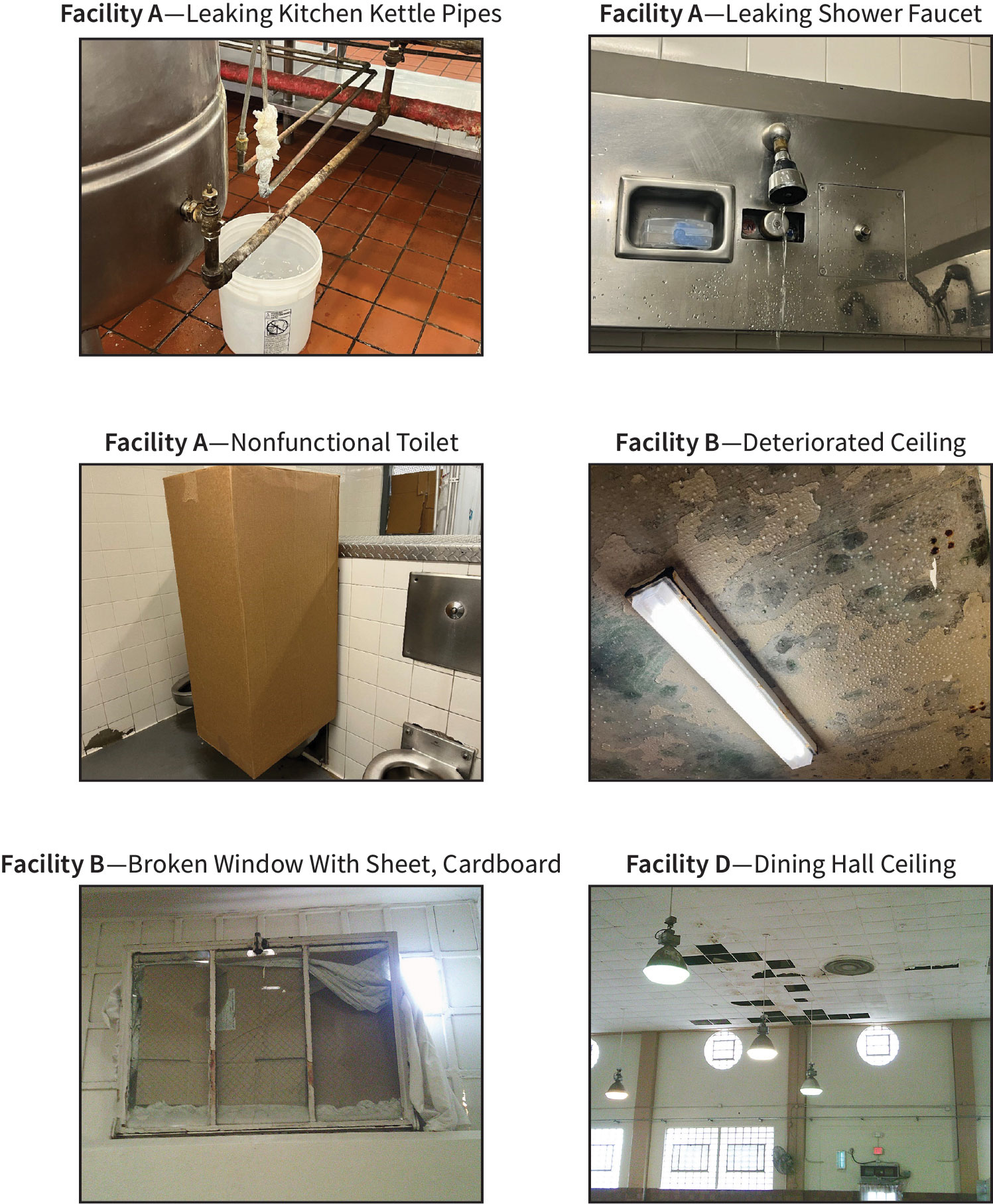
This figure displays six images of deteriorating infrastructure at CIM.
The first image shows leaking kitchen kettle pipes in Facility A.
The second image shows a leaking shower faucet in Facility A.
The third image shows a nonfunctional toilet covered by a cardboard box in Facility A.
The fourth image shows a deteriorated and dark-stained ceiling in Facility B.
The fifth image shows a broken window covered by cardboard and a sheet in Facility B.
The sixth image shows a dining hall ceiling in Facility D that is missing ceiling tiles and is deteriorating.
These images are from the auditor’s site visit to CIM in March 2026 and Public Health’s 2025 Environmental Health Survey report.
Source: Auditor photos taken in March 2026 and Public Health’s 2025 Environmental Health Survey report.
CIM’s work orders describe pervasive plumbing problems that directly affect incarcerated individuals’ access to functional toilets, showers, sinks, and hot water, and create substantial obstacles for CIM in meeting the requirements for access to showers and for maintaining hygiene standards. In 2024 and 2025, staff submitted 2,428 work orders related to plumbing. These work orders identified problems that include clogged or overflowing toilets that remained out of service for multiple days, housing units with multiple showerheads not working, showers that leaked continually, and sinks that leaked enough to cause flooding in cells. Although we saw references to debris in the toilets, our review of work orders found that toilet problems more often stemmed from mechanical failures, such as broken valves and seals. In some cases, buildings had no hot water. According to Public Health, facilities should maintain water temperatures between 100 degrees and 120 degrees to help ensure the safety of incarcerated individuals and promote hygienic practices.
Staff reported that plumbing problems were common across CIM and often routine across facilities. One facility captain explained that Plant Operations addresses these issues as quickly as possible when parts are available but that delays sometimes occur. According to CIM’s correctional plant manager, staff are unable to complete a significant number of work orders because parts are not available. Facility staff indicated that they may not prioritize addressing minor plumbing leaks or failures but do prioritize addressing them when they cause flooding or disrupt operations. Incarcerated individuals described plumbing issues as constant and highly disruptive, noting that broken toilets sometimes required them to delay relieving themselves or to use makeshift containers. They also reported that limited shower access resulted in long wait times and hygiene challenges. These plumbing-related infrastructure issues represent significant and recurring obstacles to CDCR performing its duty to maintain basic sanitation and hygiene.
The work orders also document substantial leaking and water intrusion in living areas, creating both immediate safety hazards and significant disruptions to daily activities. These conditions further undermine CIM’s ability to maintain required habitability standards. We identified 109 work orders related to leaking roofs in 2024 and 2025. According to the work orders, roof leaks caused ceilings to sag, collapse, or develop mold in hallways and treatment areas. Incarcerated individuals described widespread flooding across entire facilities during periods of heavy rain, with water entering living areas, meal areas, and gyms, forcing them to navigate around buckets and trash bags. They also explained that flooding limits their access to programming and prevents sleep. Staff noted that leaks are a recurring challenge, especially during heavy rains, and that Plant Operations often has to wait for storms to pass before making repairs. During these periods, cells are not usable, and CIM has to move incarcerated individuals elsewhere. Some leaks described in the work orders affected mental‑health crisis beds in CIM’s facilities, creating flooding that rendered these scarce beds temporarily unusable. We observed evidence of roof leaks and water intrusion in the CDCR consultant’s report, Public Health’s surveys, and during our site visits.
CIM is also unable to maintain habitable temperatures in all its facilities year-round. Court rulings require CDCR to follow a heat prevention plan when temperatures exceed certain levels. This includes following protocols, such as increasing access to water stations, ice, and fans when indoor temperatures exceed 90 degrees. In 2025, CDCR installed a new heating, ventilation, and air conditioning (HVAC) system in Facility A. However, neither Facility B nor Facility C have cooling systems in their housing units. According to CDCR, in 2016—before it installed the new HVAC systems—the indoor temperature in Facility A’s housing units reached or exceeded 90 degrees on 113 days. Our review of the notices CIM files when the temperature outside or in its housing units reaches 90 degrees or above showed that CIM reached or exceeded those temperatures on at least 465 days from 2021 through 2025. This includes at least 115 days when the indoor temperature reached 90 degrees or above. Work orders we reviewed also identified frequent issues with heating, cooling, and ventilation across CIM. According to the work orders, the lack of adequate HVAC systems leaves housing units uncomfortably cold at night and in winter, and excessively hot with little airflow during warmer months.
Staff acknowledged that temperature problems are common at CIM. Staff indicated that they attempt to mitigate these problems by distributing blankets in winter or by providing ice, fans, misters, and wellness checks during heat waves, particularly for individuals with medical vulnerabilities. Incarcerated individuals described these temperature extremes as severely affecting daily life, reporting that indoor temperatures could become so high that their sleep was disrupted and staff canceled programming. Staff and incarcerated individuals alike emphasized the negative health consequences of excessive indoor temperatures, particularly for those with respiratory conditions or those who take medications that make them sensitive to heat. According to CDCR, excessive heat within the confined spaces of housing units contributes to a much higher degree of tension and a potentially volatile and dangerous atmosphere for both staff and the incarcerated population.
In addition to these three categories of work orders, we identified various other infrastructure habitability issues that affect incarcerated individuals. CIM’s culinary areas face persistent infrastructure challenges that affect food safety, cleanliness, and daily operations, impeding CIM’s efforts to uphold required habitability standards. A reliable supply of hot water is one such challenge. One work order we reviewed documented that hot water temperatures were not high enough to sanitize food trays and utensils, reflecting concerns that staff described as recurring across CIM’s facilities. According to the culinary manager, scullery areas in several facilities face chronic problems with water temperature. She said that when water is not hot enough for proper sanitization, staff use an alternative three‑sink sanitization method. She added that although this method technically meets food safety requirements, it is not an adequate long‑term substitute for hot‑water sanitization and creates additional burdens for both staff and incarcerated workers. Further, according to the culinary manager, because Facilities B and C do not have three‑basin sinks, staff there use clearly marked, food-grade containers as one of the sink basins. Incarcerated individuals emphasized the lack of adequate sanitization. They explained that after being cleaned in the containers—which they called trash cans—trays often appeared visibly unclean, with food remnants from prior meals. They stated that among the incarcerated population, inconsistent sanitization of food service items is a common concern.
CIM’s aging infrastructure also affects its general kitchen operations. During our site visit, the kitchen at Facility A was out of service, resulting in meal delays. CIM staff indicated that about once a year CIM experiences steam and steam‑line failures that render kitchens inoperable for up to two weeks. Staff say that this disrupts food preparation and requires temporary workarounds. When a kitchen at another facility is inoperable, Facility D cooks food for that facility, and staff transport the food from Facility D to the affected facility in a designated food service truck, which sometimes leads to delays in meal services. Facility D also currently has only one working oven, although it expects to receive another when the California Rehabilitation Center (CRC) closes. Several of Facility D’s refrigerators and freezers are also inoperable. Culinary staff manage without sufficient refrigeration space by planning staggered food deliveries, so they can rotate food in and out of portable coolers. The kitchen at Facility B has been closed for years because its small size and lack of proper equipment does not meet CIM’s food preparation needs. Although CIM culinary staff make a variety of efforts to overcome CIM’s infrastructure issues, incarcerated individuals asserted that the operational challenges these issues create can affect the delivery and content of their meals.
In addition, work orders highlight that infrastructure issues affect incarcerated individuals’ access to drinking water and visitation. One work order described broken water fountains and filters in housing units, which limited incarcerated individuals’ access to drinking water. Staff noted that when fountains are inoperable, they find other sources of drinking water for incarcerated individuals, such as bottled water, or water from the kitchens. Incarcerated individuals, however, reported widespread problems with water quality, asserting that many filtered water fountains are broken and that unfiltered water is visibly discolored or contains particles, forcing many to purchase bottled water at significant personal expense.
Impact on Education and Rehabilitation Programs
CIM’s infrastructure deficiencies hinder incarcerated individuals’ access to education and rehabilitative programs and could hinder their efforts to expedite their reentry into their communities. CDCR’s mission emphasizes the importance of successfully reintegrating individuals by providing education, treatment, rehabilitation, and restorative justice programs in a safe and humane environment. In testimony before legislative committees in spring 2026, CDCR’s secretary stressed the importance of providing an environment that prepares incarcerated individuals to reenter society. As part of Proposition 57, the Public Safety and Rehabilitation Act of 2016, CDCR incentivizes incarcerated individuals to take responsibility for their own rehabilitation by providing opportunities to earn credits for good behavior and for participation in rehabilitative programs. Incarcerated individuals who participate in approved rehabilitative and educational programs are eligible to earn credits toward early release. However, to provide these services, CDCR needs its institutions to have adequate and functional classrooms and vocational spaces.
CIM provides a variety of different academic and vocational classes at its facilities, as Figure 12 shows. Academic programs include both high-school equivalency and college courses, as well as specialty classes. Before CDCR deactivated Facility D in 2023, that facility hosted most of CIM’s vocational programs, including sheet metal, masonry, carpentry, and building maintenance programs. However, after its deactivation, CIM no longer offered masonry, carpentry, or building maintenance programs, keeping only its sheet metal program. According to CIM’s supervisor of correctional education programs, CIM plans to restart the masonry and carpentry programs.
Figure 12
CIM Offers Different Academic and Vocational Programs at Each of Its Four Facilities
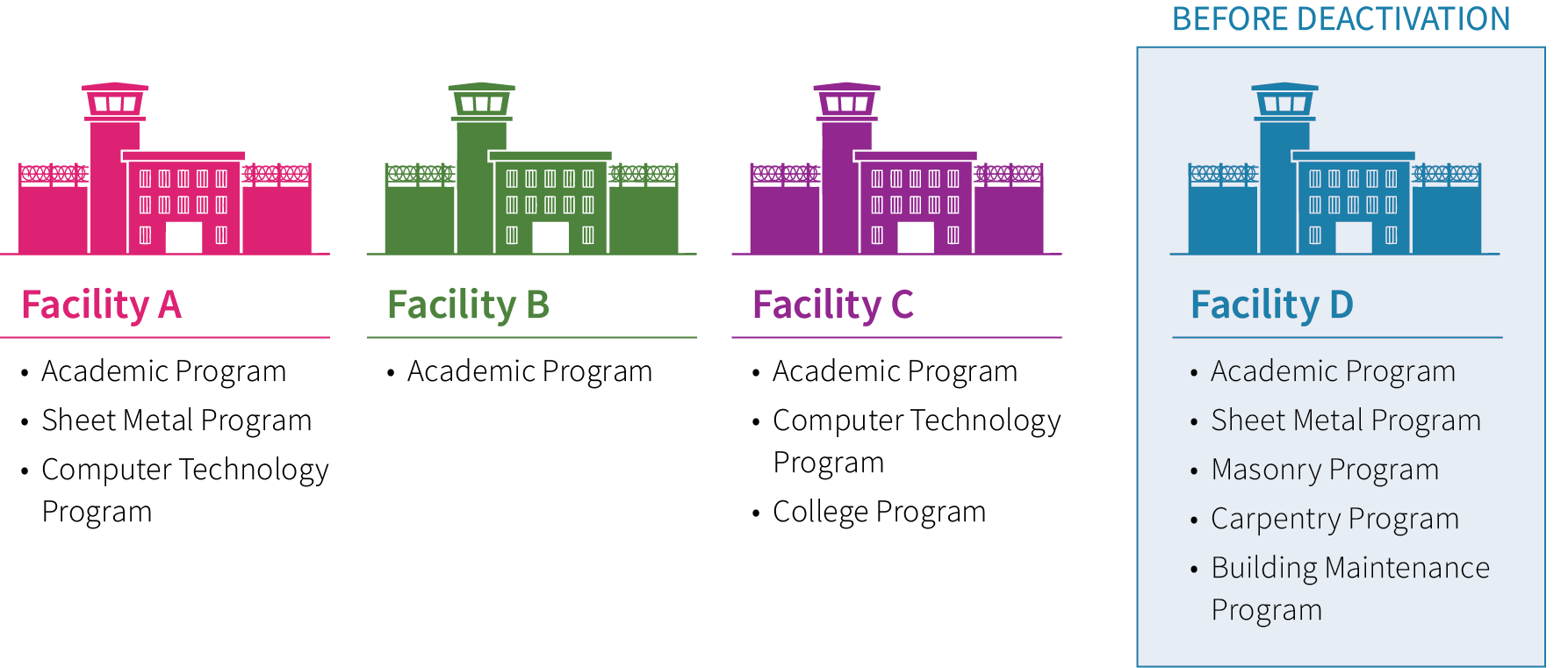
At Facility A, CIM offers academic programs, a sheet metal program, and a computer technology program.
At Facility B, CIM offers academic programs.
At Facility C, CIM offers academic programs, a computer technology program, and a college program.
At Facility D, before its deactivation, CIM offered academic programs, a sheet metal program, a masonry program, a carpentry program, and a building maintenance program.
These are the programs CIM offered as of April 2026.
The source of the data is CIM education staff.
Source: CIM education staff.
Note: Programs are as of April 2026.
To determine how CIM’s infrastructure affects incarcerated individuals’ access to education and rehabilitation programs, we reviewed CIM’s maintenance work orders to identify examples of infrastructure-related issues affecting classroom and vocational areas. We also spoke with education staff and incarcerated individuals to gain their perspective. Some of the work orders we identified describe classrooms with nonfunctioning cooling systems, resulting in extreme temperatures. Temperatures in Chino often exceed 90 degrees, and rooms without air cooling systems cannot maintain temperatures necessary to protect equipment or allow staff and students to work safely. This condition also creates concerns for individuals who are sensitive to heat and can lead to canceled classes. Incarcerated individuals we spoke with reported that teachers regularly cancel classes due to high temperatures. Although staff asserted that they attempt to find workaround solutions to the heat, such as bringing fans into the classroom, CIM’s education supervisor acknowledged that teachers sometimes cancel classes due to high temperatures. CIM’s warden stressed that although infrastructure issues may lead to cancelled classes, CIM has one of the highest program attendance rates among CDCR’s institutions.
Leaking roofs and flooding similarly impact access to rehabilitation programs. Work orders we reviewed and reports from incarcerated individuals both described persistent roof leaks in classrooms that resulted in canceled classes. The work orders emphasized that leaking roofs created slip hazards and prevented ADA‑designated individuals from attending classes. Other work orders noted that extensive leaks from rain put educational equipment such as computers and other electronic teaching aids at risk of damage. CIM’s education supervisor stated that, while it is not frequent, teachers have canceled classes due to leaking roofs following heavy rain. Collectively, these documented infrastructure issues limited access to programming, reduced instructional time, and undermined individuals’ ability to earn credits toward earlier release.
Impact on Health Care
In response to a 2001 class action lawsuit claiming that CDCR provided incarcerated individuals with inadequate medical care in violation of the U.S. Constitution and federal statutes—and due to the State’s subsequent failures to correct those deficiencies—a federal court in 2005 found that California’s prison medical system was “broken beyond repair” and imposed a receivership over CDCR’s medical system. Subsequently, CDCR and the federal court-appointed Receiver developed the Health Care Facility Improvement Program to improve the physical infrastructure serving CDCR’s health care delivery system. As part of this program, CDCR renovated CIM’s health care facilities to address the physical condition of CIM’s medical infrastructure and ensure that CIM has adequate clinical spaces to meet the health care needs of incarcerated patients, more than 80 percent of whom have medical conditions.
Although CDCR completed its upgrades to CIM’s health care facilities in November 2021, we identified numerous work orders from 2024 and 2025 that continued to describe infrastructure problems in medical spaces, some of which we list in the text box. Work orders we reviewed describe ceiling leaks that damaged walls and equipment and created fall hazards as well as problems with plumbing and clogged toilets. Roofs leak into health care areas when there are heavy rains, which can require staff to relocate affected patients to a new cell or relocate clinical service areas. In some cases, the leaks have led to the growth or accumulation of substances that resemble mold. Work orders also documented issues with a sink in a medical clinic with no running water, electrical failures, and temperatures outside acceptable ranges for storing medical supplies or operating diagnostic equipment. Staff also noted that when CDCR renovated CIM’s clinics, it did not renovate the X-ray rooms, which continue to experience periods of high temperatures.
Work Orders and Surveys Identified Infrastructure Deficiencies in Medical Spaces
- Plumbing clogs and leaks.
- Inadequate hot water.
- Roof and ceiling leaks.
- Trip and fall hazards.
- Excess heat.
- Inoperable equipment.
Source: CDCR’s Tririga data and Public Health surveys.
Further, Public Health’s two recent environmental health surveys found various infrastructure-related problems in CIM’s health care facilities. These include widespread hot-water and plumbing deficiencies across multiple health care locations, a damaged sink, broken floor tiles, damaged and deteriorated walls, and damaged ceiling tiles. Several medication rooms, exam rooms, dental areas, and biohazard handling spaces were found to have inadequate hot water, falling below the minimum temperature needed to support proper handwashing and infection control. Other areas within medical facilities had water temperatures exceeding 120 degrees, presenting potential scalding hazards that, according to Public Health, may require adjustment to align with safety standards and applicable plumbing codes. Public Health’s 2025 survey also found that the high-temperature dishwashing equipment in the Outpatient Housing Unit kitchen did not meet final rinse temperatures adequate for dishwashing, and that two reach-in refrigerators were out of service. In its corrective action plan, CIM indicated that it addressed all seven of the 2024 survey findings for health care facilities. However, CIM indicated that as of May 2026, it had only partially corrected the 16 health care findings from the 2025 survey, with staff having submitted work orders for all of them.
Staff indicated that they mitigate the effects of these infrastructure problems through established protocols, such as increased rounds, relocating patients, using fans or portable sinks, and protecting medical equipment until repairs are completed to ensure that incarcerated individuals receive medical care, and the work orders we reviewed did not indicate that these infrastructure problems prevented incarcerated individuals from receiving care. Incarcerated individuals we spoke with also indicated that, unlike the with housing and education programs, CIM’s infrastructure problems in health care spaces did not generally affect their access to care.
However, we identified one infrastructure issue in CIM’s work orders that was not within the actual health care clinics but affected access to health care: missing or broken tarps at outdoor medication pickup stations. CIM staff indicated that there are frequently work orders to repair or replace tarps because they deteriorate quickly. Incarcerated individuals described being exposed to extreme heat or rain while waiting for medications when tarps were missing or broken and said this was especially strenuous for the elderly population and those with medical concerns. As we described previously, 90 percent of the incarcerated population at CIM receives prescription medications, which means that many have to wait in outdoor pill lines to receive them. According to incarcerated individuals, some refuse to stand in these lines during inclement weather and instead choose to forgo their medications, which could be detrimental to their health.
Impact on Safety and Security
Although we did not identify any specific issues with CIM’s deteriorating infrastructure that appeared to present an imminent public safety threat, the cumulative effect of CIM’s deteriorating infrastructure increases the risk that a security incident could occur. According to the U.S. Department of Justice (DOJ), proper maintenance, modernization, and repair of correctional institutions is important to ensure the long-term use of these facilities, and failure to maintain structures can cause direct or indirect security problems. The DOJ indicates that deteriorated facilities increase the risk of escape and the inability to lock down cells, and that frustration over inadequate living conditions, such as leaking and collapsing roofs, can lead to potential violence.
CDCR’s reports show infrastructure and maintenance issues that may impact security. In November 2023, CDCR conducted a security audit of CIM that found four critical infrastructure issues, including improper fence ties, nonfunctioning lighting, a lack of inspections of storm drains, and a vehicle sally port without closed‑circuit video surveillance. CIM addressed all but one of the issues. While CIM claimed the vehicle sally port finding was addressed, a follow-up review determined that it still was not. Further, as Figure 13 shows, CIM had more security-related maintenance work orders in 2024 and 2025 for items such as failed security lighting, issues with doors, fences, and gates, and malfunctioning security systems, than most comparable institutions we reviewed. While this does not indicate a security incident is likely, it increases the risk that one could occur. As the DOJ reported, ongoing infrastructure issues increase security risks.
Figure 13
CIM Had More Security-Related Work Orders Than Most Other Institutions We Reviewed From 2024 Through 2025
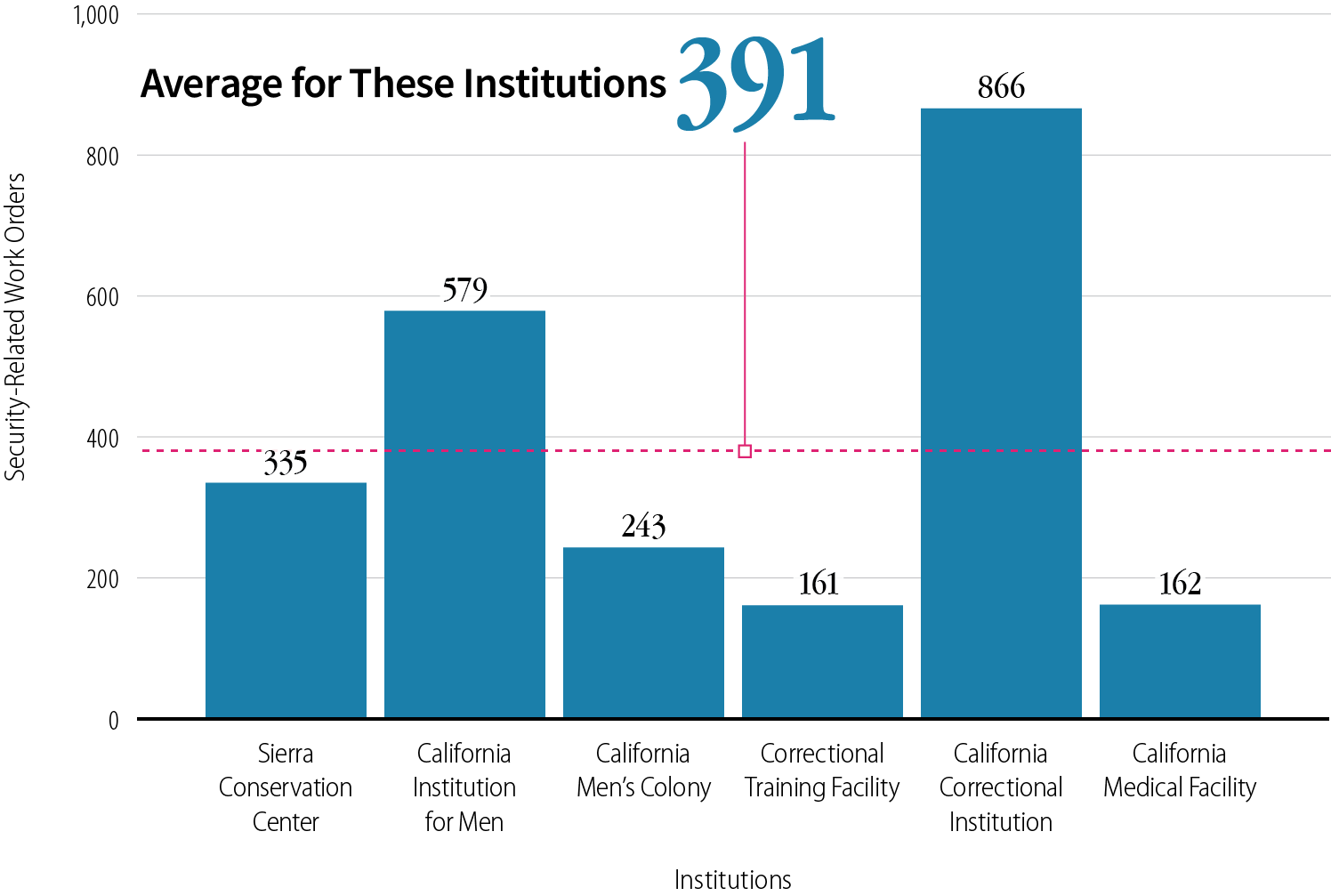
This figure is a bar chart showing the number of security-related work orders at CIM and five other CDCR institutions from 2024 through 2025.
The average number of security-related work orders for these six institutions during this period was 391.
Sierra Conservation Center had 335 security-related work orders.
California Institute for Men had 579 security-related work orders.
California Men’s Colony had 243 security-related work orders.
Correctional Training Facility had 161 security-related work orders.
California Correctional Institution had 866 security-related work orders.
California Medical Facility had 162 security-related work orders.
Source: CDCR’s Tririga data.
CIM also tracks incidents—including those related to its infrastructure—that could cause security concerns, and documents actions it takes to mitigate security and safety risks. CIM tracks reports of unusual occurrences. For example, one report noted that after the lethal electrified fence failed to reset, officers staffed guard towers until the problem could be addressed. However, one of the guard towers had a roof leak, so CIM resorted to using an armed patrol instead of staffing that tower. While CIM found workarounds to maintain security, multiple failure points require additional responses and increase the potential for a more serious incident.
In 2025, CIM reported over 100 unusual occurrences related to maintenance or infrastructure. Other examples in the reports include natural gas requiring staff to evacuate incarcerated individuals to outdoor yards or common areas; inoperable sally ports needing to be staffed by additional guards; or toilets not flushing, requiring guards to escort affected individuals to restrooms outside their cells.
Studies have found that poor prison quality and infrastructure result in worse outcomes for staff and the incarcerated population, leading to increased security incidents. One study from the National Bureau of Economic Research found that high ambient temperatures increase both the number of violent events and the probability of any violence. During our interviews, incarcerated individuals described how high temperatures often create disputes between the incarcerated population and CIM staff. A report from the Minnesota Office of the Ombuds for Corrections found that poor prison conditions contribute to unsafe environments, compromising the safety of staff, as well as incarcerated individuals, who frequently have demanding disability, medical, and mental health care needs. Thus, it is important that CIM maintain its facilities to ensure the safety and security of their staff and the incarcerated population.
Funding Available for Infrastructure Management
Key Points
- CDCR invested almost $240 million at CIM for general maintenance, repairs, and upgrades from fiscal years 2020–21 through 2024–25. Although that amount was between 200 and 680 percent of the amounts CDCR invested at other comparable institutions, it was still not sufficient for CIM to meet safety and habitability standards.
- CDCR has not established policies and procedures for prioritizing and then funding special repair projects, thus creating uncertainty over the reasons certain repairs are not made.
- The spending necessary to meet legal, regulatory, and environmental requirements leaves CDCR and CIM with too little funding to perform all necessary maintenance and repairs and undertake discretionary infrastructure projects, including $140 million in unfunded special repair projects at CIM.
Objective 3:
Has CDCR allocated adequate funding to CIM so it can maintain safety and habitability standards, and how have CDCR and CIM determined what maintenance and repairs to defer?
Objective 6:
Has CIM received an equitable amount of funding compared to other institutions?
Types of Projects and Their Funding Sources
CDCR’s institutions receive funding for the three different types of infrastructure management activities that the text box describes. These activities may be funded through CDCR’s annual budget or through budget change proposal (BCP) funds CDCR requests from the Legislature, as Figure 14 illustrates.
Three Categories of Maintenance, Repair, and Upgrade Activities
General Maintenance: Activities necessary to keep structures, grounds, equipment, and facilities within acceptable standards of structural condition, appearance, and utility.
Special Repair Projects and Deferred Maintenance: Activities necessary to keep structures and equipment functioning at the designed level of service and for which the cost or scope of work are considered extraordinary.
Capital Outlay Projects: Activities necessary to extend the design life or alter the function of a structure, or new construction.
Source: CDCR documentation.
Figure 14
Infrastructure Maintenance, Repair, and Upgrade Activities May Be Funded Through CDCR’s Annual Budget or Through BCP Funds CDCR Has Requested From the Legislature
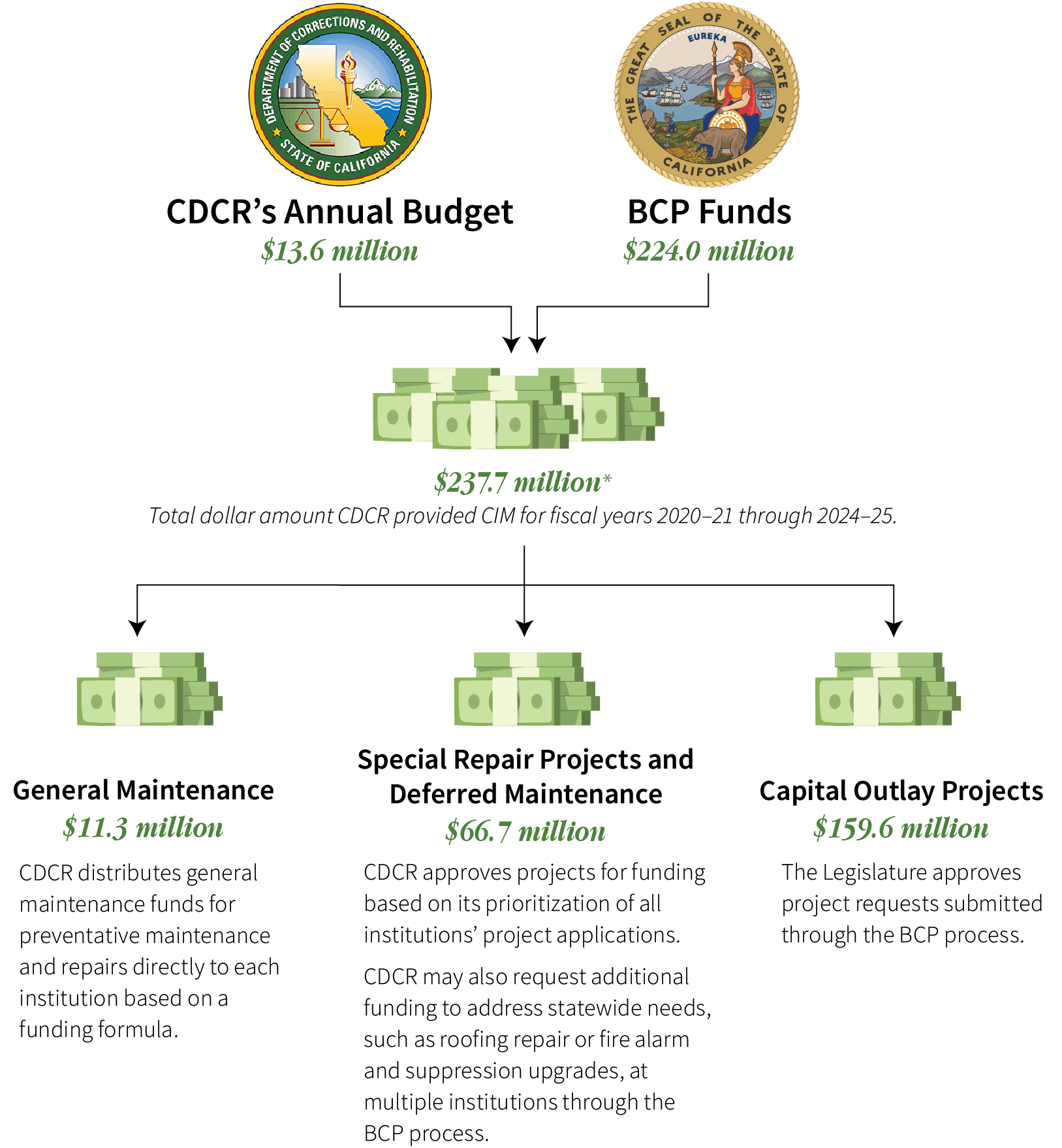
The figure shows two funding streams: CDCR’s annual budget, and BCP funds. These funding streams support the following three categories of infrastructure maintenance, repair, and upgrade activities:
1. General Maintenance: CDCR distributes general maintenance funds for preventative maintenance and repairs directly to each institution based on a funding formula. CDCR supports general maintenance activities through its annual budget.
2. Special Repair Projects and Deferred Maintenance: CDCR approves projects for funding based on its prioritization of all institutions’ project applications. CDCR supports special repair projects and deferred maintenance through its annual budget. CDCR may also request additional funding to address statewide needs, such as roofing repair or fire alarm and suppression upgrades at multiple institutions through the BCP process.
3. Capital Outlay Projects: The Legislature approves project requests submitted through the BCP process.
For Fiscal Years 2020–21 through 2024–25, CDCR provided CIM with $13.6 million from its annual budget, and another $224.0 million to CIM during those years from BCP funds. CDCR provided $11.3 million of those funds for general maintenance activities, $66.7 million for special repair projects and deferred maintenance, and $159.6 million for capital outlay projects. The total amount of funding CDCR provide to CIM during these years was $237.7 million. This total is greater than the sum of the parts due to rounding.
Source: CDCR documentation.
* Total is greater than the sum of the parts due to rounding.
General Maintenance
CDCR provides funds for institutions’ day-to-day infrastructure maintenance and repairs. CDCR’s annual budget for general maintenance is determined using a formula based on institutions’ square footage. As CDCR deactivates or reactivates facilities or institutions across the State, its budgeted amount for general maintenance has similarly changed. From fiscal years 2020–21 through 2024–25, CDCR received from the Legislature amounts ranging from $58.3 million to $75.1 million. In fiscal year 2024–25 that amount was $72.6 million.
Special Repair Projects and Deferred Maintenance
When institutions encounter nonroutine maintenance or repair needs (special repairs) for which the cost or scope is extraordinary, they submit to CDCR a request for a special repair project. CDCR’s operating manual does not define the term extraordinary; however, we reviewed project costs in fiscal year 2024–25 that ranged from about $20,000 for landfill repair and maintenance to nearly $7 million to replace four chillers and condenser pipes. The Budget Act provides CDCR with $26 million annually for special repair projects. CDCR allocates funding for special repair projects based on its prioritization of institutions’ project applications, an opaque process that we describe later.
CDCR may seek additional funding from the Legislature if it identifies special repair or deferred maintenance needs affecting multiple institutions, such as a need for statewide roofing repairs or upgrades to fire alarm and suppression systems, which it does by submitting a BCP to the Department of Finance (Finance). CDCR funded 10 of CIM’s special repair projects totaling about $67 million from fiscal year 2020–21 through 2024–25. Most of this funding went to three large projects, as Table 4 shows. CDCR requested funding for each of these three projects through the BCP process. CDCR allocated funding for the seven other projects, totaling almost $2.3 million, from its annual budget for special repairs.
Capital Outlay Projects
Finally, CDCR may use capital outlay funds for upgrades, such as for making alterations to existing structures to extend their design life or alter the structure’s function, or for new construction. CDCR must use the BCP process to obtain approval from Finance for such projects, and then the Legislature and Governor must approve the funding. CIM received funding for two capital outlay projects during the period we reviewed—the new mental health crisis facility and a project to install new HVAC systems in its Facility A.
Funding CDCR Invested at CIM
CDCR provided general maintenance, special repair, and capital outlay funds to each of its institutions, including CIM. However, none of the institutions have received sufficient funding to fully address their identified infrastructure needs. As Figure 15 shows, CDCR’s total investment in CIM’s infrastructure maintenance, repairs, and upgrades for the five years from fiscal years 2020–21 through 2024–25 has been nearly $240 million. Of this amount, $141 million, or about 60 percent, was associated with the construction of the new mental health crisis facility. This project stemmed from CDCR’s need to meet court-ordered levels of care for incarcerated individuals facing mental health crises. Excluding costs related to CIM’s mental health crisis facility, and general maintenance funds, CDCR spent about $85 million during our audit period—an average of $17 million per year—on the special repair and capital outlay projects at CIM listed in Table 4 and Figure 15. At this rate of spending, and assuming no cost increases or additional infrastructure needs, it would take CDCR 70 years to address the $1.2 billion in needed infrastructure repairs and upgrades that CDCR’s consultant identified in its 2019 facilities condition assessment.
Figure 15
CDCR Provided CIM With Nearly $240 Million for Its Infrastructure and Maintenance Needs From Fiscal Years 2020–21 Through 2024–25
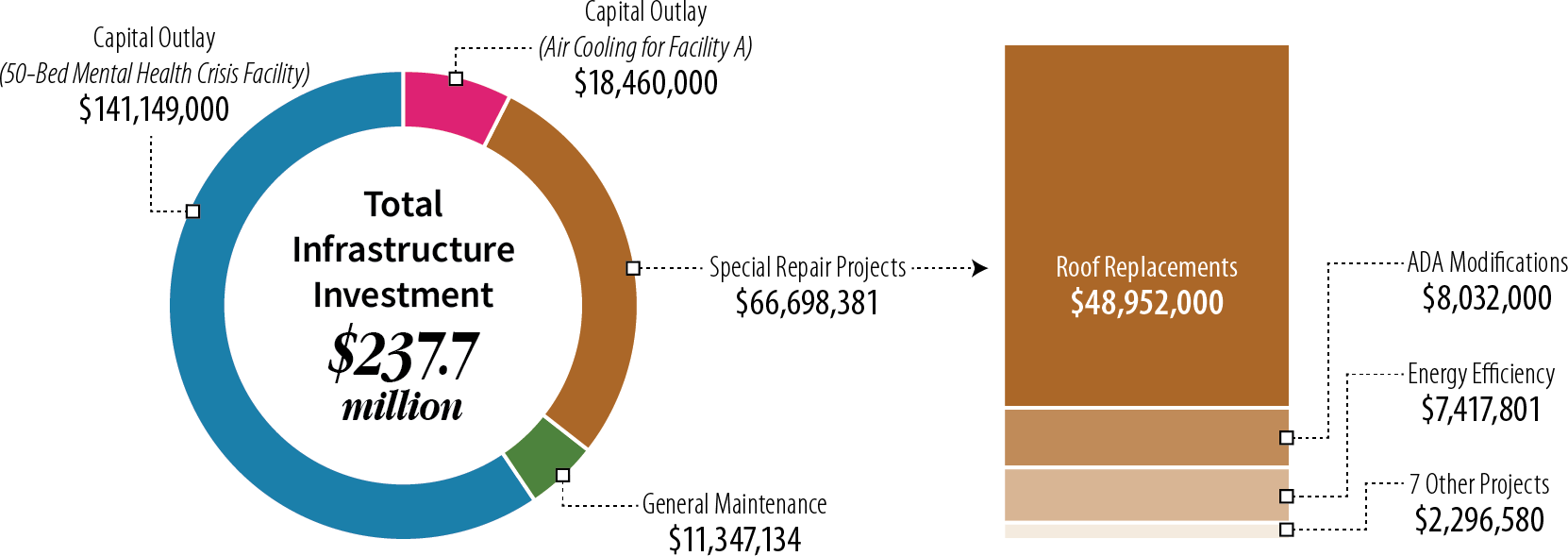
The figure depicts a pie chart that shows CDCR’s distribution of $237.7 million that it provided to CIM for infrastructure and maintenance needs from fiscal year 2020–21 through 2024–25.
CDCR provided $141,149,000 of the $237.7 million for a capital outlay project for a 50-bed mental health crisis facility.
CDCR provided $18,460,000 of the $237.7 million for a capital outlay project for air cooling for CIM’s Facility A.
CDCR provided $66,698,381 of the $237.7 million for ten special repair projects.
The figure shows that, of the nearly $66.7 million for special repair projects, CDCR allocated $48,952,000 for a roof replacement project, $8,032,000 for ADA modifications, and $7,417,801 for an energy efficiency project. CDCR allocated the remaining $2,296,580 of the $66.7 million for seven other special repair projects.
CDCR provided CIM the remaining $11,347,134 of the $237.7 million for general maintenance activities.
Source: CDCR maintenance and repair funding data.
Despite the substantial sum CDCR has invested, it has not been sufficient for CIM to meet safety and habitability standards. The text box describes some of the habitability and safety standards that CDCR needs to meet for its incarcerated population, and despite CDCR’s investment in CIM’s infrastructure, the institution is unable to consistently meet these statutory conditions. For instance, incarcerated individuals we interviewed reported that the kitchens often do not have water that is hot enough for dishwashers to sanitize dirty dishes and trays. These individuals reported that they regularly find food remnants from past meals on their trays. Work orders in Tririga substantiate these concerns. Our review of CDCR’s work order data identified 105 plumbing work orders closed during 2024 and 2025 that related to a lack of hot water at CIM. We found that 75 of those work orders remained open as of the end of 2025. One of those open work orders described how the water in one of the kitchens was not hot enough to sanitize food trays and kitchen tools. Staff indicated that they often lack the parts necessary to complete many work orders and typically run out of general maintenance funding midway through the fiscal year, which limits their ability to complete repairs and address the institution’s work order backlog. This can affect the institution’s ability to consistently meet habitability and safety standards.
Examples of Habitability and Safety Standards
- Nutritious meals prepared in sanitary kitchens
- Hot and cold potable water
- Clean clothing
- Access to showers and personal hygiene supplies
- Space for rehabilitative activities, classrooms, clinics, and other programming spaces
- Functional perimeter fencing for custody of incarcerated individuals
Source: State law.
Similarly, CDCR’s funding for special repair projects at CIM has not addressed all the institution’s needs. In August 2025, CDCR reported that it had a backlog of 513 special repair project requests from its institutions, with an estimated cost exceeding $1.6 billion. As Table 5 shows, 21 of those deferred special repair project requests are from CIM. Some of these deferred projects would address known safety and habitability concerns, such as a lack of adequate fire alarm systems and poor water quality. Likewise, although CDCR provided funding for air cooling at CIM’s Facility A, other facilities at CIM still lack these systems. Our interviews with incarcerated individuals at CIM also identified multiple ongoing or recurring safety and habitability deficiencies that these special repair projects could address, including access to clean drinking water, plumbing and drainage repairs, temperature control, roof leaks, weather protection, and other infrastructure issues that CIM has yet to address. Our review of CIM’s work orders substantiated these concerns.
Some of these unfunded projects are quite old. For example, CIM requested funds to repair its walk-in freezers during fiscal year 2008–09—17 years ago. Because CDCR has not funded this special repair project, CIM has had to rent temporary units at considerable expense to store its food. In fact, CIM has spent $492,000 on rental expenses for the temporary units in just the last five years, which exceeds the estimated $490,000 cost needed to repair the walk-in freezers. At that rate, had it had access to funds, CDCR could have repaired these freezers three times over.
CDCR estimates the total cost of CIM’s deferred projects to be roughly $140 million. While four comparable institutions we reviewed have more deferred projects, the cost of the projects at CIM exceeds that of the other institutions, as Table 6 shows. The table also shows that CIM and the four comparable institutions we reviewed together account for about a quarter of all projects CDCR has deferred. Further, Table 6 and Appendix C show that all of CDCR’s institutions—not just CIM—have unmet infrastructure needs. However, as we describe later, CDCR was unable to provide us any documentation showing why it chose to defer these projects while funding others. Without funding for these projects, CDCR and CIM have been unable to address known safety and habitability needs, making conditions worse for both staff and incarcerated individuals.
Comparing CIM’s Funding to Other Institutions
CDCR provided CIM with more funding during our review period than four other institutions we reviewed, but the results would be different if we reviewed a different time period. Table 7 shows that from fiscal years 2020–21 through 2024–25, CDCR provided about $97 million to CIM from various funding sources to address CIM’s infrastructure needs, which is between 200 and 680 percent of the amounts it allocated to four comparable institutions during these same five fiscal years. However, if we were to perform this same analysis across a different time period, we would likely see a different result. An associate director from CDCR’s Capital Planning and Project Services Branch and the CDCR maintenance chief described how CDCR executes certain large statewide projects, like those for ADA modifications, roofing repairs, health care facility improvements, and air cooling over multiple years. They stated that CDCR completes these projects incrementally at a handful of institutions each year until it has completed the upgrades at all institutions. This would result in some institutions receiving potentially significant additional funding in one period, while other institutions would receive that funding in a different period.
Our review of funding at the five institutions supports CDCR’s assertions about completing statewide projects. For example, four of those institutions received funding for the Health Care Facility Improvement Program from fiscal year 2020–21 through 2024–25. However, CIM received its funding for this project ($9.7 million) during fiscal year 2019–20—before the period of time we audited—and therefore we did not include that funding in the amounts Table 7 shows for CIM. Conversely, CIM received a total of $49 million for roof repairs during fiscal years 2022–23 and 2023–24. California Correctional Institution received about $40 million for roof repairs during fiscal year 2017–18, and roof repairs at the Correctional Training Facility are scheduled to be carried out in the future. However, because the roofing work at the other two institutions falls outside of our audit period, the table includes only the work at CIM. Similarly, while CDCR funded ADA modifications at CIM in fiscal year 2022–23, it did not fund similar modifications at the other four institutions during the five-year time period we reviewed.
CDCR’s Methodology for Allocating Funding
CDCR lacks procedures to guide how it allocates its limited maintenance funds. As a result, staff make decisions regarding how much maintenance funding to distribute to institutions—and which repair projects to fund—without such guidance.
As Figure 16 shows, CDCR distributes a base amount of general maintenance funding to each institution annually. CDCR supplements that amount with additional funds according to the institution’s active square footage and whether the institution has certain infrastructure features, such as a water treatment system, lethal electrified fencing, boilers, or chillers. The CDCR maintenance chief stated that CDCR adjusts this process to account for changes to the systems. For example, she described how, as CDCR began updating the fire alarm and suppression systems at various institutions, it also increased the funding supplements to those institutions to cover the additional annual maintenance costs associated with those upgrades.
Figure 16
CDCR Supplements Its Base General Maintenance Distributions With Additional Funding According to Each Institution’s Square Footage and Systems
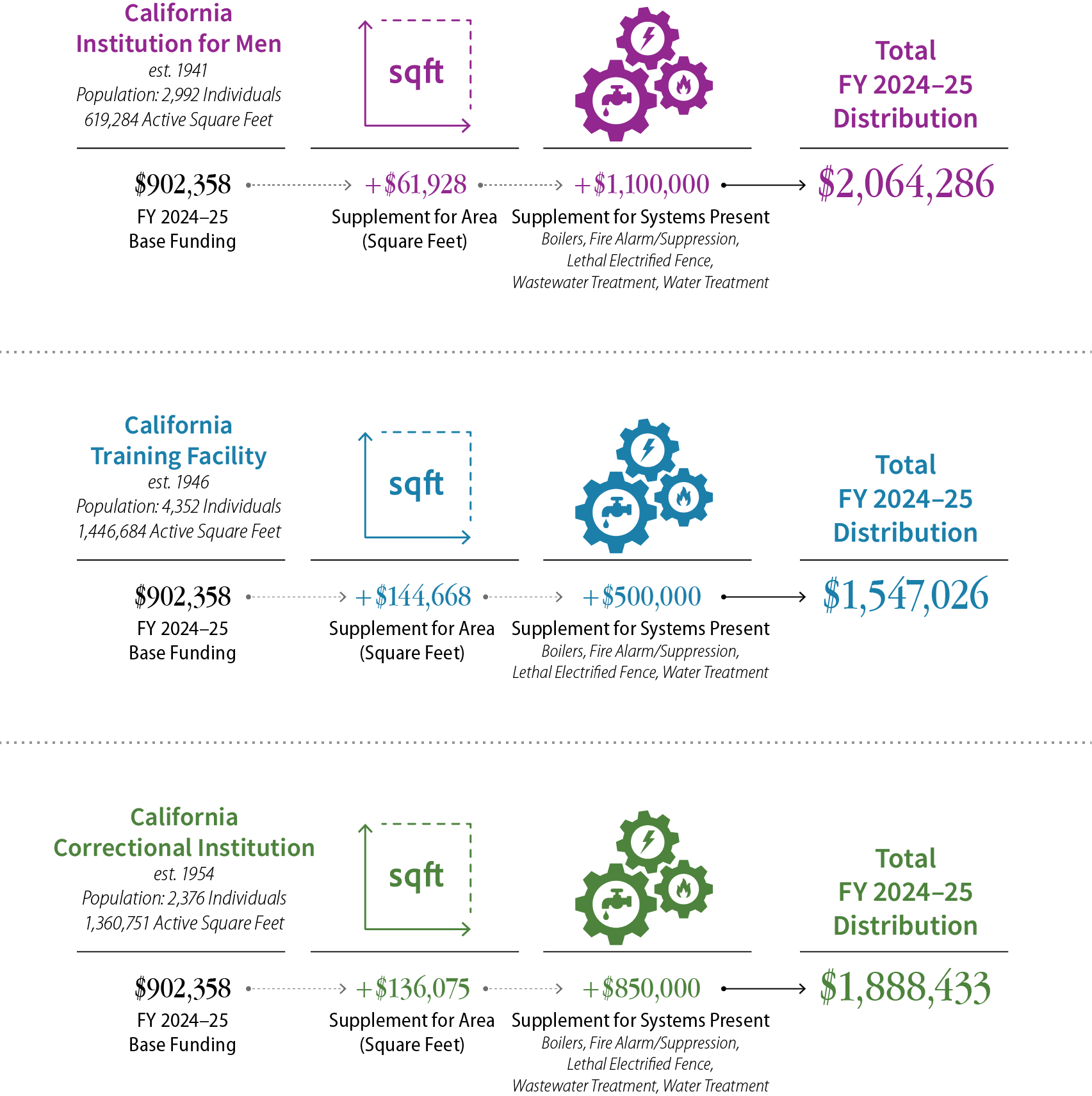
This figure depicts how differences in square footage and the various systems present at three institutions affected CDCR’s distribution of general maintenance funds to those institutions in fiscal year 2024-25.
The figure depicts three institutions: The California Institution for Men, established in 1941, with a population of 3,000 individuals; California Training Facility, established in 1946, with a population of 4,200 individuals; and California Correctional Institution, established in 1954, with a population of 2,350 individuals.
For fiscal year 2024–25, CDCR provided each of these three institutions with $902,358 in base funding. That year, CDCR also provided supplemental funding to each institution based on the institution’s active area, and on whether various systems were present at the institution.
For California Institution for Men, CDCR provided $61,928 in supplemental funding tied to the institution’s 619,284 active square feet. CDCR also provided $1.1 million in supplemental funding tied to the institution’s boilers, fire alarm and suppression equipment, lethal electrified fence, wastewater treatment, and water treatment plants. In total, CDCR distributed $2,064,286 in general maintenance funding to California Institution for Men in fiscal year 2024–25.
For California Training Facility, CDCR provided $144,668 in supplemental funding tied to its 1,446,684 active square feet, and $500,000 in supplemental funds tied to the institution’s boilers, fire alarm and suppression equipment, lethal electrified fence, and water treatment plant. In total, CDCR distributed $1,547,027 to California Training Facility in fiscal year 2024-25.
For California Correctional Facility CDCR provided $136,075 in supplemental funding tied to its 1,360,751 active square feet. CDCR also provided $850,000 in supplementary funding tied to the institution’s boilers, fire alarm and suppression equipment, lethal electrified fence, wastewater treatment, and water treatment plants. In total, CDCR distributed $1,888,433 to California Correctional Institution in fiscal year 2024-25.
The figure notes that CDCR provides institutions with different supplemental amounts for some systems. For example, CDCR provided California Institution for Men a $50,000 supplement for its boiler and a $500,000 supplement for its water treatment system, while it provided California Correctional Institution with $150,000 supplements for each of those two systems. CDCR also provides institutions supplemental funding for chillers and co-generation power systems. However, none of the institutions listed in this figure have those systems.
Source: CDCR documentation.
Note: CDCR provides institutions different supplemental amounts for some systems. For example, CDCR provided CIM a $50,000 supplement for its boiler and a $500,000 supplement for its water treatment system, while it provided California Correctional Institution with $150,000 supplements for each of those two systems. CDCR also provides institutions supplemental funding for chillers and co-generation power systems. However, none of the institutions listed here have those systems.
As Figure 16 also shows, CDCR considers an institution’s active square footage when distributing general maintenance funding but does not consider the age of the institution or the number of individuals incarcerated at the institution. This disregard of the institution’s age is, in part, because all but two of CDCR’s institutions are 29 years of age or older, and because the funding the Legislature provides CDCR for general maintenance activities is based on the active square footage at all of CDCR’s institutions statewide. However, the CDCR maintenance chief confirmed that CDCR has not documented its process for distributing funding for general maintenance projects to institutions. It also has not reviewed its methodology for distributing general maintenance funds since fiscal year 2019–20 and has not scheduled such a review. When we spoke with the chief about this lack of a documented process, she agreed that formalizing the process would be beneficial.
CDCR also lacks procedures that describe how to prioritize special repair projects for funding. The CDCR maintenance chief explained that CDCR uses a sequential process to first allocate funds for ongoing or multiyear projects. The chief stated that CDCR next prioritizes projects that mitigate risks of penalties and fines, such as projects needed to comply with requirements of the U.S. Environmental Protection Agency (EPA) or those affected by legal or regulatory considerations. She added that CDCR then considers input from internal and external stakeholders as it adjusts project priorities.
This prioritization process is important because CDCR’s annual $26 million special repair project budget is not sufficient to fund all of the requests that institutions submit. As a result, CDCR must defer projects for funding consideration, and its list of deferred projects is not small. CDCR annually submits to Finance a list that shows the special repair projects that remain unfunded because CDCR deferred them. In its August 2025 submission to Finance, CDCR reported 513 deferred projects that CDCR decided not to fund. CDCR estimates that the total cost of these projects is $1.6 billion, as Table 6 shows. We show the total number and estimated cost of all deferred projects at all institutions in Appendix C.
CDCR could not explain why it allocated funds for certain projects while deferring funding for others. The CDCR maintenance chief confirmed that CDCR does not have policies, procedures, desk manuals, or other written guidance that describes its prioritization process. She asserted that, while some documentation exists that demonstrates that prioritization is occurring, that documentation does not explain how CDCR prioritized one project over another. For example, CDCR cannot explain why in the same year it deferred a project to repair water transmission lines that CIM requested, it approved one to repair electrical and cable television services in the cells of one building at California Men’s Colony.
However, state law makes agencies responsible for establishing and maintaining policies and procedures to administer their functions and to ensure that each agency can meet its objectives. Agencies are responsible for documenting these policies and procedures and communicating them to their staff. Without established procedures to prioritize projects, CDCR cannot ensure that it consistently allocates funding to projects with the most critical needs. Further, the lack of these procedures limits CDCR’s ability to provide transparency regarding its funding allocation process. The CDCR maintenance chief agreed that CDCR would benefit from establishing written policies and procedures that describe its process for prioritizing and allocating funding for special repair projects but said that doing so has been a lower priority than the section’s other day-to-day business activities.
In contrast to the processes for distributing general maintenance funds and allocating funding for special repair projects, the State has a well-defined process for funding capital outlay projects through the BCP process. Finance provides guidance to agencies for developing and submitting the BCPs, which includes information on how BCPs function within the budgeting process, factors that affect whether a BCP will be included in the governor’s budget, and common pitfalls that may cause the Legislature or Governor to reject a BCP. The associate director of the Capital Planning and Project Services Branch indicated that CDCR submits BCP requests for projects after it has clearly identified both the problem to be addressed and the optimal solution to that problem. He provided documentation showing projects that CDCR had submitted to Finance for its review as well as those for which it had either not yet identified the optimal solution or had yet to substantiate the need.
Legal, Regulatory, and Environmental Considerations
The need for CDCR and CIM to complete infrastructure projects and maintenance that allow them to comply with legal and environmental requirements limits their ability to complete routine maintenance and repairs and fund discretionary infrastructure projects. At least as far back as 2008, the OIG reported that CDCR would need to provide CIM with $28 million annually—about one-third of CDCR’s annual maintenance and repair spending at the time—to maintain CIM in its then‑poor condition. In fiscal year 2024–25, CDCR provided CIM with $16.6 million in infrastructure funding, just $2 million of which went to maintenance and repairs. Absent additional funding for maintenance and repairs, or another long-term solution to replace or renovate CIM’s deteriorated infrastructure to meet current legal, regulatory, and environmental requirements, these requirements will continue to impede the ability of CDCR and CIM to maintain and repair CIM’s aging infrastructure.
According to CDCR, among the infrastructure projects for which it must prioritize funding to comply with legal or regulatory requirements are: ADA modifications, air cooling systems, water treatment, and health care upgrades. For example, CDCR invested $18.5 million to install air cooling units at CIM’s Facility A, which houses the largest population of CIM’s facilities, and whose wood-framed dormitories are relatively easily retrofitted. According to CDCR, it funded this project as part of a plan to manage rising interior temperatures and improve the comfort and safety of staff and the incarcerated population, a plan that it developed in response to court mandates. CDCR also invested $8 million for accessibility improvements at CIM to comply with ADA requirements. Because it dedicated this funding to comply with legal requirements, CDCR could not use the funding for other approved projects at CIM, such as replacing its water-distribution system or repairing roofs. These funding decisions were not a one-time occurrence. CDCR staff indicated that their process for funding projects prioritizes those required by the EPA, an institution’s fire marshal, or projects with legal or regulatory considerations.
Similarly, CDCR’s 2025 annual report notes that its capital outlay development and funding process focuses on prioritizing projects based on fire and life-safety needs, court orders, regulatory compliance, or program needs. The report lists several large projects that CDCR has recently completed or is actively working on to comply with legal and regulatory requirements, including ADA modifications, air cooling systems, health care upgrades, and mental health care housing. Prioritizing these projects leaves less funding available for other maintenance and repairs.
Additionally, to meet modern building standards and complete repairs and upgrades for CDCR’s aged buildings, CDCR will need to invest significant resources. In its 2018 facility condition assessment, CDCR’s consultant indicated that many of CIM’s systems are in a state of significant disrepair, that it would be difficult or potentially even impossible to repair some of these systems, and that replacing these systems will likely trigger design modifications to the systems to comply with modern building codes. The associate director of CDCR’s Capital Planning and Project Services Branch agreed that CDCR could face delays in completing an infrastructure project if building codes required CDCR to modify the project’s design. The associate director stated that CDCR takes these restrictions into consideration during the planning process and would include additional costs to comply with legal or regulatory requirements in the project’s cost estimates.
Other regulatory requirements make it difficult for CIM to complete maintenance and repairs. As we discussed previously, CDCR has not been able to provide CIM with sufficient funding to complete all of its work orders. Specifically, CIM’s budget analyst stated that to comply with local water board mandates and state regulations, CIM allocates about 40 percent of its plant operations budget to purchase supplies for its water treatment plant, which significantly diminishes its ability to allocate funds for other maintenance needs. The salt for water treatment alone costs more than $1 million per year, which is double the supplemental general maintenance funding that CDCR provides CIM for its water treatment plant. CDCR staff stated that they are aware of the situation with CIM’s water treatment plant, which also provides water for several other nearby institutions, and indicated that they are studying the feasibility of switching CIM’s water and wastewater systems to local municipal utilities.
CDCR’s Plans for CIM and California’s Correctional Institutions
Key Points
- CDCR published a 2026 Infrastructure Master Plan (master plan) that proposes renovating or rebuilding CIM and four other institutions over the next 10 years, with additional institutions in years to follow, and is reviewing contractor submissions to start the planning process.
- The State’s correctional institutions need significant infrastructure investment, and the costs to implement CDCR’s plans will be substantial, so CDCR must work with the Legislature and stakeholders to determine appropriate next steps and obtain funding, if warranted, to renovate or rebuild CIM and the other institutions it identifies.
Objective 7:
What are CDCR’s plans for the future of CIM, including any plans for potential deactivation, rebuilding, repurposing, or relocation of programs and services?
CDCR’s 20-Year Infrastructure Master Plan
In May 2026, CDCR released a 20-year master plan for addressing known shortcomings in infrastructure for housing, medical care, and rehabilitative services at each of its institutions. The master plan identifies the infrastructure needs, ranks the institutions according to severity of needs, and proposes to begin planning for the rebuilding or refurbishing of five institutions, including CIM, within the next five years. CDCR will then plan for an additional five institutions every five years after that. Provided there is funding, CDCR anticipates completing the construction and repair work for the first five institutions by mid-2035. Importantly, the master plan does not provide specifics on the cost to complete the construction and repairs, relying on future planning activities to provide the scope and budget for the proposed projects, nor does the master plan discuss potential deactivations or closures of facilities or institutions. As Table 8 shows, CDCR rated CIM as the institution with the most critical need for repair or replacement of building systems; however, the master plan currently leaves CIM for last among the first five institutions.
Figure 17 illustrates CDCR’s proposed phased approach for repairing or replacing these five institutions, starting with planning at California Medical Facility (CMF) in mid-2026, with CDCR completing construction and repair work at CMF in mid‑2032. CDCR would complete work at Central California Women’s Facility and Sierra Conservation Center in mid-2033 and at California State Prison, Corcoran (Corcoran) in mid-2034. Although CDCR rated CIM as its most critical institution, it does not propose to start work at CIM until mid-2029 and would not expect construction at CIM to be complete until mid-2035.
Figure 17
CDCR’s Infrastructure Master Plan Proposes Initially Repairing or Replacing Five Institutions
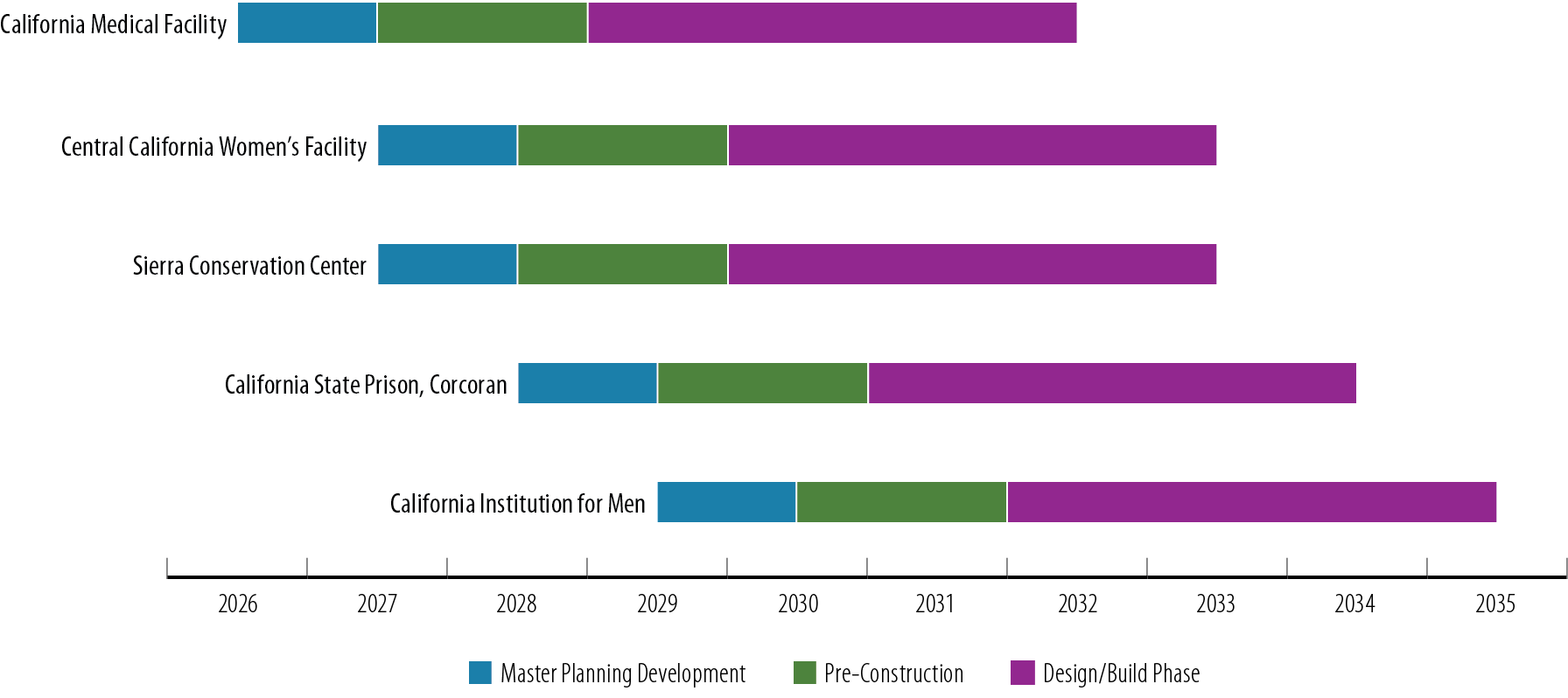
CDCR’s Infrastructure Master Plan proposes work at five of its institutions from mid-2026 through mid-2035. The five institutions are the California Medical Facility, Central California Women’s Facility, Sierra Conservation Center, California State Prison, Corcoran, and the California Institution for Men.
At California Medical Facility, master planning development is scheduled to run from mid-2026 through mid-2027. Pre-construction is scheduled to run from mid-2027 through the end of 2028, followed by the design/build phase from the beginning of 2029 through mid-2032.
CDCR plans concurrent work at Central California Women’s Facility and Sierra Conservation Center. At these two institutions, master planning development is scheduled to run from mid-2027 through mid-2028. Pre-construction is scheduled to run from mid-2028 through the end of 2029, followed by the design/build phase from the beginning of 2030 through mid-2033.
At California State Prison, Corcoran, master planning development is scheduled to run from mid-2028 through mid-2029. Pre-construction is scheduled to run from mid-2029 through the end of 2030, followed by the design/build phase from the beginning of 2031 through mid-2034.
At California Institution for Men, master planning development is scheduled to run from mid-2029 through mid-2030. Pre-construction is scheduled to run from mid-2030 through the end of 2031, followed by the design/build phase from the beginning of 2032 through mid-2035.
The figure notes that, according to CDCR, it intends to reevaluate its needs every five years to identify the next five institutions that will either be significantly rebuilt or receive significant capital investments.
Source: CDCR’s Infrastructure Master Plan.
Note: According to CDCR, it intends to reevaluate its needs every five years to identify the next five institutions that will either be significantly rebuilt or receive significant capital investments.
As part of developing the master plan, CDCR asked plant operations staff in its institutions to perform analyses of their building systems, utilities, and infrastructure. This information showed CDCR that among the systems that are poor or failing at CIM are mechanical air cooling, culinary refrigerators and freezers, emergency electrical distribution, lethal electrified and security fencing, roads and pavement, roofs, steam distribution, stormwater conveyance, and water treatment and distribution systems. CDCR indicated that work at CIM and the other institutions it identified in its master plan includes replacing utility systems, demolition and replacement of housing units, and other major projects. The conclusions from our assessment of CIM’s infrastructure align with those reached by CDCR.
In describing the deteriorated condition of its existing infrastructure, the master plan notes that much of the infrastructure has reached the end of its useful life, resulting in increased maintenance demands, operational inefficiencies, and system failures. CDCR asserts that the State’s investments in its facilities are substantially lower than industry averages for maintenance, repairs, and upgrades. The CDCR master plan also explains that the needs of the incarcerated population have changed, and that most of CDCR’s institutions were built for containment without consideration for medical and mental health care, accessibility, or rehabilitation. According to CDCR, its current infrastructure creates a barrier to the State’s movement toward improved delivery of health care services, rehabilitative programs, and support for reentry programs.
According to the director of CDCR’s Facility Planning, Construction and Management Division, when deciding which institutions to prioritize for work, CDCR considered both the condition of an institution’s infrastructure and its programmatic needs. These included factors such as the institutions’ locations, CDCR’s ability to staff them, the populations they serve, and the services they offer. The deputy director of the Facility Planning, Construction and Management Division explained that CDCR’s decision to address CMF first was driven by the institution’s large medical and mental health mission, which includes housing and program space for individuals who are aging, disabled, in end-of-life or palliative care, or are living with mental health conditions in a deteriorated incarcerated environment. As of July 2026, CDCR has selected a contractor and is negotiating a contract to begin the master planning process and perform the facility condition assessment at CMF. When we asked the director about accelerating the timeline of work at CIM, she indicated that even with adequate funding, it would be difficult to start work at CIM until the work at CMF is underway due to the large size of both institutions and other logistical considerations such as the department’s need to house displaced incarcerated individuals during construction. However, the director agreed that if the Legislature directed it to do so, CDCR could accelerate the schedule for CIM by one year and either conduct the work concurrently with or before its work at Corcoran.
Costs to Implement CDCR’s Master Plan
CDCR will face substantial costs regardless of what path forward it takes. The financial cost for updating CIM and other institutions is currently unknown, though CDCR estimates holistic repairs and replacements at CIM could run as much as $2.6 billion. As part of its master plan, CDCR updated the consultant’s 2019 cost estimates and aligned those results to the analysis its plant operations staff performed and found that the amounts were similar. Further, as part of its master plan, CDCR will obtain a facility condition assessment for each institution for which it obtains funding to repair, renovate, or rebuild, which will produce independent cost estimates and alternatives to consider.
Nevertheless, CDCR expects the financial costs to maintain, renovate, or replace CIM and the other four institutions to be substantial. Specifically, the updated 2019 facility condition assessment estimates for repair and replacement of CIM’s infrastructure run to $1.8 billion, and CDCR’s own estimates for ongoing maintenance and repairs at CIM are about $2.5 billion. However, according to CDCR, the additional upgrades included in its master plan would meet current building codes and legal requirements, improve CDCR’s operational efficiencies, reduce maintenance and repair costs in the future, and allow CDCR to provide CIM’s incarcerated population with the medical and mental health care, rehabilitation, and services they need. With the Legislature’s agreement, CDCR would prepare the project scope and budget of the work needed after conducting initial planning activities.
If the Legislature Rejects CDCR’s Master Plan
CDCR will also face substantial costs—both financial and programmatic—if the Legislature rejects its plans to upgrade CIM and other facilities. CDCR identified its expected costs to simply maintain its institutions’ existing infrastructure while making various upgrades, such as those associated with ADA requirements. As Appendix D shows, for CIM, CDCR estimated that the institution will need nearly $1.8 billion in upgrades and maintenance in the next 10 years and a total of more than $2.5 billion within the next 20 years. Even this amount of funding—an average of $180 million per year for the first 10 years—is significantly more than the $17 million on average that CDCR provided CIM for special repair and capital outlay projects, excluding the mental health facility, during the period we reviewed. However, not enacting the master plan and simply trying to maintain the institutions’ infrastructure in the current state with existing funding amounts, and making only those upgrades required to comply with court orders and other legal requirements, also carries a programmatic cost: It means that CDCR will be limited in its ability to address the outdated functionality at its existing institutions. This may impede CDCR’s ability to perform its mission-critical rehabilitation function, which aims to reduce recidivism through education, vocational training, and substance use disorder treatment.
As part of our work on assessing CDCR’s long-term strategy, the Joint Legislative Audit Committee asked us to identify any plans for the potential deactivation of CIM. CDCR’s master plan does not reference any planned future closures and mentions only historical institutional deactivations. The plan focuses its long-term strategy on factors that affect CDCR’s ability to balance its rehabilitative needs relative to the use of its existing space. The facilities director stated that CDCR currently has no plans to close any additional institutions and that an outside observer could reasonably conclude that CDCR’s sizable investment in CIM’s mental health crisis facility, its reactivation of CIM’s Facility D housing units, and its closure of the nearby California Rehabilitation Center all show that CDCR has no plans to close CIM.
Other Areas We Reviewed
Key Points
- CDCR and CIM appropriately followed security procedures and protocols when transferring incarcerated individuals to CIM due to facility closures and relocations, or when transporting them to offsite appointments.
- CDCR and CIM addressed all but two of the OIG’s recommendations after incarcerated individuals at CIM rioted in 2009. CIM has a detailed emergency operation plan that includes procedures related to emergency staffing and providing for large numbers of displaced incarcerated individuals.
- CDCR’s closures of institutions and deactivations of facilities have affected CIM’s vacancy rate and staffing level.
Objective 5:
What public safety risks exist resulting from facility closures, transfers, and emergency relocations that affect law enforcement and the neighboring community?
Transfers of Condemned Individuals to CIM
As part of CDCR’s responsibilities, it may transfer or relocate individuals in its custody while ensuring safety for the incarcerated individuals, staff, and the public. In 2016, voters passed Proposition 66, the Death Penalty Reform and Savings Act of 2016. This act requires condemned individuals, subject to CDCR’s rules and regulations, to work and pay victim restitution, if ordered. It also allowed CDCR to transfer condemned individuals to another CDCR institution. Accordingly, CDCR issued regulations that established the Condemned Inmate Transfer Program, and additional regulations that require condemned individuals to be housed in a facility with at least Level II security and a lethal electrified fence. Since the program’s approval in 2024, CDCR has transferred 51 condemned individuals from San Quentin to CIM. CDCR may also transfer incarcerated individuals from one institution to another when individuals are newly incarcerated, when their security level changes, when they need certain medical or mental health care services, or when CDCR closes or deactivates facilities. From fiscal years 2020–21 through 2024–25, CDCR transferred incarcerated individuals to CIM from 33 different institutions, state hospitals, and other sources. Figure 18 describes the process CDCR follows when preparing to transfer an incarcerated individual.
Figure 18
State Law Requires CDCR to Complete Several Reviews Before Transferring an Incarcerated Individual to a New Institution
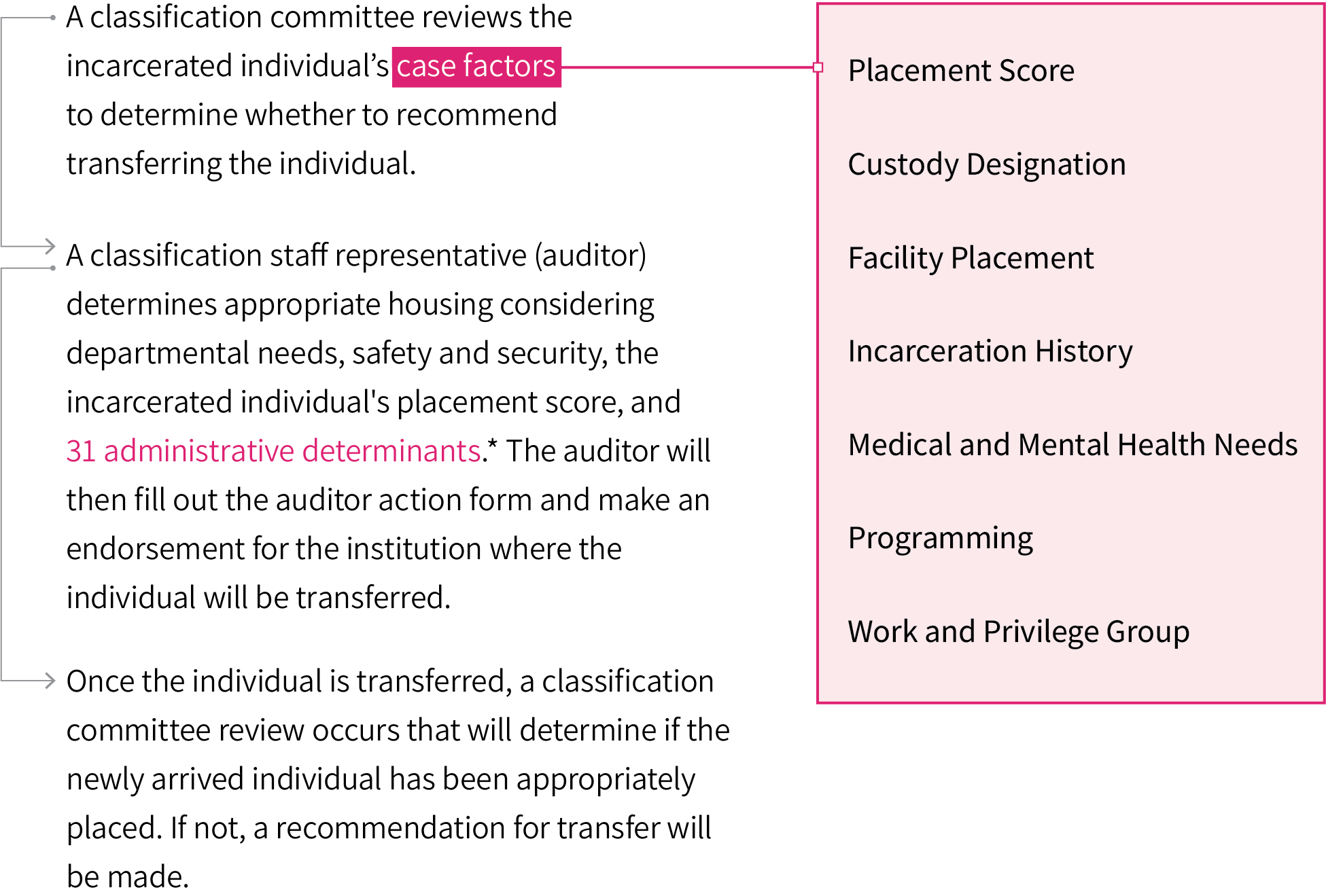
The figure shows three reviews that CDCR must conduct prior to transferring an incarcerated individual from one institution to another.
First, a classification committee reviews the incarcerated individual’s case factors to determine whether to recommend transferring the individual. These case factors include the individual’s placement score, custody designation, the facility placement, their incarceration history, their medical and mental health needs, programming, and their work and privilege group.
Next, a classification staff representative (auditor) determines appropriate housing considering department needs, safety and security, the incarcerated individual’s placement score, and 31 administrative determinants. These determinants include factors such as the individual’s age, their medical and psychological condition, whether they have been convicted of certain crimes, such as arson or sex offenses, whether they have known enemies in the incarcerated population, whether they have local family connections, and whether they are serving a life sentence or are condemned. The auditor will then fill out the auditor action form and make an endorsement for the institution where the individual will be transferred.
Finally, once the individual is transferred, a classification committee review occurs that will determine if the newly arrived individual has been appropriately placed. If not, a recommendation for transfer will be made.
Source: State law.
Administrative determinants include 31 factors, such as the individual’s age, their medical and psychological condition, whether they have been convicted of certain crimes, such as arson or sex offenses, whether they have known enemies in the incarcerated population, whether they have local family connections, and whether they are serving a life sentence or are condemned.
State regulations establish requirements for how CDCR must appropriately house incarcerated individuals. To determine appropriate housing for individuals, regulations require CDCR to perform evaluations that result in assigning individuals both a placement score and a custody designation. The placement score is based on an assessment of various factors, such as the person’s needs and public safety risk, which determine what level of security an institution must have to house that individual. The custody designation refers to where an incarcerated person shall be housed and assigned, and the level of staff supervision required to ensure institutional security and public safety. The law requires CDCR to assign condemned individuals a close custody designation for at least five years after transferring them from San Quentin.
An incarcerated individual with a close custody designation always requires direct and constant supervision by custody staff during the incarcerated person’s assigned work hours, regardless of their placement score. In addition to condemned individuals, other incarcerated individuals can be assigned a close custody designation, such as those sentenced to life without the possibility of parole. Regulations require male individuals with close custody designations to live in celled housing, not dormitories, and prohibit them from working outside the main security perimeter or off prison grounds. According to CDCR, close custody provides the highest security level for the condemned population while still allowing their integration into the general population. To comply with the law specifying that CDCR generally cannot house condemned individuals at an institution with a security designation of less than Level II, and requiring that their housing facility be surrounded by a lethal electrified fence, CIM’s Facility C is an appropriate housing unit for some condemned individuals.
Transfers of Other Incarcerated Individuals to CIM
We found that CDCR and CIM followed state regulations to appropriately house individuals whom CDCR transferred to CIM. We selected for review the records of five incarcerated individuals whom CDCR transferred to CIM for different reasons. In two of the five cases we evaluated, CDCR transferred the individuals to CIM as part of the Condemned Inmate Transfer Program. In another case, CDCR transferred a newly reincarcerated individual from a reception center to their permanent housing placement. In the other two cases, CDCR transferred the incarcerated individuals to CIM as temporary housing assignments—one went to CIM’s Restricted Housing Unit in Facility B, and the other went to CIM’s medical Outpatient Housing Unit. As part of our review, we verified whether CDCR and CIM followed all the processes and considered all the case factors and administrative determinants described in Figure 18 for the five individuals we selected. We concluded that CDCR properly completed its reviews before transferring these individuals to CIM to ensure that it appropriately housed them based on their security level and custody designation, while also considering their case factors and any administrative determinants.
CIM staff indicated that CDCR temporarily transfers individuals, such as those in the five cases we reviewed, for different reasons. One reason is that CIM is geographically located near offsite health care services, and CDCR has contracts with many health care providers in the region to meet the needs of the incarcerated population. Further, the Restricted Housing Unit serves as temporary housing when someone poses an immediate threat to safety, endangers security, or jeopardizes an investigation. State regulations allow CDCR to temporarily transfer to CIM individuals with Level III or higher classification for these types of services and protections. We found that CDCR and CIM properly followed all documented processes and procedures for transferring and assigning new housing to those individuals whose cases we reviewed.
Facility Closures
When facilities or institutions close, CDCR finds appropriate new facilities for those incarcerated at the closed locations, and it does so according to the same review process we describe in Figure 18. Sometimes the appropriate housing for the individual will be in a different facility within the same institution. For example, when CDCR deactivated Facility D at CIM in 2023, it transferred 438 individuals formerly housed at that facility directly to CIM’s Facilities A, B, and C. CDCR recently transferred incarcerated individuals from California State Prison, Solano, before deactivating one of its facilities in April 2026. CDCR has also begun transferring incarcerated individuals from CRC to CIM in preparation for CRC’s closure in fall 2026, and CDCR says that it reactivated dormitories at CIM’s Facility D in May 2026 to accommodate the resulting increase to the institution’s population.
Transportation of Incarcerated Individuals for Services Offsite
CIM transports incarcerated individuals outside of the institution for medical or mental health care, among other reasons. In our assessment, we observed that CIM frequently transported incarcerated individuals offsite for doctor’s appointments and hospital visits, and we found that CDCR and CIM have extensive policies and procedures to ensure public safety when doing so. CIM’s restricted confidential policy for transporting incarcerated individuals includes a matrix for assessing what security measures are required for each case. CIM determines appropriate security measures, such as the necessary number of officers and types of restraints, according to the individual’s security level and medical background. CIM’s protocols specifically include notifying local law enforcement when they transport condemned individuals outside of the institution. We found that CIM reduced potential safety risks by following those policies and procedures for the four individuals whose records we reviewed.
CIM’s Emergency Plans
According to an April 2010 OIG report on CIM’s 2009 riot—which left seven of its eight dormitories uninhabitable and displaced more than 1,150 incarcerated individuals, many of whom CIM held in outdoor exercise yards for several days after the riot—CIM lacked adequate contingency plans to house its population in the event of such an emergency. The report included three recommendations for CDCR and six for CIM. These included a recommendation to CDCR to ensure that emergency operation plans for CIM and all other institutions provide adequate housing, food, clothing, medical attention, and other essential services to large numbers of incarcerated individuals who may be displaced by major events such as riots or natural disasters, and a recommendation that CIM establish emergency operations procedures to assure that the institution can summon a sufficient number of trained and properly equipped peace officers to transport or escort injured individuals to outside medical care facilities.
According to CDCR’s corrective action plan and as Table 9 shows, CDCR indicates that it fully implemented two of the three recommendations that OIG addressed to it, and CIM reports that it fully implemented five of OIG’s six recommendations for CIM. Both entities have partially implemented recommendations related to identifying incarcerated individuals who lack identification cards. Specifically, CDCR and CIM have yet to obtain field-deployable equipment capable of rapidly identifying individuals by using some combination of fingerprints, iris scans, or facial recognition. Staff at CIM indicated that CDCR is working on obtaining tablets that would allow officers to identify incarcerated individuals quickly through CDCR’s Strategic Offender’s Management Software without needing to review an incarcerated individual’s identification card.
As state regulations require, CIM has an emergency operations plan to assist in the preparation for, response to, and recovery from various hazardous incidents, and it prioritizes safety and security for its incarcerated population, CIM staff, and the public. The plan includes steps to provide housing, food, and medical attention to incarcerated individuals who may be displaced by major events such as riots or natural disasters. According to CIM staff, when CIM experiences an emergency, natural disaster, or other serious incident that affects multiple facilities, such as a fire or gas leak, management activates an incident command post. For example, CIM activated its incident command post in response to the 2018 escape described earlier in this report. CIM conducts annual drills to rehearse activating its incident command post response, in which managers document the situation, identify what security measures to take, and determine how to continue caring for and feeding the incarcerated population during the incident.
To assist in the operation of the command post, CIM’s emergency operations plan details the duties of the incident commander and includes a variety of checklists that identify steps that staff members need to take, including contacting emergency services, assessing safety and security concerns, and providing medical support. The plan also includes contact information for various local emergency services, local stakeholders, and other state agencies. As the OIG recommended, the plan includes detailed procedures related to emergency staffing and providing meals for large numbers of displaced incarcerated individuals. According to staff, CIM has several predetermined areas in each of its facilities, such as gymnasiums, chapels, culinary areas, and education classrooms, where it can relocate individuals in an emergency. However, staff asserted that before CIM could relocate any individuals to other institutions, it would need to complete appropriate transfer review procedures to ensure proper custody and determine that the destination facility was appropriate for the incarcerated individual. Depending on the number of individuals CIM may need to relocate, that process could take a considerable period of time. Staff indicated that if CIM needed to evacuate the entire institution, they would notify CDCR’s Office of Emergency Services, other nearby institutions, and CDCR’s state transportation services for assistance.
As we describe in the Introduction, in 2018, an individual in CIM’s custody in Facility D escaped from the institution. In response to the escape, CIM drafted an after-action report that included details of the incident, deficiencies in need of correction, and recommendations to correct the deficiencies. In its corrective action plan in response to the report, CIM indicated that it had fully corrected most of the deficiencies and, according to CIM’s warden, it has subsequently completed the remaining items. According to the warden, CIM’s actions included the installation of anti-climb mesh and river rock “ankle-breakers”—large rocks intended to slow down an individual who lands on them—on the Facility D perimeter fence, the removal of vegetation, the installation of new lighting, and the purchase of equipment such as night-vision binoculars and spotlights to improve nighttime surveillance of the institution’s property. The warden explained that CIM is planning to install a new audio-video surveillance system in fall 2026, which should further improve the ability of staff to monitor the institution’s grounds.
Effects of Facility Deactivations and Institution Closures on Staffing Levels
CDCR’s deactivations of facilities and closures of institutions have led to temporary increases in unfilled staff positions at CIM. According to CIM staff, when CDCR deactivates or closes a facility or institution, it imposes a hiring freeze to allow employees from a deactivated institution or facility to apply for a transfer to other institutions according to the employee’s priority ranking. As Table 1 shows, CDCR has deactivated or closed multiple institutions and facilities since 2019.
According to CIM staff, the hiring freezes associated with these deactivations and closures have affected its staffing levels. Staff explained that during a hiring freeze, CIM is only able to hire limited-term employees, subject to certain hiring restrictions, and that the process for doing so is lengthy. Staff further noted that when an employee from a deactivated institution transfers to CIM and fills the position of a limited-term CIM employee, the limited-term employee loses their employment at CIM unless they have another permanent CIM position to which to return. In addition, CDCR program support staff indicated that when they know CDCR will close an institution, they wait to fill vacancies at other institutions in anticipation of staff transfers from the closing institution. The net result of these conditions is an increase in unfilled staff positions at CIM.
According to CDCR staff, when facility deactivations like this typically occur, institutions can often absorb the positions made obsolete by transferring staff to unfilled positions in other parts of the institution. However, not all staff from deactivated facilities remain at their institutions, leading to a decline in staffing levels at institutions where deactivations have occurred. As Figure 19 shows, CIM experienced its highest vacancy rate for both custody and non-custody staff in the months leading up to the deactivation of CIM’s Facility D, and Figure 20 illustrates that after the facility’s April 2023 deactivation, the number of authorized and filled positions for both custody and non-custody staff at CIM declined.
Figure 19
CIM’s Rates of Unfilled Staff Positions Peaked in the Months Leading Up to the Deactivation of CIM’s Facility D
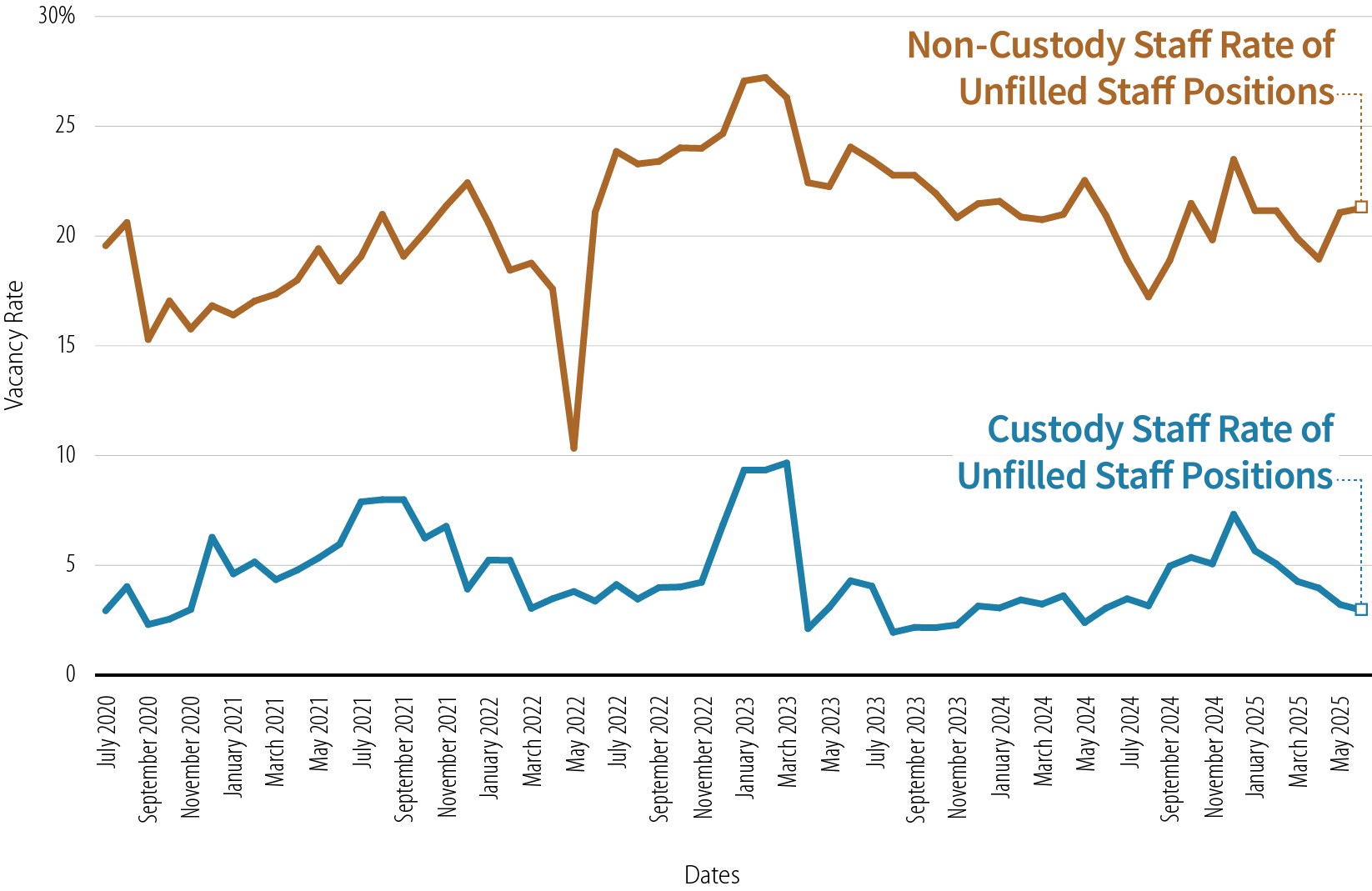
The figure depicts the percentage of unfilled positions (vacancy rate) for custody staff and for non-custody staff at CIM between July 2020 and May 2025.
In July 2020 the rate of unfilled staff positions for custody staff was roughly three percent. The rate varied between three percent and eight percent between July 2020 and December 2022, but spiked to nearly 10 percent between January 2023 March 2023. The rate dropped back to roughly two percent in April 2023 and was at roughly three percent in May 2025.
In July 2020 the non-custody staff rate of unfilled staff positions was roughly 20 percent. That rate peaked at roughly 27 percent in January and February 2023, and was roughly 21 percent in May 2025.
CDCR deactivated CIM’s Facility D in April 2023. CDCR reactivated the facility in May 2026.
Source: CIM staffing data.
Note: CDCR deactivated CIM’s Facility D in April 2023 and reactivated it in May 2026.
Figure 20
CIM’s Total Authorized and Filled Staff Positions Declined After CDCR Deactivated CIM’s Facility D in April 2023
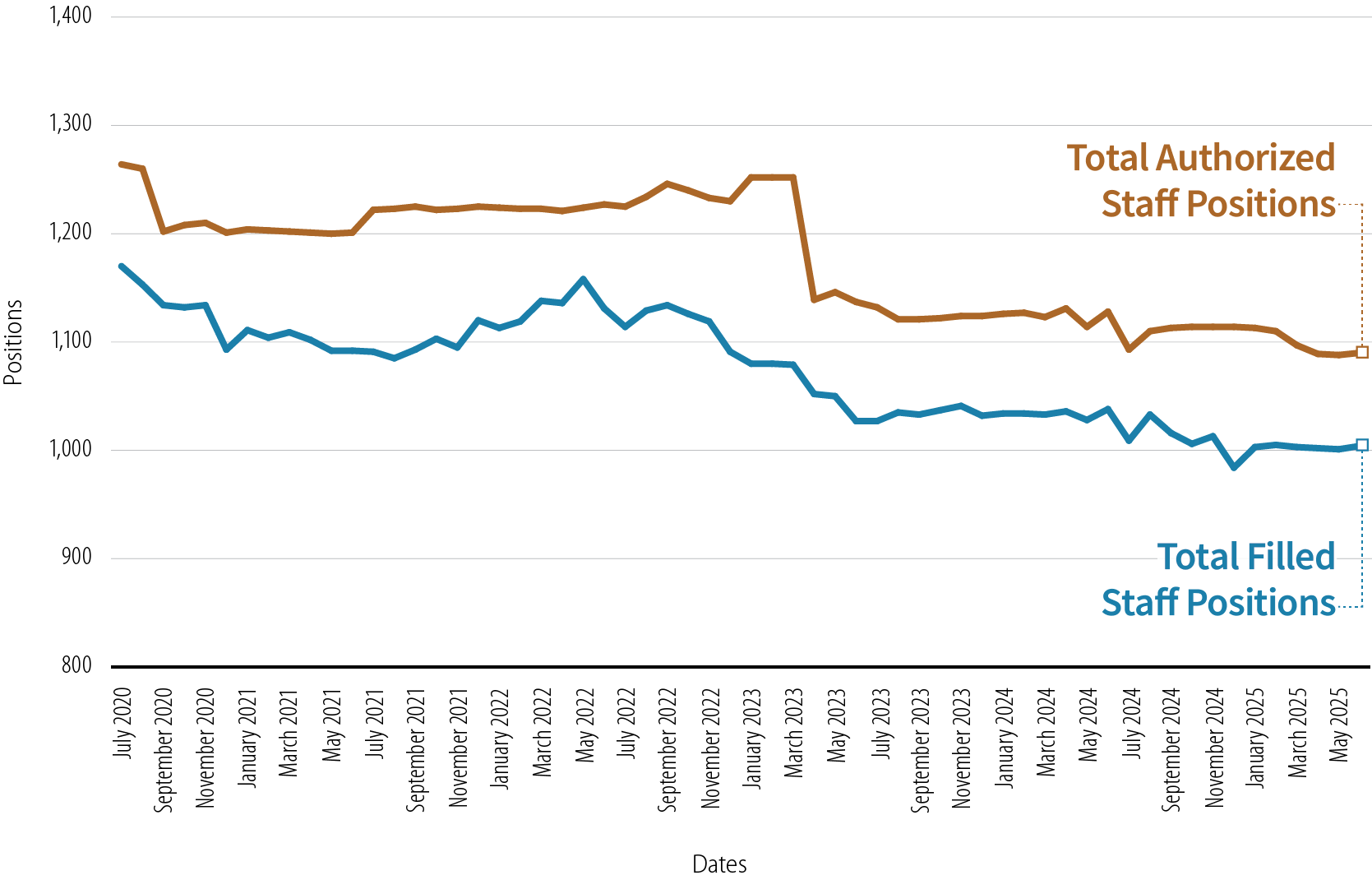
The figure shows that CIM had roughly 1,260 total authorized positions in July 2020. After dropping to 1,200 in September 2020, CIM’s authorized positions slowly increased back to roughly 1,250 by March 2023. CIM’s authorized positions dropped from 1.250 to roughly 1,140 in April 2023 and slowly declined to roughly 1,090 in May 2025.
CIM’s total filled staff positions generally follows this pattern. CIM had roughly 1,170 filled staff positions in July 2020. Its filled position count fell to about 1,080 in March 2023. CIM’s filled staff positions then dropped to 1,050 in April 2023, and declined to just over 1,000 in May 2025.
Source: CIM’s staffing data.
Further, beginning in September 2023, CDCR imposed additional hiring restrictions at CIM for 31 classifications because of the closure of two other institutions. Of the affected classifications, nine were for positions related to infrastructure management. Other positions included food managers, cooks, teachers, and vocational staff. CIM staff noted that the high vacancy rates for non-custody staff are the result of difficulties filling these positions: although the institution can hire limited-term employees to fill them, the hiring restrictions impose additional barriers that make it more difficult to hire employees during this time. Further, staff noted that CIM may have to wait for new staff transferring from other institutions to complete their work at those institutions before assuming their new CIM roles.
Recommendations
Legislature
To ensure that accurate information is available about the current condition of the infrastructure at CDCR’s institutions, the Legislature should amend state law to require CDCR to perform periodic facility condition assessments on a rotating basis so that it assesses each institution at least once every five years. The law should require that assessments include, but not be limited to, the following:
- The effect on the institution’s operations of each identified infrastructure deficiency, including the number of incarcerated individuals and rehabilitation programs affected by each deficiency.
- The risks associated with each identified infrastructure deficiency.
- Recommended projects for addressing identified infrastructure deficiencies.
- A cost-benefit analysis of repairing compared to replacing the infrastructure for each identified deficiency.
CDCR
To ensure that its institutions adequately track maintenance backlogs, CDCR should, by October 1, 2026, include the following as part of its operating procedures:
- Specific guidance for how institutions should manage their work order data in Tririga or any asset management platform to improve accountability, productivity, and information capture, including benchmarks for the ratio of open-to-closed work orders, and for the time expected to complete or otherwise close work orders that are outdated. This guidance should include specific instructions to institutions for reviewing open work orders, such as when a work order should be considered outdated, and the proper status descriptions that institutions should use to indicate why a work order could not be completed and should be closed, or that the work order is still in progress and needs to remain open, along with its expected completion date.
- Guidance on the oversight of staff that plant operations management should perform, including a requirement for periodic audits of active work tasks by the plant operations analyst.
- Periodic audits of institutions that should begin by February 1, 2027, to ensure that institutions are following CDCR’s work order guidance and that data accurately reflect each institution’s maintenance backlogs.
To ensure that its allocation processes for special repair projects clearly and consistently identify projects that address its most critical needs, and to increase the transparency of its prioritization process, CDCR should, by October 1, 2026, enact policies and procedures for prioritizing special repair project requests for funding. These policies and procedures should identify the factors CDCR uses in its prioritization process, such as statutory and court requirements, risk of security incidents, and the number of affected incarcerated individuals and rehabilitation programs, and the weight that each of those factors carries. They should also incorporate the use of a matrix or similar tool to rank each special repair project request it has received by those weighted factors.
To increase public safety and mitigate the effects of CIM’s deteriorated infrastructure on meeting safety and habitability standards, providing educational and rehabilitative programs, and supporting its mission—and to comply with legal requirements and court orders—CDCR should move forward its plans for CIM by one year, and by July 2028 should retain a contractor to complete a facility condition assessment and develop a plan to address CIM’s infrastructure needs. The plan should include preliminary cost estimates, funding sources, and time frames to complete the work. CDCR should share the results of the facility condition assessment, the cost estimates, and its plan with the Legislature and other stakeholders to determine appropriate next steps and obtain funding, if warranted, to repair, renovate or replace CIM’s facilities.
CIM
To ensure that it can adequately track its maintenance backlog to manage its facility needs, CIM should do the following by October 1, 2026:
- Review work orders in Tririga that have been open for more than 30 days to ensure that they reflect needed maintenance that the institution will complete—or else close them and document whether the work was completed, or why it could not be completed—and enforce its current policies regarding closing work orders that have been completed.
We conducted this performance audit in accordance with generally accepted government auditing standards and under the authority vested in the California State Auditor by Government Code section 8543 et seq. Those standards require that we plan and perform the audit to obtain sufficient, appropriate evidence to provide a reasonable basis for our findings and conclusions based on the audit objectives. We believe that the evidence obtained provides a reasonable basis for our findings and conclusions based on our audit objectives.
Respectfully submitted,
GRANT PARKS
California State Auditor
August 13, 2026
Staff:
Vance Cable, Audit Principal
David DeNuzzo, CIA, CFE, Senior Auditor
Robert J. Evans
Hannah Hillers
Julie Magana
Richard Power, MBA, MPP
Legal Counsel:
Joe Porche
Appendices
Appendix A
Repair Projects
In 2019, CDCR’s consultant completed a facility condition assessment of CIM’s infrastructure. A facility condition assessment evaluates the site and building systems at each facility then grades or ranks them. The consultant found CIM’s infrastructure was in poor condition. Additionally, the consultant recommended that CDCR complete 26 projects at CIM, with a total estimated cost of more than $1.2 billion. According to CDCR, it estimates the current cost of the recommendations, adjusted for 2026 values, to be about $1.8 billion. While CDCR has requested funding or begun work on a handful of these projects, it has not funded most and has completed none. Table A lists these 26 projects and their estimated 2019 costs.
Appendix B
Sample Work Orders
CDCR uses Tririga, a data system from IBM, to track work orders across its institutions. CIM staff recorded more than 7,800 work orders in Tririga from January 2024 through December 2025, which are categorized by the affected type of building system, including plumbing, HVAC, security, electrical, and equipment. We reviewed the work orders and selected 34 work orders related to habitability standards, including 17 work orders related to housing, 10 work orders related to health care, and seven work orders related to education and rehabilitation programming. We ensured that our selection encompassed a variety of issues, such as leaks, temperature, plumbing, and culinary infrastructure; represented work orders from all of CIM’s facilities; and included both open and closed work orders. Table B presents elements of the Tririga data for the 34 work orders we selected, including the date the work order was entered into Tririga, the description of the problem that the individual who requested the work order provided, and the CIM facility where the problem was located. Collectively, this selection of work orders highlights a wide variety of infrastructure issues at CIM that affect both staff and the incarcerated population.
Appendix C
CDCR’s Unfunded Special Repair Projects
CDCR annually submits to Finance a report showing its special repair project requests that remain unfunded. CDCR provides special repair funds to institutions when the cost or scope of required maintenance to keep structures and equipment functioning is extraordinary. In its August 2025 submission to Finance, CDCR identified 513 projects from the current and prior years that it was not able to fund. These projects have an estimated total value exceeding $1.6 billion. Table C shows a count of the deferred projects and their estimated cost by institution, as reported by CDCR in its August 2025 report to Finance.
Appendix D
Cost of Necessary Repairs to Existing Systems
CDCR’s 2026 Infrastructure Master Plan includes an estimate of infrastructure repair and replacement costs, by institution, for utilities, site work, and building systems needed for CDCR to maintain current system operations over the next 20 years. CDCR further subdivided those estimates into five-year intervals to identify projects needing funding and support within five, 10, 15, and 20 years. CDCR’s total estimate for infrastructure work needed to keep all its existing institutions operational and in good repair for the next 20 years is $73 billion. Table D provides the summary of that analysis by institution.
Appendix E
Scope and Methodology
The Joint Legislative Audit Committee (Audit Committee) directed the California State Auditor to conduct an audit of CDCR to determine CDCR’s infrastructure management practices at CIM. Specifically, the Audit Committee asked us to determine the current condition of CIM and its infrastructure, review CDCR’s allocation of funds to CIM and compare them to other comparable institutions, evaluate the operational impacts and potential safety risks of CIM’s deteriorating infrastructure, and assess CDCR’s long-term plans for CIM. Table E lists the objectives that the Audit Committee approved and the methods we used to address them. Unless otherwise stated in the table or elsewhere in the report, statements and conclusions about items selected for review should not be projected to the population.
Assessment of Data Reliability
The U.S. Government Accountability Office, whose standards we are statutorily obligated to follow, requires us to assess the sufficiency and appropriateness of computer-processed information we use to support our findings, conclusions, or recommendations. In performing this audit, we relied on electronic data files that we obtained from CDCR. Based on our review of CIM’s work order tracking data, and discussions with CDCR and CIM on their data management practices, we determined that the work order data were sufficiently reliable for completeness, but unreliable for work order completion dates. Although we recognize that these limitations may affect the precision of the numbers we present, there is sufficient evidence in total to support our audit findings, conclusions, and recommendations.
Response to the Audit
California Department of Corrections and Rehabilitation
July 24, 2026
Mr. Grant Parks
California State Auditor
621 Capitol Mall, Suite 1200
Sacramento, CA 95814
Dear Mr. Parks:
Thank you for the opportunity to review the draft 2025-110 California Institution for Men: Its Deteriorating Infrastructure Adversely Affects Incarcerated Individuals, While Increasing the Risk of a Security Incident. The California Department of Corrections and Rehabilitation (CDCR) acknowledges the concerns outlined in the report and appreciates your office’s efforts in conducting this review.
We appreciate the audit’s attention to the significant infrastructure repair and replacement backlog that the department faces. We agree with the audit’s assessment that the department’s annual special repair budget is not sufficient to fund the needed special repairs and that to meet modern building standards and complete repairs, the department will need to invest significant resources. The assessments in the audit are consistent with the department’s findings in the CDCR Infrastructure Master Plan, which reflects the department’s commitment to updating its aging infrastructure, including at the California Institution for Men (CIM). The department looks forward to engaging with appropriate stakeholders to develop proposals and ultimately improve the living and working conditions both at CIM and across the CDCR system.
If you have any questions, contact me at (916) 323-6001.
Sincerely,
JEFF MACOMBER
Secretary
Footnotes
- Throughout this report we use the terms incarcerated population and incarcerated individuals to refer specifically to adults incarcerated in CDCR’s institutions. ↩︎
- Correctional accreditation standards are generally set by the American Correctional Association (ACA) and are intended to improve facility operations through adherence to clear standards relevant to all areas of the operation of correctional facilities, processing centers, and reentry centers, including safety, security, order, inmate care, programs, justice, and administration. ↩︎