
2025-122 Riverside STEM Education Center Project
Delayed Decision-Making and Inconsistent Communication Contributed to Delays, Higher Costs, and Reduced Transparency
Published: June 9, 2026Report Number: 2025-122
June 9, 2026
2025‑122
The Governor of California
President pro Tempore of the Senate
Speaker of the Assembly
State Capitol
Sacramento, California 95814
Dear Governor and Legislative Leaders:
As directed by the Joint Legislative Audit Committee, my office conducted an audit of the Riverside Unified School District (district). Our assessment focused on the district’s oversight and management of the STEM Education Center (STEM Center) project, and we determined in general that delayed decision-making and inconsistent communication regarding the STEM Center have contributed to delays, higher costs, and reduced transparency.
The district’s progress on the STEM Center has stalled for nearly a decade because of multiple site changes, an extended California Environmental Quality Act review, and University of California, Riverside’s (UC Riverside) decision to place the project on hold. Although the environmental impact report (EIR) for the project was complete, UC Riverside had not submitted the EIR or the required lease agreements to the UC Board of Regents for certification and approval—steps necessary before the district could proceed. As a result, the project remained on indefinite hold for nearly a year before both agencies eventually announced in May 2026 that they are no longer seeking to develop the STEM Center on UC Riverside’s campus. Meanwhile, longstanding facility deficiencies and safety hazards at the existing Riverside STEM Academy campus continue to affect students, even as demand for enrollment far exceeds available capacity.
We also found that the district’s inconsistent communication about its use of Measure O funding—a 2016 bond measure authorizing the district to issue $392 million for school facility projects—reduced transparency and contributed to public concerns. Although district spending complied with the Measure O ballot language, the district could have more effectively communicated its early decision to dedicate bond funding to new school construction, including the STEM Center and three other schools. Rising construction costs, shifted funding priorities, and expanded project scopes meant that the district has delivered fewer projects than it had initially planned. Moreover, the district inconsistently reported and documented how much Measure O funding it allocated to the STEM Center, sometimes without clear board approval. This lack of clear records reduced transparency and hindered the public’s and board’s ability to understand the extent of actual funding commitments.
Respectfully submitted,
GRANT PARKS
California State Auditor
Selected Abbreviations Used in This Report
| academy | Riverside STEM Academy |
| board | Riverside Unified School District’s Board of Education |
| bond oversight committee | Independent citizens’ bond oversight committee |
| CEQA | California Environmental Quality Act |
| district | Riverside Unified School District |
| EIR | Environmental impact report |
| master plan | Long-Range Facilities Master Plan |
| STEM | Science, Technology, Engineering, and Mathematics |
| STEM Center | STEM Education Center |
| UC Regents | UC Board of Regents |
| UC Riverside or university | University of California, Riverside |
Summary
Key Findings and Recommendations
Riverside Unified School District (district) is a large public school district in Southern California serving 38,000 students across 51 schools and governed by a five‑member Board of Education (board). Among its schools is the Riverside STEM Academy (academy), a grade 5 through 12 program recognized for its academic success. To address capacity limitations at the academy and expand science, technology, engineering, and mathematics (STEM) opportunities, the district has since 2013 been pursuing the development of a STEM Education Center (STEM Center) on the campus of the University of California, Riverside (UC Riverside or university). The proposed STEM Center would serve up to 1,200 high school students, with grades 5 through 8 remaining at the current academy site.
The proposed STEM Center project has involved a series of public board actions, including facility design funding approval, a partnership agreement, and the initiation of the environmental review process required under the California Environmental Quality Act (CEQA). However, the project has experienced delays related to site changes, environmental review, and unresolved negotiations. In 2016, Riverside voters approved Measure O, authorizing the district to issue bonds to repair and upgrade schools and to acquire and construct new school sites and facilities. The district has used a small portion of these bond funds—approximately $1.9 million as of December 2025—for planning the STEM Center but, if approved, the district would require additional funding for the $134 million it estimates it needs to construct the project. As of May 2026, the project had remained on indefinite hold, pending the UC Board of Regents’ (UC Regents) certification of the environmental impact report (EIR) and both the UC Regents’ and the district board’s approval of required lease documentation. After reviewing our draft report, the district and UC Riverside issued a joint press release on May 22, 2026 stating that they are no longer seeking to develop the proposed STEM Center on the UC Riverside campus.
Progress on the STEM Center Stalled Because of the District’s and University’s Unresolved Negotiations and Delayed Decision‑Making
The district’s progress on the STEM Center has stalled in the early planning phases after years of delays arising from multiple site changes, an extended CEQA review, and unresolved negotiations with the university. These delays increased planning and design costs and resulted in the loss of $6 million in state grant funding. Although the EIR is complete, the STEM Center project had been on hold for nearly a year, because the university had not provided the EIR or the required lease agreements to the UC Regents for certification and approval. At the same time, the existing academy campus continues to face longstanding facility deficiencies and site‑specific safety hazards, including inadequate science facilities, limited instructional and support spaces, and its location within an area with very high fire risk and in proximity to an active jet fuel pipeline. Despite high demand for enrollment, the district has made limited improvements at the academy.
Although the district and the university have not executed the ground lease agreement, we found the district’s board complied with key legal requirements when discussing or making decisions related to the STEM Center project, including allowing for public comment. The district met legal requirements, but it missed an opportunity to be transparent with the public when it did not publish in meeting minutes its 2018 ground lease term sheet that described the lease terms it and the university had agreed to. Several lease terms are comparable to those used for similar schools located on university campuses, although some board members have raised concerns about the district investing in a facility located on university‑owned property, particularly because ownership could revert to the university at the end of the lease.1 In December 2025, district staff presented the board with several preliminary alternatives should the STEM Center project not proceed, including retaining and improving the current academy site, repurposing an existing district campus, or constructing a new academy on district‑owned vacant land. The board has not directed staff to further develop these alternatives because it was awaiting the UC Regents’ certification of the EIR, and no timeline had been established with the university for determining whether the STEM Center project would move forward. However, after reviewing our draft report, the district and UC Riverside made a public statement that they are no longer seeking to build the STEM Center on the UC Riverside campus.
The District’s Inconsistent Communication Regarding Key Measure O Funding Decisions Reduced Transparency and Contributed to Public Concerns
Although the district’s process for selecting Measure O projects to receive bond funding complied with the applicable laws and requirements we reviewed, the district missed key opportunities to clearly communicate its priorities to the public, particularly its prioritization of new school construction. Its campaign materials and Long‑Range Facilities Master Plan (master plan) did not indicate that the district would use Measure O funds to construct new schools, including the STEM Center and three other schools. The board later shifted funding priorities, opting to allocate larger amounts to fewer schools and expanding project scopes at selected campuses. Rising costs for expanded project scopes and escalation of construction costs limited the number of projects the district could complete. Ultimately, these decisions resulted in the district delivering fewer projects than it originally planned and communicated to voters, with the district entering the planning, construction, or completion phase for only 41 percent of the projects it initially prioritized.
The district’s incomplete presentation of project costs limited transparency and hindered the board’s ability to make informed decisions regarding Measure O funds. District staff provided budgets that did not include key cost components, such as the impact of inflation on construction costs, leaving the board and public with an inaccurate understanding of total project costs at various schools, including the STEM Center. The district also inconsistently documented and reported how much bond funding it committed to the STEM Center, with records showing varying amounts across different documents and fiscal years, sometimes without clear board approval. These inconsistencies, combined with the district’s incomplete presentation of financial information, contributed to uncertainty about the district’s financial commitments.
In addition, we reviewed the district’s conflict of interest policies and found that they aligned with state requirements. Additional board policies contained provisions like those used by nearby school districts, which, if followed, could help safeguard public funds. However, we identified two instances in which board members reported gifts that appeared to have exceeded the allowable annual limit. Upon our discovery of the issue, both board members provided us with documentation demonstrating that they attempted to rectify the excess to within the allowable limit and amended their statements of economic interests filings to reflect an allowable gift value.
To address these findings, we have made recommendations to the district, which focus on improving transparency and standardizing budget and accounting practices.
Agency Comments
After reviewing our draft report, the district and UC Riverside issued a public statement on May 22, 2026 stating that they are no longer seeking to build the STEM Center on the UC Riverside campus. In addition, UC Riverside provided a response that offered additional context regarding the decision-making conclusions described in our report, whereas the district did not provide us with a response.
Introduction
Background
Located in Southern California, the district is the State’s 16th largest school district and serves 38,000 students across 51 schools. The district is governed by a five‑member board, with each member elected to represent a separate trustee area. Among the district’s schools, one of its most successful is the existing academy, which U.S. News & World Report ranked sixth in California high schools and 43rd in the nation in academic year 2025–26. To expand opportunities for its students to pursue interests in STEM in an accelerated and concentrated environment, the district forged a partnership with UC Riverside in 2015 to pursue the development of a STEM Center on the university campus. The district has been working toward a STEM high school at UC Riverside for more than a decade and in doing so has faced public scrutiny regarding transparency and accountability. The Joint Legislative Audit Committee (Audit Committee) directed us to examine transparency and compliance with laws related to the district’s and board’s actions on the STEM Center project.
Riverside STEM Academy
With a focus on STEM, the academy currently serves students in grades 5 through 12. The district opened the academy in 2011 at a different location before relocating it to the former Hyatt Elementary School in 2013, where it remains. The academy initially served students in grades 5 through 8, and in 2013, the district began expanding the school to include grades 9 through 12. As the text box shows, the academy serves more than 650 students from across the district. If the district constructs the STEM Center as it currently envisions, the students in grades 5 through 8 will remain at the current location, and the high school students will move to the new facility.
STEM Academy Campus Information
Year Built: 1964
Grade Levels: 5–12
Enrollment (2024–25): 665
Graduation Rate: 91 percent
Student Demographics:
- 45 percent Hispanic or Latino
- 23 percent White
- 19 percent Asian
- 4 percent Black or African American
- 9 percent other
- 60 percent male, 40 percent female
- 54 percent socioeconomically disadvantaged
Source: 2025 Facilities Master Plan and 2024–25 School Accountability Report Card.
STEM Education Center
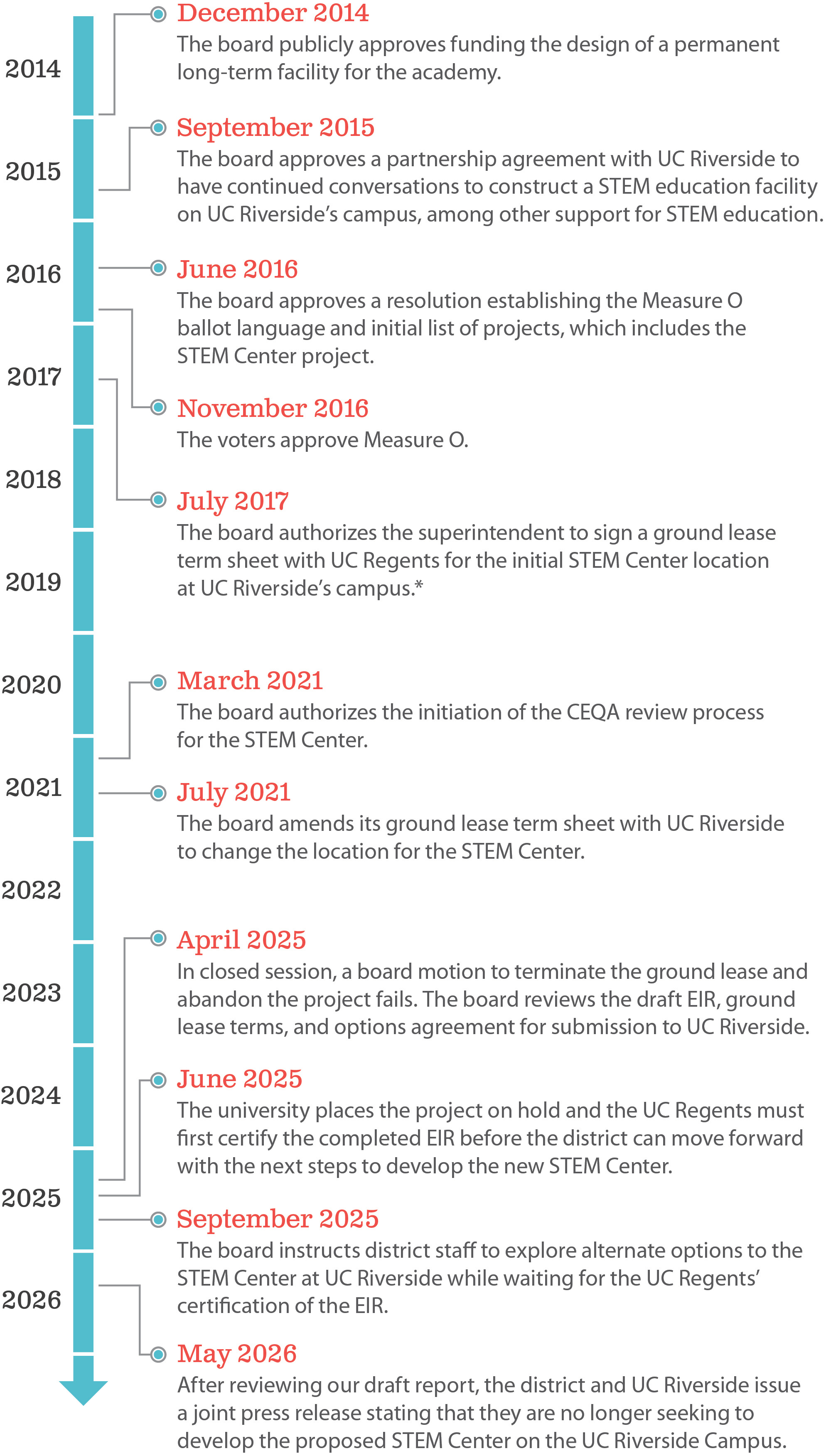
Since 2013, the district’s board has publicly considered a partnership with UC Riverside for a STEM high school to address the existing academy’s capacity and facilities limitations as the campus could not adequately serve the number of incoming students as the program expanded. As most recently envisioned, the STEM Center could have served as many as 1,200 high school students from the academy and throughout the district. If approved by the UC Regents and district board, the STEM Center would have been located on the UC Riverside campus. As Figure 1 shows, the board publicly approved funding the design of a permanent long‑term facility in 2014 and authorized district staff in 2021 to begin the environmental review process required under CEQA. Additionally, there was a two‑year period—from 2023 through 2024—during which board minutes did not reflect any public discussion of the STEM Center project. This gap in time partially aligned with the district’s involvement in litigation related to the STEM Center project, which concluded in September 2025, and ongoing work on the EIR.
Figure 1
The District Board Approved Key Milestones of the STEM Center, But Ultimately Decided With the University to Not Develop the Project
Source: District board meeting agendas, minutes, and materials.
* Term sheets are generally a non-binding overview of the negotiated lease terms, preceding entering into an actual lease; however, sometimes parties agree to include binding terms.
Figure 1 shows a timeline of major actions the district board and UC entities have taken regarding the STEM Center project from 2014 through 2025.
December 2014: The board publicly approves funding the design of a permanent long‑term facility for the academy.
September 2015: The board approves a partnership agreement with UC Riverside to continue discussions about constructing a STEM education facility on the UC Riverside campus, among other support for STEM Education.
June 2016: The board approves a resolution establishing the Measure O ballot language and an initial list of project types, including the STEM Center project.
November 2016: Voters approve Measure O.
July 2017: The board authorizes the superintendent to sign a ground lease term sheet with the UC Regents for the initial STEM Center location at UC Riverside’s campus. Footnote: Term sheets are generally a non-binding overview of the negotiated lease terms; however, sometimes parties agree to include binding terms.
March 2021: The board authorizes initiation of the CEQA process for the STEM Center.
July 2021: The board amends its ground lease term sheet with UC Riverside to change the STEM Center location.
April 2025: In closed session, a motion to terminate the ground lease and abandon the project fails. The board reviews the draft Environmental Impact Report (EIR), the ground lease terms, and an options agreement for submission to UC Riverside.
June 2025: The university places the project on hold and the UC Regents must first certify the completed EIR before the district can move forward with the next steps to develop the new STEM Center.
September 2025: The board instructs district staff to explore alternate options to the STEM Center at UC Riverside while waiting for the UC Regents’ certification of the EIR.
May 2026: After reviewing our draft report, the district and UC Riverside issues a joint press release stating that they are no longer seeking to develop the proposed STEM Center on the UC Riverside campus.
Since 2021, the district and university took steps to negotiate agreed upon terms and completed the EIR for the project’s most recent site. However, UC Riverside placed the STEM Center project on hold in June 2025. As Figure 2 details, UC Riverside, as the lead agency for the project’s CEQA process, was responsible for finalizing the EIR and submitting it to the UC Regents for their certification. The district, therefore, could not approve and advance the STEM Center project further until after the UC Regents took action. Nevertheless, after reviewing our draft report, the district and UC Riverside issued a joint press release on May 22, 2026 stating that they are no longer seeking to develop the proposed STEM Center on the UC Riverside campus.
Figure 2
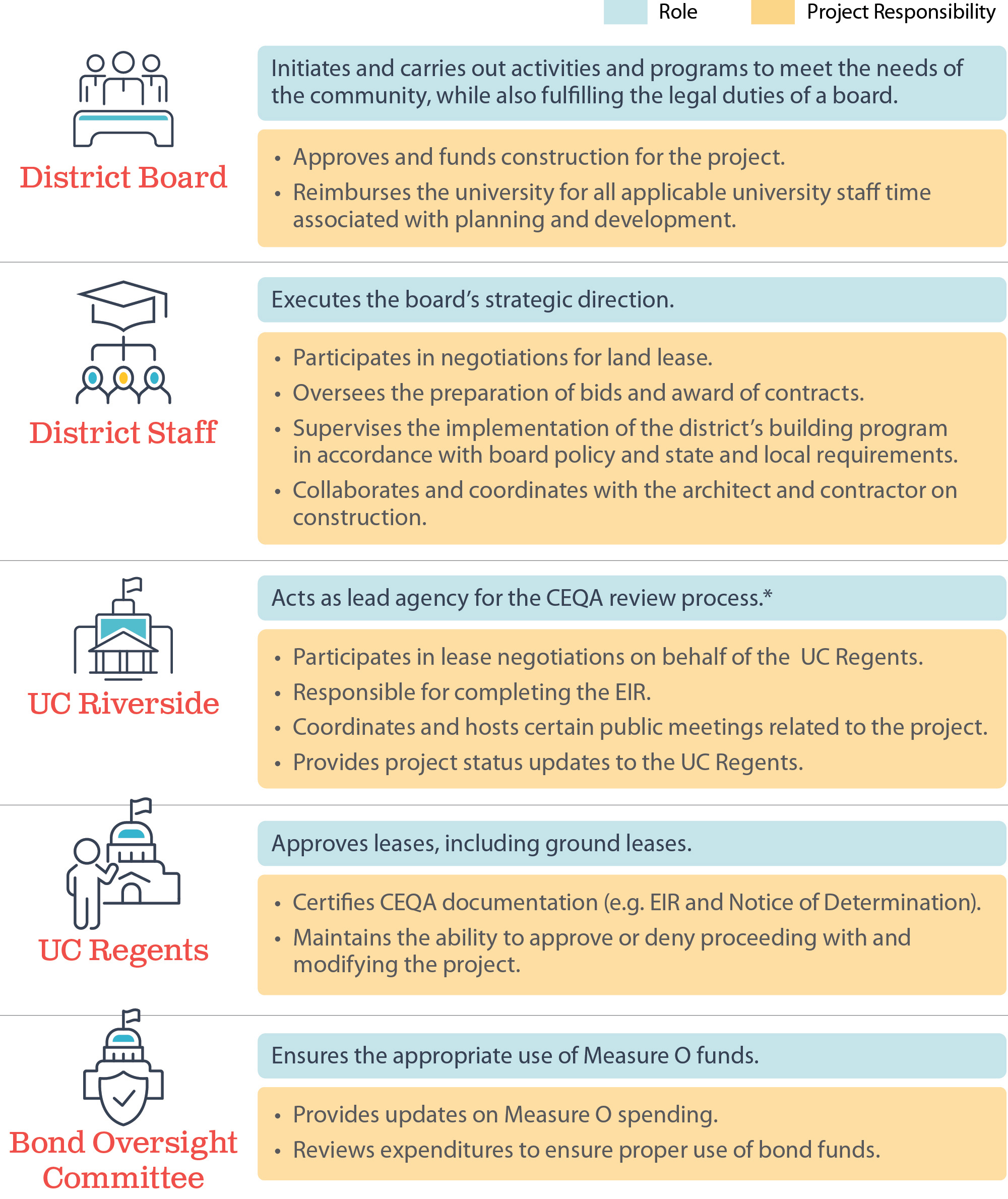
The District Board and UC Regents Are Responsible for Approving the STEM Center Project
Source: Bond oversight committee bylaws, ground lease term sheet, board policies, UC Regents bylaws, state law, and other district documentation.
* The UC Regents and all of its campuses are a single entity and for this CEQA project the lead agency. For purposes of this report we refer to UC Riverside as the lead agency for CEQA, while noting that the UC Regents must certify the final EIR.
Figure 2 describes the key entities involved in the STEM Center project and summarizes each entity’s role and responsibilities.
District Board
Role: Initiates and carries on activities and programs to meet community needs while fulfilling the legal duties of a board.
Project Responsibilities:
Approves and funds construction for the project.
Reimburses the university for all applicable university staff time associated with planning and development.
District Staff
Role: Executes the board’s strategic direction.
Project Responsibilities:
Participates in land acquisition negotiations.
Oversees preparation of bids and award of contracts.
Supervises implementation of the district’s building program according to board policy and state and local requirements.
Collaborates and coordinates with the architect and contractor on construction.
UC Riverside
Role: Acts as the lead agency for the CEQA process.*
Project Responsibilities:
Participates in lease negotiations on behalf of the UC Regents.
Completes the Environmental Impact Report (EIR).
Coordinates and hosts certain public meetings related to the project.
Provides project status updates to the UC Regents.
UC Regents
Role: Approves leases, including ground leases.
Project Responsibilities:
Certifies and files CEQA documentation, including the EIR and the Notice of Determination.
Retains authority to approve or deny proceeding with the project and to approve modifications.
Bond Oversight Committee
Role: Ensures appropriate use of Measure O funds.
Project Responsibilities:
Provides updates on Measure O spending.
Reviews expenditures to ensure proper use of bond funds.
Measure O
In 2016, Riverside voters approved Measure O, authorizing the district to issue $392 million in bonds to repair and upgrade schools and to acquire and construct new school sites and facilities. The text box shows select requirements under state law for bonds. The Measure O ballot language includes a wide range of allowable projects, such as upgrading and replacing aging infrastructure, modernizing school facilities, and building new school facilities. In one instance the Measure O ballot language also names a specific project to partner with UC Riverside and Riverside City College to build a STEM Center to serve local high school students and provide access to college‑level instruction. To oversee the appropriate use of bond proceeds, state law requires the board to establish an independent citizens’ bond oversight committee (bond oversight committee). The bond oversight committee is to inform the public of how bond funds are spent and review spending to ensure that the district uses bond funds only for allowable purposes.
Select Bond Requirements in State Law:
- Bond proceeds for the construction, reconstruction, rehabilitation, or replacement of school facilities, furnishing and equipping school facilities, and the acquisition or lease of real property for school facilities must be approved by 55 percent of voters.
- Bond proceeds can only be used on a list of specific school facilities and projects after the school board has evaluated safety, class size, and technology needs.
- Bond proceeds may not be used for teacher or administrator salaries.
Source: State law.
In 2023, an association of Riverside residents and taxpayers, Riversiders Against Increased Taxes (RAIT), filed a lawsuit in Riverside Superior Court alleging that the district planned to misuse Measure O funds by spending on new school construction, including the STEM Center. In January 2024, the court ruled in favor of the district, finding that Measure O allows spending on new school construction. RAIT appealed the decision, and the district prevailed on appeal.
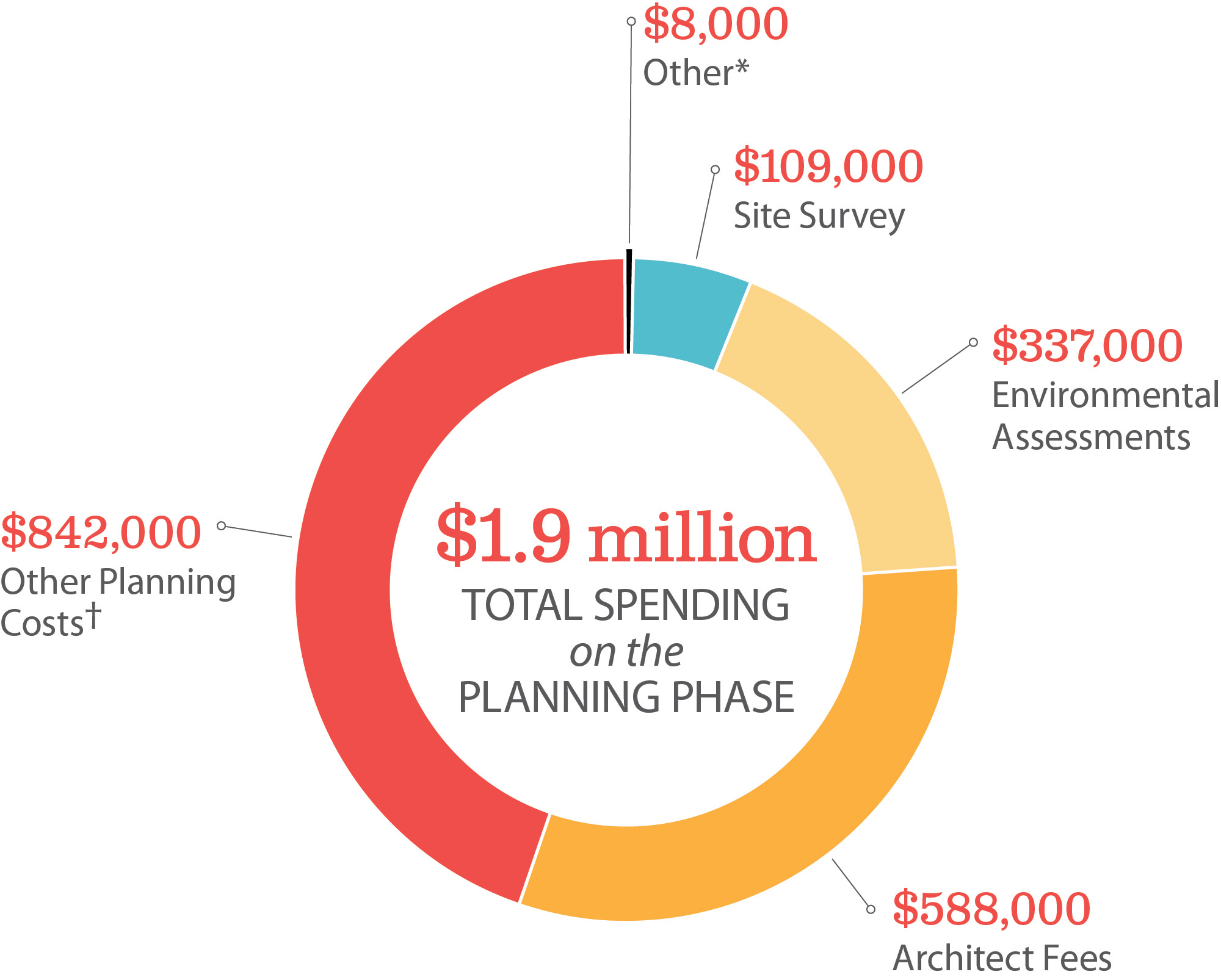
According to the district’s accounting system, from 2017 through December 2025, the district spent more than $355 million in Measure O funds on various projects. As Figure 3 shows, the district spent $1.9 million of the $355 million, or less than 1 percent of Measure O funds spent, on the planning phase of the STEM Center from 2017 through December 2025. Nonetheless, the district did not intend to use any remaining Measure O funds for the STEM Center’s construction. If the UC Regents and the district board had ultimately chosen to proceed with the STEM Center project, the district indicated it would have needed to secure other funding sources to pay for construction, which it estimated in December 2025 would cost $134 million.
Figure 3
The District Spent $1.9 Million on the Planning Phase of the STEM Center Project, as of December 2025
Source: The district’s accounting system.
* Other costs includes various administrative costs, legal costs, professional and consulting services, operating costs, and other site costs.
† Other Planning Costs primarily includes expenditures to consultants and to UC Riverside. As discussed later in the report, the ground lease term sheet agreement between the district and UC Riverside requires the district to reimburse UC Riverside for certain planning costs.
Figure 3 presents a pie chart illustrating that the district spent $1.9 million on the planning phase of the STEM Center project as of December 2025.
The chart divides total planning expenditures into five categories, architect fees, environmental assessments, site survey, other planning costs and other. Other planning costs primarily include expenditures for consultants and UC Riverside. The ground lease term sheet requires the district to reimburse UC Riverside for certain planning costs. Other costs include administrative costs, legal costs, professional and consulting services, and operating costs, and site-related costs. Other planning costs is the largest category, accounting for eight hundred forty two thousand dollars. Architect fees is the second largest category, accounting for five hundred eighty-eight thousand dollars. Environmental assessments account for three hundred thirty seven thousand dollars. One hundred nine thousand dollars was spent on site survey expenses. Lastly, the other category accounts for just eight thousand dollars.
Audit Results
- Progress on the STEM Center Stalled Because of the District’s and University’s Unresolved Negotiations and Delayed Decision‑Making
- The District’s Inconsistent Communication Regarding Key Measure O Funding Decisions Reduced Transparency and Contributed to Public Concerns
Progress on the STEM Center Stalled Because of the District’s and University’s Unresolved Negotiations and Delayed Decision‑Making
Key Points
- Riverside Unified School District’s (district) efforts to develop the STEM Education Center (STEM Center) project faced years of delays, rising costs, and stalled progress because of repeated site changes, an extended California Environmental Quality Act (CEQA) review, and delayed decisions by the University of California, Riverside (UC Riverside or university). Although the district directed resources to planning the STEM Center, it has made limited investment in the existing Riverside STEM Academy (academy) despite longstanding facility deficiencies, safety hazards, and growing student demand.
- The district met key legal requirements in its decision‑making on the STEM Center but was inconsistent in communicating important actions to the public, which contributed to concerns about transparency. While the proposed lease terms are generally comparable to similar agreements, some board members have raised concerned about the proposed ground lease agreement. The district has not pursued alternative lease options but has identified several preliminary non‑lease alternatives.
The District Has Faced Significant Challenges in Its Attempts to Develop the STEM Center
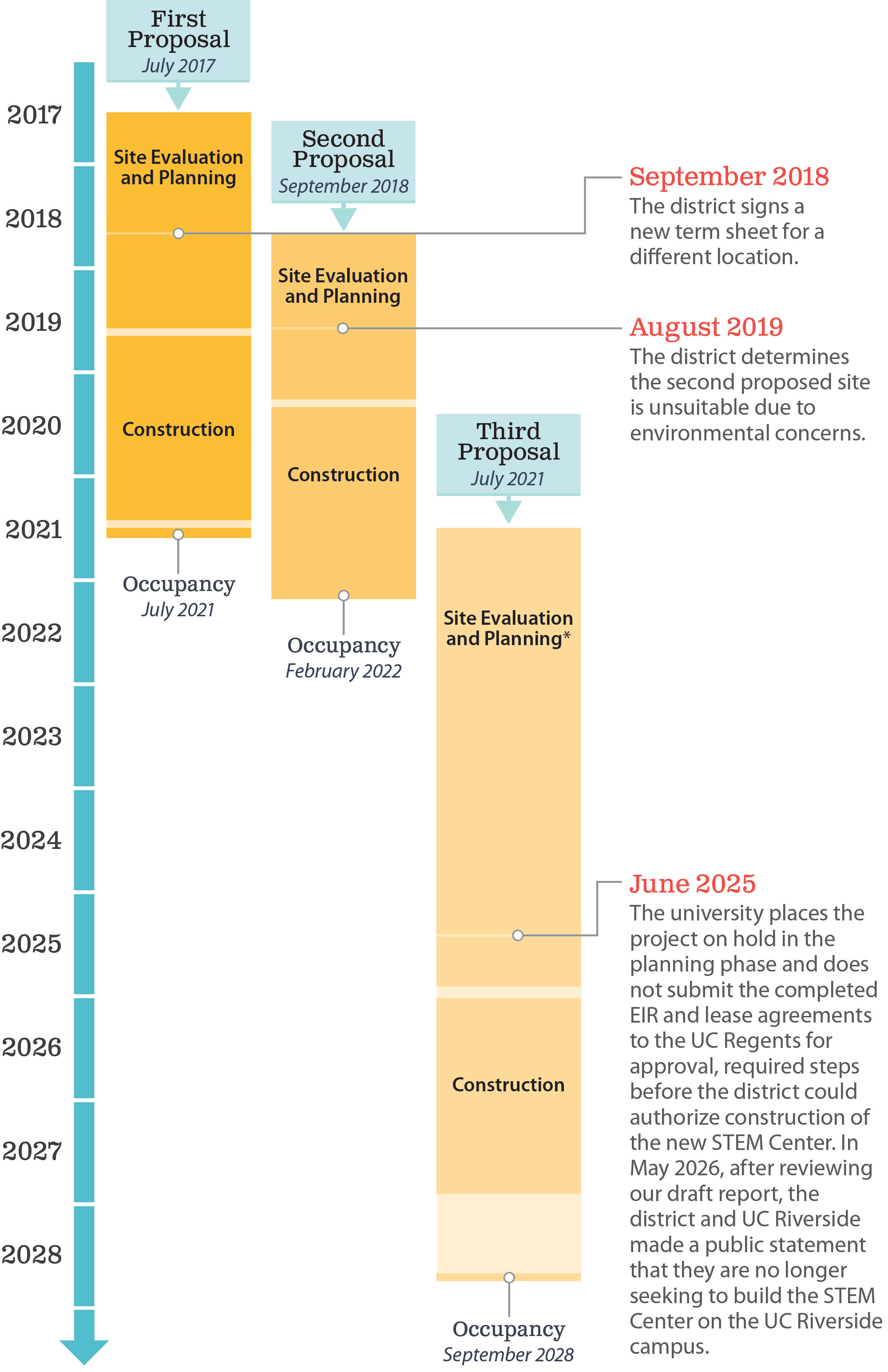
Since 2017, the district has experienced significant delays in its efforts to develop the STEM Center, which will increase planning and design costs. These delays primarily resulted from changes to the proposed site, a prolonged CEQA review process, and UC Riverside’s indecision regarding the future of the STEM Center project. As Figure 4 shows, the district has proposed three project timelines since 2018 and has not advanced beyond the planning phase in any of the three timelines. As a result of these delays, in 2022, the district was unable to secure $6 million in state funding for the STEM Center. In 2018, the district board directed staff to apply for a state grant under the Career Technical Education Facilities Program to fund the STEM Center project. Although the State accepted the district’s application in 2021, the State rescinded the approval for the grant funding in 2022 because the district did not submit required planning approvals and specifications to the Office of Public School Construction. Further, the district spent more than $400,000 in bond funding on planning and site survey work for the STEM Center project before the district identified the current project site, indicating that it could have lost some funds spent on planning for previous sites. Although some of the prior planning and design work may still be usable for the current site, each site change and additional delay results in financial losses and pushes construction further into the future.
Figure 4
The District Did Not Advance Beyond the Planning Phase in Any of Its Three STEM Center Project Timelines
Source: Board minutes, ground lease term sheets, staff interviews, public statements, and other planning documents.
* Although the district signed a new term sheet in July 2021, it conducted planning for the STEM Center earlier that year, which is not depicted in this figure.
Figure 4 compares three versions of the district’s STEM Center project timelines and shows that the district did not advance beyond the planning phase in any of them. The first proposal was presented in July 2017, but the district signed a new term sheet for a different location in September 2018 while still in the site evaluation and planning phase. Similarly, the second proposal, dated September 2018, did not advance beyond the site evaluation and planning phase and the district determined that the second proposed site was unsuitable due to environmental concerns. The third proposal, dated July 2021, also did not advance beyond the site evaluation and planning phase. In June 2025, the university placed the project on hold and did not submit the completed EIR and lease agreements to the UC Regents for approval, required steps before the district could authorize construction of the new STEM Center. In May 2026, after reviewing our draft report, the district and UC Riverside made a public statement that they are no longer seeking to build the STEM Center on the UC Riverside campus.
According to district and university staff, the delays to the STEM Center project occurred primarily because of frequent site changes and the required CEQA review process, among other factors. UC Riverside and the district initiated the CEQA review process, which spanned nearly three years from 2021 through 2024, which both parties agree took longer than normal. UC Riverside’s director of campus planning cited the required coordination between both parties as well as the concurrent lease negotiations as factors that contributed to the extended process. In fact, when the district board approved the district to move forward with the CEQA review process in March 2021, district staff told the board it could take 10 to 16 months to complete the CEQA process. The longer the project is delayed, the more expensive construction will become because of cost escalation—the impact of inflation on a project’s final costs.
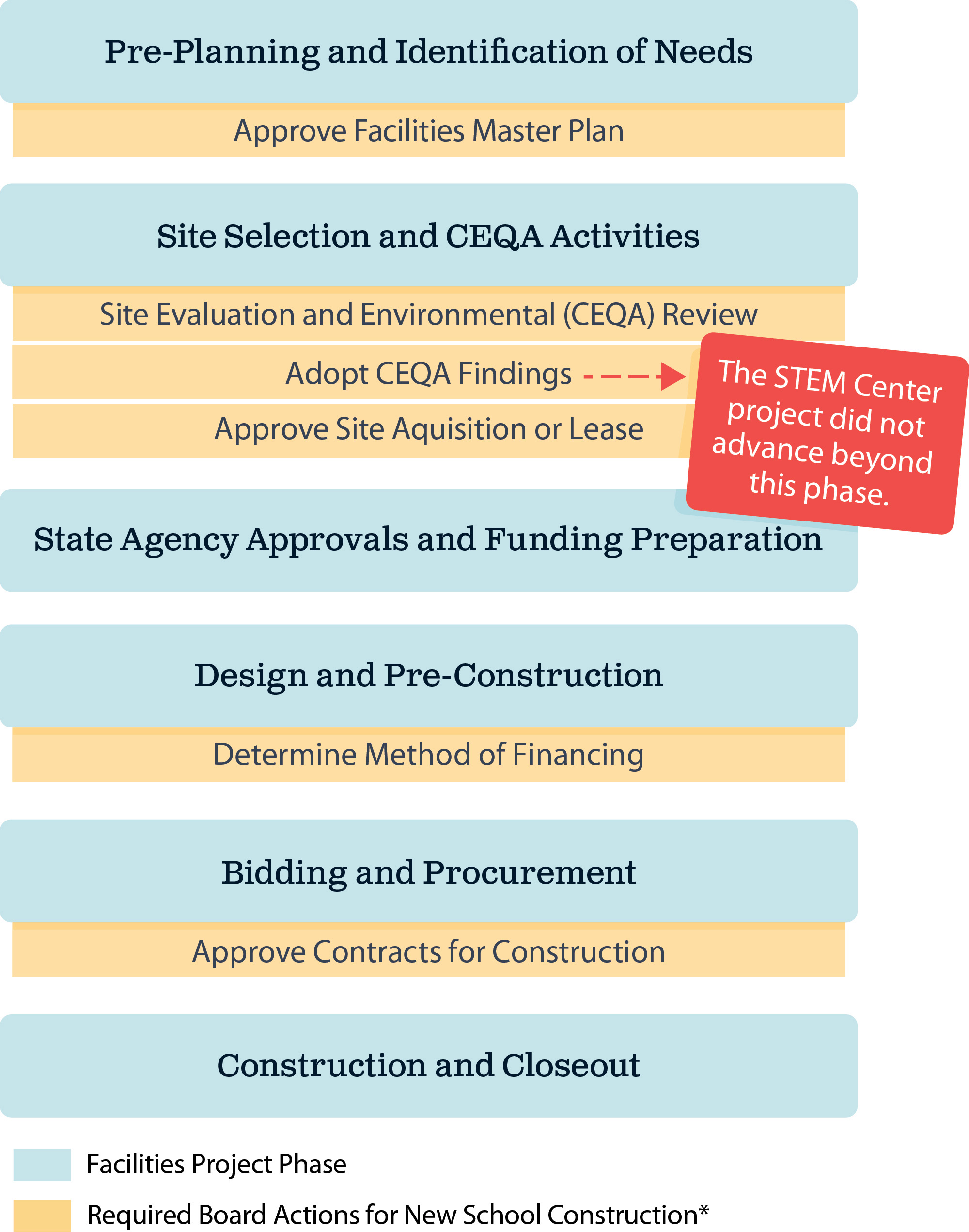
UC Riverside had not submitted the completed EIR or required lease agreements to the UC Regents for certification and approval, which were required before the district could move forward with the project, as the text box shows. Further, as Figure 5 details, before the district can begin constructing a new facility, its board must authorize key actions, such as approving site acquisition and adopting CEQA findings. However, the district was waiting for the UC Regents to certify the EIR. In September 2025, district staff informed the public during a board meeting that the board had reviewed the draft EIR, the options agreement, and the ground lease agreement in April 2025, though it was not reported in those meeting minutes. The district informed us that it then provided the required agreements and draft EIR to UC Riverside for review and approval in June 2025. As the lead agency for the CEQA review process and owner of the property, UC Riverside must present the completed EIR and required lease agreements to the UC Regents for certification and approval. Because UC Riverside had not done so, the district could not move forward with the STEM Center project. Although UC Riverside facilitated the CEQA review process, the district is responsible for covering the associated costs. However, rather than presenting the items to the UC Regents for certification and approval, UC Riverside placed the STEM Center project on hold for nearly a year.
Documents Required to Construct the STEM Center
- EIR: Identifies the project’s environmental impacts, feasible alternatives, and proposed mitigation measures.
- Option to Ground Lease (options agreement): An agreement between UC Riverside and the district that grants the district exclusive option to ground lease the property for building the STEM Center while the district secures funding and conducts necessary planning activities.
- Ground Lease: A long-term agreement that grants the district rights to the leased UC Riverside property for the purpose of constructing and operating the STEM Center.
Source: State law and district documentation.
The university’s decision to put the STEM Center project on hold has been a primary factor preventing progress and limiting communication between the parties. According to UC Riverside’s interim vice chancellor of planning, budget, and administration (interim vice chancellor), UC Riverside staff were originally going to submit the project to the UC Regents in July 2025, which coincided with the arrival of a new chancellor at the university. The interim vice chancellor further stated that the outgoing chancellor chose to pause the project to allow the incoming chancellor sufficient time to learn about the project. According to the district’s assistant superintendent of facilities, planning, and development (facilities assistant superintendent), the district historically attended monthly standing meetings with representatives at UC Riverside, but because the university had placed the STEM Center project on hold, it discontinued these monthly meetings as of June 2025. Under best practices, management from both entities should communicate relevant and quality information to help each other achieve their respective objectives and address related risks.
Figure 5
The Board Must Authorize Several Actions During a Facilities Project
Source: District policies, state law, board presentations, and staff interviews.
* Other parties, such as the UC Regents and state agencies may also need to issue their own approvals during various phases of the project.
Figure 5 shows the actions the district board must authorize during the various phases of a facilities project. It shows that the board must approve the Facilities Master Plan during the pre‑planning and identification of needs phase. During site selection and CEQA activities, the board is responsible for authorizing the site evaluation and environmental review and adopting CEQA findings, followed by approving the site acquisition or lease. The figure indicates that the STEM Center project did not advance beyond this phase. In the subsequent phase related to state agency approvals and funding preparation, the figure lists no specific board action, but in the design and pre‑construction phase the board must determine the method of financing for the project. During bidding and procurement, the board must approve contracts for construction. The construction and closeout phase does not list a specific action in the figure. A note clarifies that although the table describes required board actions for new school construction, other parties such as the UC Regents and state agencies may also need to issue their own approvals during different phases of the project.
Although the details of negotiations remain confidential, we identified a critical communication problem that was delaying a decision on whether to move forward with the project. To facilitate a timely resolution, we provided both parties with separate confidential management letters describing our concerns. In response to our letters, UC Riverside and the district provided us with a joint letter stating that the two institutions have convened on three separate occasions—in August and December 2025, and January 2026—to discuss the status and path forward for the STEM Center project. The joint letter also noted that because both UC Riverside and the district had new leadership, it took time to ensure that new leadership received complete briefings on the project’s history, status, and potential future course before taking formal action. Although the letter stated that the two institutions will continue to engage proactively to establish a clear path forward consistent with their goals, it did not indicate that the two entities would resume regularly scheduled meetings or whether they resolved other problems we identified in our management letters. Moreover, because the STEM Center project was on hold for nearly a year and neither entity had committed to resolving the problems we identified, we were increasingly skeptical that UC Riverside and the district would move forward with the project as envisioned. In fact, after reviewing our draft report, the district and UC Riverside issued a joint press release on May 22, 2026 stating that they are no longer seeking to develop the proposed STEM Center on the UC Riverside campus.
While Progress Stalled on the STEM Center, the District Deferred Investing in the Existing Academy Campus
Although the district has long recognized facility deficiencies and limitations at the existing academy site, it has made limited progress in addressing them even as it pursued construction of the new STEM Center project. Because the district’s most recent plan keeps students in grades 5 through 8 at the existing campus, these unresolved shortcomings continue to affect a substantial portion of the academy’s population. After relocating the academy to its current location in August 2013, the district began expanding the program to include high school students. This pushed the district to explore ways to overcome facility and capacity challenges that included adding relocatable classrooms, relocating portions of the program to other schools, or developing a new STEM high school on UC Riverside’s campus. In fact, by October 2013, the board was considering approving $400,000 for the addition of relocatable buildings on the campus, noting, however, that this was a short‑term solution that would accommodate only the incoming 10th grade students. By 2014, the district had already initiated discussions with UC Riverside about constructing a STEM high school on the university’s campus, a partnership the board later formalized in 2015. Building the STEM Center was intended to help address capacity problems for high school students at the academy but did not offer a solution for the infrastructure problems affecting the rest of the student body at the existing academy site.
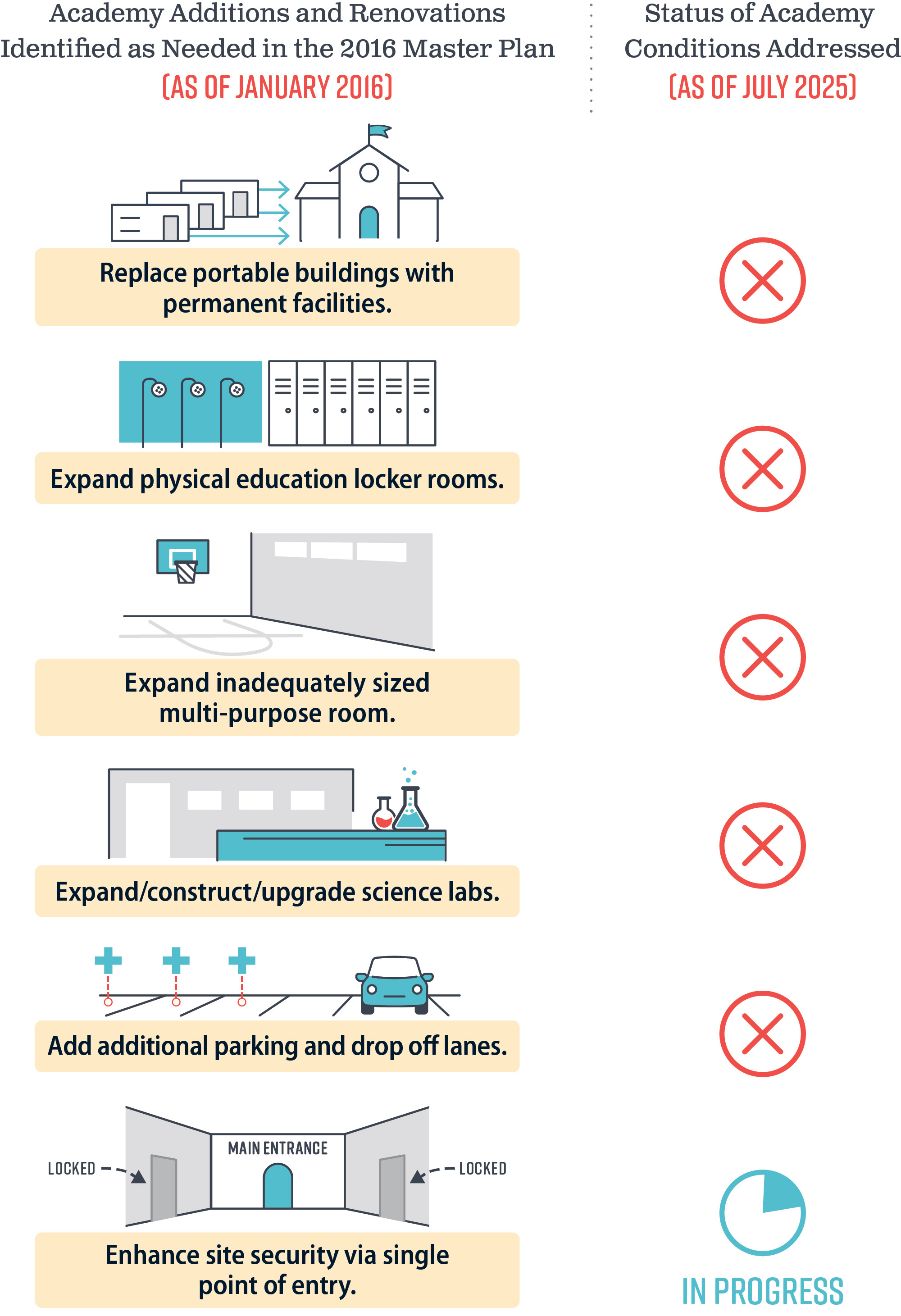
Despite the academy’s limitations, the district has made little progress addressing the site’s most critical facility needs for students. For example, the text box highlights the academy’s most pressing challenges, which the district identified during an inspection it conducted in August 2025. The district also identified significant facility and maintenance repairs in its 2016 Long‑Range Facilities Master Plan (master plan) that it had not addressed as of July 2025.2 The district has completed some improvements such as updating landscaping, preparing to install a shade structure, and redoing the multipurpose room flooring. As Figure 6 shows, many of the conditions remained unaddressed and later reappeared in the district’s 2025 update to its master plan. These unaddressed and persisting facility deficiencies have drawn the attention of community members, who raised their concerns to the board in April 2025.
Selection of Current Academy Facility Shortcomings
- Inadequate science equipment, such as the following:
- Lack of gas for Bunsen burners
- Reliance on a portable fume hood to protect students and staff from hazardous vapors
- No dedicated library
- Overcrowded administrative space that lacks storage
- No gym or middle school-sized multi-purpose room
- Lack of the six additional science classrooms needed to accommodate current enrollment
- Facilities designed for elementary students that are inadequate for middle and high schoolers
- Heating, ventilation, and air conditioning (HVAC) system that functions sub-optimally during warm weather
Source: District inspection documentation and auditor observation.
To complete these limited improvements at the academy, the district did not use any Measure O funding, despite it being an acceptable use of the funds. Instead, as of January 2026, it spent roughly $77,000 from other funds on the academy for permanent construction and planning. District staff stated that the reason the district may not have prioritized Measure O funding for the academy is because of its plans to build the STEM Center. However, the district still intends for students in grades 5 through 8 to remain at the existing site, and the facility shortcomings are not specific to the high school student population. The district’s estimated cost to modernize the academy has consistently ranked among the 10 most expensive projects of district facilities in 2016 and 2025 when compared to the district’s approximately 50 total schools. Furthermore, the longer the district delays addressing these problems, the more expensive they become because of cost escalation. For example, the district’s 2016 estimate of $48 million to modernize the academy’s campus nearly doubled to $83 million by 2025.
Figure 6
The District Has Not Addressed the Need for Academy Additions and Renovations for Nearly a Decade
Source: The district’s 2016 and 2025 master plans and district facilities documentation.
Figure 6 presents a table comparing the facility additions and renovations identified as needed for the academy in the district’s 2016 master plan with their status as of July 2025. The master plan identified the need to replace portable buildings with permanent facilities, expand the physical education locker rooms, enlarge the undersized multi‑purpose room, expand or upgrade the science labs, add parking and drop‑off lanes, and enhance site security through a single point of entry. As of 2025, none of these improvements had been completed except for the site‑security enhancement, which the district reports as in progress. All other planned additions and renovations remain unaddressed nearly a decade after being identified. The figure draws on information from the district’s 2016 and 2025 master plans and other district facilities documentation.
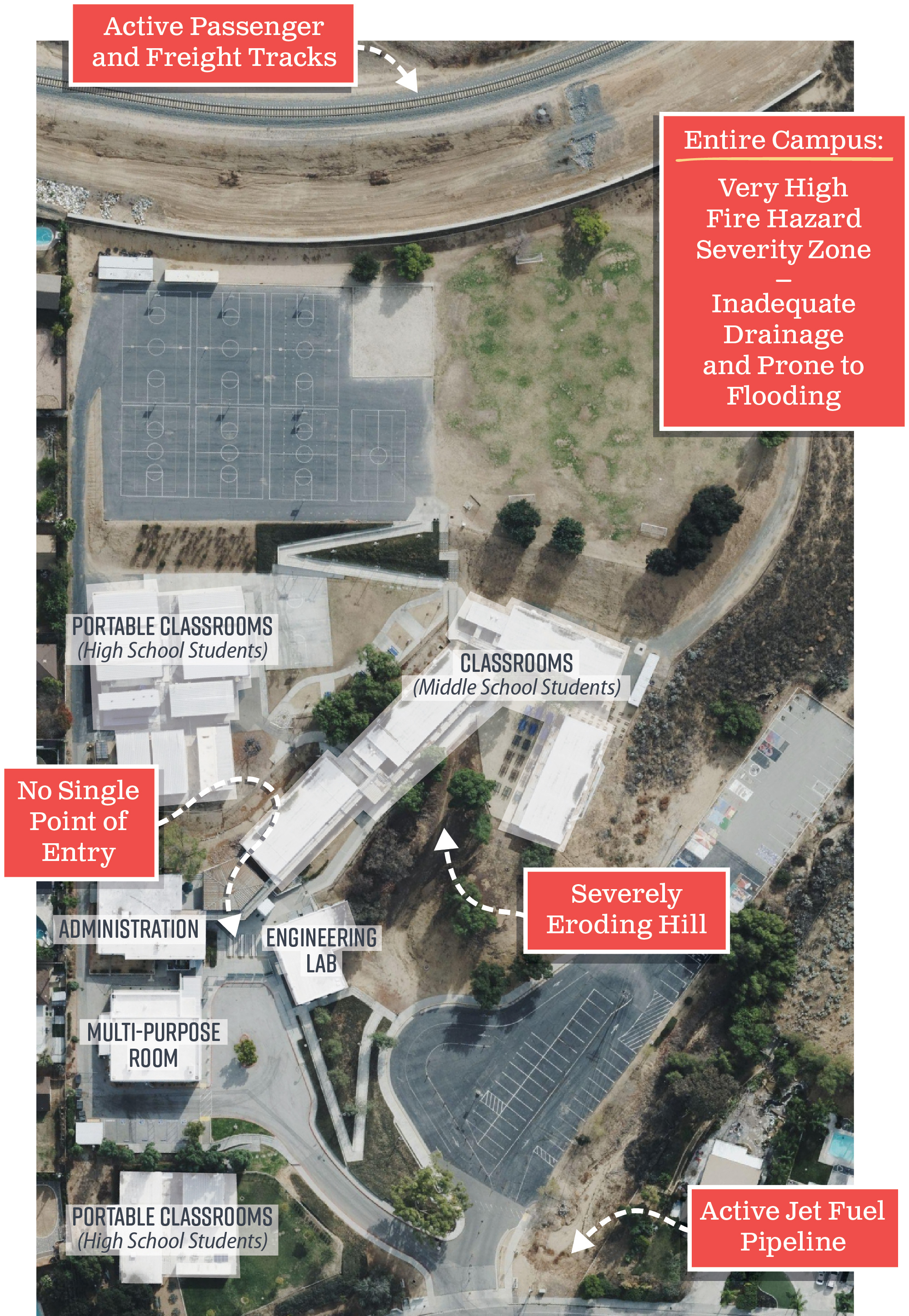
In addition to facility deficiencies, the academy’s current location presents inherent safety and environmental risks that further affect the district’s long‑term planning, as Figure 7 shows. For example, the school is in an area that the State believes is a Very High Fire Hazard Severity Zone. This is the most severe of three possible fire hazard categories because of the area’s fire weather, available fuel, and the likelihood of wildfire spread, among other factors.
One of the site’s most concerning obstacles is the presence of an active jet fuel pipeline that runs along the western boundary of the campus adjacent to the parking lot and transports fuel to the U.S. Air Force March Air Reserve Base. In January 2025, the district obtained a pipeline risk assessment from an engineering firm to support its request for state hardship funding to potentially relocate the school to a safer location. Although the firm’s assessment found the pipeline did not exceed the California Department of Education’s (CDE) threshold for significant risk, the condition nonetheless reflects the type of hazard the district has sought to avoid at other potential school sites. For example, when assessing potential sites for the STEM Center, the district rejected one location because of its proximity to railroad tracks and a high‑pressure gas line. CDE recommends that the first and most effective risk mitigation option is to determine if there are alternative sites farther from pipelines that will still meet objectives. The district must consider whether it should accept the risk and follow the plan for grades 5 through 8 to remain at the current academy site or to avoid the risk entirely by moving the school elsewhere, as CDE guidelines and the district’s previous actions would suggest.
Figure 7
Students at the Existing Academy Are Subject to Multiple Hazardous Conditions
Source: Apple Maps, auditor observation, district facilities documentation, and 2025 master plan.
Figure 7 displays a map and related information illustrating several hazardous conditions affecting students at the existing Riverside STEM Academy. The figure highlights that the campus lacks a single point of entry, is located near an active jet fuel pipeline, and is adjacent to active passenger and freight rail tracks. It also lies within a Very High Fire Hazard Severity Zone, and the site experiences inadequate drainage that makes it prone to flooding, along with a severely eroding hill near school facilities. This map was sourced through Apple Maps imagery, district facilities documentation, the district’s 2025 master plan, and direct auditor observations during onsite visits in November 2025.
Despite these persistent facility and safety challenges, demand for enrollment at the academy remains high. The academy served 665 students in academic year 2024–2025. Yet, according to the assistant superintendent of instruction there are nearly 1,300 students on the waitlist, the majority of whom are middle schoolers. Thus, even if the district were to have built the STEM Center, which would have accommodated a maximum of 1,200 students, the waitlist would still be large. The academy’s facility deficiencies and site hazards, combined with the high demand for enrollment, illustrate how decisions about the STEM Center directly affected the district’s ability to address the academy’s longstanding facility and safety needs.
Although the District Complied With Key Legal Requirements for Governing Bodies, We Identified Transparency Concerns
The Audit Committee directed us to determine whether the district complied with applicable state laws when making decisions related to the STEM Center and providing transparency surrounding the proposed ground lease with UC Riverside, among other things. We concluded that the district’s board complied with key legal requirements when discussing or making decisions related to the STEM Center project, although its efforts to maintain transparency were inconsistent.
State Law Compliance
As the governing body of the district, the board is required to adhere to state law, such as the Brown Act, which establishes requirements for conducting public business, including how the board must conduct its actions and deliberations. The text box shows the key provisions of the state laws that we reviewed. To assess compliance with these requirements, we reviewed agendas, minutes, and other board materials related to board meetings held from 2011 through 2025. As Figure 8 shows, the board discussed matters related to the STEM Center in at least 30 public meetings, held votes in open session, consistently provided opportunities for public comment, and informed the public about formal actions made in closed session.
Key Requirements for Governing Bodies
- Boards must conduct business in public meetings and provide time for public comment.
- Boards may hold discussions in closed session only when permitted by law, such as real estate negotiations.
- Boards must generally report out actions taken in closed session.
- Agreements approved in closed session must be publicly available when final.
- School boards must make meeting minutes available to the public.
Source: State law.
Transparency Concerns
Although the district’s actions did not constitute a legal violation, it did not report in meeting minutes that the board reviewed key documents related to the STEM Center project in closed session, which raises concerns about transparency. In September 2025, district staff informed the public during a board meeting that the board had reviewed the draft EIR, ground lease, and options agreement in April 2025. However, we reviewed the board meeting minutes from April 2025 to determine whether the board informed the public at the time that it reviewed those agreements and did not identify any discussion of these items until the September 2025 board meeting. Further, the district informed us that it provided the draft EIR, ground lease, and options agreement to UC Riverside for the UC Regents’ review in June 2025, providing more indication that the board had performed a review of those documents in April 2025. To be more transparent to its stakeholders, the board should have informed the public in April 2025 that it reviewed the documents. The limited availability of public information may help explain why some community members have expressed concerns about the district’s transparency.
Figure 8
We Reviewed 30 Board Meetings and Found That the Board Followed Key Legal Requirements When Discussing the STEM Center Project

Source: Board meeting agenda, minutes, and materials.
* Although we did not identify any actions or discussions related to the STEM Center project until 2013, we reviewed meeting minutes as far back as 2011, when the district established the academy, to ensure that we captured relevant meetings.
† Three of the four missing meeting minutes covered important project milestones, such as the board’s approval of Measure O bond language, its review of ground lease terms, and project updates. The district, however, was able to provide the missing materials upon request. As of April 2026, the district has updated its website to include the missing meeting minutes.
‡ Although not a legal violation, the board did not report that it reviewed key documents related to the STEM Center project—a transparency concern that we discuss later.
Figure 8 summarizes the audit team’s review of 30 board meetings, selected from meetings held between 2011 and 2025 in which the board discussed the STEM Center project. The figure shows that in 15 of these meetings the board voted publicly in open session, and in all 30 meetings it allowed for public scrutiny and feedback. It further indicates that the district posted meeting minutes for 26 of the 30 meetings in its online archive, noting that the four missing minutes—three of which included major project milestones—were later provided by the district and subsequently added to its website by April 2026. The figure also shows that the board agendized five closed‑session items and informed the public of the two instances in which it took formal action. Overall, the figure concludes that the board allowed for public participation and complied with key legal requirements when discussing or acting on matters related to the STEM Center project. The image notes that although it is not a legal violation, the board did not report that it reviewed key documents related to the STEM Center project—a transparency concern that is discussed later in the report.
We also reviewed the board’s minutes to determine whether the terms of the ground lease agreement were available to the public. Although the district has not executed a ground lease agreement with UC Riverside, in 2017 its board authorized the district superintendent to sign the ground lease term sheet for the STEM Center project. In 2018, the district signed a second ground lease term sheet with UC Riverside, which the board later amended in 2021. Although they are not leases, the term sheets outline the key provisions that the district and UC Riverside have negotiated for the proposed ground lease agreement, which is important because these documents represent the only publicly available summaries of the negotiated terms to date.
However, the district could not provide evidence that it obtained board approval for the 2018 term sheet or that it published the document in meeting minutes at the time. Because the district had made public the 2017 and 2021 term sheets, it could have likewise published the signed 2018 agreement. The board’s general counsel said that because the 2018 ground lease term sheet did not contain provisions that were binding, the board did not need to take action on it or publish it with a meeting agenda. Nevertheless, because the district had updated terms, including the project site, in the term sheet, we question why it did not bring the item to the board as it did for the 2021 amendment. By not seeking the board’s approval and publishing the term sheet in the corresponding meeting minutes, the district missed an opportunity to bolster the public’s trust in its transparency. In July 2021, the district amended the 2018 agreement to update the project site and include provisions requiring the district to reimburse UC Riverside for certain planning costs. This agreement reflects the most current terms that both parties have agreed to, and the board did make those terms publicly available in 2021.
The board has publicly acknowledged concerns about transparency and communication. At the April 2025 board meeting, where, as the board later disclosed, it reviewed the draft EIR, one board member addressed public concerns about the board’s communication surrounding the project. The board member explained that the board had intended to discuss the EIR at a later meeting, but that the board’s legal counsel advised the board that agendizing the item could jeopardize the CEQA process, which was still underway. He went on to say that the project is unique because the proposed location is on UC Riverside’s property and, as the lead agency for the CEQA process, UC Riverside must do everything first. In the same board meeting, the board member also acknowledged that because of a miscommunication, the board believed the terms of the proposal had been changed from the prior understanding, which led the board to inform UC Riverside that it would no longer be interested in the project. District staff had also planned to communicate to the community at large, including through its website. However, after sending the initial email indicating the district would not move forward with the project, the board learned that it had incorrect information in the proposal, which made the email that it sent inaccurate.
Finally, the district’s website provided very little information about the project’s status. In fact, district staff informed us that the district had taken down the project‑specific webpage while it was waiting for the UC Regents to certify the EIR. Nevertheless, the district’s other project‑specific webpages provide the status of the projects, budget information, and access to key project documents, such as CEQA‑related documents. Further, UC Riverside’s STEM Center website was also offline, as of May 2026. To maintain transparency with the public, the district and board should have communicated key information about the status of the project on its website.
Comparable Terms
The Audit Committee also asked us to evaluate the terms of the lease agreement against comparable lease terms to determine whether the agreement protects the district’s interests. We compared the terms that the district has made publicly available to other similar entities and, as Table 1 shows, several key lease terms for the STEM Center are comparable to the terms of similar institutions and at UC Riverside. Two of the ground leases that we reviewed had terms that were similar to the STEM Center, specifically for high schools located on other university campuses. We also reviewed ground lease agreements between the UC Regents and private development firms for student housing.
We noted some differences in the ground lease terms between the UC Regents and the private development firms and from its terms with the district. We noted these same differences for the two other high schools. First, the terms for the three high schools include mutual protection from liabilities for both parties, while two of the ground lease agreements with the private firms did not. According to the executive director of real estate services at UC Riverside, UC Riverside and the district are public entities, so it is a best practice to include this clause. Second, the terms for the three high schools do not require those schools to pay a substantial amount of rent. The executive director of real estate services at UC Riverside indicated that the university would not charge the district regular rent for the property and considers more than financial gain because the district and UC Riverside are both public education entities with shared goals, which is not the case for the private development firms. Notably, all the ground lease terms we reviewed specify that the lease will expire in 50 years or less, with the STEM Center having the longest duration of 50 years with the possibility of two 10‑year extensions.
Even though the lease terms for the STEM Center are similar to the lease terms with other similar entities, some board members have raised concerns about the proposed lease agreement in public meetings. In fact, in 2021, when the board approved the current terms, one board member opposed the action and indicated that it was unacceptable to spend district funds on a project that could potentially result in the district donating the property to UC Riverside in 50 or 70 years. At another board meeting in 2025, that same board member made a motion to terminate the ground lease agreement, but the motion did not pass. After the lease expires or is terminated, UC Riverside will either assume ownership of the building or require the district to demolish the building at its own expense. Although the leases we reviewed for similar high schools include an option granting the universities ownership of the facilities when the lease ends, only the UC Riverside ground lease terms, including the STEM Center, include both this option and an option that would require the tenant to demolish the facilities. We did not identify any university policies that limit the duration of ground lease agreements. However, the executive director of real estate services at UC Riverside stated that as a general practice, the University of California does not typically extend lease agreements beyond a 50‑year threshold, as demonstrated by the ground lease agreements that it provided to us.
This provision raises concerns, as the district indicated that it prefers to build on land that it owns. Although purchasing the land may be preferable, the district’s facilities assistant superintendent confirmed that UC Riverside could not agree to that option. The executive director of real estate services at UC Riverside also told us that it would not be an option for the district to purchase the land.
The District Has Identified Some Preliminary Alternatives to the STEM Center Project
The Audit Committee directed us to evaluate any planning the board conducted to assess additional lease options should the current lease agreement be terminated. After interviewing district staff and reviewing board meetings, we found that the district has not planned for alternative lease options. According to the facilities assistant superintendent, the district does not plan to pursue alternative ground lease options because it generally prefers to build on land that it owns. The district also maintains only one other active land lease—for an annex office for the district’s wellness staff—and will not need to renew the lease because the district purchased a new office to accommodate all staff.
Although the district is not interested in different lease options, in September 2025 district staff discussed potential alternatives for the proposed STEM Center and, in December 2025, district staff presented the board with several preliminary non‑lease alternatives should the project not proceed. As Table 2 shows, the preliminary alternatives include keeping the academy at its current site, repurposing an existing campus for the academy, co‑locating it on an existing secondary school site, or constructing a new facility on district‑owned vacant land. The board has not yet directed staff to commit to one of these alternatives. This appears to be reasonable given that the district was awaiting the UC Regents’ certification of the EIR. However, after reviewing our draft report, the district and UC Riverside made a public statement that they are no longer seeking to build the STEM Center on the UC Riverside campus.
The District’s Inconsistent Communication Regarding Key Measure O Funding Decisions Reduced Transparency and Contributed to Public Concerns
Key Points
- Although the district’s process for selecting Measure O projects complied with applicable laws and requirements, it missed key opportunities to communicate its priorities to the public. Further, because the board opted to allocate larger amounts of Measure O funds to fewer schools and project costs increased, in part, because of the impact of inflation on construction costs, the district delivered a smaller share of the improvements than it originally indicated it would complete at all schools.
- By providing project budgets that did not include critical cost components, the district reduced transparency and hindered the board’s ability to make informed decisions about Measure O spending. The district also inconsistently reported and inadequately documented how much Measure O funding it allocated to the STEM Center, creating uncertainty about its actual commitments and reducing transparency for the board and the public.
The District Missed Key Opportunities to Communicate Its Measure O Priorities to the Public
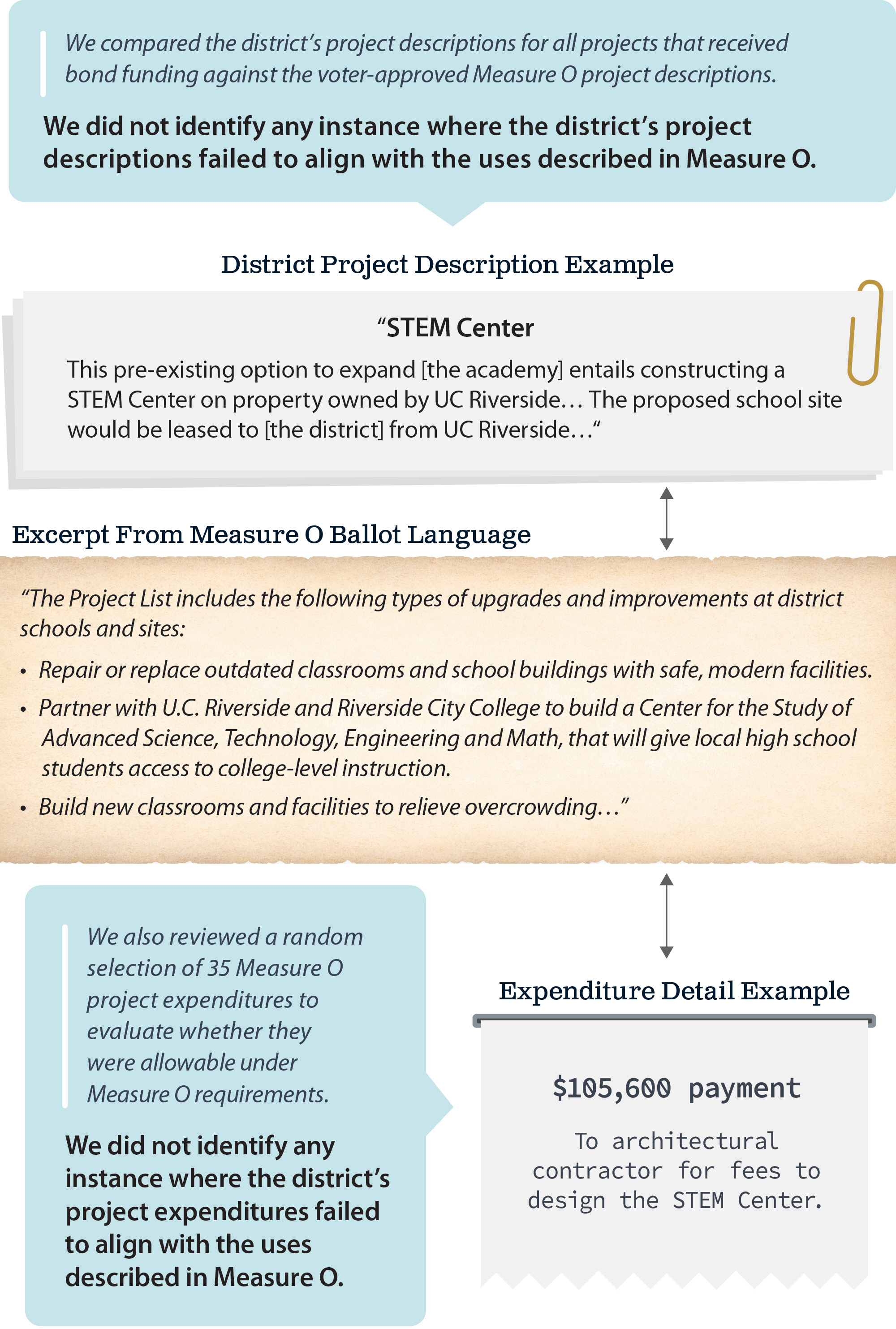
We found that the district’s process for selecting the projects that would receive bond funding complied with Measure O ballot language and applicable laws and requirements that we reviewed, but the district could have better communicated its priorities to the public.3 The Measure O ballot language included a broad list of project types the district could pursue with bond funds, some of which we describe in the text box. Figure 9 shows that all 35 project expenditures that we tested aligned with the types of projects listed in the voter‑approved Measure O ballot language. Nevertheless, the district could have more clearly communicated to the public in its campaign materials and master plan that it planned to use bond proceeds to construct new schools. Although spending on new school construction is allowable because it is listed in the Measure O ballot language, those projects constituted about 22 percent of total Measure O spending, as of December 2025. Further, because the board changed its priorities and project costs increased, Measure O funded fewer projects than the district initially planned.
Types of Projects Measure O Ballot Language Described
- Improve older schools so that they meet the same safety and academic standards as newer schools.
- Repair or replace outdated classrooms and school buildings with safe, modern facilities.
- Acquire land.
- Furnish and equip school facilities.
- Modernize school facilities to improve access for students with disabilities.
- Construct new schools.
- Partner with UC Riverside and Riverside City College to build a center for the study of advanced STEM.
Source: Measure O ballot language.
Figure 9
We Reviewed a Selection of Measure O Project Descriptions and Expenditures and Found Each Aligned With the Requirements Outlined in Measure O
Source: Measure O ballot language, district facilities documentation, district accounting system data, and other supporting documentation.
Figure 9 presents a comparison of the district’s Measure O project descriptions and expenditures against the project uses authorized by voters in the Measure O ballot language. The figure states that the audit team reviewed project descriptions for all bond‑funded projects and found no instance in which a district project description failed to align with the uses described in Measure O. The graphic includes an example district project description for the STEM Center, which explains that the project involved constructing a STEM Center on property leased from UC Riverside. It also includes an excerpt from the Measure O ballot language, which lists types of upgrades allowed under the measure, including repairing or replacing outdated classrooms, partnering with UC Riverside and Riverside City College to build a STEM-focused center, and constructing new classrooms and facilities to relieve overcrowding. Another portion of the figure shows an expenditure example—a $105,600 payment to an architectural contractor for STEM Center design work. The figure notes that the audit team also reviewed a random sample of 35 Measure O project expenditures and found no instances in which the expenditures failed to align with Measure O’s permissible uses. The sources for this comparison include the Measure O ballot language, district facilities documentation, district accounting data, and other supporting materials.
The District Could Have More Effectively Communicated to the Public That It Intended to Use Measure O Funds for New School Construction
After Measure O passed in November 2016, the district board held a series of public workshops throughout 2017 in which it developed a prioritized list of campuses to receive bond funding for facilities projects, including new school construction projects. The new construction projects included the STEM Center and three other projects the district refers to as neighborhood schools: Casa Blanca Elementary School (Casa Blanca), Ofelia Valdez‑Yeager Eastside Elementary School (Eastside), and Highgrove Elementary School II (Highgrove II). As the text box describes, the district board prioritized projects based on site conditions, school capacity, state mandated requirements, and availability of funding, among other factors. In October 2017, the district board approved and prioritized 11 projects—including the STEM Center—for the first issuance of Measure O bond funding. The board also identified more than 40 additional projects to fund in future issuances of bond funding. As we discuss later, spending on new school construction decreased the district’s ability to fund other prioritized projects. Although the district is allowed to use bond funding toward new construction and prevailed in a lawsuit challenging its ability to do so, we identified several areas where the board could have better communicated this intent to the public.
District Criteria for Measure O Project Prioritization
- Failing systems: site condition, depreciation, and deferred maintenance.
- Statutory requirements: building code, accessibility, and site requirements.
- School capacity: enrollment, overcrowding, and excessive portables.
- Funding availability: local and state funding eligibility.
Source: Board presentation and meeting minutes.
Note: The above criteria are ordered by how the district board generally weighted them in the project prioritization process.
First, although the Measure O ballot language states that new school construction is an allowable project type, other supporting campaign materials the district used to promote Measure O—such as fliers and pamphlets—did not inform voters that the district might use bond funds to construct new schools. Current district staff provided us with all campaign materials related to Measure O that they found in their archives, including multiple campaign mailings, factsheets, and a PowerPoint presentation. Even though the district may have used other campaign materials and communications with voters in 2016 in addition to the materials it provided, none of the materials we reviewed communicated to voters that Measure O would fund new school construction. Instead, the materials emphasized improving campus security systems, repairing or replacing outdated classrooms and buildings, improving access for students with disabilities, and updating instructional technology, among other modernization and renovation projects. District staff indicated that the district would not be able to fit everything in the campaign materials and would have been attempting to highlight the key benefits of the bond. Because the campaign materials were an important way that the district communicated to the public about its Measure O priorities, the district missed a key opportunity to be transparent about its spending plans for the bond measure.
Second, the district did not emphasize new school construction to voters in its 2016 master plan. In the Measure O ballot language, the district implied that its master plan would inform the projects it would fund with bond proceeds. The district’s facilities director told us that the master plan is the district’s primary tool for communicating its facilities needs to the public. The 2016 master plan, however, did not include the Casa Blanca, Eastside, or Highgrove II new school construction projects that the district prioritized for funding after voters approved Measure O.
Further, the district’s master plan did not include a budget or plan for the STEM Center project, although it was a new construction project that the district had proposed for several years and specifically listed in the Measure O ballot language. Instead, in the site plan for the existing academy, the district’s master plan makes a single reference to the STEM Center project in a footnote on a map, stating that future planning for the high school program of the academy includes partnering with a local four‑year college to build a center for STEM studies. However, the plan did not describe the STEM Center project, nor did it include budgeting information for it, as it did for other projects in its master plan. As a result, the district missed an important opportunity to communicate about the project to voters.
Because of turnover, current district staff could not explain why the district did not fully include these new school construction projects in the master plan. The district developed the master plan, approved in February 2016, by working with multiple architectural firms, school site representatives, and a core team of the district’s instructional, facility, and maintenance staff. We attempted to speak with some of the architects who worked on the plan, but none of those individuals still worked for the firm that led the development of the master plan. Nevertheless, the district’s facilities assistant superintendent stated that facilities master plans are often based on existing school sites, rather than potential construction. However, the district’s 2025 update to its master plan includes cost estimates for two potential new school construction projects and features them in a prioritized list of projects across the district.
Because the Board Changed Its Priorities and Project Costs Increased, Measure O Funded Fewer Projects Than the District Initially Planned
Although the district board did not change which projects Measure O could fund, it substantially shifted its funding priorities, resulting in the district funding fewer projects than it had originally planned, as Table 3 shows. The Audit Committee asked us to determine whether, at any time, the district changed the projects that Measure O could fund. In our review, we found the district did not deviate from the project eligibility requirements of the Measure O bond language. Thus, it did not change the projects Measure O could fund. However, the district board changed its approach to allocating Measure O funds, opting to allocate larger amounts to fewer schools and increasing project scopes at selected sites to achieve more extensive improvements at those locations. Although the board had the discretion to adjust project scopes and funding priorities and did so in public meetings, these decisions—combined with cost increases—resulted in the district entering the planning, construction, or completion phase for only 41 percent of the projects it previously prioritized to receive Measure O funding. One of the projects not completed is the STEM Center.
Although the board discussed and approved budget increases in public meetings, the district’s post‑bond approach differed from what it had told voters, specifically that every school would benefit from Measure O funds. In various campaign materials in support of Measure O, the district said every school in the district would benefit from bond funds. District staff further reiterated this claim in a board meeting and even listed it as a key goal during early board workshops to prioritize Measure O projects. However, soon after the board voted to prioritize schools for funding, the board decided to increase project scopes at select schools with the goal of achieving efficiencies and equity across schools. For example, in a March 2018 meeting, the board directed the district to move forward with budgets at four schools beyond what it previously discussed, increasing estimated costs by $46 million for those projects. Board members acknowledged during that meeting that increasing budgets for certain schools would reduce the Measure O funds available to support other schools. Similarly, the board also allocated $35 million more than originally planned to North High School, in part to address potential scope increases in December 2021. Although these changes were made in public meetings, they marked a shift from the district’s initial intention to complete projects at all schools rather than concentrate resources on a smaller set of campuses.
The district originally planned to fund the majority of its prioritized projects with both Measure O bond proceeds and other funding sources, including state funding assistance for new construction and modernization projects. In May 2020, the district planned to use state funding to complete 17 projects that were lower in the priority list. However, because of the increase in costs for certain projects—including the two new school construction projects that we describe in the next section—the district had to change plans. Instead of using certain state funding for multiple other projects, district staff told us that the district now expects to use this funding for the construction of the Eastside neighborhood school. These higher‑than‑anticipated project costs reduced the amount of funding available for smaller improvements across the district, ultimately limiting Measure O from delivering the broader, districtwide improvements that the district communicated to the public.
The District’s Incomplete Presentation of Total Project Costs Reduced the Board’s and the Public’s Understanding of How the District Would Spend Measure O Funds
We identified several instances in which district staff presented incomplete or unrealistic information to the board about total Measure O project costs, resulting in the public and the board having inadequate information about how the district would spend Measure O funds. In October 2021, the board allocated approximately $187 million—nearly half of all Measure O funds—to six projects.4 However, the board allocated insufficient amounts for the construction of Casa Blanca and Eastside at the October 2021 board meeting, in part because the budgets did not account for cost escalation—the impact of inflation on construction costs.
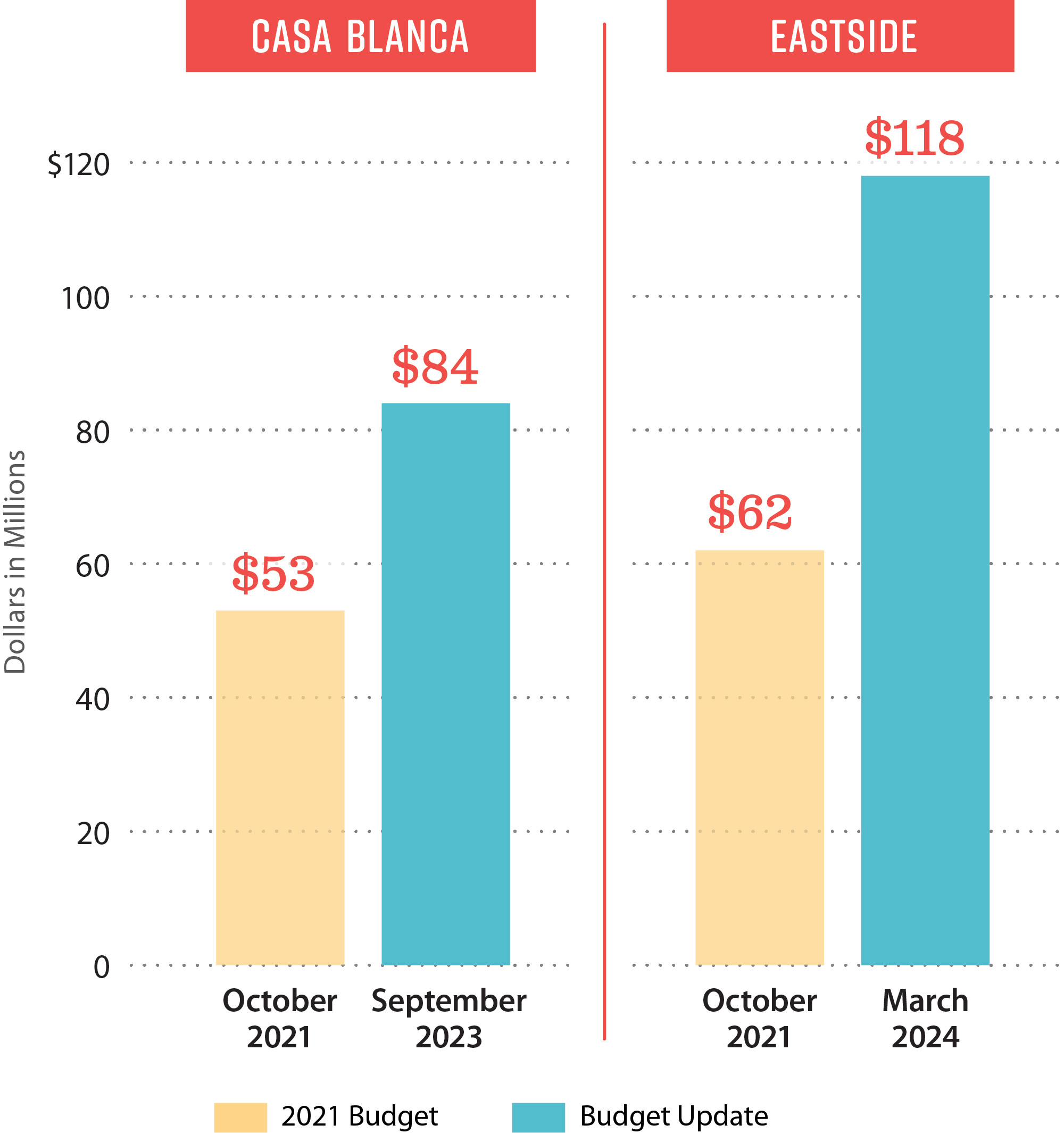
Specifically, as we show in Figure 10, the board allocated $53 million for Casa Blanca in October 2021 and, two years later, it allocated nearly $31 million more to the Casa Blanca project. Although the budget noted that district staff did not include escalation costs, the budget included some contingency costs of $5.4 million, which were insufficient to make up the difference. By not accounting for escalation in October 2021, the district excluded from its estimate crucial material and labor costs that increased much higher during the COVID‑19 pandemic. Indeed, the annual California construction cost index was 13.4 percent in 2021 and averaged 7 percent from 2022 through 2024. These increases were significantly higher than in prior years, with the annual California construction cost index averaging 3 percent from 2016 through 2020. Similarly, the district included some escalation costs at 4 percent annually for Eastside’s $62 million project budget, but this amount was insufficient. The board voted in March 2024 to nearly double Eastside’s 2021 allocation, increasing the budget to about $118 million.
Figure 10
The District’s Updated Project Budgets for Casa Blanca and Eastside Were Higher Than Its Estimates From About Two Years Earlier
Source: District board presentations and board meeting minutes.
Note: The projects above are funded from multiple sources and do not reflect only Measure O funding that has been spent.
Figure 10 presents a bar chart comparing earlier and updated project budget estimates for two school construction projects—Casa Blanca and Eastside—and shows that the district’s updated budgets were substantially higher than estimates from about two years earlier. For Casa Blanca, the chart shows an October 2021 budget estimate of $53 million and a September 2023 updated budget of $84 million. For Eastside, the October 2021 estimate was $62 million, which increased to $118 million by March 2024. Each pair of bars visually contrasts the initial 2021 budget with the later update, illustrating the scale of the budget growth for both sites. The figure notes that the projects draw funding from multiple sources and the budgets shown do not represent only Measure O spending. The source cited is district board presentations and board meeting minutes.
Current district staff stated that Casa Blanca’s and Eastside’s budgets increased primarily because of inflation, unrealistic initial budgets, and increased project labor costs resulting from a labor agreement the board approved in June 2023. Eastside’s budget also increased by $10 million because of an expanded project scope. To understand why the 2021 estimates were inaccurate, we also spoke with the former district staff member who presented the estimates. The staff member said that he intended the budgets as snapshots and that budgets increase over time, noting that design changes, construction cost escalation, the COVID‑19 pandemic, and labor contract negotiations affected costs. However, the district’s current facilities assistant superintendent stated that the construction managers at the time told the former district staff member that the construction estimates were inadequate. He further noted that it is unusual for construction estimates for school facilities to be as incorrect as the 2021 cost estimates were.
This pattern of incomplete cost presentations extended also to recent budget presentations on the STEM Center, where the district excluded soft costs from the presented total project budget. Total project budgets generally include soft costs, such as architect, testing, and inspection costs. In its 2025 update to the master plan, staff included a $91.5 million budget for the STEM Center that excluded soft costs. Later that year, district staff presented an updated estimate of $134 million for the STEM Center project that included soft costs, illustrating how incomplete cost estimates can lead to significant revisions and a lack of transparency.5
Some board members expressed frustration about the district’s presentations of budgets at public board meetings. For example, at the October 2021 board meeting where these initial budgets were presented, one board member said he felt he was lacking basic financial information about Measure O projects that he needed to make good decisions. Another board member at that same meeting indicated that she had not received the financial background information for another $61.5 million project. Additionally, the board accidentally excluded $11.5 million from its allocation to North High School in the October 2021 meeting because of confusion about the total budget and in December of that year had to vote to allocate the additional funding to the school. One board member at the December 2021 meeting said it was unfortunate that the board had to discuss the budget allocation again.
Best practices for internal controls state that management needs current, complete, and accurate information to make informed decisions to support achieving their operations, reporting, and compliance goals. In fact, the district’s current facilities director, who began working at the district in June 2024, stated that he considers it a best practice to present the board with total estimated project budgets, including escalation and soft costs. However, we found that the district does not have a board policy requiring staff to present total estimated project budgets that include such key elements. Without requirements to present complete project budgets, the district risks repeating the same inaccuracies that previously limited the board’s ability to make informed financial decisions.
The District Did Not Clearly Communicate How Much Bond Funding It Intended to Dedicate to the STEM Center Project
The district could not demonstrate that it had obtained required board approval for key Measure O funding decisions related to the STEM Center, leaving its true funding commitments unclear. As Figure 11 illustrates, we identified problems with the district’s unclear allocations, lack of contract approval documentation, and inconsistent reporting. These three concerns all stem from the same underlying problem—the district’s lack of controls to document and verify that the board had approved key funding decisions. This lack of clear, consistent records not only undermines transparency but also prevents the board and the public from reliably determining what funding the district intended or authorized for the project.
Figure 11
The District Lacked Documentation and Verification of Board Approvals for Commitments and Allocations for the STEM Center
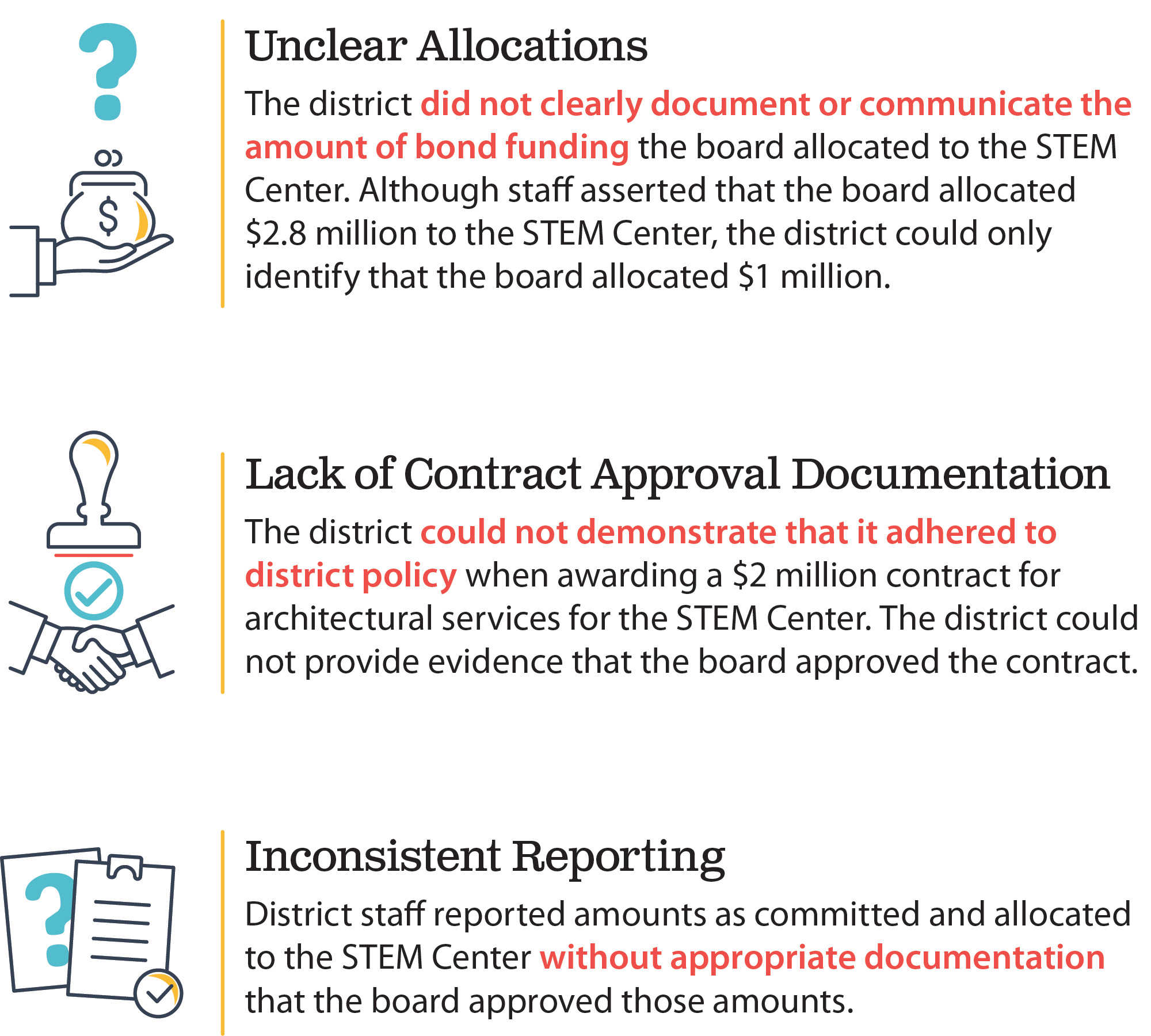
Source: State law, district policy, the district’s audited financial statements, bond oversight committee reports, board meeting minutes, and interviews with district staff.
Figure 11 presents three documented issues with the district’s handling of board approvals, commitments, and allocations for the STEM Center. The first issue, titled “Unclear Allocations,” explains that the district did not clearly document or communicate the amount of bond funding allocated to the STEM Center. Although staff stated the board allocated $2.8 million to the STEM Center, the district could only identify documentation supporting a $1 million allocation. The second issue, titled “Lack of Contract Approval Documentation,” states that the district could not demonstrate that it followed district policy when awarding a $2 million architectural services contract for the STEM Center and could not provide evidence that the board approved the contract. The third issue, titled “Inconsistent Reporting,” notes that district staff reported amounts as committed and allocated to the STEM Center without having the required documentation showing that the board approved those amounts. The figure uses icons representing documents, contracts, and reporting, and cites its sources as state law, district policy, audited financial statements, bond oversight committee reports, board meeting minutes, and interviews with district staff.
Unclear Allocations
The district did not clearly document or communicate the amount of bond funding the board allocated to the STEM Center, creating uncertainty about its actual funding commitments to the project. State law requires that when a governing body allocates funding for specific projects, this action is to be agendized, approved by a majority vote during a publicly noticed meeting, and for these votes to be reported. District staff told us that the board allocated $2.8 million in Measure O funding to the planning phase of the STEM Center project as of March 2026, but they were unable to provide documentation showing formal board approval of this amount. Instead, our review of board meeting minutes and staff presentations from 2017 through 2025 found that the board had only approved, during an October 2021 board meeting, an allocation of $1 million in Measure O funding for the STEM Center project.
During the October 2021 board meeting, a board member questioned the inclusion of the $1 million STEM Center allocation, stating that district staff should not have included this item because the board had already previously committed the money for CEQA. The board nevertheless approved the allocation. However, we found no evidence of a previous $1 million allocation or any other Measure O allocations for the STEM Center project when reviewing board meeting minutes from 2017 through 2025. This lack of documentation creates uncertainty about how much Measure O funding the district intended to dedicate to the STEM Center and calls into question whether it appropriately obtained board approval for allocations for the STEM Center.
We also identified instances in which the board approved planning and design actions for the STEM Center without first publishing cost estimates or documenting the allocation of funding for the STEM Center project. In August 2019, the board directed staff to change the proposed site without discussing the associated costs or the funds already spent on the previous site. Similarly, when the board discussed approving the CEQA process in March 2021, the district staff’s presentation materials did not include a budget or cost estimate for the project. Although board members seemed to be discussing a $300,000 budget for CEQA based on our review of a video of the meeting, the district did not publish this figure in board meeting minutes or in the board presentation. Nevertheless, the board approved the action.
Lack of Contract Approval Documentation
We identified an instance in which the district could not demonstrate that it adhered to its own policies when awarding a contract for the STEM Center. In June 2017, the district entered a contract—the main contract related to the STEM Center—with an architectural firm for nearly $2 million for architectural services for the STEM Center. Under board policy, all contracts must be approved or ratified by the board. However, when we discussed this issue with district staff, they were unable to provide documentation that the contract had been approved by the board. We reviewed all board meeting minutes in April, May, and June 2017 and were also unable to find evidence that the board approved or ratified the contract.
Inconsistent Reporting
As Figure 12 shows, multiple documents, such as audited financial statements and bond oversight committee reports, listed inconsistent amounts of Measure O funding that the board committed to the STEM Center from 2017 through 2025, with reported amounts ranging from $1 million to $2.1 million and once up to $48 million.6 For example, the audited financial statements for Measure O for fiscal year 2017–18 reported $0 in commitments to any project, which would include the STEM Center project, whereas the bond oversight committee annual report from fiscal year 2017–18 reported $2.1 million in commitments to the STEM Center. Notably, district staff presented in December 2025 that the board had allocated $2.8 million to the STEM Center project. However, we have only seen this amount reported as a budget in the bond oversight committee documents—although these reports have listed inconsistent project budget amounts from 2017 through 2025.
Figure 12
The District Regularly Changed the Amount it Reported as Committed to the STEM Center, Sometimes Erroneously and Without Board Approval
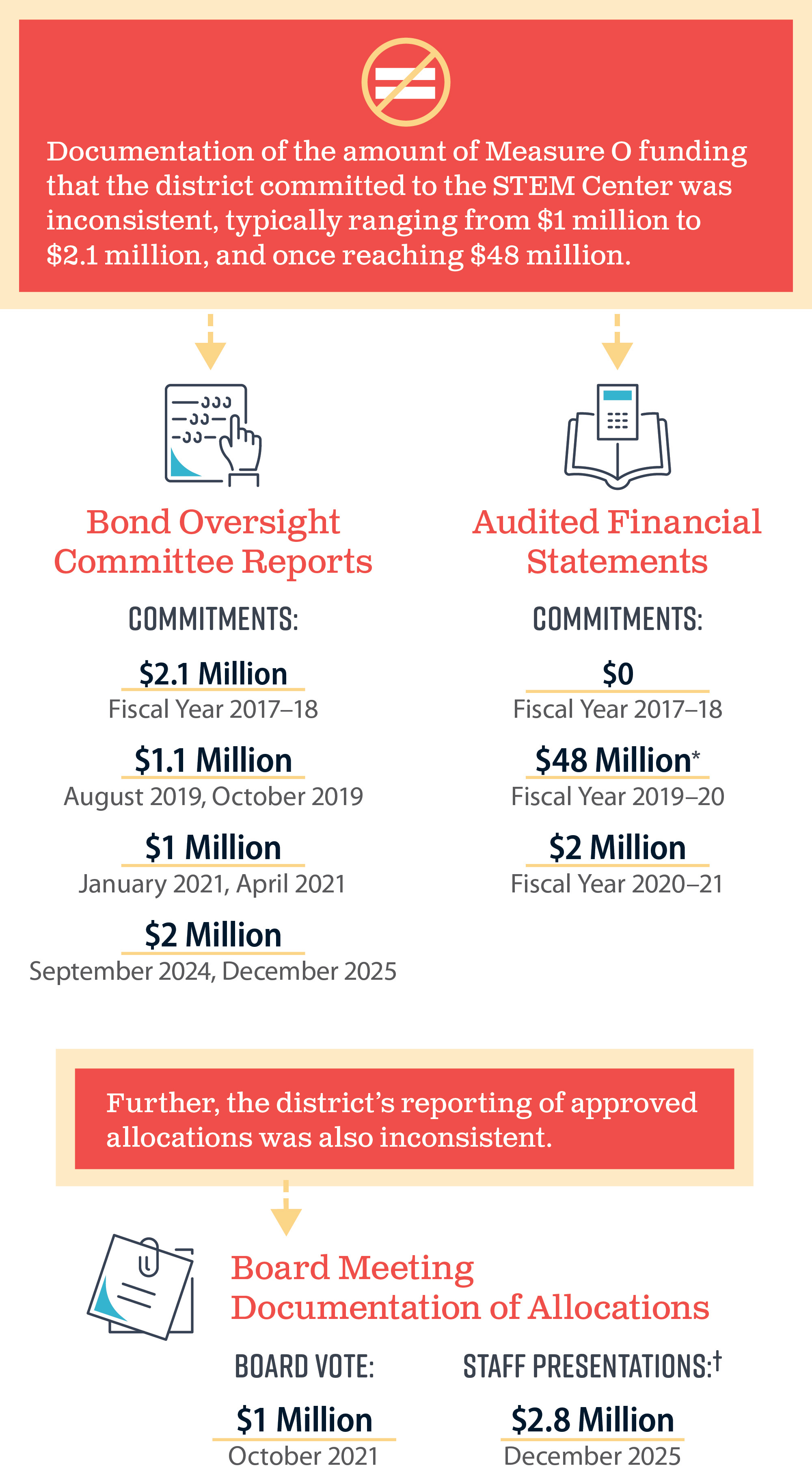
Source: Audited financial statements, bond oversight committee reports, board meeting minutes and presentations, and interviews with district staff.
* District staff informed us that the reported $48 million commitment reflects the total project budget at the time and not the amount committed to the STEM Center, even though it was reported as a commitment in the audited financial statements for fiscal year 2019–20.
† District staff reported $2.8 million in allocations for the STEM Center in a December 2025 presentation to the board. However, we did not find evidence that this amount was allocated by the board.
Figure 12 presents a comparison of how different district documents reported the amounts committed or allocated to the STEM Center, showing that these amounts varied widely and were often inconsistent or unapproved. The figure states that documentation of Measure O funding committed to the STEM Center ranged from $1 million to $2.1 million in various bond oversight committee reports, and in one instance reached $48 million. The bond oversight committee section lists commitments of $2.1 million in fiscal year 2017–18, $1.1 million in August and October 2019 reports, $1 million in January and April 2021 reports, and $2 million in September 2024 and December 2025 reports. The audited financial statements section shows commitments of $0 in fiscal year 2017–18, $48 million in fiscal year 2019–20, and $2 million in fiscal year 2020–21. A note clarifies that district staff said the $48 million represented the total project budget at the time rather than the actual amount committed to the STEM Center, even though it was reported as a commitment in the audited financial statements for fiscal year 2020-19. The figure also highlights inconsistencies in reporting allocations: board meeting documentation shows the board approved a $1 million allocation in October 2021, while staff presentations in December 2025 reported $2.8 million in allocations without board approval. District staff reported $2.8 million in allocations for the STEM Center in a December 2025 presentation to the board. However, we did not find evidence that this amount was allocated by the board. The overall message is that the district regularly changed the reported committed and allocated amounts for the STEM Center, sometimes incorrectly and sometimes without the required board authorization. The sources listed are audited financial statements, bond oversight committee reports, board meeting minutes and presentations, and interviews with district staff.
Without clear documentation of its approved allocations and commitments, the district cannot reliably demonstrate how it intends to use bond funds, increasing the risk of miscommunication to the public. The frequency and magnitude of the inconsistencies also limit the ability of the board and the community to understand the district’s actual funding plans for the STEM Center, making it more difficult to hold the district accountable for its spending decisions. In fact, multiple community organizations have argued for greater transparency and accountability surrounding the board’s spending and decision‑making processes. Such concerns from the community underscore the importance of accurate, consistent reporting and tracking of approvals to maintain public confidence in the district’s stewardship of public funds.
Lack of Controls
We would expect that the district document and verify that the board approved contracts and allocations as part of its internal control system. According to district staff, it is the district’s practice to document the board approval date for all construction contracts, but it does not have a specific written procedure. For example, although the board policy says that the district must obtain board approval for contracts, the policy does not provide a specific control staff should follow to ensure that it obtains the board’s approval before spending funds. As a result, the district’s lack of accurate, consistent records of board‑approved actions hinders transparency and increases the risk that the board and the public will misunderstand how bond funds are spent.
Other Areas We Reviewed
To address the audit objectives approved by the Audit Committee, we also evaluated the board’s conflict of interest policies and determined whether the board’s members complied with those policies and existing legal requirements when considering the STEM Center project.
Although the Board’s Conflict‑of‑Interest Policy Aligns With State Law, We Identified Concerns Related to Gift Limits
As Figure 13 shows, we found that the board’s conflict‑of‑interest policy aligns with applicable state laws that we reviewed. We also reviewed district policies specific to bidding, site selection, construction costs, and payments for goods and services and determined that they contained provisions like those used by four nearby school districts, which, if followed, could help safeguard public funds. Finally, we analyzed the statements of economic interests filed by current and former board members since 2016 and compared their reported sources of income, assets and investments, and gifts against every contractor that received Measure O funds. Through this analysis, we identified two instances in which board members accepted and reported gifts in the form of a dinner hosted by a district contractor that the board members had voted to award multiple contracts to in the same year in which they reported receiving the gifts. The contractor holds these dinners annually to coincide with an education conference that many school board members routinely attend, with multiple district board members also typically attending the dinner. In the two identified cases, the reported value of the gifts appears to have exceeded the allowable annual limit by $144 and $262, respectively. However, because we cannot independently verify the number of attendees and the total cost of the dinners, we cannot confirm whether the gifts the board members reported in their statements of economic interests do in fact result in a violation.
Figure 13
The Board’s Conflict of Interest Policy Contained All Legally Required Provisions
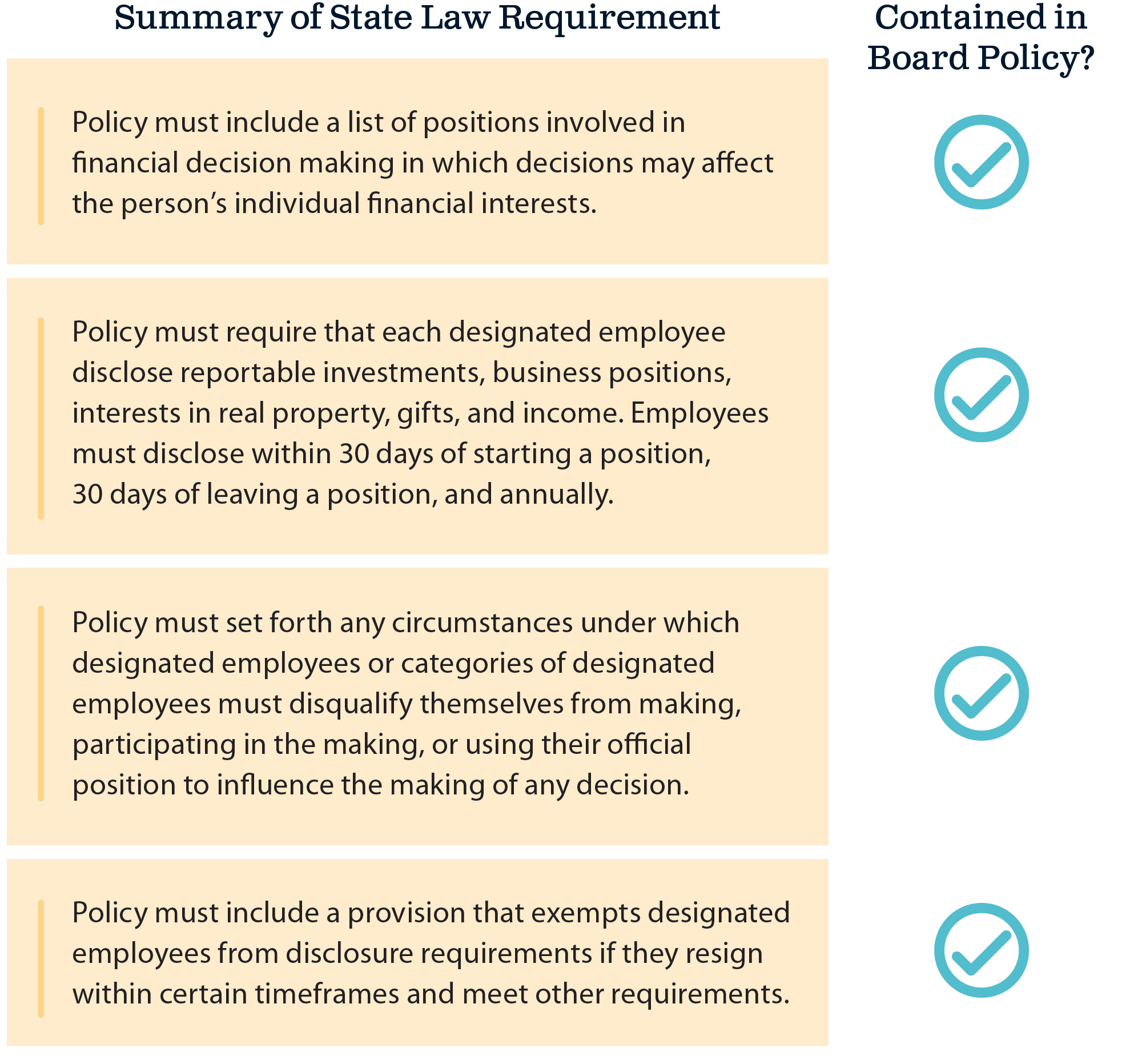
Source: District policies and state law.
Figure 13 presents a table comparing requirements in state law for conflict‑of‑interest policies with whether those requirements are included in the district’s board policy. The left column summarizes four provisions required under state law. The policy must include a list of designated positions involved in financial decision‑making, in which decisions may affect the person’s individual financial interests. The policy must also require that each designated employee disclose investments, business positions, real property interests, gifts, and income within 30 days of starting or leaving a position and annually. The policy must set forth any circumstances under which designated employees must disqualify themselves from participating in decisions in which they have a financial interest or using their official position to influence the making of any decision. Lastly, the policy must include a provision exempting designated employees from disclosure obligations if they resign within required timeframes and meet specific conditions. The right column indicates, using green checkmark icons, that the district’s board policy contains each of these required provisions. The figure cites district policies and state law as the sources.
In both cases, the board members explained that district staff provided the gift amounts for reporting, but the board members did not realize that those amounts exceeded the state limit. Although the board’s policy prohibits accepting gifts above the allowable limit, the policy does not clearly identify the specific dollar threshold, which is adjusted biennially under state law. However, the updated gift limit is listed in the standard instructions for completing the statement of economic interest filings form. After we informed the board members of these concerns, both provided us with documentation demonstrating that they attempted to rectify the excess to within the allowable limit and amended their statement of economic interest filings to reflect an allowable gift value.
We did not identify additional signs of impropriety in their statements of economic interests or campaign disclosures, and the district’s contracting and bidding policies, if followed, may help mitigate conflicts of interest. However, we were unable to review six statements of economic interests because of various circumstances. One filer had not filed three forms and had then passed away, so we could not follow up on those forms. The district could not find two forms because of a potential error with their system. The district indicated that it attempted to obtain the forms from Riverside County but that it did not keep the records past the Fair Political Practices Commission’s document retention schedule. The district could not provide the final missing form, nor could it explain why the board member did not submit it.
We conclude that the district’s conflict‑of‑interest policy aligned with requirements in state law and that the gift‑limit concerns we identified do not indicate a systemic problem. We discussed with the district our findings and the importance of clearly communicating conflict‑of‑interest requirements, including the current gift limit threshold.
Recommendations
After reviewing our draft report, the district and UC Riverside issued a public statement on May 22, 2026 stating that they are no longer seeking to build the STEM Center on the UC Riverside campus. Because it already made this decision public, we no longer make recommendations to UC Riverside and the district specifically related to the STEM Center project. Our recommendations to the district related to budgets and reporting commitments are still applicable.
Riverside Unified School District
To ensure clear communication with the board and public, the district should, by December 2026, develop a written policy that requires it to maintain and follow a consistent methodology for presenting facilities projects budgets for board review. That methodology should require the district to do the following:
- Ensure budgets include soft costs, possible increases in project scope, and cost escalation. The policy should also ensure that cost escalation estimates are updated no less than annually.
- Review previously established budgets to identify any major changes to maintenance, repair, replacement, and new construction needs for facilities projects, as needed. When it identifies such changes, the district should adjust expected costs and present those estimates publicly to the board.
To ensure accurate and transparent reporting of funding commitments, the district should, by December 2026, adopt a policy to require staff to document and verify whether the board approved allocations and contracts before spending those funds. The policy should also specify standardized definitions for allocations and commitments, which should be shared with any external agencies working with the district, including private auditors, consultants, and financial advisors.
We conducted this performance audit in accordance with generally accepted government auditing standards and under the authority vested in the California State Auditor by Government Code section 8543 et seq. Those standards require that we plan and perform the audit to obtain sufficient, appropriate evidence to provide a reasonable basis for our findings and conclusions based on the audit objectives. We believe that the evidence obtained provides a reasonable basis for our findings and conclusions based on our audit objectives.
Respectfully submitted,
GRANT PARKS
California State Auditor
June 9, 2026
Staff:
Michelle Sanders, PMP, Deputy State Auditor
Nicholas Sinclair, Senior Auditor
Nigel Brannon, M.A.
Emma Carney
Kent Casimir
Amanda Schallert
Legal Counsel:
Heather Kendrick
Michael Sorich
Appendix
Scope and Methodology
The Audit Committee directed the California State Auditor to conduct an audit of the district to evaluate its oversight and management of the STEM Center project. The table lists the objectives that the Audit Committee approved and the methods we used to address them. Unless otherwise stated in the table or elsewhere in the report, statements and conclusions about items selected for review should not be projected to the population.
Assessment of Data Reliability
The U.S. Government Accountability Office, whose standards we are statutorily obligated to follow, requires us to assess the sufficiency and appropriateness of computer‑processed information we use to support our findings, conclusions, or recommendations. In performing this audit, we relied on electronic data files that we obtained from the district’s Galaxy Business Information System (accounting system) for Measure O transactions. To evaluate these data, we reviewed information about the data, interviewed staff knowledgeable about the data, performed dataset verification, conducted electronic testing of key data elements, and performed completeness and accuracy testing. We found the Measure O transaction data in the district’s accounting system to be sufficiently reliable for the purpose of identifying the amount of Measure O funding the district has spent on different projects.
Response
UC Riverside
May 26, 2026
Grant Parks, State Auditor
State of California
621 Capitol Mall, Suite 1200
Sacramento, CA 95814
Dear Mr. Parks:
The University of California, Riverside (UC Riverside) would like to thank the audit team and the Auditor of the State of California for their work and engagement throughout the process of conducting this audit. UC Riverside also appreciates the California State Auditor’s Office direct outreach to leadership at UC Riverside and Riverside Unified School District (RUSD) regarding its concerns related to critical communications between our institutions.
① We agree that timely, clear decision-making is important in this partnership – equally important is decision-making that is thoughtful, well-reasoned and aligned with the priorities of the partners. While we can appreciate that publicly available information may have created the misperception that UC Riverside was responsible for delays in decision-making, the joint UC Riverside and RUSD response letter to the outreach referenced above sought to address that misperception by reflecting the ongoing communication about expectations, roles, and priorities of the new leaders of the respective institutions to ensure coordination and accountability on the status and path of the STEM Center project. To that end, UC Riverside and RUSD have issued the attached joint statement about the future of the STEM center.
The California State Auditor’s Office staff demonstrated professionalism, efficiency, and flexibility throughout this engagement. We thank them for their effort.
If you have any questions, please contact Asirra Suguitan, Associate Vice Chancellor and Campus Controller.
Sincerely,
S. Jack Hu, Ph.D.
Chancellor
Liz Pinney-Muglia
(951) 788-7135 ext. 80421
epinney-muglia@riversideunlfied.org www.riversideunified.org
John Warren (951) 534-8912
john.warren@ucr.edu
www.ucr.edu
FOR IMMEDIATE RELEASE
5/22/2026
RIVERSIDE UNIFIED SCHOOL DISTRICT AND UC RIVERSIDE ANNOUNCE STRATEGIC EXPANSION ON STEM EDUCATION
RIVERSIDE, Calif., May 22, 2026 – The Riverside Unified School District (RUSD) and University of California, Riverside (UCR) announced today that they are no longer seeking to develop the proposed STEM Education Center on the UCR campus while both institutions work together to expand and strengthen STEM learning, college readiness, and community-supported opportunities for students across all RUSD schools.
RUSO and UCR share a long-standing partnership focused on preparing students for the jobs of the future. This decision reflects both partners’ assessment of how STEM education can reach the greatest number of students across the district.
“Leadership has changed in both organizations, and with that comes an opportunity to think more expansively about our approach to partnership in service of Riverside’s students,” said RUSD Superintendent Sonia Llamas. At the center of this decision are students across our district who are already excelling, imagining, creating, and preparing for their futures. Our focus is on connecting the dots across our schools, partners, and community so the talents of our students are met with the tools, support, and opportunities they deserve.”
During this period, UCR and RUSO will convene a multidisciplinary working group to assess opportunities for expanded STEM programming, while also exploring broader ways to connect students across the district with UCR’s academic resources and expertise. The group will include leaders from relevant disciplines, including UCR’s School of Education, School of Business, College of Natural and Agricultural Sciences, College of Engineering, and College of Humanities, Arts, and Social Sciences. The working group will also include representatives from both organizations with expertise ln career pathways, college readiness, and admissions, with a focus on strengthening the supports that help students prepare for and successfully transition into university experiences.
“UCR remains deeply committed to our partnership with Riverside Unified and to expanding access to high-quality STEM education for students throughout our community,” said Chancellor S. Jack Hu. “This collaborative move will allow us to work with RUSD to explore how we can leverage the experience in STEM education to broaden opportunities across more schools and ensure our efforts align with the evolving needs of students and educators.”
Both institutions reaffirm their commitment to working together to advance educational opportunity and innovation for students across the Riverside community.
Additional updates will be shared as the collaborative planning process moves forward.
###
Comment
California State Auditor’s Comment on the Response From UC Riverside
To provide clarity and perspective, we are commenting on the response to our audit report from UC Riverside. The number below corresponds with the number we have placed in the margin of the university’s response.
① Although UC Riverside notes that publicly available information may have created a misperception that it was responsible for delays in decision‑making, as we explain, UC Riverside, as the lead agency for the CEQA process, had not submitted the completed EIR or required lease documentation to the UC Regents for certification and approval—actions that prevented the district from moving forward with the project. Further, we explain that UC Riverside placed the project on hold for nearly a year and paused monthly standing meetings with the district during this period. Thus, we stand by our conclusion that UC Riverside’s decision to put the STEM Center on hold has been a primary factor preventing progress on the project.
Footnotes
- As we describe in the Audit Results, under the current ground lease terms, after the lease ends, UC Riverside can either assume ownership of the STEM Center or elect to have RUSD remove the buildings and restore the land to its original condition. ↩︎
- The master plan is a document the district developed for board approval detailing the district’s anticipated short‑ and long‑term facilities needs and priorities. ↩︎
- Projects funded by Measure O must align with the approved purposes in the ballot language. In selecting specific projects to receive Measure O bond funding, the district did not use any additional criteria other than the requirements of Measure O and Proposition 39, which contains requirements related to school facilities bond funding. ↩︎
- Of the $187 million it allocated, the district included $10 million for project contingencies. ↩︎
- The $91.5 million and $134 million were estimates and not amounts already allocated to the project, as we discuss later. ↩︎
- District staff informed us that the reported $48 million commitment reflects the total project budget at the time and not the amount committed to the STEM Center, even though it was reported as a commitment in the audited financial statements for fiscal year 2019–20. ↩︎