

2025-050 Campus Sexual Harassment
UC and CSU Have Improved Their Practices, but Further Actions Are Necessary
Published: June 30, 2026Report Number: 2025-050
June 30, 2026
2025‑050
The Governor of California
President pro Tempore of the Senate
Speaker of the Assembly
State Capitol
Sacramento, California 95814
Dear Governor and Legislative Leaders:
As required by Education Code section 67382.1, my office conducted an audit of the efforts of the University of California (UC) and the California State University (CSU) to address and prevent sexual harassment. In general, we determined that UC and CSU have improved their responses to sexual harassment but should take further action to protect their campus communities.
Our review included a selection of two campuses in each system—UC Irvine, UC Riverside, Cal Poly San Luis Obispo, and Sacramento State—and primarily focused on how these four campuses responded to reports that students or employees (respondents) had engaged in sexual harassment toward others (complainants). We reviewed 97 cases and found six with substantive issues. For example, in one case that a campus closed without taking formal action, it was unclear whether the campus had met with a complainant who was interested in pursuing a formal process and had requested a meeting. In another case, a complainant stated that she wanted the campus to investigate her report, but the campus appeared to have pressured her to pursue an alternative resolution agreement instead. We also observed inconsistencies in the discipline that campuses imposed on respondents following investigations.
Campuses could more consistently implement best practices to better prevent and address sexual harassment. For instance, the campuses closed several cases without taking formal action because complainants had not responded to email outreach, but the campuses did not document consideration of any other outreach methods, such as phone calls or text messages. Additionally, although investigators or hearing officers reached reasonable determinations in each investigation case we reviewed, some case reports contained analytical gaps or problematic language that may have reduced the involved parties’ confidence that the outcomes were fair.
The UC and CSU system offices oversee campuses’ efforts, and we make several recommendations to these offices to develop or update guidelines for their campuses, including to help improve campuses’ communication with complainants, ensure the quality of hearing officer reports, and increase consistency in disciplinary outcomes.
Respectfully submitted,
GRANT PARKS
California State Auditor
Summary
Key Findings and Recommendations
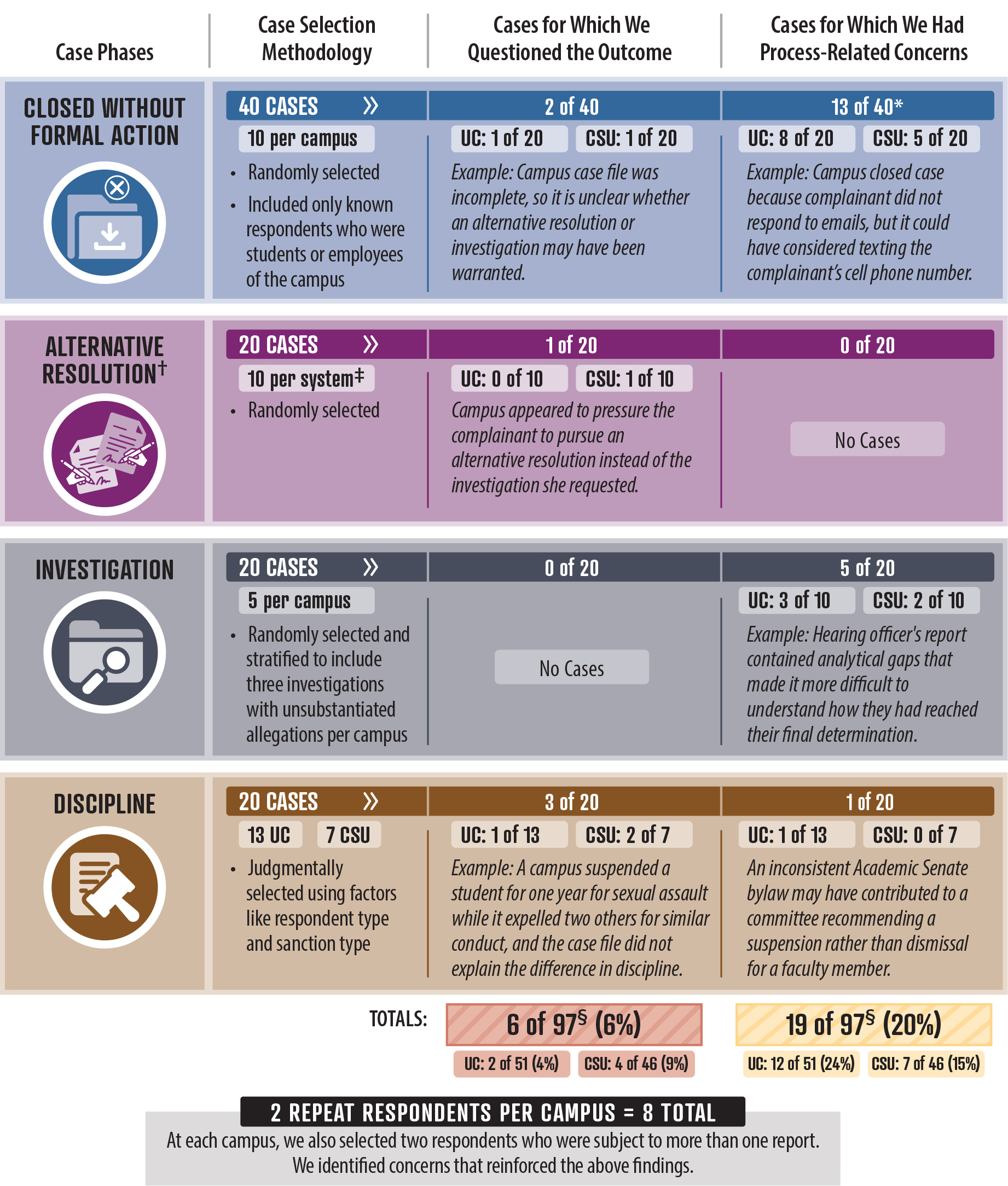
Both Title IX of the federal Education Amendments of 1972 (Title IX) and state law govern universities’ efforts to respond to sexual harassment. Under these laws, sexual harassment includes various types of sexual misconduct, including sexual assault and stalking. To evaluate efforts by the University of California (UC) and the California State University (CSU) to prevent and address sexual harassment, state law directs our office to review the systems’ policies and oversight every three years, starting in or before 2026. It also requires us to assess the practices of two selected campuses in each system. For this audit, we reviewed the University of California, Irvine (UC Irvine); the University of California, Riverside (UC Riverside); California Polytechnic State University, San Luis Obispo (Cal Poly San Luis Obispo); and California State University, Sacramento (Sacramento State). Our review primarily focused on how the Title IX offices at these campuses addressed 97 unique cases involving allegations that students or employees (respondents) had engaged in sexual harassment toward others (complainants).1 Figure 1 summarizes our results.
Figure 1
Our Review of 97 Cases Identified Six With Substantive Issues and 19 With Process‑Related Areas for Improvement
Source: Case files.
* We did not include our finding about campuses’ holding educational conversations with respondents, which was a best practice that did not appear to affect campuses’ broader decisions about whether to pursue an alternative resolution or investigation instead of closing the cases without formal action. Campuses’ decisions about whether to hold these conversations involve nuanced considerations—which we discuss later in the report—that made it less straightforward to establish a count of the exact number of cases that warranted such a conversation.
† We use the term alternative resolution in this report to refer to what CSU policy calls informal resolution.
‡ Only four alternative resolution cases at Cal Poly San Luis Obispo were available to select based on our audit period and other parameters. We selected one additional case at Sacramento State to ensure we tested 10 CSU cases.
§ Three selected cases overlapped between two phases—investigation and discipline—resulting in 97 unique case files.
Figure 1 shows that we tested 97 cases across all the phases of a case and that we identified six with substantive issues and 19 with process-related issues. The selection methodology for the 97 cases was either random or judgmental based on the phase. An example of a case with substantive issues is that a campus appeared to pressure a complainant to pursue an alternative resolution instead of the investigation she requested. An example of a case with process-related issues is that the hearing officer’s report contained analytical gaps that made it more difficult to understand how they had reached their fi¬nal determination.
Cases Closed Without Formal Action: The Systems Should Standardize Certain Practices to Increase Complainant Participation and Respondent Accountability
Of the 97 unique case files we reviewed across the four campuses, Title IX offices closed 40 after the intake and initial assessment stage (closed without formal action). We questioned the outcomes of two of these cases. For example, in one of the cases, the file showed that a complainant who had reported sexual assault and had met with a Title IX office staff member reached out to schedule a follow‑up meeting. However, we could not determine from the case file whether the staff member had met with the complainant again or why the office had not pursued a formal resolution process. Campus officials told us it is possible that the staff member met with the complainant but did not document the interaction. Nevertheless, it was not clear to us that the Title IX office took appropriate action to address the complainant’s allegations.
Our review of other cases that the campus Title IX offices closed without formal action indicates that by more consistently applying best practices, the campuses could improve complainant participation and better prevent sexual harassment. For example, the campuses frequently emailed complainants to determine if they wanted to move forward with their cases. However, the campuses did not always document their consideration of other options for contacting nonresponsive complainants, such as their phone numbers. When the campuses did use such options, it sometimes prompted complainants to engage with campus offices and pursue their cases. Campuses were also not consistent in using nonpunitive educational conversations—a helpful option for intervening with respondents in the absence of a formal resolution process—to help address respondents’ alleged behavior and prevent its recurrence.
Alternative Resolution and Investigation: The Systems Should Strengthen Their Processes to Better Ensure Consistent, Appropriate Case Outcomes
We reviewed 20 cases in which the campus Title IX offices used alternative resolution—a process that involves complainants and respondents reaching an agreement in place of a campus conducting an investigation. We did not identify significant concerns with 19 of these cases. However, in one CSU case, Title IX office staff appeared to pressure a complainant to use the alternative resolution process despite the complainant’s stated preference that the campus conduct an investigation. Case file notes and perspective from campus staff suggest that staff encouraged the complainant to forgo an investigation because they anticipated that the investigation might not produce a favorable result for the complainant. However, nothing in CSU’s policy states that staff may use their interpretation of preliminary evidence to steer a complainant toward a specific process. The complainant ultimately signed a resolution agreement that included disciplinary probation for the respondent rather than suspension or expulsion. She wrote in an impact statement afterward that she felt little had been done to hold him accountable.
In all 20 cases we reviewed that involved investigations, campuses reached reasonable determinations about whether respondents had committed sexual harassment; however, five case reports contained analytical gaps or dismissive or otherwise problematic language. Although the analytical gaps and problematic language did not cause us to conclude that the campuses’ final determinations were erroneous, these types of issues may reduce the complainants’ and respondents’ confidence that the final determinations are fair. Further, we are concerned that campuses may not detect similar or more significant analytical gaps that could impact the final determinations in future cases.
The campus Title IX offices generally completed their investigations within required timelines, but the involved parties then had to wait an average of nearly four additional months for hearings. This additional delay resulted in substantially longer case timelines that extended an already burdensome process for the parties involved.
Respondent Discipline: The Systems Should Establish Additional Guidelines to Improve the Consistency and Transparency of Campuses’ Disciplinary Decisions
We reviewed campuses’ disciplinary decisions in 20 cases that included investigations with substantiated findings of sexual harassment. Twelve of these cases involved respondents who were students, and eight involved respondents who were employees. Based on the available documentation and our conversations with campus officials, we concluded that 17 of these disciplinary decisions were reasonable. However, in three cases, we identified unexplained inconsistencies in disciplinary outcomes. For example, at one CSU campus, decision‑makers suspended two students for sexual assault violations but expelled other students for similar violations, and the case files did not clearly explain the reasons for these different outcomes. We also had concerns about one UC case in which the campus did not dismiss a faculty member for conduct that was more egregious than conduct in other cases we reviewed that resulted in dismissal.
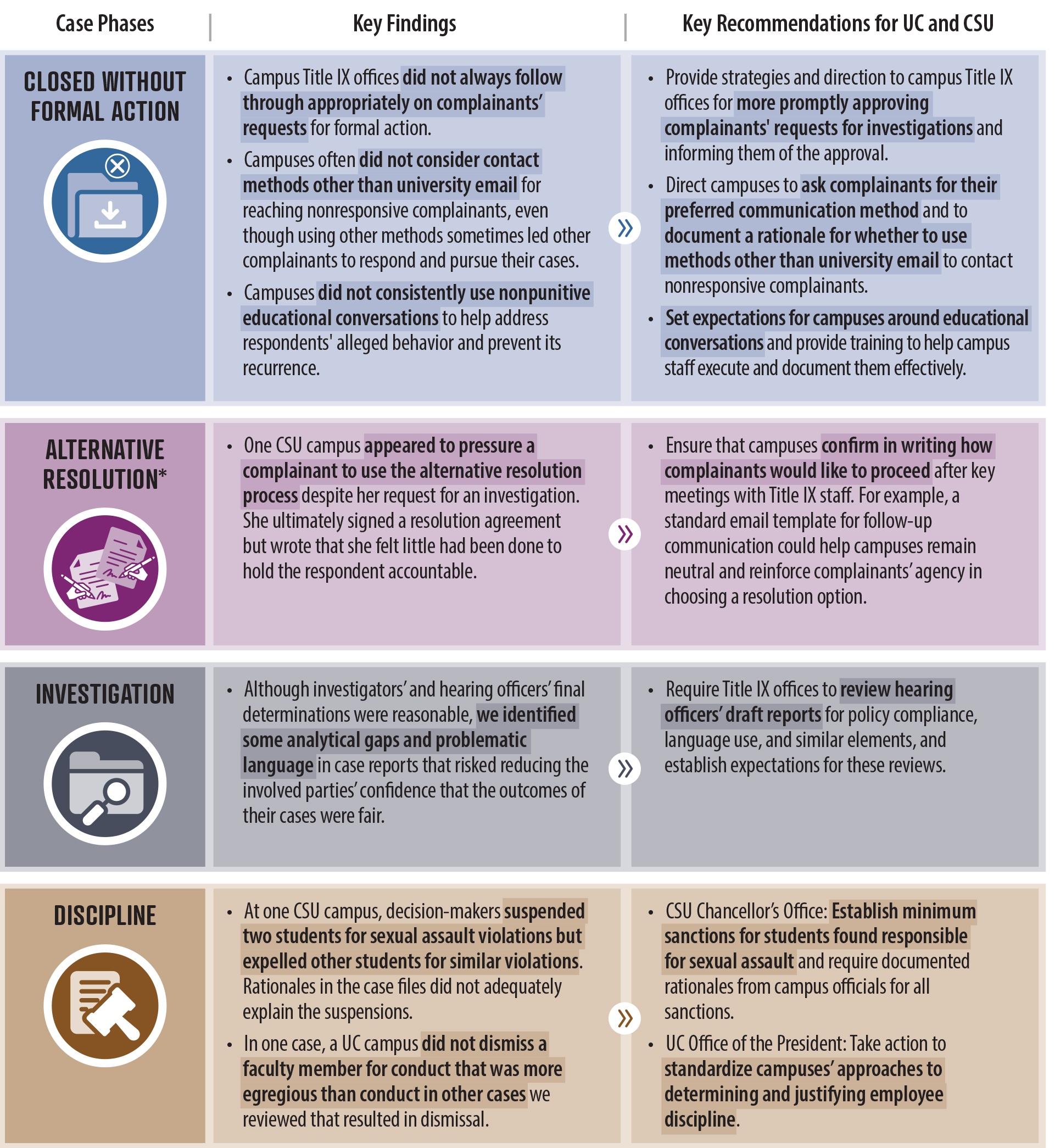
To address these findings, we recommend that the UC Office of the President and the CSU Office of the Chancellor (CSU Chancellor’s Office) revise their policies or guidance and take additional steps as necessary to help ensure that the campuses they oversee implement best practices for responding to reports of sexual harassment. Figure 2 provides an overview of our key findings and recommendations.
Figure 2
Summary of Our Key Findings and Recommendations
Source: Audit report.
* We use the term alternative resolution in this report to refer to what CSU policy calls informal resolution.
Figure 2 shows the key findings and recommendations for each case phase that we reviewed. For example, in cases that campuses closed without formal action, campus title IX offi¬ces did not always follow through appropriately on complainants’ requests for formal action. We therefore recommended to the UC and CSU that they provide strategies and direction to campus Title IX offices for more promptly approving complainants’ requests for investigations and informing them of the approval. In our review of cases that resulted in discipline, we found that at one CSU campus, decision-makers suspended two students for sexual assault violations but expelled other students for similar violations and that rationales in the case files did not adequately explain the suspensions. As a result, we recommended that the CSU establish minimum sanctions for students found responsible for sexual assault and require documented rationales from campus officials for all sanctions.
Agency Comments
The UC Office of the President and the CSU Chancellor’s Office stated that they are committed to implementing our recommendations.
Introduction
Background
Sexual harassment can have a significant negative effect on the well‑being of students and employees on university campuses.2 The Association of American Universities found in its 2019 campus climate survey that 13 percent of all students had experienced sexual assault—with higher rates for undergraduate women and students with nonconforming social identities—and that 42 percent had experienced at least one sexually harassing behavior since enrollment. Other, more recent surveys across a smaller number of universities or at individual institutions have resulted in similar findings.
Title IX is designed to eliminate discrimination on the basis of sex in any education program or activity receiving federal financial assistance, and its regulations govern universities’ responses to sexual harassment. These regulations establish the terms complainant and respondent—which refer to an individual alleged to have experienced possible sexual harassment and an individual alleged to have perpetrated it, respectively—and require the equitable treatment of both parties. In 2024, the U.S. Department of Education updated Title IX regulations to broaden the definition of sexual harassment and eliminate the requirement for a live hearing as part of the investigation process, among other changes. Federal courts then vacated the new regulations, and the Department of Education now enforces the prior 2020 regulations. In addition to being subject to these federal regulations, the UC and CSU systems must also comply with additional requirements in state law and in their own systemwide policies. These additional requirements enable them to investigate cases of sexual harassment that may fall outside the narrower definition in federal regulations.
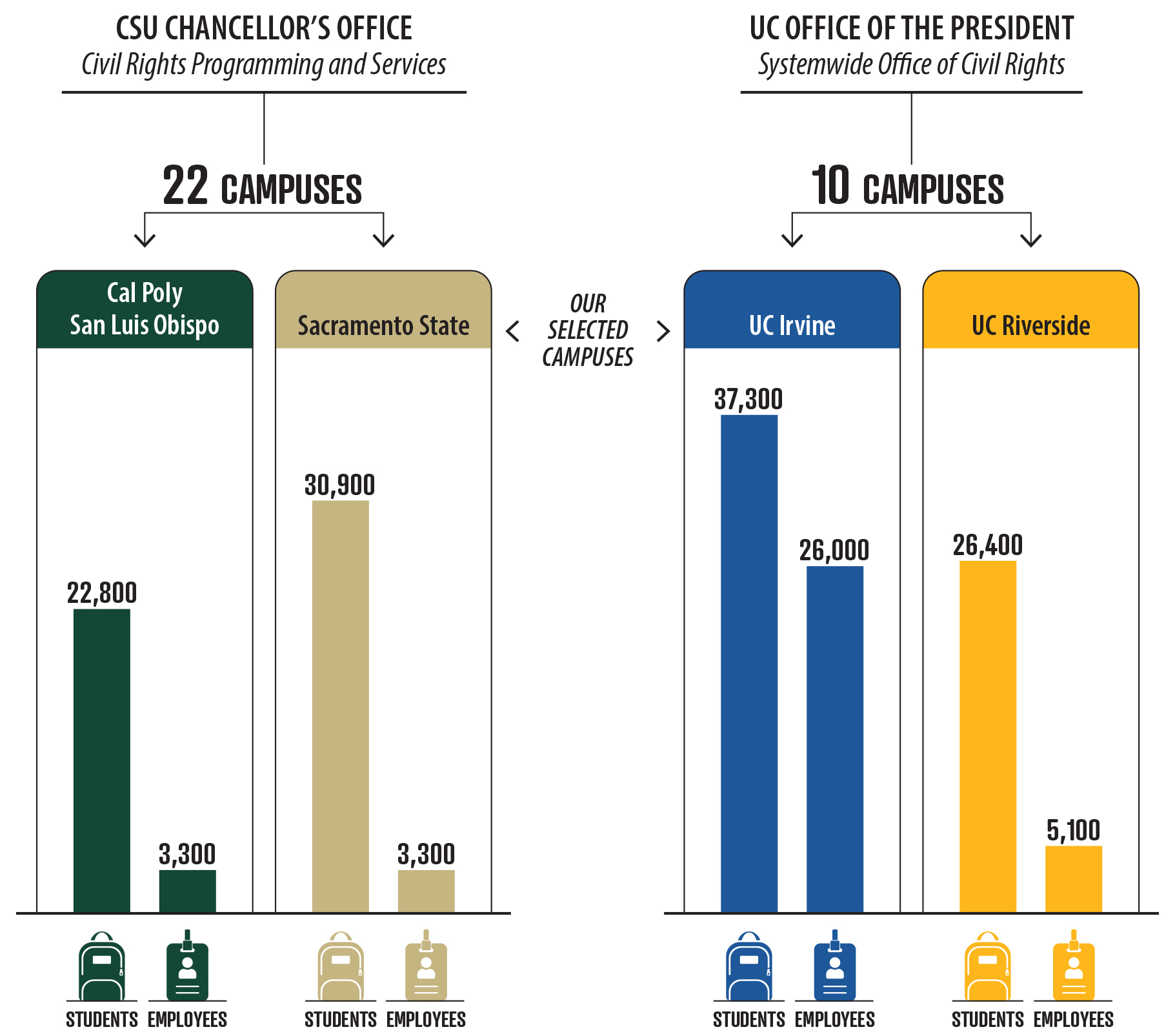
From 2013 through 2023, our office conducted three audits of the UC and CSU systems’ efforts related to addressing sexual harassment.3 Table B in Appendix B shows that the systems have fully implemented nearly all our previous recommendations. In September 2024, the Governor approved Assembly Bill 2407, which requires our office to conduct four audits over a 10‑year period—beginning with this audit—to assess the UC and CSU systems’ abilities to address and prevent sexual harassment on campuses. As part of each audit, state law requires us to evaluate the relevant efforts of the CSU Chancellor’s Office, the UC Office of the President, and two campuses from each system. As Figure 3 shows, we selected UC Irvine, UC Riverside, Cal Poly San Luis Obispo, and Sacramento State for this audit.
Figure 3
We Selected Two CSU and Two UC Campuses for This Audit
Source: Institutional research webpages.
Note: We counted student employees as students and medical staff as employees. We used data from 2024 because the case files we reviewed were generally from between August 2023 through July 2025.
Figure 3 shows the student and employee counts and system offices for the four selected campuses. Cal Poly San Luis Obispo and Sacramento State receive oversight from the CSU Chancellor’s Office and UC Irvine and UC Riverside receive oversight from the UC Office of the President. Cal Poly San Luis Obispo, Sacramento State, and UC Riverside all have between 22,000 and 31,000 students and between 3,300 and 5,100 employees. UC Irvine has 37,300 students and 26,000 employees.
Campus Title IX Offices Are Responsible for Receiving and Responding to Reports of Sexual Harassment
Each UC and CSU campus has a designated Title IX officer or coordinator who oversees the campus’s compliance with Title IX and the system’s sexual harassment policies. These individuals generally work within broader campus offices (campus Title IX offices) that can include other officials such as deputy Title IX officers, investigators, and intake coordinators. One key function of campus Title IX offices is receiving and responding to reports of sexual harassment.
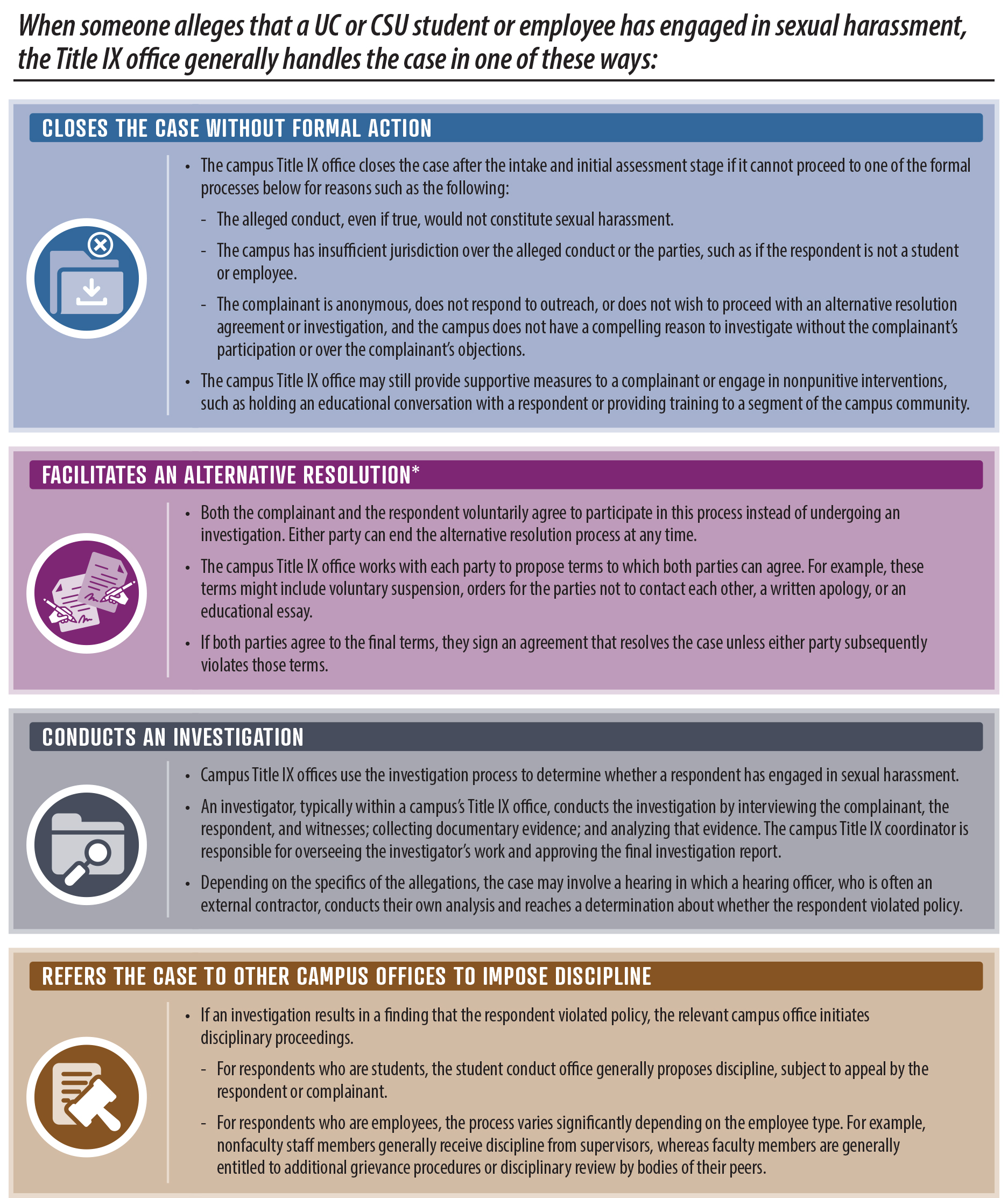
As Figure 4 shows, campus Title IX offices can respond to a report of sexual harassment in different ways. The four campuses we reviewed as part of this audit closed most sexual harassment cases after the intake and initial assessment stage (closing without formal action), as we show in Table A.1 in Appendix A. Campuses may close cases without formal action for a number of reasons. For example, formal action—pursuing an alternative resolution agreement or an investigation—requires that a report allege conduct that, if true, would violate policy. In addition, taking formal action also generally relies upon complainants’ participation in the process both because evidence‑gathering during an investigation can be difficult without a complainant’s involvement and because federal and state law and the systems’ policies place importance on considering a complainant’s privacy and autonomy.
Figure 4
Our Review Focused on Four Key Phases of the Case Resolution Process
Source: UC and CSU policies and case files.
* We use the term alternative resolution in this report to refer to what CSU policy calls informal resolution.
Figure 4 shows the four case phases and key criteria and outcomes of each phase. For example, a campus may close a case without formal action for a number of reasons, but the campus Title IX offi¬ce may still provide supportive measures to a complainant or engage in nonpunitive interventions, such as holding an educational conversation with a respondent or providing training to a segment of the campus community. Additionally, campus Title IX o¬ffices use the investigation process to determine whether a respondent has engaged in sexual harassment. Depending on the specifics of the allegations, the investigation may involve a hearing in which a hearing offi¬cer, who is often an external contractor, conducts their own analysis and reaches a determination about whether the respondent violated policy.
The alternative resolution process is an option for complainants and respondents who would prefer to resolve a case without an investigation and potentially a live hearing, both of which can be burdensome for participants. The alternative resolution process is generally available only if the campus would otherwise conduct an investigation. Further, if a complainant decides they want an investigation, they can end the alternative resolution process at any time and pursue an investigation instead. Title IX offices use the investigation process to determine whether a respondent has engaged in sexual harassment and, if so, to initiate disciplinary proceedings.
Campuses Provide Programs and Services to Detect and Prevent Sexual Harassment
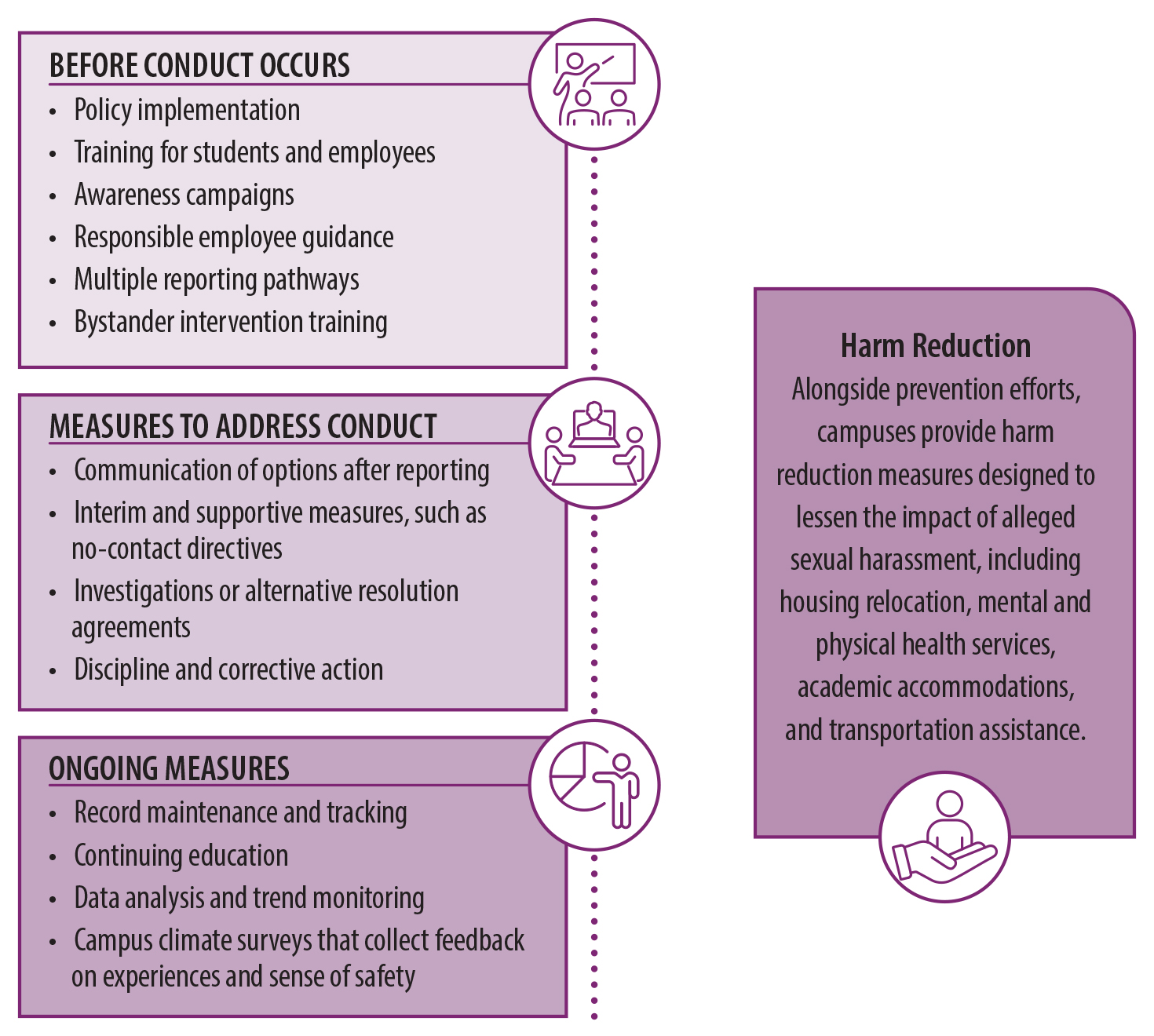
In addition to responding to reports of sexual harassment, campuses can employ a range of strategies to detect and prevent sexual harassment and to support students and employees, as Figure 5 illustrates. For example, campus Title IX offices must coordinate with other campus partners to ensure that students and employees receive required training on preventing and reporting sexual harassment. Additionally, campuses must designate a person who can offer confidential consultations to students and employees without reporting sexual harassment concerns to the campus Title IX office. This service can take the form of a confidential advocacy office, such as the CARE Advocacy Offices for Sexual and Gender‑Based Violence and Misconduct (CARE offices) that exist at each UC campus. CARE offices work to prevent sexual harassment and address its effects through actions such as educating the campus community on healthy relationships and affirmative consent; helping those who have experienced harm obtain items or services to support their safety and basic needs; and assisting complainants as they navigate interactions with campus Title IX offices.
Figure 5
Campuses Can Employ a Range of Strategies for Detecting and Preventing Sexual Harassment
Source: System policies, interviews with campus staff, campus prevention documentation, and our office’s prior audits of UC and CSU.
Figure 5 shows the different strategies that campuses take to detect and address sexual harassment. It includes strategies for before conduct occurs, like training campaigns and responsible employee guidance, as well as measures after conduct has occurred, such as communicating available options, offering interim measures, or conducting an investigation. It also shows ongoing measures campuses may take, like record maintenance and data analysis. Additionally, it includes harm reduction efforts to lessen the impact of alleged sexual harassment when it occurs.
In this audit, we assessed campuses’ prevention and detection efforts primarily by evaluating Title IX offices’ responses to reports of sexual harassment. The campuses’ responses to these reports are central to our audit objectives and to the prevention of sexual harassment. For example, consistently and appropriately implementing supportive measures for involved parties and educating or disciplining respondents can help deter sexual harassment. Further, this process has been the source of key findings in our prior audits of UC and CSU campuses. Subsequent audits in this series may delve more deeply into other types of prevention measures, such as efforts related to new requirements in state law that campuses must meet by July 2026. Under these requirements, each campus Title IX office will need to oversee the implementation of a sexual harassment prevention and outreach program as well as prevention training for students, faculty, and staff.
The UC and CSU System Offices Oversee Campuses’ Efforts
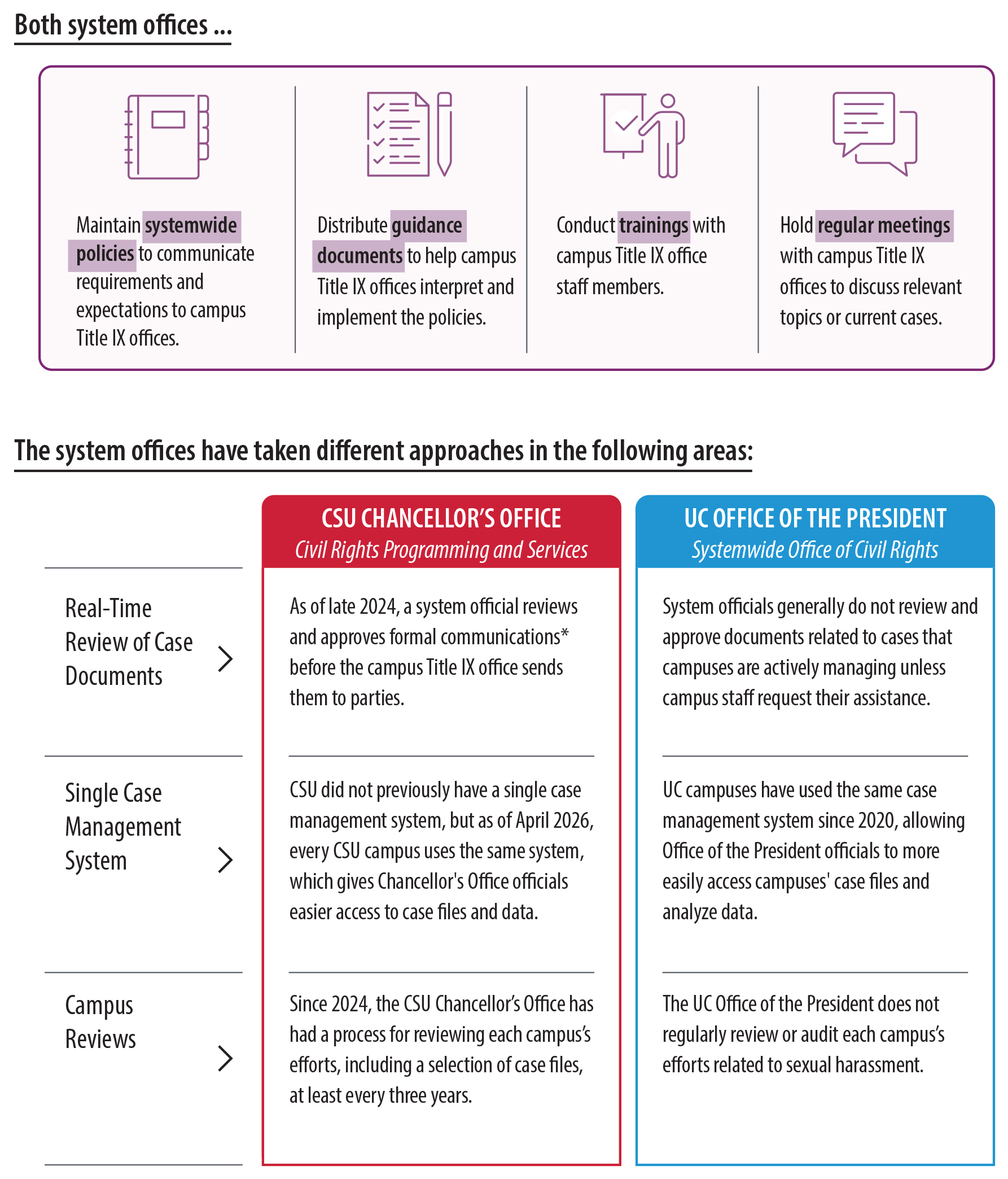
State law directs us to evaluate the efforts of the UC Office of the President and the CSU Chancellor’s Office to provide consistency in and oversight of campuses’ responses to reports of sexual harassment. As Figure 6 describes, both system offices develop policies, guidance documents, and training to ensure consistency across campuses. The CSU Chancellor’s Office generally takes a more hands‑on approach to overseeing campus Title IX offices’ case management and has implemented several related measures since our most recent audit report, published in July 2023. In contrast, the UC Office of the President does not generally review campuses’ case documents or decisions unless campus staff request its assistance, although it does regularly meet with campus Title IX offices. In conducting this audit, we reviewed whether gaps in systemwide policies, guidance, or other oversight measures may have contributed to our findings related to how campus Title IX offices responded to reports of sexual harassment, and we made associated recommendations to improve oversight.
Figure 6
Both System Offices Oversee Campuses’ Responses to Reports of Sexual Harassment in Several Ways
Source: UC and CSU policies, procedures, and webpages, and interviews with UC and CSU officials.
* Formal communications include notices of investigation, notices of no investigation, investigation reports, hearing reports, and sanction letters.
Figure 6 shows the oversight characteristics of the CSU Chancellor’s Office and the UC Office of the President. Both systemwide offices take certain actions like maintaining systemwide policies and distributing guidance documents. The offices differ in other ways. For example, as of late 2024, at the CSU Chancellor’s Office, a system offi¬cial reviews and approves formal communications such as investigation reports before the campus Title IX offi¬ce sends them to parties. By contrast, at the UC Office of the President, system offi-cials generally do not review and approve documents related to cases that campuses are actively managing unless campus staff request their assistance.
Audit Results
- Cases Closed Without Formal Action: The Systems Should Standardize Certain Practices to Increase Complainant Participation and Respondent Accountability
- Alternative Resolution and Investigation: The Systems Should Strengthen Their Processes to Better Ensure Consistent, Appropriate Case Outcomes
- Respondent Discipline: The Systems Should Establish Additional Guidelines to Improve the Consistency and Transparency of Campuses’ Disciplinary Decisions
Cases Closed Without Formal Action: The Systems Should Standardize Certain Practices to Increase Complainant Participation and Respondent Accountability
Key Points
- Of the 40 cases we reviewed that campus Title IX offices closed without formal action, we questioned the outcomes of two, both of which included allegations of unwanted sexual contact. In the first case, an office at a CSU campus did not initiate an investigation after a complainant had requested one and the Title IX coordinator had found the case eligible for an investigation; the complainant subsequently stopped responding to contact from the office. In the second case, documentation gaps make it unclear whether staff at a UC campus met with a complainant who had requested a meeting.
- In 12 of the 40 cases closed without formal action, campus Title IX offices did not consider using methods other than university email to contact nonresponsive complainants despite having other options for contacting them, such as texting, calling, or using a personal email address. Six of these 12 cases included allegations that may have warranted an investigation or alternative resolution had complainants chosen to move forward with the cases. Our review of other cases found that using alternate contact methods can successfully prompt complainants to engage.
- Campuses could more consistently use nonpunitive educational conversations to address respondents’ alleged behavior and prevent its recurrence. Both UC campuses employed this tool—although not always consistently—for cases they closed without formal action, whereas the two CSU campuses did not engage respondents in educational conversations in any of the 20 cases we reviewed. Although holding educational conversations is a best practice, it is not advisable in every case, and campus offices’ reservations about its use, coupled with a lack of systemwide guidelines, contributed to the inconsistencies we observed.
- When we reviewed cases involving eight respondents who were the subject of multiple reports alleging sexual harassment (repeat respondents), the problems we identified mirrored the concerns we discuss in the previous bullets. In cases involving four of the eight repeat respondents, campuses could have taken additional steps to contact complainants or to conduct educational conversations with the respondents before closing the cases without formal action. For example, shortcomings in a UC campus’s outreach to and communications with a complainant may have deterred an investigation involving a respondent who had already been the subject of two previous reports.
Campuses Inappropriately Closed Two of the 40 Cases We Reviewed
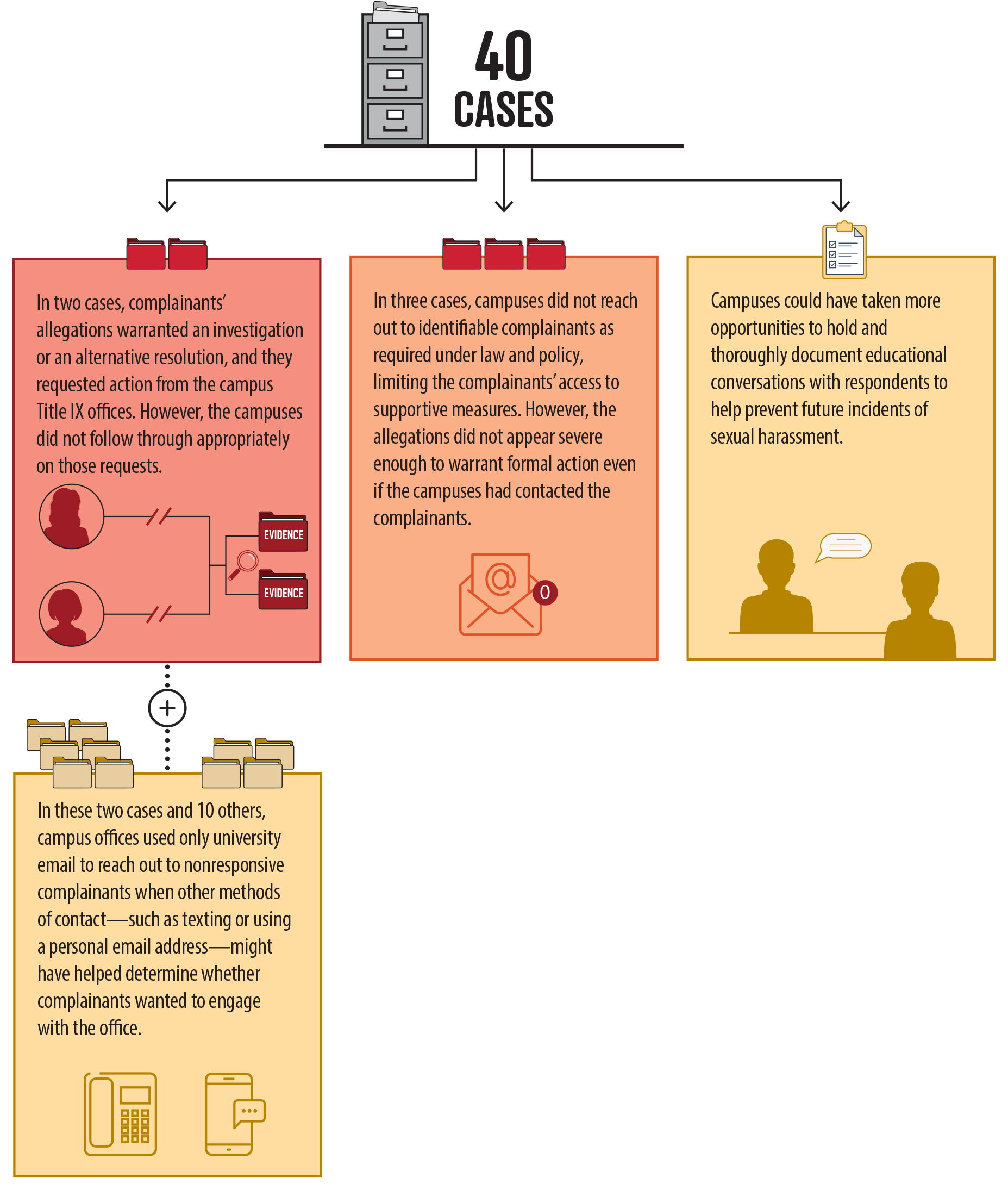
We reviewed 40 cases that campus Title IX offices closed without formal action to determine whether the closures complied with Title IX requirements, UC and CSU system policies, and best practices. Figure 7 summarizes the types of issues we identified in these 40 cases. We questioned the outcomes of two. In both cases, campuses did not take steps we expected based on each system’s policies and closed the cases without formal action when an alternative resolution or investigation was likely warranted.
Figure 7
Our Review of 40 Cases That Campuses Closed Without Formal Action Revealed Opportunities for Improvement
Source: Case files.
Figure 7 outlines the issues we identified across the 40 cases that campuses closed without formal action. For example, in two cases, complainants’ allegations warranted an investigation or an alternative resolution, and they requested action from the campus Title IX o¬ffices. However, the campuses did not follow through appropriately on those requests. Additionally, in these two cases and 10 others, campus offi¬ces used only university email to reach out to nonresponsive complainants when other methods of contact—such as texting or using a personal email address—might have helped determine whether complainants wanted to engage with the o¬ffice.
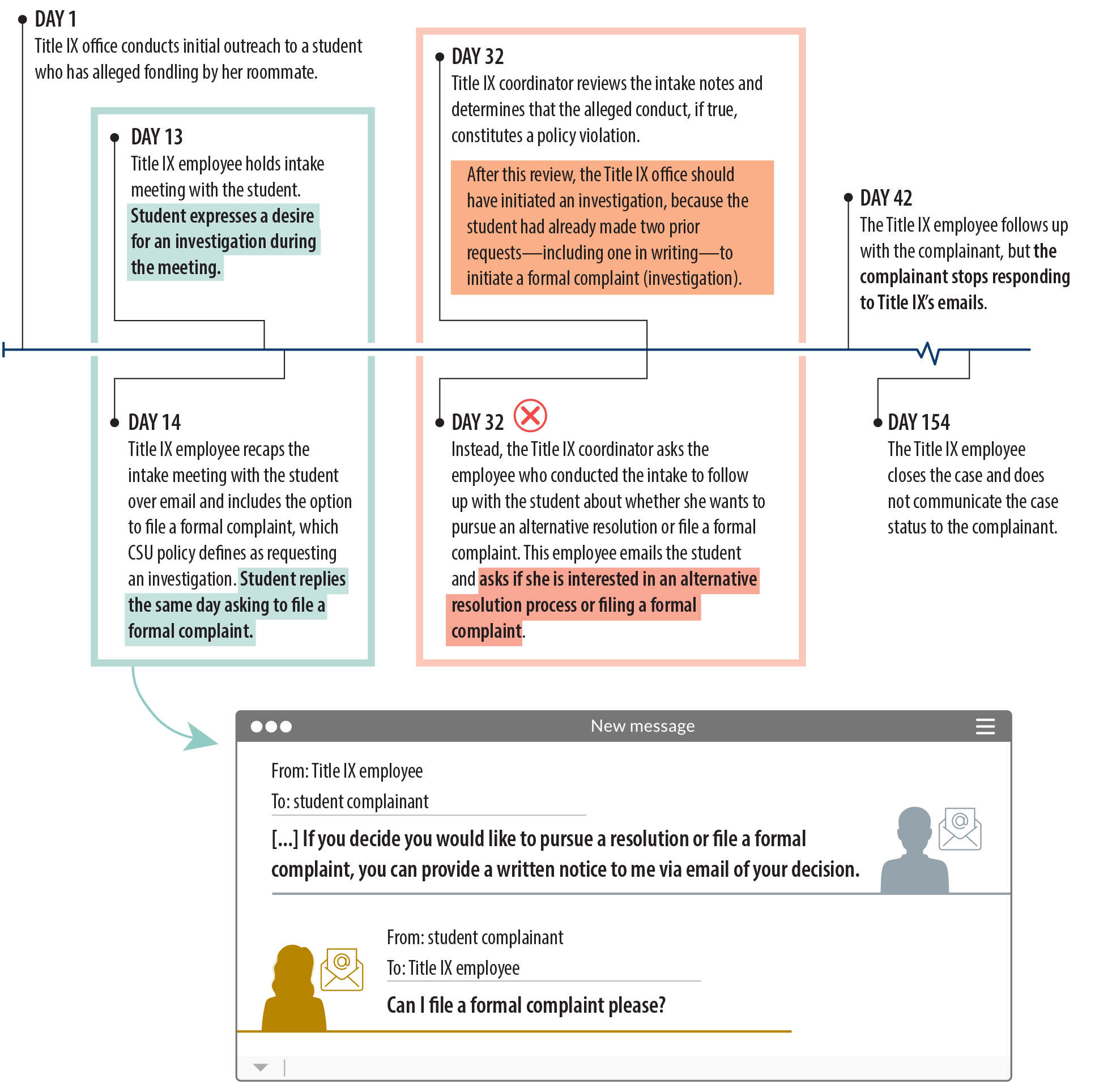
In one CSU case, the campus did not initiate an investigation following a complainant’s request, as Figure 8 shows. If a student reports unwanted sexual contact by a respondent affiliated with the campus and expresses a desire for an investigation, the Title IX office should generally proceed with that investigation. In this case, the complainant twice indicated a desire to proceed and the Title IX coordinator’s review found the case eligible for an investigation. However, instead of opening the investigation, the Title IX office sought yet another confirmation from the complainant. This step may have discouraged the complainant from continuing to participate because the office had yet to act on the complainant’s already‑stated wishes. The Title IX office closed this case several months after the final email because the complainant was nonresponsive. However, we question whether the campus adequately addressed the complainant’s concerns given that it did not take action even after the complainant twice requested that it investigate the complaint.
Figure 8
A CSU Campus’s Delay in Initiating an Investigation May Have Contributed to a Complainant’s Not Responding to Emails
Source: Case file.
Figure 8 is a timeline graphic that outlines the interaction between a campus Title IX office and a complainant who wanted to file a formal complaint. Days 13 and 14 since the office received the report include an intake meeting with the complainant where she requested an investigation and an email from the complainant where she asks to file a formal complaint. Day 32 since the office received the report includes an email from the Title IX office to the complainant asking if she would like to begin an alternative resolution process or file a formal complaint. By day 42 since the office received the report, the complainant has stopped responding to emails.
When we asked about this case, the Title IX coordinator stated that when the complainant wrote, “Can I file a formal complaint, please?” office staff did not consider her words an affirmative statement requesting an investigation. The Title IX coordinator acknowledged that staff could have interpreted the complainant’s request as an affirmative statement, but the coordinator thought that this approach would have been risky from a legal and policy compliance perspective. To support their assessment of risk, the coordinator pointed to the definition of formal complaint, which includes a signed document or electronic submission from the complainant requesting an investigation.
However, CSU policy states that an email from a complainant may serve as a formal complaint, and the policy does not state that a complainant’s request for an investigation must be phrased in a particular way. Given that the complainant clearly asked to file a formal complaint, we would have expected the office to initiate the investigation after determining that the allegations, if true, would constitute a policy violation. By instead asking the complainant to restate her desire for an investigation in different words more than two weeks later, the office may have undermined the complainant’s trust in the Title IX process and contributed to her disengagement with the process. The CSU Chancellor’s Office agrees that the complainant’s request was sufficient to trigger an investigation.
The second case that we identified as having been inappropriately closed without formal action involved sexual assault allegations at a UC campus. In this case, significant documentation gaps make it unclear how the Title IX office responded after the complainant re‑engaged the office, as the text box shows. We would have expected the Title IX staff member to have responded to the complainant and documented the outcome. Further, we would have expected the office to have followed through on the alternative resolution process if the complainant was still interested. Campus officials stated that it is possible that the staff member met with the complainant but did not document the interaction; however, in the absence of such evidence, we are concerned that the campus may not have taken appropriate action to respond to the complainant’s requests and to address the alleged sexual assault.
Timeline of Events for a UC Case in Which a Student Complainant Alleged Sexual Assault
April: Complainant meets with a campus staff member. According to case notes, complainant wants to pursue an alternative resolution agreement but is prepared to request an investigation if respondent refuses to sign the agreement.
May: After meeting again with complainant, staff member drafts an agreement and requests complainant’s feedback.
June (three weeks later): Staff member emails complainant to follow up. Staff member states that if complainant does not respond within two weeks, the office will close the case.
- After not receiving a response to the follow-up emails, the office closes the case without formal action.
Mid-July (three weeks after case closure): Complainant emails staff member and mentions taking time to think and discuss with family. Complainant requests a meeting.
Late July (two weeks later): Apparently having not received a response, complainant follows up. Staff member responds and lists availability for a meeting.
- Complainant: “Friday works perfectly for me … Please let me know what time works best for you.”
- Case file does not contain any additional records of a meeting, follow-up emails, or any further steps the campus took to address complainant’s allegations.
Source: Case file.
We identified two factors that either contributed or may have contributed to the problems we identified in this case file. First, the staff member who managed the case either did not respond to the complainant or—if a meeting did occur, as the campus suggested—did not document the case’s resolution adequately. Campus officials stated that the staff member left the office a few months after this case, preventing clarification on its outcome and the decisions that the employee made. Second, during the intake meeting, the campus staff member did not appear to seek the complainant’s permission for the office to call or text if it was unable to reach her by email—a best practice we discuss in greater detail in the following section. Had the office tried to contact the complainant by other means, it might have learned that the complainant did not intend to disengage from the process; if so, it likely would have kept the case open. Had the case remained open, other campus officials might have asked whether the staff member had met with the complainant, given that officials told us they actively monitor open cases.
In an additional three cases we reviewed that were closed without formal action, campuses did not reach out to identifiable complainants after receiving reports from third parties. Law and policy require campuses to attempt to contact identifiable complainants under these circumstances to ensure these individuals’ access to outreach and supportive measures—support that the complainants in these cases did not receive. However, the fact that the campuses did not reach out to these complainants did not affect the bases for the campuses’ decisions to close the cases without formal action. In each case, the allegations did not meet policy thresholds for initiating an investigation or alternative resolution. Given the limited frequency of these issues within our case selection, we believe they do not indicate a systemic pattern of campuses’ failing to reach out or provide support to complainants.
Campuses Closed 12 of the 40 Cases Without Trying to Contact the Complainants by Any Means Other Than University Email
Complainants generally play a critical role in formal action that campuses take to address sexual harassment: complainants’ participation is necessary for an alternative resolution agreement and is crucial for an investigation, considering the testimony and evidence they can offer. As a result, when campuses do not receive responses from complainants, it limits their ability to initiate an investigation or impose discipline. Nonetheless, in 12 of the 40 cases that campus Title IX offices closed without formal action—including the two cases we discuss in the previous section—the campuses relied exclusively on university email to contact nonresponsive complainants and did not document their consideration of other available contact methods, such as phone or personal email address.
UC and CSU policies do not require campuses to consider using contact methods other than email for complainants; however, guidance from the CSU Chancellor’s Office, existing practices at the four campuses, and our review of case files suggest that doing so is a best practice. For example, the CSU Chancellor’s Office issued guidance in January 2024 that states that when reaching out to complainants, campus Title IX offices should consider various modalities of contact, such as email, phone call, and text message. The guidance also states that allegations of more egregious conduct or of conduct that may pose a safety risk may warrant additional efforts, such as reaching out through a third party who initially reported the conduct. Deciding which contact methods to use is not always straightforward. For instance, third parties may report allegations involving complainants who have not yet provided their own contact preferences to the Title IX office or may not desire to engage with the office at all.
Of the 12 cases we reviewed in which campuses could have considered using additional contact methods, six involved allegations that, had campuses reached the complainants, might have warranted formal action. These six cases involved allegations that were either clearly severe, such as sexual assault, or of unclear severity given the information available in the case file. Because the allegations in the remaining six cases were less severe, the campuses would likely have closed them without formal action regardless of complainant participation. However, even in these instances, contacting the complainants might have yielded other benefits, such as facilitating the complainants’ access to supportive measures or increasing the Title IX office’s knowledge of the respondents and the specifics of their alleged behavior.
In one of the six cases that could have warranted formal action, a CSU campus Title IX office held an intake meeting with a complainant and determined that the allegations—which included dating violence, stalking, and sexual assault—justified an investigation if the complainant wanted one. The complainant also expressed interest in a no‑contact order. However, she did not respond to two follow‑up emails from the Title IX office. At this point, the office closed the case rather than using another communication method, despite having the complainant’s phone number, her second email address, and contact information for a third‑party employee who had reported the conduct and was familiar with the complainant and the allegations. The office also missed an opportunity at its intake meeting with the complainant to confirm and document whether she was open to receiving a text or call if an email went unanswered.
In another example from among the six cases that could have warranted formal action, a complainant’s supervisor reported to a UC campus Title IX office that the complainant had alleged that a coworker made several inappropriate comments to her. These comments included asking her for a massage, asking whether she had a boyfriend, and indicating that she made him sexually aroused. The complainant did not respond to two emails from the Title IX office, and the office closed the case without having communicated with the complainant directly. Although the office discussed the case on the phone with the complainant’s supervisor, the office did not document any attempts to ask the supervisor to confirm the complainant’s contact information and preferred communication method.
The supervisor told the Title IX office that the complainant and respondent had been separated and would not have further contact at work, and a campus Title IX official told us that they believed the complainant had likely received the office’s emails and had chosen not to engage with the office. Still, the office could have taken steps to ensure it was using the most effective outreach method. In fact, in a different case that the same campus closed without formal action, a Title IX office staff member took these types of steps. After sending an email to the complainant in that case, the staff member spoke with the complainant’s supervisor, who had initially reported the conduct, and received the complainant’s phone number. The staff member then called the complainant, who said she had not received the Title IX office’s email and requested to have it sent to a personal email address instead. After clarifying the facts of the complainant’s report, the campus office helped refer the complainant to supportive resources and addressed the report through an educational conversation with the respondent.
The campuses offered various reasons for not consistently using or considering using contact methods other than university email to reach complainants. Campus and system officials generally noted that university email is the standard communication method, that a nonresponse often signals that a complainant does not wish to participate, and that additional outreach may overwhelm or harm a complainant—especially if the complainant does not want to interact with the Title IX office. In addition, UC Office of the President officials told us that attempting outreach through third parties who make reports—specifically, asking these third parties, such as supervisors or others in positions of power, to check with complainants to ensure they have received the campus offices’ emails and have actively chosen not to participate—may put undue pressure on complainants to participate. Still, campus Title IX offices told us that they sometimes check in with or reach out through a third party, especially when the third party is knowledgeable about Title IX policies, such as employees who work in housing, athletics, or campus advocacy offices.
Several cases we reviewed demonstrated that campuses already use alternate outreach methods in certain instances and that doing so can successfully prompt complainant participation. For example, in one CSU alternative resolution case, the campus Title IX office sent the complainant a text message after two unanswered emails, which led the complainant to respond and commence the alternative resolution process. In a UC case, a third party made a report but the complainant did not respond to multiple outreach attempts by the Title IX office. The office then learned from another campus official that it had used an incorrect email for the complainant. After correcting the email, the office received a response from the complainant, who ultimately participated in an investigation that resulted in the campus dismissing the employee respondent. These examples demonstrate the value of additional outreach and indicate that nonresponse from a complainant does not always indicate a desire not to engage with the Title IX office.
We acknowledge that Title IX offices must strike a balance between respecting complainants’ privacy and safety and conducting proactive outreach to ensure they do not miss an opportunity to engage complainants in the process and address sexual harassment. By providing additional guidance to campuses, the CSU Chancellor’s Office and the UC Office of the President could facilitate campuses’ ability to navigate these decisions. CSU’s current guidance encourages consideration of non‑email contact methods but lacks specificity about when or how to use these methods and does not require campuses to document their consideration. The UC system does not currently provide any guidance on the subject. By providing thorough guidance, the two systems could better ensure that Title IX offices identify at intake a complainant’s preferred email address and determine if the complainant is comfortable with the office calling or texting. Further, the guidance could provide examples and identify factors for consideration that would help campuses decide how to proceed when a third party reports allegations and the campus has not been able to contact the complainant through email. The guidance could also state that for cases involving more severe allegations, campuses should briefly document their decisions about whether to use alternate contact methods to engage nonresponsive complainants.
Campuses Could Use Nonpunitive Interventions More Consistently to Educate Respondents and Prevent Additional Misconduct
Even for cases they close without formal action, campuses can still take nonpunitive action to address respondents’ alleged behavior and prevent its recurrence. For example, campuses can have preventive, educational conversations with respondents about the reported behavior. Holding educational conversations with respondents is a best practice for at least two reasons. First, doing so can help campuses intervene to prevent sexually harassing conduct from continuing or escalating. Second, it can also put respondents “on notice” about the conduct and position campuses to implement appropriate discipline in the event that the conduct does continue.
Campuses can take other nonpunitive actions to prevent respondents’ alleged conduct from continuing or escalating, such as implementing increased monitoring in the environment in which the alleged misconduct occurred or providing training more broadly to students and staff. However, educational conversations with respondents were the most targeted and potentially helpful measures we observed in the cases we reviewed. Nonetheless, they were also a source of inconsistency. The two UC campuses we reviewed employed educational conversations with respondents as a nonpunitive intervention in certain cases but not in others. The two CSU campuses did not employ nonpunitive interventions in any of the cases we reviewed that were closed without formal action.
Of the campuses we reviewed, UC Irvine’s Title IX office had the most formal and thorough process for engaging respondents in educational conversations. It refers to these conversations as policy compliance meetings and has a template that its staff use to summarize what they discussed with the respondent, including the allegations, the respondent’s response to the allegations, and the policies relevant to the alleged conduct. The template also includes a standard note that the staff member informed the respondent that new information or allegations could result in an investigation. Likely as a result of this formal process and template, our review found that UC Irvine frequently documented that it had held such meetings with respondents when it closed cases without formal action. Further, the documentation enabled us to understand the scope and quality of the conversations.
We also reviewed two cases in which UC Riverside’s Title IX office conducted educational conversations with respondents. We found both conversations to be useful, but one of the cases included more thorough documentation than the other. In particular, one case file contained notes from the conversation that included the specific topics that the Title IX office’s staff member had covered, whereas the second case involved a different campus office and merely contained an email from that office noting that a conversation had occurred that “address[ed] the matters raised in the complaint.”
We also reviewed cases in which it was unclear why the UC campus Title IX offices did not initiate or document an educational conversation. For example, the UC Irvine Title IX office did not hold an educational conversation with an employee respondent in a case involving allegations of the respondent making several sexual or romantic comments to another employee. Although the respondent’s supervisor had already met with the respondent about the alleged conduct, the case file did not indicate that the conversation had been educational in nature. Consequently, it was unclear from the file whether the respondent had received instruction about UC’s policies or been told that additional misconduct could lead to the campus taking formal action. Additionally, in a UC Riverside case involving allegations that a student respondent had engaged in sexual activity in a dorm room several times with roommates present, the Title IX office recommended that either Residential Life or the Title IX office conduct an educational conversation with the respondent because the conduct was not yet a violation of policy. However, it is unclear from the case file whether this conversation took place.
In contrast to the UC campuses we reviewed, the two CSU campus Title IX offices did not conduct educational conversations in any of the 20 cases we reviewed, even when the allegations indicated such conversations could have been beneficial. For example, one CSU case involved a respondent allegedly making several inappropriate comments to two individuals—such as asking for their phone numbers multiple times and making a sexually suggestive remark—and the case file noted that although a witness had addressed some of the respondent’s behavior in the moment, the respondent had continued to bother one of the complainants. However, the Title IX office did not take any independent action to engage the respondent in an educational conversation. In another CSU case, a third party alleged that a respondent had engaged in unwanted touching of a complainant’s waist. This was the fourth report against the respondent within the first two months of the school year, but the campus did not engage the respondent in an educational conversation.
System and campus officials offered reasons why a campus might choose not to hold an educational conversation when closing a case without formal action. For example, they noted that it is important to respect complainants’ privacy and wishes, especially if meeting with a respondent would reveal the complainant’s identity or subject the complainant to potential retaliation. In addition, officials noted that educational conversations can be difficult to navigate, in part because the conversations must remain nonpunitive, must not restrict respondents’ free speech or due process rights, and must not interfere with academic freedom.
We acknowledge these nuances and observed some of them play out in cases we reviewed. Nevertheless, the UC and CSU systems could be better positioned to prevent sexual harassment if they standardized an approach that included regular use of educational conversations and case file documentation similar to UC Irvine’s. The systems’ policies currently do not set an expectation that campuses hold these conversations regularly and document them thoroughly. Taking respondents’ rights into account, the systems could set this expectation, specify the types of factors campuses should consider in deciding whether to hold an educational conversation, require documentation of the conversation or of the reasons why one was not advisable, and provide training to help Title IX offices execute the conversations.
When we proposed this concept to the system offices, officials noted that these conversations are one intervention option among many and that Title IX coordinators should choose the option that best addresses the specifics of a case. Nevertheless, officials from both systems agreed that the conversations can be useful. In fact, the CSU Chancellor’s Office was already in the process of developing new guidance for campus offices.
Campuses Did Not Take All Steps Available to Them When Closing Some Cases Involving Repeat Respondents
We conducted additional work to determine how the campuses managed cases that involved respondents who were the subject of multiple reports (repeat respondents). Federal and state law and the systems’ policies generally indicate that campuses should take steps to address and prevent the recurrence of sex discrimination incidents, including sexual harassment. Further, previous audits and media articles have raised concerns about whether UC and CSU campuses are doing enough to prevent individuals from repeatedly harassing members of their communities. As Table A.2 in Appendix A shows, the four campuses we reviewed have all managed cases involving repeat respondents. To determine whether the campuses took sufficient steps to prevent repeated misconduct, we selected eight respondents—two from each campus—who were the subject of multiple sexual harassment reports. We reviewed the sexual harassment case files associated with each of these respondents, including cases that campuses had closed before our audit period. The case files related to these eight respondents were in addition to the nearly 100 case files we reviewed and describe throughout the report.
Although campuses took reasonable steps to address reports for three of the eight respondents, we have concerns about how campuses responded to reports about the other five—and in particular, how campuses managed certain cases they closed without formal action for four of these respondents.4 Our concerns related to the cases for these four respondents generally mirror the problems we describe earlier in this section. Specifically, campuses did not always reach out to or communicate effectively with complainants, reducing the likelihood of the campuses’ formally investigating and disciplining the respondents. The campuses also did not consistently conduct educational conversations with respondents when such conversations appeared warranted. The fact that these respondents were the subject of multiple allegations underscores the need for campuses to proactively manage the risk of further misconduct.
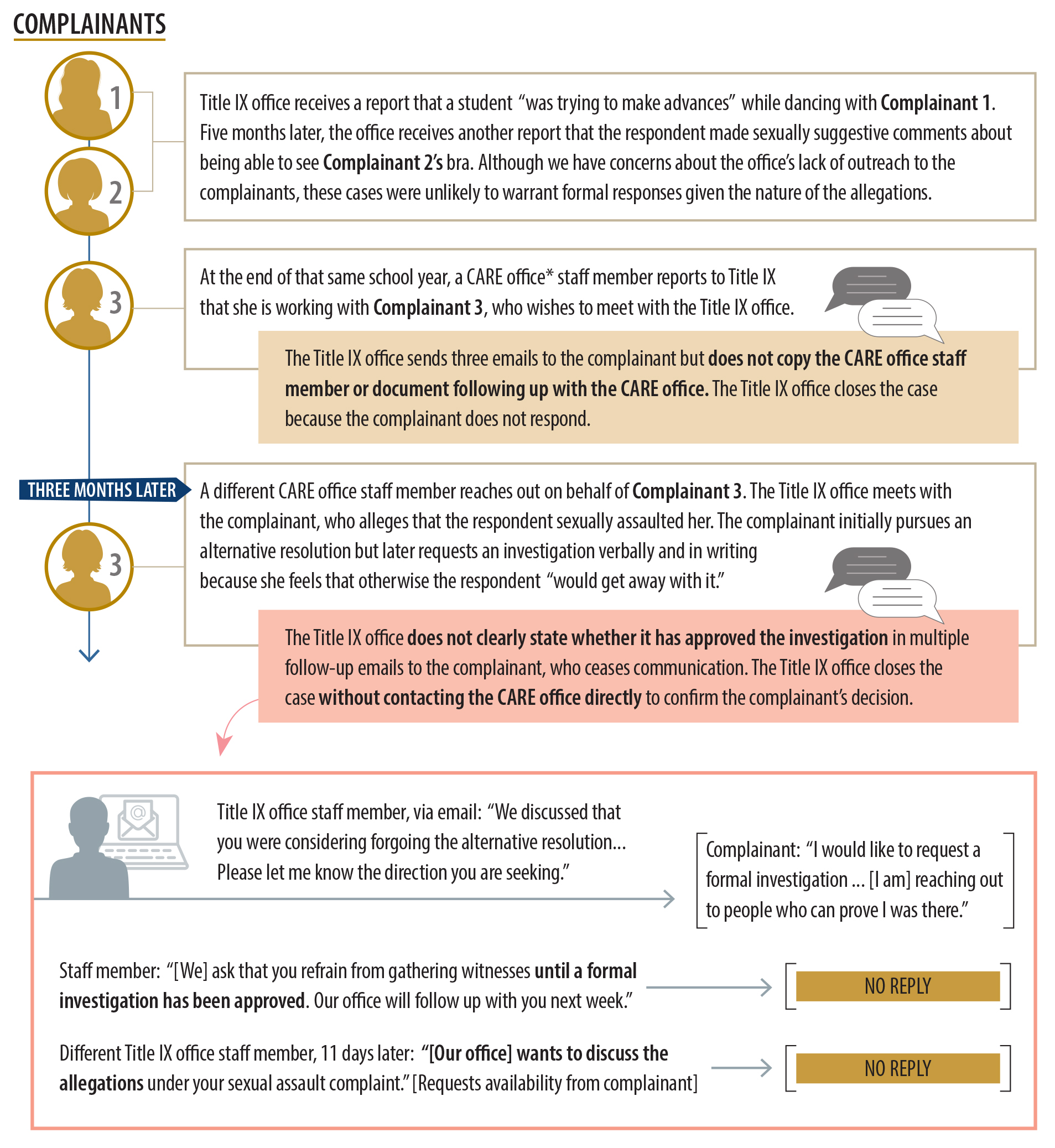
Figure 9 shows an example of how a UC campus’s communication with a complainant may have deterred her from pursuing an investigation related to sexual assault allegations. UC guidance states that if a complainant requests an investigation during the alternative resolution process, the campus should open one. Therefore, we would have expected the campus to respond to the complainant’s email requesting an investigation by confirming that it would be opening one. Instead, the campus sent several emails to the complainant without confirming its approval of the investigation. The complainant subsequently stopped responding, resulting in the case being closed without formal action.
Figure 9
Shortcomings in a UC Campus’s Communications With a Complainant May Have Deterred an Investigation of a Repeat Respondent’s Behavior
Source: Case files.
* As we explain in the Introduction, CARE offices are confidential advocacy offices that exist at each UC campus and work to prevent sexual harassment and address its effects.
Figure 9 is a graphic that shows the reports of multiple complainants alleging sexual harassment by the same respondent. The third complainant meets with the Title IX office and alleges sexual assault and begins the alternative resolution process. The graphic shows the communication between the Title IX office and this complainant after she requests to switch to an investigation from the alternative resolution. The Title IX office does not confirm it will begin the investigation, and the complainant eventually ceases communication.
Although the complainant’s reasons for not responding are unclear, improved communication from the campus could have increased the likelihood of an investigation moving forward. The campus Title IX officer generally agreed with our concerns about this case. The officer clarified that the campus likely needed to meet with the complainant again before formally beginning the investigation so that it could learn more about the allegations to ensure that it investigated all potential policy violations and so that the campus could transition the complainant to the new investigator assigned to the case. Nevertheless, had the campus more quickly and clearly communicated to the complainant that it planned to initiate an investigation, the complainant might have continued corresponding with the campus.
In an example from CSU, a campus did not attempt to contact the complainant using her phone number and ultimately closed the case without formal action—precluding any investigation or discipline—because the complainant did not respond to the campus’s emails. The complainant had called the campus Title IX office when she made her report, which involved alleged sexual assault by a respondent who had already been the subject of multiple prior reports. The Title IX office’s case file also documented the complainant’s phone number. However, the case file did not explain why the campus did not attempt phone contact with the complainant.
Similarly, campuses did not always conduct or adequately document educational conversations with respondents. In three CSU cases, for example, internal emails or notes indicate that the campuses considered conducting an educational conversation, but we observed no documentation in the case files that anyone had followed through. Two of those respondents were then the subject of at least one additional report of misconduct alleged to have occurred in the months that followed. The CSU Chancellor’s Office generally agreed that educational conversations were warranted in these cases and could have helped the campuses attempt to address the patterns of concerning behavior. The CSU Chancellor’s Office also shared with us draft guidance that would require campuses to elevate reports of repeat respondents to the Chancellor’s Office for further review before determining next steps.
Alternative Resolution and Investigation: The Systems Should Strengthen Their Processes to Better Ensure Consistent, Appropriate Case Outcomes
Key Points
- We reviewed 20 cases that involved the alternative resolution process and did not identify significant concerns with 19 of them. However, in one CSU case, campus staff appeared to pressure a complainant to use the alternative resolution process despite the complainant’s preference for an investigation. The complainant ultimately signed a resolution agreement that included disciplinary probation for the respondent—rather than suspension or expulsion—and wrote afterward that she felt little had been done to hold the respondent accountable.
- The campuses reached reasonable determinations in all 20 cases we reviewed that involved investigations; however, we identified gaps in analysis or language that was dismissive or otherwise problematic in five of the reports for these cases. These shortcomings did not cause us to conclude that the cases’ outcomes were erroneous, but they risked reducing the complainants’ and respondents’ confidence that the final determinations were fair. Further, they raise concerns about campuses’ abilities to detect and correct similar analytical gaps or problematic language in the future. Campuses generally completed their investigation reports on time or documented the reasons for extensions, but subsequent hearings further lengthened an already burdensome process for the parties involved.
One Campus Appeared to Pressure a Complainant to Engage in an Alternative Resolution Process
As we explain in the Introduction, the alternative resolution process allows a complainant and respondent to sign an agreement instead of undergoing an investigation. The alternative resolution process has benefits and drawbacks for complainants, as the text box shows. This process is intended to be voluntary and to give the parties more agency over the outcomes of their cases. The campuses generally told us that the process works well for many complainants and can be a beneficial alternative to an investigation. For example, UC Irvine’s Title IX officer shared that alternative resolutions can give complainants more agency over resolution terms and more flexibility in how they choose to process their experiences.
The Alternative Resolution Process’s Potential Benefits and Drawbacks for Complainants
Potential Benefits
- Complainant agency:
- Complainants can propose a wide range of terms, such as apologies, impact statements, no-contact directives, counseling, or disciplinary action.
- Complainants can avoid a potentially burdensome investigation process that may include a live hearing. However, they maintain the right to begin or resume the investigation process at any point before they sign the final agreement.
- Shorter timeline:
- The process has fewer procedural steps compared to the investigation process. For example, 14 of the 20 alternative resolution cases we reviewed took less than five months to resolve, with several taking one or two months. In contrast, none of the 20 investigation cases we reviewed took less than five months.
Potential Drawbacks
- Most alternative resolution cases do not require an admission of responsibility by the respondent. Any discipline is voluntary on the respondent’s part.
- A respondent can always reject terms that are proposed in the agreement.
Source: UC and CSU policies and guidance, interviews with campus officials, and review of case files.
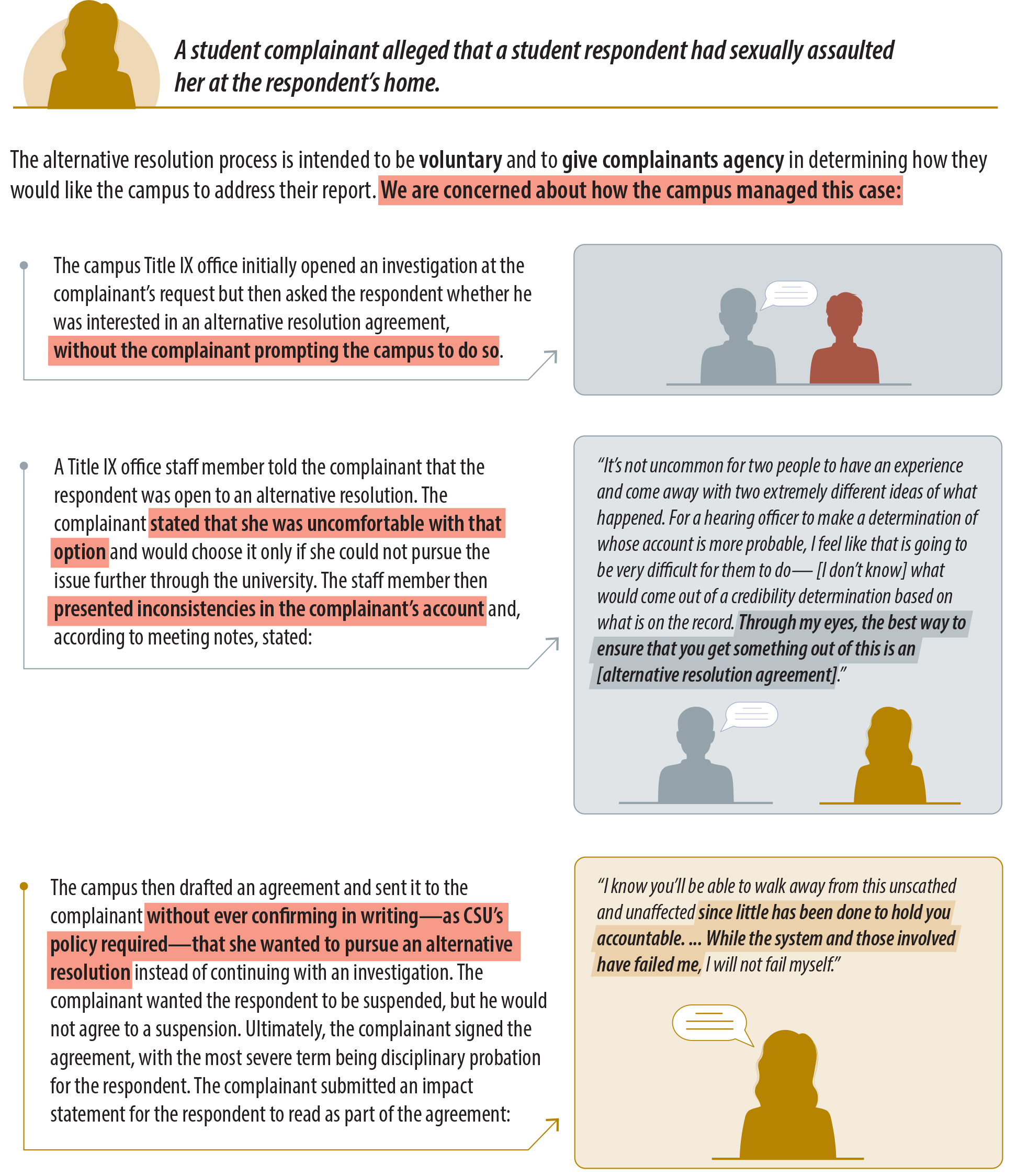
When we reviewed 20 randomly selected alternative resolution cases, we did not identify any significant concerns with 19.5 However, in one of the cases, a CSU campus appeared to have pressured a complainant toward an alternative resolution instead of an investigation, as Figure 10 shows. This case met CSU’s policy requirements for initiating an investigation based on the nature of the alleged conduct, the respondent’s status as a current student, and the complainant’s stated desire that she wanted a “thorough investigation” that would result in discipline, such as expulsion, for the respondent. Given this context and the voluntary nature of the alternative resolution process, we would have expected campus Title IX staff to continue with the investigation as soon as the complainant expressed discomfort with the prospect of pursuing an alternative resolution.
Figure 10
A CSU Campus Appeared to Pressure a Complainant to Use the Alternative Resolution Process Despite the Complainant’s Wishes to Pursue an Investigation
Source: Case file and CSU policy.
Figure 10 is a graphic that outlines the way a campus appeared to pressure a complainant to accept an alternative resolution instead of an investigation. The campus Title IX office initially opened an investigation at the complainant’s request but then asked the respondent whether he was interested in an alternative resolution agreement, without the complainant prompting the campus to do so. Despite the complainant expressing discomfort at the option, the Title IX office stated, “Through my eyes, the best way to ensure that you get something out of this is an alternative resolution agreement.” After following through on the alternative resolution, the complainant wrote in her impact statement that “While the system and those involved have failed me, I will not fail myself.”
However, according to interview notes, staff continued to push the complainant to pursue an alternative resolution. Moreover, although CSU policy required the campus to obtain the complainant’s and respondent’s voluntary, written consent before engaging in the alternative resolution process, the campus did not document the complainant’s written agreement to do so. Case file notes and perspective from campus staff suggest that staff members encouraged the complainant to forgo an investigation because they anticipated that the investigation might not produce a favorable result for the complainant and that an alternative resolution was more likely to achieve the sort of outcome they believed the complainant wanted. However, we struggle to understand this course of action, given that the complainant clearly stated that she wanted discipline for the respondent, indicated that she felt she could support aspects of her case, and voiced discomfort with the alternative resolution process multiple times.
Although presenting the potential results of an investigation process could be a reasonable action when done in a neutral manner to help a complainant make an informed decision, nothing in CSU policy states that a campus may use its interpretation of preliminary evidence to steer a complainant toward a specific process. The CSU Chancellor’s Office agreed that the campus’s management of this case was not compliant with policy and did not align with how the system expects campuses to facilitate alternative resolutions. As we show in Figure 10, after the complainant signed the final agreement, she wrote in her impact statement that the system had failed her and that little had been done to hold the respondent accountable.
Unrelated to this case, the CSU Chancellor’s Office subsequently released detailed guidelines for campuses about navigating the alternative resolution process. These guidelines include best practices for discussing options with complainants and respondents. They underscore the importance of supporting the parties’ empowerment and self‑determination. The guidelines also emphasize that Title IX staff should remain neutral and impartial when discussing options with parties and should refrain from directly or indirectly encouraging a party to exercise a given option.
Although these guidelines help address our concerns with the CSU case in question, additional steps could help ensure that campuses in both the UC and CSU systems consistently implement the approach detailed in the guidelines. For example, if campus Title IX staff confirmed in writing after key meetings which process a complainant prefers, it would give complainants a chance to correct any misunderstandings. This approach could also help ensure that campuses remain neutral, communicate necessary information, and document their compliance with policy.
When we spoke with the CSU Chancellor’s Office about this recommendation, it was already in the process of developing a standard template for such an email. Campuses could use such a template following key meetings to ensure each confirmatory email is brief, neutral, and supportive of the complainant’s agency. In the CSU case we describe earlier, an email of this nature to the complainant after the meeting in which the campus discussed pursuing an alternative resolution could have given the complainant a chance to state in writing whether she wanted to continue with the investigation. Further, it could have helped communicate to the complainant that it was entirely her decision.
A standardized post‑meeting email could also help address similar gaps in documentation that we observed at other campuses and across other resolution processes. For instance, in three UC alternative resolution cases we reviewed, meeting notes and other case file documentation did not clearly indicate when or how the complainants had decided to pursue an alternative resolution instead of an investigation, although we found nothing to suggest that the campuses had inappropriately persuaded them to do so. Similarly, in one UC case that a campus closed without formal action, the case file did not record anything about the complainant’s preferred process, even though the campus had conducted an intake meeting and the allegations might have warranted an investigation.
The Outcomes of Campuses’ Investigations Were Reasonable, but Five Reports Contained Analytical Gaps or Problematic Language
As we explain in the Introduction, campus Title IX offices use the investigation process to determine whether a respondent has violated the system’s sexual harassment policy. We found that the final determinations about whether respondents had violated policy were reasonable in all 20 cases we reviewed that involved investigations. However, three of the investigations contained gaps in decision‑makers’ analyses of the parties’ credibility and related evidence, which may have reduced the parties’ confidence that the final determinations were fair. Further, in two of these cases and in two additional hearing officer reports, we identified dismissive or otherwise problematic language, such as a hearing officer stating that a complainant “overreacted to…clumsy flirtation.” Finally, we found that although the campuses generally completed investigation reports within required time frames, the involved parties then had to wait an average of nearly four additional months for the resulting hearings.
Three Investigations Contained Analytical Gaps in Decision‑Makers’ Evaluations of the Parties’ Credibility and Related Evidence
In three investigations, the decision‑makers—hearing officers in two cases and a campus investigator in the third—did not adequately document how key evidence factored into their reasoning, did not fully support their assessments of the parties’ credibility, or did not clearly align their analyses with the applicable policy definitions. These three cases involved sexual assault allegations and did not include witnesses who directly observed the alleged assaults, so the complainants’ and respondents’ accounts were especially critical sources of evidence.
In one of the three cases, a hearing officer used a questionable application of the definition of affirmative consent in UC policy. UC policy places responsibility for obtaining affirmative consent on all parties involved and notes affirmative consent must be ongoing and can be revoked at any time during sexual activity. The policy further states that subsequent sexual relations or a dating relationship alone are not sufficient as evidence of consent to prior conduct. The investigator applied this standard and concluded the evidence supported a policy violation. After the respondent did not accept that preliminary determination, the case proceeded to a hearing, where the hearing officer’s analysis diverged from the investigator’s and from UC policy. As the text box shows, the hearing officer placed considerable weight on the complainant’s lack of verbal refusal and on the parties’ later consensual encounter, inferring that the subsequent sexual activity made it unlikely that the prior encounter was nonconsensual.
In One UC Case, the Investigator and Hearing Officer Assessed Credibility Differently
The investigator in the case made a preliminary determination of sexual assault based in part on the following factors:
- Complainant indicated a more clear ‘pushing’ of respondent’s hand than in previous allegations.”
- Respondent changed their response to documentary evidence (text message) from “agreeing they should have stopped only to appease complainant” to claiming the text referred to a different incident.
The hearing officer determined that a violation of policy had not occurred, with their reasoning including but not limited to the following:
- Claimed parties’ consensual sex the following night made nonconsent the previous night “unlikely.”
- Relied heavily on complainant’s lack of verbal communication.
Source: Case file.
The hearing officer’s reasoning diverged from the policy framework by treating the complainant’s absence of a verbal refusal and the parties’ later consensual encounter as indicators that the complainant had consented the prior night—two sources UC policy identifies as insufficient to establish consent. The hearing officer’s report did not provide any additional facts to explain how they had arrived at their determination that there was not enough evidence to establish a lack of consent. The investigator expressed similar concerns to us regarding the weight the hearing officer placed on the subsequent consensual encounter, although the investigator also noted it was a complex investigation in which reasonable people could disagree about the outcome. Consequently, the investigator did not have any major concerns about the hearing officer’s determination differing from their own.
In a CSU case, a hearing officer did not fully address relevant text messages when assessing credibility. For example, the hearing officer wrote that text messages the complainant sent after the respondent’s alleged misconduct suggested the complainant was disappointed that she could not remain friends with the respondent; according to the hearing officer, these messages undercut the complainant’s assertion that she viewed the sexual encounter as nonconsensual. However, the hearing officer’s analysis did not reference or explain several text messages the complainant sent to the respondent and to a witness that clearly indicated she viewed the encounter as nonconsensual and did not wish to have further contact with the respondent. These omissions weakened the clarity and completeness of the hearing officer’s credibility assessment.
Campus Title IX staff noted that they had reviewed the report for grammar, logical consistency, and other components but had not identified issues that warranted revision. After the complainant appealed the hearing officer’s decision, the Chancellor’s Office also reviewed the case and did not overturn that decision. Although we are not questioning the decision itself, the hearing officer’s supporting analysis was only about a page long and contained analytical gaps that limited the overall clarity and robustness of their determination.
The analytical gaps we observed raise concerns about the adequacy of campus Title IX offices’ reviews of hearing officer reports. Neither UC nor CSU policies establish an expectation for campus Title IX offices to substantively review draft hearing officer reports, and the campuses’ approaches to reviewing these draft reports varied. For example, one campus Title IX office told us it regularly works with the student conduct office and campus counsel to ensure the drafts are thorough, defensible, and well‑supported. The campus said it does not maintain documentation of these reviews because they involve drafts and are privileged and internal. Another campus Title IX office told us that it reviews some draft hearing officer reports for substance but does not do so consistently because of unclear systemwide expectations and a concern that doing so could impact the hearing officer’s independence. A third campus Title IX office reported that it sometimes conducts limited checks—such as confirming required components are present or ensuring the report is grammatically correct—but does not evaluate the substance of a hearing officer’s reasoning or their application of policy definitions.
In the absence of clear guidance and consistent expectations, gaps in evidence analysis, credibility assessments, or policy interpretation may go unaddressed. These limitations did not necessarily cause the analytical issues we identified, but they create conditions in which campuses are less likely to detect or correct reasoning errors or policy misapplications, increasing the risk of inconsistent or insufficiently supported decision‑making.
Four Hearing Officer Reports Included Dismissive or Otherwise Problematic Language
State law requires employees involved in the grievance process to be trained in “trauma‑informed” investigatory and hearing practices, which the UC notes in its training for hearing officers includes avoiding judgmental language. Nonetheless, we identified three instances in which hearing officers went beyond their responsibility to determine whether respondents violated UC or CSU policy, instead explicitly stating within reports that the alleged sexual conduct was consensual. According to the CSU Chancellor’s Office, such language is unnecessary under policy and goes beyond the hearing officer’s role of determining whether a respondent violated policy.
Additionally, we reviewed one UC case in which the hearing officer made multiple unnecessary comments about the parties involved in the case. The text box includes examples of some of these comments. Notably, the comments were all in the written report, with some appearing after the hearing officer had already stated their decisions regarding policy violations. We are concerned about the problematic nature of the comments, and the campus Title IX office agreed. We are additionally concerned that such comments could discourage other complainants from filing complaints or participating in the hearing process.
Examples of Hearing Officer Statements in One UC Hearing Report
- “Taking into account these instances of Complainant’s unjustified overreaction …”
- “She overreacted to Respondent’s clumsy flirtation …”
- “The University discipline process is ideally intended to provide an opportunity for young people to experience personal growth and develop greater depth of understanding that enables them to move forward in their lives with a more sophisticated and mature approach to human relationships. Sadly, in this instance, it does not appear to have achieved that result.”
Source: Case file.
Note: Emphasis added.
To address hearing officers’ use of dismissive or otherwise problematic language in reports, our recommendations overlap with those intended to address issues within report analyses. As we describe previously, neither system has established consistent expectations for reviewing the substance of draft hearing officer reports. In adopting clear expectations for campus Title IX offices’ reviews of these reports, UC and CSU should ensure that campuses include checks for trauma‑informed language in their review processes, consistent with state training requirements. Including this type of review would help identify and remove language that is dismissive or otherwise problematic. Given that state law already requires employees to be trained in trauma‑informed practices, systems and campuses should ensure that these requirements are reflected in expectations for report content and review.
Campuses Generally Completed Their Investigation Reports Within Required Timeframes, but Subsequent Hearings Significantly Extended the Process
UC and CSU policies establish timelines in which investigators must complete their reports—90 business days for UC and 100 for CSU—and allow extensions for “good cause,” such as the reasonable absence of a party or complexity related to multiple parties or numerous witnesses. In our review of 20 investigated cases, we found that campuses generally complied with policy by meeting expected investigation timelines and documenting necessary extensions. The campuses concluded seven investigation reports within established timeline goals and documented good cause extensions for the other 13. These extensions averaged 25 business days.
Although our case file testing focused on investigation report timelines, we observed that hearings often extended the overall duration of cases. Specifically, the parties in the 11 cases we reviewed that included a hearing waited an average of 74 business days—nearly four months—from the issuance of the final investigation report to the hearing. These delays resulted in substantially longer case timelines that extended an already burdensome process for the parties involved. According to the CSU Chancellor’s Office, prolonged gaps in a case’s timeline can reduce parties’ participation and may result in the case concluding after a student has left the institution.
Several factors may contribute to delays in scheduling hearings. For example, system and campus officials indicated that coordinating the availability of all parties and securing a hearing officer can extend this process. In addition, UC and CSU policies include time frames for aspects of the pre‑hearing process but do not establish specific time frames in which hearings must be held. Officials at the system offices acknowledged that there are several factors that can cause hearing delays and indicated that they are exploring opportunities to improve the hearing process. Campus officials suggested that creating a pool of hearing officers that each system employs directly, instead of using external contractors, could improve hearing timeliness and address other issues with the hearing process. It was not clear to us from the case files we reviewed which specific solution would be most effective in ensuring timely hearings. Although we noted that some hearings took longer to schedule than others, the available information did not indicate whether these delays were the result of systemic issues or case‑specific circumstances. Therefore, we do not make a formal recommendation on this matter. However, future audits in this series may examine hearing timeliness in greater detail.
Respondent Discipline: The Systems Should Establish Additional Guidelines to Improve the Consistency and Transparency of Campuses’ Disciplinary Decisions
Key Points
- When we reviewed 12 cases involving discipline for students, we found that decision‑makers at a CSU campus suspended two students for sexual assault violations but expelled two others. The case files did not clearly explain the reasons for those differences in discipline.
- When we reviewed eight cases involving discipline for employees, we had concerns about one case in which a UC campus did not dismiss a faculty member even though campuses dismissed other employees for similar or less egregious conduct. Campus officials explained the risks associated with pursuing dismissal in this specific case, but it was not clear to us from those explanations or from case file documents that the campus’s decision was consistent with the decisions in other cases or proportional to the respondent’s conduct.
- Campuses appropriately carried out and documented the completion of the assigned discipline in all 20 cases we reviewed. In two cases in which students did not complete their required sanctions, such as writing reflection essays, the campus placed a hold on the student’s records to ensure compliance. We confirmed with the UC Office of the President and the CSU Chancellor’s Office that none of the respondents in our selection who separated from a campus later enrolled or worked at another campus within the same system.
In Two Cases Involving Student Respondents, a Campus Imposed Inconsistent Sanctions
In both the UC and CSU systems, when an investigation substantiates a sexual harassment policy violation involving a respondent who is a student, campus officials outside of the Title IX office—often student conduct officers or administrators—determine disciplinary sanctions. Both systems require campuses to impose discipline that is consistent and appropriate to the circumstances of each case. To arrive at proportional and consistent disciplinary outcomes, campus officials rely on preexisting criteria, such as the types of aggravating factors and mitigating factors that the text box lists. Because these factors can vary across cases, campus officials must exercise judgment when weighing them.
Campuses Weigh Case-Specific Factors When Determining Student Sanctions
Examples of types of aggravating factors and mitigating factors that campus officials consider:
- Severity of conduct
- Intent by respondent
- Prior history of conduct
- Impact on complainant
Examples of sanctions that campus officials may impose based on the factors, in order of severity:
- Probation
- Exclusion from areas/activities
- Suspension
- Expulsion
Source: Case files and UC and CSU policies.
To assess whether the four campuses assigned consistent and proportional sanctions in cases with student respondents, we judgmentally selected and reviewed 12 case files—six from CSU campuses and six from UC campuses. We compared disciplinary sanctions across cases with similar types of misconduct and reviewed the campuses’ rationales for the discipline in the context of each system’s policy for determining sanctions. Ultimately, we identified inconsistencies in the sanctions for two CSU sexual assault cases that raised questions about the reasonableness of those sanctions.
As Figure 11 shows, four cases at the same CSU campus that involved sexual assault with penetration led to different disciplinary outcomes: two resulted in expulsions (Cases A and B), while the other two resulted in suspensions of 15 months and one year, respectively (Cases C and D). It was unclear to us from the case files why the campus’s sanctions in the latter two cases were as lenient as they were. In Case C, for instance, the campus Title IX office recommended a two‑year suspension and a 15‑month denial of access to campus for a substantiated sexual assault with force. However, the hearing officer then recommended 15 months for both the suspension and the denial of access—which the campus ultimately imposed as the final sanction—without explaining the basis for the change. When we asked about the discrepancy, officials explained that the Title IX office does not dispute a hearing officer’s recommended sanction if it falls within the “general range” for the violation type. Nonetheless, the hearing officer’s own report stated that the campus’s recommended two‑year suspension was appropriate, leading us to conclude that the reduction may have been an oversight on the hearing officer’s part that campus administrators did not correct.
Figure 11
A CSU Campus Imposed Discipline on Two Student Respondents That Was Inconsistent With the Discipline in Other Cases We Reviewed
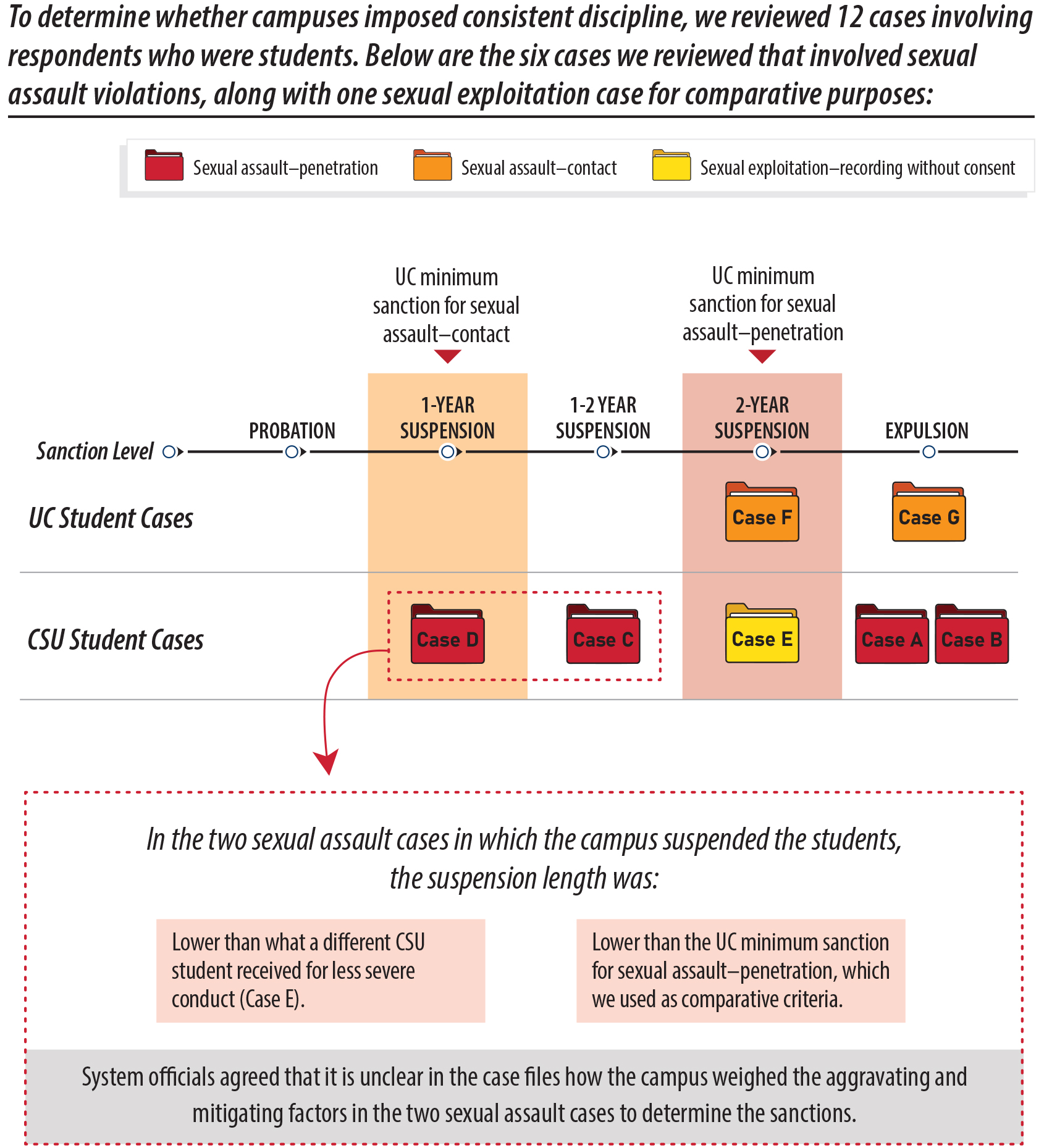
Source: Case files, UC policy, and interviews with system officials.
Figure 11 outlines the different disciplinary outcomes for student respondents in the cases we reviewed that resulted in discipline. One sexual assault-contact case received a 2-year suspension and another received an expulsion. Two sexual assault-penetration cases received expulsions and one sexual exploitation case received a 2-year suspension. In a noted discrepancy, two sexual assault-penetration cases we reviewed received suspensions below two years. This was both lower than what a student received for less severe conduct and lower than the UC minimum sanction for the policy violated.
Beyond inconsistencies within the same campus, we also identified an inconsistency between the two CSU campuses we reviewed. Figure 11 shows that the students in Cases C and D received less severe sanctions for sexual assault with penetration than the two‑year suspension another student at a different CSU campus received in Case E for filming other students without their consent—a sexual exploitation violation. Based on our review of those three case files, including the aggravating and mitigating factors in each case, and of comparative criteria such as UC cases and policy, we could not understand the basis for the disparity in sanction levels between Cases C and D and Case E. This type of disparity raises concerns about whether students may receive unfairly different discipline based on the CSU campus they attend.
One reason we questioned these disciplinary outcomes is that the case files did not always include clear rationales for how campus officials had weighed different aggravating and mitigating factors to arrive at the specific sanctions they imposed. In Case C, for example, the campus officials’ analysis merely noted that there were no mitigating factors and that the findings were serious violations of CSU policy, rather than explaining in detail how certain aggravating factors—such as the respondent’s use of force and multiple assaults and the complainant’s impact statement describing significant educational disruption and safety concerns—translated into a suspension rather than an expulsion.
In Case D, the campus’s analysis included a more thorough explanation of aggravating and mitigating factors than in Case C and referenced detailed sanction history from previous cases; however, those cases appear to involve dating violence rather than sexual assault. Although the sanction history the campus drew on was for the incorrect policy violation, campus officials told us that the one‑year suspension significantly affected the respondent’s life and that the sanctions included an educational component, reflecting the campus’s role as an educational institution. Nevertheless, the campus imposed more severe sanctions in Cases A and B, which we found were comparable cases, and we have concerns that such inconsistencies might lessen a complainant’s trust in the process. An official with the CSU Chancellor’s Office agreed that the sanctions in Cases C and D did not align with institutional precedent and that the decision‑makers’ analysis lacked the detail necessary to explain how the campus had arrived at those sanctions.
A related and underlying factor is that CSU’s policies do not include any minimum sanctions to serve as baseline or default levels of discipline that campuses can adjust for a given case if they document a rationale. In contrast, UC’s student adjudication policy includes minimum sanctions for sexual assault, dating or domestic violence, and stalking. UC’s approach has two clear benefits. First, it sets a common standard for campus officials and students to introduce a basic level of accountability and disciplinary consistency for the most severe violations. Second, it strengthens campuses’ rationales for the discipline they impose because campuses can begin with the minimum sanction as a default and then increase or decrease it based on specific aggravating or mitigating factors.
As an example of how minimum sanctions function in practice, UC’s policy sets a minimum sanction of at least a one‑year suspension for sexual assault‑contact violations unless there are exceptional circumstances. Figure 11 shows that the two UC cases we reviewed involving sexual assault‑contact violations (Cases F and G) resulted in the campuses imposing sanctions that met or exceeded this minimum sanction. Further, the campuses thoroughly documented the aggravating factors in each case that supported their decisions to impose more severe sanctions than the minimum. If CSU had adopted UC’s minimum two‑year suspension for sexual assault with penetration, the campus might have imposed more consistent sanctions for Cases A through D and at least would have been expected to justify why exceptional circumstances existed in Cases C and D that warranted less severe suspensions. Without establishing minimum sanctions for the most severe violations and requiring documented rationales for deviating from them, CSU policy lacks an adequate structure to ensure that campuses’ sanctions are consistent.
Some CSU campus officials told us that minimum sanctions could create a rigid system that limits their ability to impose flexible and case‑specific sanctions. One official also stated that such a system reflects a criminal justice approach rather than an educational approach and would disproportionality affect marginalized students who may lack the financial means to secure sustained advocacy throughout the process. However, UC’s policy demonstrates that minimum sanctions can be flexible and allow deviations under exceptional circumstances. In fact, one UC case we reviewed as part of our investigations analysis included a deviation in which the campus imposed only a one‑quarter suspension for sexual assault‑contact and justified its basis for the exceptional circumstance.
UC campus officials generally acknowledged the benefits of minimum sanctions. UC Irvine’s associate director of student conduct explained that minimum sanctions can be helpful in determining student sanctions and can set expectations for students when they give their input on proposed sanctions. UC Riverside’s assistant director of student conduct similarly noted that minimum sanctions create a systemwide baseline for certain conduct violations. The assistant director also emphasized that they apply only to cases with the most serious violations and that the campus often imposes sanctions stricter than the minimums in those cases. The CSU Chancellor’s Office generally agreed that minimum sanctions or sanction ranges could increase disciplinary consistency and was drafting new sanction guidelines at the time of our audit.
One Campus Lacked a Clear Rationale for Not Dismissing an Employee for Egregious Conduct
The discipline process for UC and CSU employees is more complex than the student discipline process because it applies to various types of employees, including Senate faculty, non‑Senate faculty, and staff, and each employee type has distinct procedures and decision‑makers. Staff cases rely primarily on administrators, while faculty cases include review by peers and additional procedures. Further, as the text box shows, employees can receive a broad range of disciplinary actions. Nonetheless, the employee discipline process is like the student discipline process in that both are grounded in the principle of ensuring that outcomes are consistent, appropriate, and proportional to the conduct.
Campuses Can Impose a Range of Disciplinary Actions on Employees
Examples of disciplinary actions for UC and CSU employees, in order of severity:
- Training
- Warning/written censure
- Suspension
- Demotion/salary decrease
- Dismissal
Examples of factors that UC campuses may consider in determining disciplinary action for faculty sexual harassment respondents:
- Prior history of substantiated sexual harassment cases
- Use of force
- Power differential
- Impact of conduct
Source: UC and CSU policies.
To evaluate the systems’ employee disciplinary processes and the outcomes they produce, we reviewed eight judgmentally selected case files—one from a CSU campus and seven from UC campuses—all involving employees found to have violated sexual harassment policies.6 We identified significant concerns related to one of these eight cases and procedural concerns about another, both of which we include in Figure 12. In Case 1, the discipline for a UC faculty member was inconsistent with other cases we reviewed and arguably disproportionate to the nature and history of the respondent’s conduct. In Case 2, an inconsistent Academic Senate bylaw may have contributed to a committee recommending a suspension rather than a dismissal for another UC faculty member, although the campus chancellor ultimately upheld the dismissal.7
Figure 12
A UC Campus Did Not Dismiss a Faculty Member Even Though UC Campuses Dismissed Two Other Employees for Similar or Less Egregious Conduct
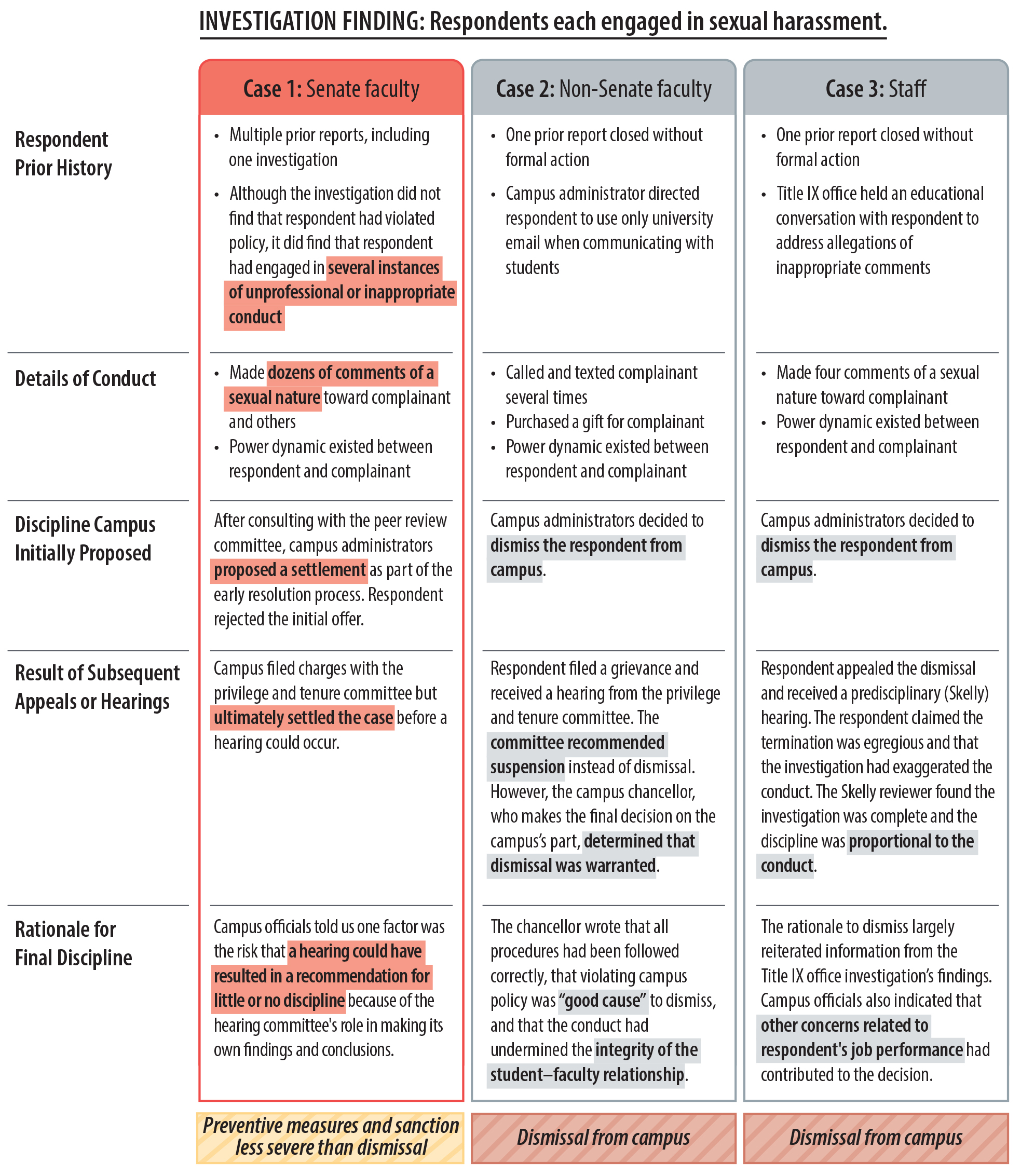
Source: Case files and UC policies.
Note: To protect the privacy of those involved in these cases, we do not specify which UC campus handled which case in this figure. However, the cases above include both UC Irvine and UC Riverside cases.
Figure 12 compares the case details and discipline outcomes for three different employee cases at UC campuses. In one case, an employee made dozens of comments of a sexual nature towards a complainant and already had multiple prior reports, including an investigation. The campus eventually chose not to dismiss this employee and instead pursued a settlement with the respondent prior to any hearing on the case. In the other two cases, the employees each had one prior report and engaged in conduct that was concerning but less severe than the reported conduct of the first employee. In both cases, the campuses decided to dismiss the employees.
As Figure 12 shows, a UC campus did not dismiss the faculty member in Case 1 but campuses did dismiss the faculty and staff respondents in Cases 2 and 3 for engaging in conduct that was similar in nature or less severe. This discrepancy raises concerns about whether campuses applied employee discipline consistently in these cases. Beyond the inconsistency, specific factors in Case 1 caused us to question whether the discipline was appropriate and proportional to the conduct. For example, the respondent had a history of similar allegations, and the campus had made previous attempts to intervene in the behavior.
Despite these concerns, nothing in the case file or accompanying documents clearly explained why the specific factors in Case 1 did not warrant dismissal. Instead of proceeding with a hearing before the privilege and tenure committee—which reviews formal disciplinary charges against faculty members and would have made a recommendation to the chancellor for a final decision—the campus resolved the case through a voluntary agreement (settlement) as part of the early resolution process. The case file did not contain a rationale explaining why the campus decided to settle or how it arrived at the final terms. Settlements understandably involve negotiations and considerations that make documenting a rationale more complex. Nevertheless, the documents available from Case 1 caused us to question the campus’s decision not to pursue dismissal, especially considering that campuses dismissed the respondents in Cases 2 and 3.
Differences in employee types and protections help explain some variation in disciplinary outcomes, but these differences did not alleviate our concerns with the inconsistencies between Case 1 and other cases we reviewed. For example, cases with staff respondents—as opposed to faculty respondents—follow a disciplinary framework under which supervisors and administrators have clear authority to dismiss respondents for sexual harassment, subject only to a limited appeal process. Certain staff may also be “at will” or subject to dismissal without cause. In every case we reviewed involving a staff respondent, including Case 3 from Figure 12, the campus dismissed the respondent. We recognize that faculty disciplinary processes can be more complex than those for nonfaculty staff members and may require additional steps and considerations. Nonetheless, we are concerned that these differences alone do not clearly explain why the campus did not pursue dismissal in Case 1.
Not every official involved in Case 1 was still at the campus and available to speak with us; however, those who were pointed to risks related to the privilege and tenure committee’s role in making its own findings and conclusions and to risks related to the respondent’s due process rights as reasons for settling the case. Campus officials told us that pursuing a settlement may have been the most reliable path to ensuring some level of accountability, given the possibility that the hearing committee might have found that the preponderance of evidence did not support a policy violation or might have recommended minimal discipline because of the evidence available at the hearing. Campus officials also cited the risk of subsequent litigation related to the respondent’s due process rights. However, in Case 2, a campus proceeded with a privilege and tenure committee hearing despite similar risks and ultimately dismissed the respondent. Taken together, Cases 1 and 2 demonstrate to us that campus administrators may weigh these types of risks inconsistently.
Given that employee discipline involves complex processes and multiple stakeholders, increased oversight from the UC Office of the President could be especially beneficial to help ensure reasonable consistency across cases. For example, the Office of the President could consider revising its policies to require campus decision‑makers to provide detailed rationales that justify the specific sanctions they impose, similar to its existing policies for student discipline that require consideration of aggravating and mitigating factors. The Office of the President has already developed guidance around aggravating and mitigating factors for faculty respondent cases that it could use in implementing such an effort. In addition, the office collects data from campuses on the discipline they impose and could leverage those data to identify potential inconsistencies, review case specifics, follow up with campuses as needed, and provide guidance or make policy changes to address any potential concerns.
The Campuses Documented That They Had Carried Out Assigned Disciplinary Actions
Beyond assessing whether student and employee discipline was proportional to the respondents’ conduct and consistent across cases, we also reviewed whether campuses followed through by carrying out that discipline. In our 2023 audit of CSU, our office identified instances in which campuses could not demonstrate that they had implemented discipline or corrective actions.8 Further, state law requires our office to assess, in selected cases, whether the discipline that campuses administered effectively deterred future harassment—which relies on campuses appropriately administering that discipline. As a result, for the 20 discipline cases in our selection, we verified whether campuses carried out the final disciplinary actions that decision‑makers had assigned.
We found that campuses appropriately carried out the required discipline in all 20 cases. For the 12 cases involving discipline for students, campuses documented that they had administered the intended sanctions in each case by taking steps such as providing evidence of respondents’ suspensions or reflection essays. In two of these cases, students who had received disciplinary probation and educational sanctions did not complete required sanctions, such as reflection essays, within the campus’s specified deadlines. However, the campus then appropriately placed a hold on each student’s records pending completion of the sanctions, and the students had yet to re‑enroll at the campus at the time of our audit. We also checked with the UC Office of the President and the CSU Chancellor’s Office to ensure that the students from our selection of 12 cases who separated from their campus after receiving discipline did not subsequently enroll at another campus within the same system.
Similarly, for the eight cases in our selection involving employees, the campuses provided sufficient evidence that they had carried out the required discipline. In one case, the campus intended to dismiss the respondent, but the respondent was laid off because of an unrelated departmental closure before the dismissal could be imposed. Nonetheless, the campus Title IX office documented that it had shared its investigatory findings with another UC campus that had reached out regarding the respondent’s employment application and further noted that its investigatory findings would remain in the respondent’s personnel file for future reference. As we did for student respondents, we also confirmed with the UC Office of the President and the CSU Chancellor’s Office that none of the employee respondents from our case selection whom a campus dismissed had moved to another campus within the same system. We discuss each system’s compliance with new passing the harasser laws in the next section.
Other Areas We Reviewed
The CSU Chancellor’s Office Should Make Specific Updates to Its Policies to Fully Implement New Statutory Requirements
Our audit objectives include evaluating whether UC’s and CSU’s sexual harassment policies and practices are consistent with federal and state law. In addition to reviewing the systems’ and selected campuses’ compliance with various legal requirements as part of our case file testing, we also reviewed UC’s and CSU’s policies for compliance with several new statutory requirements that generally relate to employee respondents. These requirements place restrictions on official letters of recommendation and on the option for formerly tenured faculty members to return to a faculty position after leaving an administrator position (retreat rights). They also limit the use of alternative resolution agreements and settlements. Finally, they require for CSU and request for UC that as part of the hiring process, campuses take steps to obtain information about applicants’ previous instances of substantiated misconduct, with the intent of preventing an issue known as passing the harasser.
UC’s current policies generally comply with the statutes we evaluated. Although CSU’s current policies comply with several aspects of these statutes, Table 1 identifies areas in which we recommend that the CSU Chancellor’s Office make targeted updates to ensure the policies’ full compliance with state law. One example that we include in Table 1 is the absence of an explicit prohibition on the use of alternative resolution agreements—which CSU’s policy refers to as informal resolution—between student complainants and employee respondents or in any cases involving employee respondents who have been accused of committing sexual assault, sexual violence, or sexual battery.
The assistant vice chancellors for civil rights and for human resources in CSU’s Office of General Counsel provided context for the omissions, including that the state law prohibiting such agreements between student complainants and employee respondents defines informal resolution differently than CSU policy does. They also explained that the types of agreements state law restricts would be rare or CSU would not allow them in practice and that substantive revisions to policy generally require bargaining with labor unions. They further stated that although CSU does not consider its current policy language to be noncompliant with state law, it is open to updating the policy to reflect the language in the statute should it be necessary to fully comply. We recommend making the prohibitions explicit in policy to fully comply with state law.
Although we reviewed some cases that would have been subject to restrictions in the new statutes, campuses closed those cases before the new requirements took effect in January 2025. Therefore, the gaps in campus policy that we describe in this section did not have a material effect on any of the specific cases we evaluated.
Recommendations
UC Office of the President and CSU Chancellor’s Office
To ensure that complainants who wish to engage with a campus Title IX office have every opportunity to do so, the UC Office of the President and the CSU Chancellor’s Office should, by January 2027, revise their sexual harassment policies or related guidance—and provide accompanying training or support as needed—to direct campus Title IX offices to do the following:
- Briefly document the office’s rationale for using or not using contact methods other than university email, such as a phone number or personal email address, to reach a complainant. At minimum, the offices should document this brief rationale for any report alleging sexual harassment that could result in an alternative resolution or investigation and that the office intends to close without formal action primarily because a complainant has not responded to emails. As part of this rationale, the office should also consider whether it is appropriate to communicate with third parties who are aware of the case and familiar with the Title IX process by taking steps such as reaching out to a mandated reporter or CARE official to confirm a complainant’s contact information or to ask about the complainant’s interest in engaging with the office.
- During intake meetings, ask complainants for their preferred email address and ask whether they are comfortable receiving a phone call or text message as a secondary option if at some point they do not respond to the office’s emails. The offices should document the results of these questions, including the email address and phone number as appropriate. The offices should also consider incorporating these questions into their forms for reporting sexual harassment, if the forms do not already include them.
To ensure that campus Title IX offices consistently address respondents’ alleged behavior and reduce the risk of its recurrence, the UC Office of the President and the CSU Chancellor’s Office should, by January 2027, do the following:
- Revise their sexual harassment policies or related guidance to set a clear expectation that campus Title IX offices should consider holding and documenting educational conversations with respondents for cases they close without formal action. The policies or guidance should include examples of factors for offices to consider when they decide whether these conversations are advisable, such as the complainant’s wishes and safety, the severity of the allegations, and the likelihood that a conversation could help prevent future misconduct. The policies or guidance should also require offices to document a brief rationale when they decide a conversation is unnecessary for a report that names a respondent affiliated with the campus and includes allegations that, if true, would violate the sexual harassment policy.
- Provide training—along with templates or other guidance, as needed—to help campus Title IX office staff execute and document educational conversations effectively. For example, the systems could share UC Irvine’s approach to holding and thoroughly documenting its policy compliance meetings.
To improve campus Title IX offices’ communication with complainants and reduce barriers to complainants’ participation in an investigation, the UC Office of the President and the CSU Chancellor’s Office should, by January 2027, revise their policies or guidance, conduct training, or take other steps to provide campus offices with direction and strategies for making timely decisions about approving or not approving a complainant’s request for an investigation and for informing the complainant about that decision as soon as possible, even if that communication is informal. The system offices should include examples of situations that could warrant expedited approval of a request for an investigation, such as if the campus has already begun the alternative resolution process and the complainant requests to end that process and instead pursue an investigation.
To reinforce complainants’ agency in choosing a resolution option and to help campus Title IX offices remain neutral in that process, the UC Office of the President and the CSU Chancellor’s Office should, by January 2027, take steps to ensure that campus offices confirm in writing how the complainant would like to proceed after key meetings with campus Title IX staff. For example, the system offices could provide a standard email template for campuses to use for follow‑up communication that thanks the complainant for meeting, reminds them of their agency in the process, and confirms the office’s understanding of whether the complainant wants an investigation, wants to begin or continue the alternative resolution process, wants the campus to close the case without formal action, or wants more time to decide.
To strengthen the quality, consistency, and trauma‑informed nature of investigation and hearing reports, the UC Office of the President and the CSU Chancellor’s Office should, by July 2027, revise their systemwide policies or related guidance to require campus Title IX offices to review all draft hearing officer reports. The revised policies or guidance should include the following components:
- Clarify the permissible scope of the Title IX offices’ review by defining the specific types of feedback reviewers may provide—such as identifying inconsistent applications of system policy or the use of problematic language—while prohibiting input that would affect the hearing officer’s independence, such as altering the officer’s factual findings or responsibility determinations.
- Establish expectations for what the Title IX offices’ review must evaluate, including whether credibility assessments, evidence analyses, and policy applications are complete, well‑supported, and consistent with systemwide policy and whether the draft report includes only language that is trauma‑informed.
- Require the Title IX offices to confirm in writing the completion of their review before issuance of the hearing officer’s report.
UC Office of the President
To improve the consistency, transparency, and appropriateness of disciplinary decisions involving employee respondents found to have violated its sexual harassment policy, the UC Office of the President should, by July 2027, take action to standardize campuses’ approaches to determining and justifying employee discipline, especially for faculty members, and report to us on its efforts. For example, the Office of the President could consider taking one or more of the following actions:
- Revise its policies to require the final campus decision‑maker in each employee discipline case—such as the chancellor or chancellor’s designee for faculty respondent cases—to provide to the campus Title IX office a written rationale that considers specified aggravating and mitigating factors and justifies the specific, final disciplinary actions.
- Establish a process to routinely identify in its discipline data potentially inconsistent disciplinary outcomes across cases and campuses, to determine the reasons for the discrepancies, and to provide guidance or make policy changes as necessary. For instance, the Office of the President could provide campus decision‑makers with information about typical or expected disciplinary outcomes based on employee type and the nature of the violations.
CSU Chancellor’s Office
To improve consistency and proportionality in disciplinary sanctions involving student respondents, the CSU Chancellor’s Office should, by July 2027, revise its systemwide policies or related guidance to establish minimum sanctions for at least the most severe sexual harassment violations and to require documented rationales from campus officials for all sanctions, similar to the UC system’s policies. The revisions to policy or guidance should do the following:
- Set minimum sanctions for students found responsible for sexual assault, while still allowing for deviations in exceptional circumstances.
- Require student disciplinary decision‑makers to provide written rationales that identify specific mitigating and aggravating factors they used to support each sanction. For example, when a sanction is below the minimum sanction, decision‑makers should explain their reasoning using specific mitigating factors that apply to the case.
To ensure that its policies fully comply with state law, the CSU Chancellor’s Office should, by July 2027, revise its policies to implement each specific component of Education Code section 66284, including closing the gaps we show in Table 1 related to campuses’ use of retreat rights, settlements, and informal resolutions.
We conducted this performance audit in accordance with generally accepted government auditing standards and under the authority vested in the California State Auditor by Government Code section 8543 et seq. Those standards require that we plan and perform the audit to obtain sufficient, appropriate evidence to provide a reasonable basis for our findings and conclusions based on the audit objectives. We believe that the evidence obtained provides a reasonable basis for our findings and conclusions based on our audit objectives.
Respectfully submitted,
GRANT PARKS
California State Auditor
June 30, 2025
Staff:
John Lewis, MPA, CIA, Audit Principal
Michael Valdez, Senior Auditor
Nick Versaci, Senior Auditor
Atena Baghbanian
Kendall Leon, PhD
Annie Lloyd
Cameron Parker
Meredith Wang
Aidan Wogan
Legal Counsel:
David King
Appendices
- Appendix A—Data From the Four Campuses We Reviewed
- Appendix B—Implementation Status of Prior Recommendations to the UC and CSU System Offices
- Appendix C—Scope and Methodology
Appendix A
Data From the Four Campuses We Reviewed
Appendix B
Implementation Status of Prior Recommendations to the UC and CSU System Offices
From 2013 through 2023, we conducted three audits of UC’s and CSU’s responses to sexual harassment reports. As Table B demonstrates, the systemwide offices have fully implemented nearly all our previous recommendations.
Appendix C
Scope and Methodology
Education Code section 67382.1 requires the California State Auditor to conduct audits of the ability of the UC and CSU systems to address and prevent sexual harassment on campus. The first of these four audits must be completed in or before 2026, and the remaining audits must occur every three years thereafter until 2036. Table C lists our objectives and the methods we used to address them. Unless otherwise stated in the table or elsewhere in the report, statements and conclusions about items selected for review should not be projected to the population.
Assessment of Data Reliability
The U.S. Government Accountability Office, whose standards we are statutorily obligated to follow, requires us to assess the sufficiency and appropriateness of computer‑processed information we use to support our findings, conclusions, or recommendations. In performing this audit, we relied on electronic data files that we obtained from UC Irvine, UC Riverside, Cal Poly San Luis Obispo, and Sacramento State. To evaluate these data, we reviewed information about the data, interviewed staff knowledgeable about the data, and conducted electronic testing of key data elements. We found the data to be of undetermined reliability. Although we recognize that this limitation may affect the precision of the numbers we present, there is sufficient evidence in total to support our audit findings, conclusions, and recommendations.
Responses
California State University
June 12, 2026
Mr. Grant Parks
State Auditor
California State Auditor
621 Capitol Mall, Suite 1200
Sacramento, California 95814
Dear Mr. Parks:
Thank you for the opportunity to review and respond to the draft audit report on sexual harassment. The CSU agrees with the recommendations detailed in this audit report and is committed to implementing them as part of our ongoing efforts to strengthen systemwide Title IX/sexual harassment oversight, consistency, and compliance. As you are already aware, implementation efforts related to settlement agreements, the development of student sanction guidelines, improved response protocols for repeat respondents, and enhanced strategies for delivering educational conversations, when appropriate, are already underway.
We appreciate that the report reflects the substantial progress the CSU has made since the CSA’s 2023 review in strengthening its Title IX framework and systemwide response processes. In particular, we value the recognition of CSU’s improvements in responding to sexual harassment matters, including implementation of nearly all prior audit recommendations, the development of a more hands-on systemwide oversight model, as reflected in the report, and improved timeliness in completing investigations.
The CSU remains committed to continuous improvement and views the recommendations in this report as an important opportunity to further strengthen our policies, practices, and support for students and campus communities.
On behalf of the CSU, I extend my appreciation to the audit team for their diligence, professionalism, and collaboration throughout the audit process.
Sincerely,
Mildred García
Chancellor
University of California
June 12, 2026
Mr. Grant Parks
California State Auditor
621 Capitol Mall, Suite 1200
Sacramento, CA 95814
Dear State Auditor Parks:
Thank you for the opportunity to review and respond to the draft audit report. We appreciate the time and effort your team has committed to this audit and their engagement with personnel at UCOP, UC Irvine, and UC Riverside.
Preventing and addressing sexual harassment across all UC campuses and locations is a priority of the University of California. We strive to maintain policies, procedures, and practices that reflect our commitment to care and fairness, fully comply with state and federal law, and are consistently implemented systemwide.
We accept the report’s recommendations and are committed to implementing them. As we work toward fulfilling the recommendations, our commitment remains steadfast to our UC community members so that they may continue to pursue their educational and career goals in an environment free from sexual harassment.
Sincerely,
James B. Milliken
President
cc: Senior Vice President Bustamante
Systemwide Executive Director Spear
Systemwide Deputy Audit Officer Hicks
Systemwide Director Richardson
Footnotes
- We selected a total of 100 cases across different phases of the case resolution process. Three cases we selected overlapped between the investigation and discipline phases, resulting in 97 unique cases. ↩︎
- Sexual harassment is defined under federal and state law to refer to a range of inappropriate conduct of a sexual nature, including sexual assault and stalking. ↩︎
- Sexual Harassment and Sexual Violence: California Universities Must Better Protect Students by Doing More to Prevent, Respond to, and Resolve Incidents, Report 2013‑124, June 2014; The University of California: It Must Take Additional Steps to Address Long‑Standing Issues With Its Response to Sexual Harassment Complaints, Report 2017‑125, June 2018; California State University: It Did Not Adequately or Consistently Address Some Allegations of Sexual Misconduct, Report 2022‑109, July 2023. ↩︎
- Our concerns about the fifth respondent relate to a UC campus’s investigative determination that the respondent had not violated policy. However, this investigation preceded our audit period, and we did not identify similar concerns in any of the investigations we reviewed that the campus had completed more recently. ↩︎
- For example, campuses consistently documented both parties’ agreement to the final terms and consistently documented the completion of those terms. Three of the 20 cases did not result in a finalized agreement for clear, documented reasons, such as one party ultimately not agreeing to the terms and therefore not signing the agreement. ↩︎
- Our selection included mostly UC cases because the two CSU campuses we reviewed closed few cases that involved employee discipline during our two‑year audit period. ↩︎
- The inconsistency was with UC Academic Senate bylaw 337. At the time of our audit, that bylaw applied the clear and convincing evidence standard even though related bylaw 336 applied the preponderance of evidence standard for allegations involving sexual violence or sexual harassment. Because the effect of this inconsistency was minimal with respect to the case we reviewed, we did not make a formal recommendation regarding it. Additionally, in June 2026, the Academic Senate was in the process of revising bylaw 337 to align it with bylaw 336. ↩︎
- California State University: It Did Not Adequately or Consistently Address Some Allegations of Sexual Harassment, Report 2022‑109, July 2023. ↩︎