
2025-049 Mendocino County
It Should Continue to Address Its Strained Financial Condition and Can Improve Several Important Operational Processes
Published: December 18, 2025Report Number: 2025-049
December 18, 2025
2025-049
The Governor of California
President pro Tempore of the Senate
Speaker of the Assembly
State Capitol
Sacramento, California 95814
Dear Governor and Legislative Leaders:
As required by Government Code section 8546.11, my office conducted an audit of Mendocino County (Mendocino). This report concludes that Mendocino must take additional action to address its strained financial condition and improve several processes critical to its operations.
From fiscal year 2019–20 through 2023–24, Mendocino experienced trends that threaten its financial health, including expenditures that have grown more quickly than revenue and a decrease in its general fund reserve. Mendocino has faced a persistent deficit when developing its annual budget and will likely continue to face these deficits without further action. Moreover, Mendocino’s procurement and financial reporting processes leave it vulnerable to waste, fraud, and abuse. We found insufficient documentation or justifications for nearly half of the 30 expenditures we reviewed and found some expenditures violated prohibitions on direct funding of religious organizations and gifts of public funds. Mendocino also lacked adequate justifications for sole-source contracts, and county departments have split contract agreements across multiple years, allowing them to avoid certain requirements or approvals. Moreover, the Auditor-Controller-Treasurer-Tax Collector’s Office must take corrective action to address known deficiencies in its procedures that have contributed to late financial reporting.
Finally, the county experienced two errors in the 2024 presidential primary election. The county’s Elections Office was not responsible for the first error, in which incorrect ballots were mailed to nearly all voters. However, the Elections Office assigned voters to incorrect voting precincts, causing some voters to receive incorrect ballots again. We found that as of the time of our audit, the Elections Office still had not ensured that it had assigned all voters to their correct precincts, which could lead it to issue additional incorrect ballots in the future.
Respectfully submitted,
GRANT PARKS
California State Auditor
Selected Abbreviations Used in This Report
| ACFR | Annual Comprehensive Financial Report |
| ACTTC | Auditor-controller-treasurer-tax collector |
| CEO | Chief executive officer |
| DGS | California Department of General Services |
| GFOA | Government Finance Officers Association |
| GIS | Geographical Information Systems |
| RFP | Request for proposal |
| RGS | Regional Government Services |
| SCO | State Controller’s Office |
| SOS | California Secretary of State |
| USDOJ | U.S. Department of Justice |
Summary
Key Findings and Recommendations
Mendocino County (Mendocino) is a county in northern California with a population of about 90,000. The county is governed by a five-member board of supervisors (board) that serves as the county’s executive and legislative body. The board appoints a chief executive officer (CEO) who is responsible for directing the overall operation of the county. Apart from the supervisors, there are four other elected officials that play key roles in the overall operations of the county. They are the assessor-clerk-recorder, the auditor-controller-treasurer-tax collector (ACTTC), the sheriff, and the district attorney. Recently, media reports have indicated that Mendocino has struggled financially and that errors occurred in the county’s administration of the 2024 presidential primary election (2024 primary election). Because of these concerns, the Legislature and the Governor amended state law to require our office to perform an audit of Mendocino in specified areas. This audit responds to that requirement and concludes the following:
Mendocino’s Financial Condition Is Gradually Declining and Requires Corrective Action
From fiscal year 2019–20 through 2023–24, Mendocino experienced three significant trends that threaten its overall financial health: stagnating tax revenue, expenditures that have grown more quickly than revenue, and a decrease in its general fund reserve. The county’s total tax revenue, which is its second largest source of revenue, remained relatively unchanged for the five-year period while expenditures from its general fund grew by more than 30 percent and its general fund reserve dropped slightly below the recommended minimum level. As these trends have occurred, Mendocino has dealt with issues related to its property tax system, which have contributed to untimely assessments of properties to determine their taxable value and uncollected past due taxes. The county estimated that as of December 2025 it had $30.6 million in uncollected taxes, penalties, interest, and fees related to defaulted properties. Also, for the past three fiscal years, Mendocino has faced a deficit when developing its annual budget. As a result, it has had to plan for the use of one-time funding and delays in spending to create balanced budgets. Although Mendocino has thus far been able to avoid the use of these one-time funds to address actual costs, we believe that it will continue to face persistent deficits if it does not take additional action to address its budget deficit, such as raising tax rates.
The County’s Procurement and Financial Reporting Processes Leave It Vulnerable to Waste, Fraud, and Abuse of Public Funds
Mendocino has not exercised sufficient oversight of staff spending that would best protect it against waste, fraud, and abuse. We reviewed 30 total expenditures from across three county departments and found problems with the documentation or justification supporting nearly half of these expenditures. For example, staff purchased items such as a television without documenting the reasons why and did not reconcile advance payments to staff for travel with the actual costs of those trips. In addition, we found that Mendocino has not sufficiently overseen the use of the asset forfeiture funds spent by the Sheriff’s Office and District Attorney’s Office. As a result, we found that these offices were making donations of these funds without adequate safeguards against improper spending. In fact, we found donations to a religiously affiliated school that violate state and federal constitutional provisions, and we also found that the District Attorney’s Office made a gift of public funds when it spent $3,600 on an end-of-year gathering and dinner event for its staff and their guests. Finally, more than half of the 20 sole‑source contract agreements we reviewed lacked adequate justification to support that a sole-source contract was necessary, and county departments split contract agreements across multiple years, allowing them to avoid seeking competitive bids for agreements or obtaining board approval for the use of county funds on these contracts.
A Vendor Mistake and a Weak County Process Caused Ballot Errors in the 2024 Primary Election
During Mendocino’s administration of the 2024 primary election, the county’s ballot printing vendor issued incorrect ballots to nearly every one of the more than 50,000 voters in the county. Although the county responded quickly to issue corrected ballots, 691 voters submitted only the incorrect ballot when they voted. Shortly after resolving this error, the county discovered that it had not placed some voters in the correct voting districts and had to send another corrected ballot to 177 voters. We concluded that the county still has not placed all voters in the correct voting precincts, which can affect what races appear on their ballots.
We made recommendations to the county to take steps to address its declining fiscal condition, including engaging with its residents about raising additional revenue and making cuts to its expenditures. Additionally, we recommend that the county establish greater oversight over spending and create accountability for the use of asset forfeiture funds by having offices or departments that spend those funds report to the board annually about their use of the funds. Finally, we recommend that the county establish a more robust process for assigning voters to the correct voting precincts to protect the integrity of future elections.
Agency Comments
The board, CEO’s Office, Assessor-Clerk-Recorder’s Office, and ACTTC’s Office agreed with our recommendations and indicated they were willing to implement them. Although we did not make any recommendations directly to the Sheriff’s Office, it agreed with our conclusions. We also did not make any recommendations to the District Attorney’s Office, but that office expressed disagreement with our conclusions about its operations.
Introduction
Background
Mendocino is a county in northern California with a population of about 90,000. As Figure 1 shows, a five-member board governs the county. Each member of the board represents a district that comprises a distinct geographic area of the county. The board serves as the legislative and executive body in county government and determines the overall policies for county departments. It also appoints the CEO, who is responsible for implementing the board’s policies and, more generally, for planning, organizing, controlling, and directing the overall operation of the county. In addition, the CEO serves as the liaison between the board and department heads and elected officials. Several departments at the county—including Social Services, Behavioral Health, and Human Resources—report to the CEO.
Figure 1
Summary of the Organization of Mendocino’s Government

The figure is structured as a flowchart. At the top of the flowchart are the citizens of Mendocino County.
This flows via five arrows into five different elected offices.
These are the Accessor-Clerk-Recorder, the Auditor-Controller-Treasurer-Tax Collector, the Sheriff, the District Attorney, and the Board of Supervisors, which includes five members.
The Board of Supervisors oversees all the county departments not headed by elected officials. Under the Board of Supervisors is the Chief Executive Officer, which reports to the Board of Supervisors and manages the County departments, including Social Services, the Behavioral Health Department, and Human Resources, among others.
Source: Mendocino’s 2024–25 budget book.
Mendocino has four other elected officials: the assessor-clerk-recorder, the ACTTC, the district attorney, and the sheriff. Some of these officials serve in multiple roles related to county governance. For example, the county’s assessor-clerk-recorder is responsible for assessing taxable property, processing and maintaining legal records such as marriage certificates, and administering county elections.
Mendocino’s board voted in 2021 to consolidate what were then two separately elected positions: auditor-controller and treasurer-tax collector. Consequently, Mendocino’s ACTTC is currently responsible for several functions critical to financial management, accounting, and financial reporting at the county, as the text box shows. In November 2025, the board voted to separate the two positions—an action that will take effect in January 2027.
Roles and Responsibilities of the ACTTC
- Exercising general supervision over the method of keeping accounts used by all entities under the board’s control.
- Responding to board orders to maintain statistics and prepare reports that are needed for the management of the county.
- Acting as financial counsel to the board and CEO.
- Receiving and disbursing funds into and from the county’s treasury.
- Preparing the county’s Annual Comprehensive Financial Report and the fiscal schedules for the county’s annual budget.
- Collecting, maintaining custody of, and investing county funds.
- Administering the collection of property and cannabis‑related taxes.
Source: State law and Mendocino’s budget book.
Financial Management of the County
Mendocino’s government provides or facilitates services for county residents in several different areas, including public protection, public assistance, and health and sanitation. Each year, Mendocino creates a budget showing the amounts it plans to spend in these and other areas. The budget process begins with each county department developing the proposed budget for its operations in the upcoming fiscal year. The CEO and ACTTC meet with departments to discuss their budgets, and the CEO then produces the proposed budget for that fiscal year. The board is responsible for adopting the county’s annual budget. State law requires all counties to adopt a balanced budget in which budgeted expenditures equal budgeted revenue. Thus, Mendocino must balance its projected expenditures against the revenue it expects to receive from sources such as taxes, fees, and the state and federal government.
To ensure uninterrupted operations during emergencies and to serve as a buffer during economic downturns, it is important for governments to maintain an unrestricted general fund balance. The Government Finance Officers Association (GFOA) has recommended governments maintain a minimum unrestricted general fund balance of no less than two months of general fund revenue or expenditures. Unrestricted funds are those funds that a government can use at its discretion and that are not restricted to only specific uses by law, regulation, or grant agreement terms. The GFOA cautions that this guidance is a suggestion for the minimum balance that governments should carry and that the actual amount that a government chooses should reflect that government’s unique circumstances. For example, governments dependent on more volatile sources of revenue without corresponding flexibility to adjust expenditures may need to keep a larger balance. In this report, we refer to the unrestricted general fund balance as a general fund reserve and discuss Mendocino’s general fund reserve later in this report.
Throughout the year, Mendocino reports on its financial activities and condition. The CEO generally updates the board each quarter on the status of the budget for the current fiscal year, including projections of the revenue the county expects to receive in that fiscal year. Additionally, after the end of each fiscal year, Mendocino prepares its Annual Comprehensive Financial Report (ACFR), which provides information from its audited financial statements on the amount of funding received, spent, and available for each of its major funds. The finalized ACFR therefore provides critical information to county government officials and the public on Mendocino’s financial condition.
State Law Required an Audit of Mendocino’s Financial Controls and Elections
Recent media reports have indicated that Mendocino’s financial condition is poor or declining, citing the frustration of members of the board who stated that they did not know the county’s overall financial condition. Mendocino’s late financial reports prompted the State Controller’s Office to perform a review of Mendocino’s financial reporting that concluded in July 2024, and that review resulted in several recommendations for improvement. Additionally, the county encountered problems in 2024 during the administration of the primary election in which voters received incorrect ballots. Finally, in 2023 the ACTTC and another county staff member were indicted on charges of misappropriation of public funds. Those charges have since been dismissed.
These events have caused concern that Mendocino was not operating effectively. Accordingly, the Legislature and the Governor amended state law to require us to perform this audit by January 1, 2026. The audit was required to include a review of any potential waste, fraud, abuse, and mismanagement; the county’s administration of elections in 2024; and the county’s contracting and procurement. To evaluate Mendocino in these areas, we reviewed several county departments, including those administered by the CEO, the assessor-clerk-recorder, the ACTTC, the district attorney, and the sheriff. We identify the objectives for our audit in the Appendix.
Audit Results
- Mendocino’s Financial Condition Is Gradually Declining and Requires Corrective Action
- The County’s Procurement and Financial Reporting Processes Leave It Vulnerable to Waste, Fraud, and Abuse of Public Funds
- A Vendor Mistake and a Weak County Process Caused Ballot Errors in the 2024 Primary Election
Mendocino’s Financial Condition Is Gradually Declining and Requires Corrective Action
Key Points
- Mendocino County (Mendocino) faces a strained financial condition. Its tax revenue has remained generally unchanged over a five-year period, its expenditures are growing at a rate greater than its revenue, and its general fund reserve has declined.
- The county is behind in completing property tax assessments that would assist in identifying additional revenue and in collecting property taxes that have gone unpaid. Mendocino has struggled to complete property tax-related tasks since at least 2021 when it began using new software to assist its process. The county estimated that as of December 2025 it needed to collect $30.6 million in taxes, penalties, interest, and fees related to properties in default status.
- Mendocino faces a structural budget deficit that it is unlikely to resolve without further strategic action from its board of supervisors (board). Although the board has taken some steps to control expenditures, it will likely need to consider additional cuts to expenditures and methods of increasing revenue, such as tax increases.
Trends in Mendocino’s Revenue, Expenditures, and Reserve Are Straining Its Financial Health
Poor financial health can negatively affect a county’s ability to provide critical services such as public protection, health and sanitation, and public assistance to its residents. To assess Mendocino’s financial health, we analyzed the county’s financial trends from fiscal years 2019–20 through 2023–24. We found that the county’s ability to continue to provide its current level of services to its residents is at risk because of three significant trends: stagnating tax revenue, increasing expenditures, and a decrease in its general fund reserve.
Mendocino’s tax revenue did not grow significantly during the period we reviewed. As the text box shows, tax revenue was the second most common source of revenue for Mendocino’s governmental funds from fiscal years 2019–20 through 2023–24. The county’s largest source of revenue, intergovernmental revenue, increased in each year we reviewed, and the overall percentage of governmental fund revenue that was from intergovernmental sources was generally the same at Mendocino as we observed at some other counties. Accordingly, we have no concerns about Mendocino’s largest funding source. However, tax revenue remained relatively flat during the years we reviewed. Figure 2 shows the major tax revenue sources for the county and how much revenue they generated. Comparatively flat revenue growth from its second largest revenue source is a strain on Mendocino’s ability to maintain service levels for its residents, particularly because of the increasing expenditures we discuss later.
Mendocino’s Largest Revenue Sources for Governmental Funds and Average Annual Amounts
Intergovernmental Revenue (such as Medi-Cal or Mental Health Services Act funds)—$187.4 million
Tax Revenue (such as property and sales taxes)—$98.7 million
Other (such as fines or license fees)—$32.5 million
Source: Mendocino’s Annual Comprehensive Financial Report (ACFR) for fiscal years 2019–20 through 2023–24.
Figure 2
Mendocino’s Tax Revenue Remained Generally Consistent From Fiscal Years
2019–20 Through 2023–24

This figure shows a line graph with five lines representing different tax revenue trends at Mendocino County. The first line is Mendocino County’s total tax revenue, which has stayed generally flat from fiscal year 2019–20 to fiscal year 2023–24, rising from about $90 million to $105 million.
The total tax revenue is made up of four categories of tax revenue: Property Tax Revenue, Sales and Use Tax Revenue, Transient Occupancy Tax Revenue and Other Tax Revenue. These lines are shown below the total tax revenue line.
Property Tax Revenue, which makes up the majority of total tax revenue, rises from about $50 million to $65 million between fiscal year 2019–20 and fiscal year 2023–24. The line is generally steady except for a spike between fiscal year 2022–23 and fiscal 2023–24.
The second largest tax revenue type is Sales and Use Tax Revenue, which increased from about $25 million to $30 million between fiscal year 2019–20 and fiscal year 2023–24.
Transient Occupancy Tax makes up the third largest category and increased from around $5 million to $10 million between fiscal year 2019–20 and fiscal year 2023–24.
All other remaining tax revenue decreases from about $6 million to $2 million between fiscal year 2019–20 and fiscal year 2023–24.
Source: Mendocino’s audited financial statements.
During our audit period, Mendocino experienced the highest tax revenue growth in its property taxes. This revenue increased by about $11.5 million in fiscal year 2023–24, as Figure 2 shows. When we asked Mendocino’s acting assistant CEO (assistant CEO) about this increase, she explained that it was partially a result of the county’s concerted effort to collect supplemental property taxes because the county had a backlog of these tax bills. We discuss the county’s trouble with timely property tax collection in the next section. This effort caused the county to record a larger amount of revenue in fiscal year 2023–24. However, Mendocino has not projected that property tax revenue will continue to grow at this pace. When the county adopted its fiscal year 2025–26 budget, it projected that property tax receipts for fiscal year 2025–26 would be about the same as in fiscal year 2023–24.
The second significant trend Mendocino faces is the growth of its expenditures, which are increasing at a faster rate than its revenue. The county’s total revenue from all sources across all governmental funds—not only tax revenue—increased by 25 percent during the years we examined. However, expenditures from those same funds increased by 44 percent, or nearly twice as much as its revenue growth.
To review this trend more closely, we examined the change in revenue and expenditures within the county’s general fund. The general fund is the primary operating fund of the county and funds the county’s core services such as public safety and assistance. Although the county maintains other funds for specialized purposes, the general fund is the largest of the county’s governmental funds, accounting for more than half of the county’s revenue and expenditures from all governmental funds. As Figure 3 shows, revenue and all other funding flowing into the general fund increased by a total of about 20 percent, or about $43 million, during our audit period. However, over the same period, expenditures and all other funding flowing out of the general fund grew by 32 percent, or about $60 million.1
Figure 3
Mendocino’s General Fund Expenditures Increased Faster Than Its Revenue From Fiscal Years 2019–20 Through 2023–24

The graph shows two lines, one showing the changes in General Fund Revenue between fiscal year 2019–20 and fiscal year 2023–24 and the other showing changes in General Fund Expenditure between fiscal year 2019–20 and fiscal year 2023–24.
To the side of the line graph, the total growth of the two lines is shown. General Fund Revenue grew by 20% between fiscal year 2019–20 and fiscal year 2023–24 and General Fund Expenditure grew by 32% during the same period.
The graph shows that General Fund Expenditures and Revenues generally increased at a steady rate, but that General Fund Expenditures have grown faster than General Fund Revenues. The General Fund Revenue line spikes from fiscal year 2021–22 to fiscal year 2022–23, from about $215 million to $255 million. The reason for this spike is explained in the report text.
Source: Mendocino’s audited financial statements.
Note: We calculated general fund revenue by combining revenue and all other financing sources. We calculated general fund expenditures by combining expenditures and all other financing uses. Other financing uses in these fiscal years consisted only of transfers out of the general fund, and we concluded that the nature of Mendocino’s transfers out of the general fund was operational. Mendocino’s transfers were nearly entirely for the purpose of supporting its governmental activities, including debt service. The figure shows a substantial increase in revenue in fiscal year 2022–23. Mendocino’s assistant CEO explained that in that fiscal year the county changed how it accounted for state provided realignment funding and expressed her belief that the significant rise in general fund revenue in this fiscal year was primarily because of the county’s change in accounting method. Accordingly, the increase in revenue does not represent a substantial change to the total funding flowing into the county, but rather reflects a change to the county’s approach to accounting for these funds.
Although Figure 3 shows that Mendocino saw a significant bump in revenue of about $37 million from fiscal years 2021–22 to 2022–23, this increase was largely because of a change in accounting method. Mendocino’s assistant CEO explained that the county began accounting for state realignment funding differently in fiscal year 2022–23 and expressed her belief that the significant rise in general fund revenue in fiscal year 2022–23 was primarily because of the county’s change in accounting methods and not because of new revenue. Mendocino has kept its total general fund expenditures below revenue in most of the years we examined. However, if the trends we observed continue, that will no longer be the case, and Mendocino will need to determine whether it should cut service levels to match its revenue.
A significant factor in the county’s growing expenditures is the increase in the amount it spends on personnel. The amount the county spent from its general fund on personnel increased about $25.4 million, from $110.3 million in fiscal year 2019–20 to $135.7 million in fiscal year 2023–24, accounting for 57 percent of the total increase in general fund spending.2
Actions Mendocino took in recent years will cause continued upward pressure on its personnel costs. In late 2023 and early 2024, the county approved salary increases for many of the bargaining units representing its employees that would be phased in over a three-year period. These increases were generally linked to a market study the county performed to assess the amount to pay its employees. The results of the market study varied by position classification. For certain positions, the study identified that the county’s existing salaries were comparable to the market rate. In other instances, the study concluded that the county would need to pay some positions more than their current rate to equal the market. In some cases, the increase was greater than 10 percent. On average, the increase in wages needed to pay market rates throughout the county was about 4 percent. The information the county provided to us about its agreements with many of the bargaining units shows that the county agreed to increase salaries during a three-year period so that they are equal to or greater than the rates found by its market study by the end of the third year. We identified that these increases began to take effect in the final fiscal year we reviewed—fiscal year 2023–24—but their full impact will not be seen until the end of fiscal year 2025–26.
The final significant trend is the decline in the county’s general fund reserve. As we explain in the Introduction, the Government Finance Officers Association (GFOA) recommends that general purpose governments, such as Mendocino, maintain a general fund reserve equal to at least two months of general operating revenue or expenditures. The county’s reserve policy specifies that the county will maintain a general fund reserve of at least $10 million or 6.35 percent of the previous year’s general fund expenditures. The county tracks this reserve in a dedicated account, and as of June 2024, the balance of that account was $10.3 million. However, Mendocino has additional unrestricted funds reported in its financial statements as being in its general fund that it could access if needed, and we include those in our assessment of its general fund reserve. Specifically, we defined Mendocino’s unrestricted general fund reserve as equivalent to its unrestricted general fund balance. Nevertheless, even with our more expansive definition of the county’s general fund reserve, the county’s available funds fall just short of the GFOA recommended minimum, as Figure 4 shows.
Figure 4
Mendocino’s General Fund Reserve Fell Below the GFOA’s Recommended Minimum Amount in Recent Years
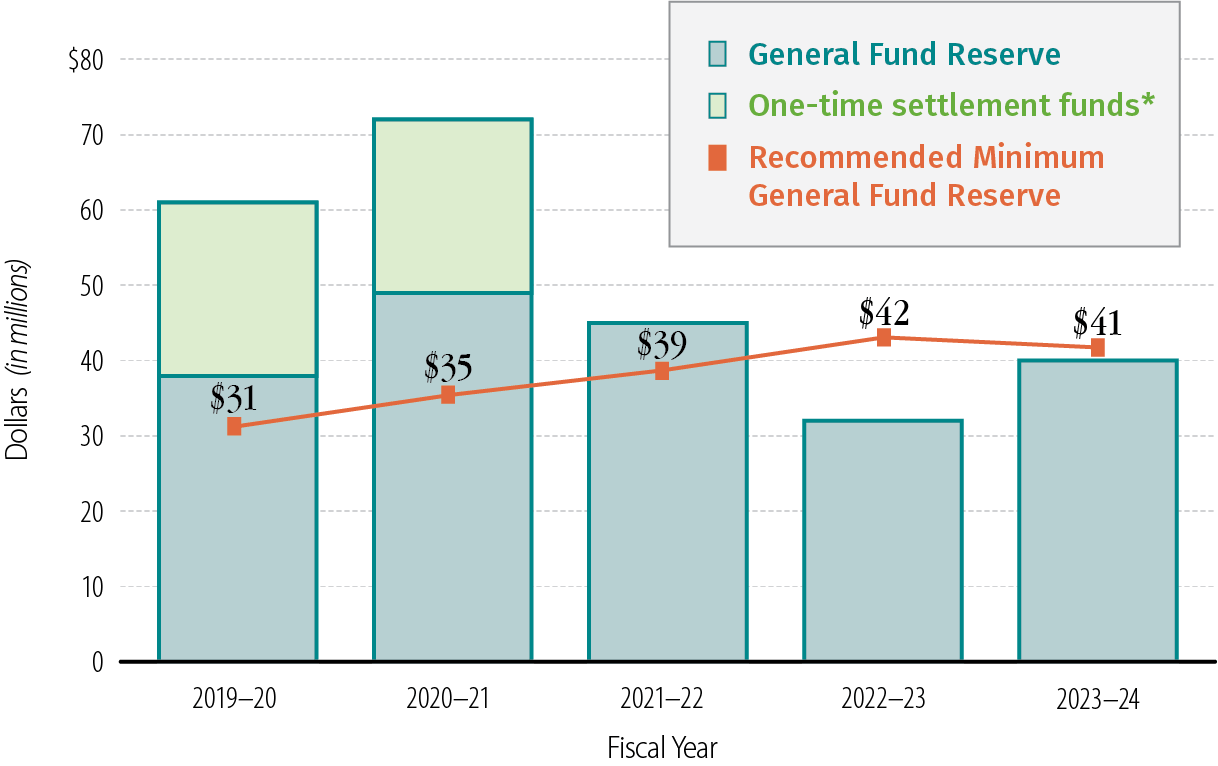
The bar graph shows five bars for each fiscal year between 2019–20 and fiscal year 2023–24. These bars show the county’s total general fund reserves for each fiscal year, and show that these reserves have generally declined from fiscal year 2019–20 to 2023–24. The first two bars (fiscal year 2019–20 and fiscal year 2020–21) are made up of both general fund reserves and one time settlement funds, while the bars representing the remaining years are comprised solely of general fund reserves. For the first two bars, one-time settlement funds comprise about one-third of the total reserves.
In addition to the bars, the figure shows a line representing the Government Finance Officer’s Association recommended minimum reserve amount, which is calculated based on Mendocino’s expenditure level for each fiscal year. From fiscal year 2019–20 to 2023–24, the amount is calculated as $31 million, $35 million, $39 million, $42 million, and $41 million.
The figure shows that Mendocino’s general fund reserves were above the recommended amount for fiscal years 2019–20, 2020–21, and 2021–22. Mendocino’s general fund reserves were below the recommended amount for fiscal years 2022–23 and 2023–24.
Source: Mendocino’s audited financial statements.
Note: We calculated the recommended minimum general fund reserve amount by using the GFOA’s recommended minimum for general purpose government reserves of two months of expenditures. We calculated expenditures by including all general fund expenditures and all other uses of financing from the general fund. The general fund reserve shown in the figure includes all unrestricted funds as reported in Mendocino’s audited financial statements.
* Mendocino continued to hold about $670,000 in one-time settlement funds in fiscal years 2021–22 through 2023–24 that we do not depict in this figure for those years due to its scale.
We can attribute most of the reduction in Mendocino’s reserve over time to a $22 million settlement Mendocino received from the Pacific Gas & Electric Company following the 2017 wildfires in the county. Mendocino recorded this funding in its financial statements for fiscal year 2019–20. Over the next two fiscal years, Mendocino moved more than $21 million of this funding from its reserve to be used by county departments and various districts in the county for a variety of projects, which caused its general fund reserve to decline significantly by the end of fiscal year 2021–22. However, the receipt and distribution of the settlement funding only partially explains the trend in Mendocino’s reserve. Mendocino has also used $4.5 million from its reserve to help finance expansion of its county jail and transferred $1.2 million to help provide increases in employee salaries and benefits in fiscal year 2022–23. The assistant CEO stated that in fiscal year 2024–25, the county repaid the funding it used to help finance the county jail’s construction.
Mendocino’s reserve policy is outdated and is not effective for guiding the county in its future consideration of how much to keep in reserve for unexpected circumstances. The county last updated its reserve policy in April 2012. Although the policy refers to GFOA’s guidance as a reference for setting the county’s reserve target, the policy refers to GFOA’s old guidance that GFOA has since replaced. The county’s policy continues to cite the GFOA’s recommended reserve level as between 5 and 15 percent of annual revenue or one to two months of expenditures, when in fact the GFOA has since changed this recommendation to be about 17 percent of revenue or expenditures. Further, the policy sets the county’s actual reserve target at an amount equal to the greater of $10 million or 6.35 percent of the county’s general fund expenditures in the previous fiscal year, an amount well below GFOA’s recommended minimum. Therefore, amendments to the county’s reserve policy are overdue and necessary to assist the county in determining the future actions it needs to take. At a minimum, the county should revise its policy in light of its current fiscal constraints, the instability of some of its funding sources, and the likelihood of unplanned expenditures and establish a reserve target at least at the GFOA recommendation of a minimum of two months of expenditures or revenue.
Mendocino Has Not Assessed Properties and Collected Property Tax Revenue in a Timely Manner
As we indicate in the previous section, the county depends on property tax revenue to support a significant portion of its operations. Two entities in the county collaborate to ensure that the county collects the appropriate amount of property tax revenue: the Assessor-Clerk-Recorder’s Office (Assessor’s Office), and the Auditor‑Controller-Treasurer-Tax Collector’s Office (ACTTC’s Office). Figure 5 shows Mendocino’s process for determining the amount of property taxes owed by property owners, collecting these payments, and distributing property tax funding to recipients throughout the county.
Figure 5
Mendocino’s Property Tax Process Involves Two Departments and Provides Funding to Governments Throughout the County
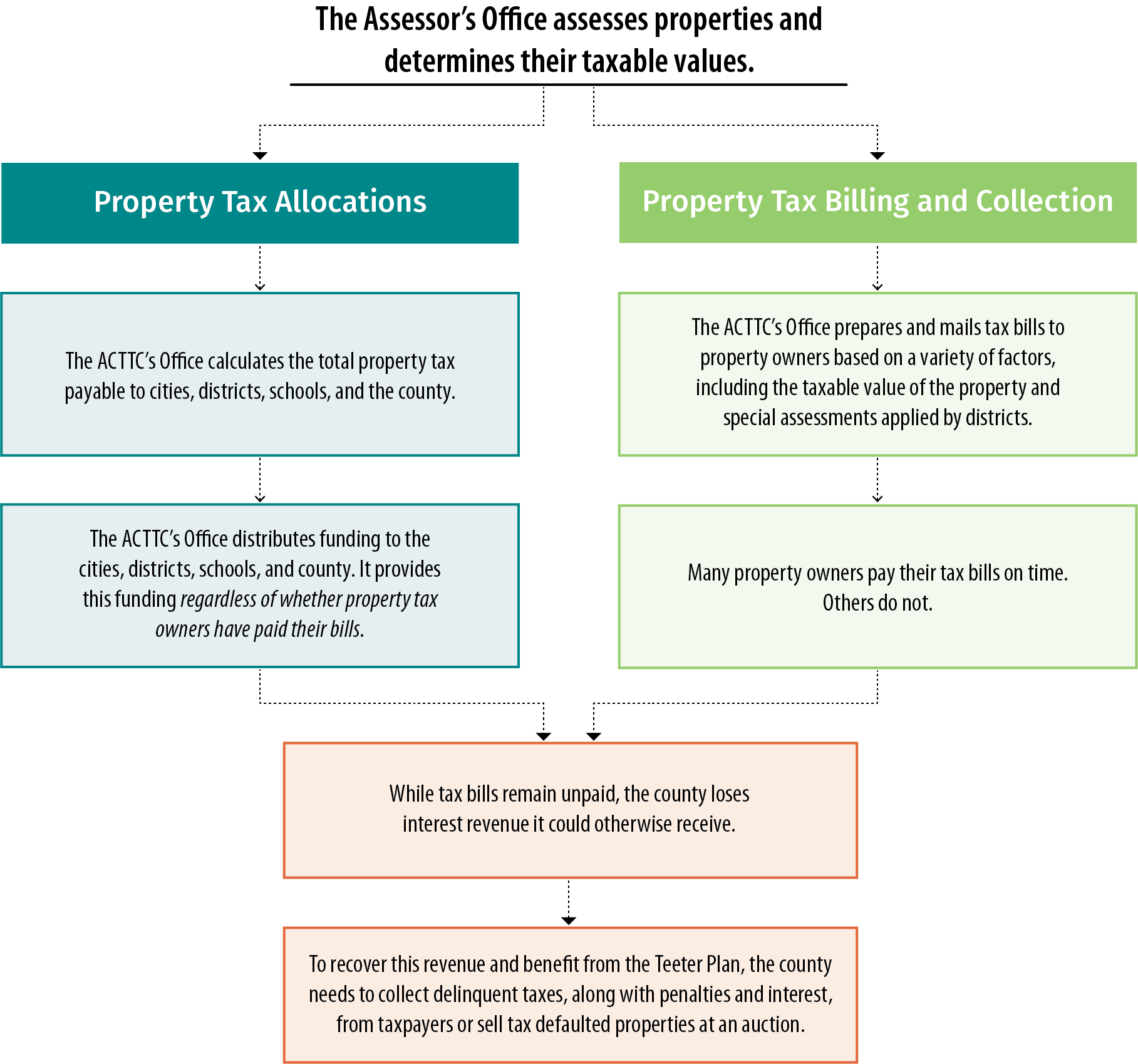
The flowchart starts with a first step of the Assessor’s Office assessing properties and determining their taxable value.
The flowchart then divides into two separate branches, indicating activities that happen concurrently with each other: 1) property tax allocations and 2) property tax billion and collection.
The first branch (property tax allocations) shows that the ACTTC’s office calculates the total property tax owed to cities, districts, schools and the county and then distributes funding to the cities, districts, schools and county. Crucially, it provides this funding regardless of whether property tax owners have paid their bills.
The second branch (property tax billing and collection) shows that, concurrently with the steps described previously, the ACTTC’s office also prepares and mails tax bills to the property owners based on a variety of factors, including the taxable value of the property and any special assessments applied by districts. While many property owners pay these tax bills on time, others do not.
The flowchart then converges to describe the effects of delayed tax collection. While tax bills remain unpaid the county loses interest revenue it could otherwise receive. To recover this revenue and benefit from the Teeter Plan, the county needs to collect delinquent taxes, along with penalties and interest from tax payers or sell tax defaulted properties at auction.
Source: State law, Mendocino’s ACFR, budget book, website, and tax revenue information.
California provides counties with different options for collecting and distributing revenue from property taxes. Mendocino has chosen to use the Teeter Plan. Under the Teeter Plan, Mendocino allocates property tax funding from a dedicated property tax fund to participating entities, such as schools and the county general fund, regardless of its actual receipt of property tax payments. The county then subsequently collects property tax payments and any late-payment penalties that taxpayers owe. Property tax payments, including those that are delinquent, are required to be deposited to the same property tax fund that the county used to provide allocations to participating entities. Because Mendocino provides property tax allocations before it collects property tax payments, the county must collect those payments in a timely fashion, or it risks forgoing interest income that it otherwise would have gained. If the county cannot collect tax payments, along with penalties and interest from delinquent tax bills, the county is able to recover the property tax revenue through an auction of defaulted properties. The county may succeed in recovering its revenue through an auction, or it may need to sell properties at a loss.
To facilitate its property tax assessment and collection process, Mendocino relies on software that serves as its central system for assessing the value of properties, calculating the amount of property taxes owed, and processing property tax bills (property tax system). In 2015, the county entered into an agreement with a vendor to obtain a property tax system to replace the system it was using at that time. Mendocino’s deputy CEO indicated that concerns over the long-term application and support of its previous system—which had minimal control over data integrity—led to the county’s decision to procure a new system. In early 2021, the county completed its conversion to the new system. However, Mendocino has since faced several problems using the new system that have contributed to delays in the receipt of property tax payments.3 As we explain later, the county must collect more than $30 million in unpaid property taxes, penalties, interest, and fees related to properties in default status.
Mendocino’s struggles with its new property tax system began shortly after the county started using it. To properly assess the taxable value of a property, the county needs to know specific information about it, such as the size of the land and the improvements made to the property. According to staff in the Assessor’s Office and the ACTTC’s Office, the information about some properties was not transferred properly to the county’s new property tax system, and the deputy CEO further explained that the integrity of the previous system’s data contributed to these errors. The county shared examples of these problems in the form of support tickets that it had submitted to its vendor.4 In one example, the county raised concerns that information about the land or improvements was completely missing for some properties. The vendor subsequently identified eight properties that were missing such information. In another case, the county identified that information about the size of the land for about 1,000 properties did not match the information in the county’s old system. The vendor’s staff determined that the vendor could automatically fix the information for about 200 of these properties, but Mendocino’s staff would need to manually correct the remaining 800.
Staff in the Assessor’s Office and the ACTTC’s Office provided examples of other problems that have affected their ability to assess property values and issue correct tax bills promptly. For example, the property tax system calculated incorrect tax bills, in some cases doubling the tax rate or the amount owed on select property tax bills. In some of these cases, owners had already paid the incorrect bill before the county could address the issue. County staff told us that there had been no evidence of the issue recurring and explained that, for one batch of incorrect bills, including those that some owners had paid, they reprocessed the bills in November 2025. In another example, specific to certain types of property tax bills, the property tax system did not identify the correct owner and instead generated bills to the wrong owner. Support tickets show that the county had raised this issue in various forms with the vendor at least three times. The county’s assistant treasurer-tax collector stated that this issue was resolved in October 2025.
Staff who administer property taxes explained that the problems they have encountered with the property tax system have slowed their ability to complete their work. Although the county adopted its system in early 2021, Assessor’s Office staff told us in 2025 that they must still manually input or correct property information when conducting assessments. One staff member stated that he has had to input information for nearly every parcel he has reviewed in the past four years. The assistant treasurer-tax collector similarly asserted that the unreliable data have resulted in delays to the county’s property tax process. One staff member told us that he spends approximately 30 percent to 50 percent of his time each week troubleshooting issues within the system, and the assistant treasurer-tax collector told us that she has a staff person whose time is almost entirely dedicated to analyzing issues and resolving fixes within the system.
The county’s issues with its property tax system have contributed to untimely assessments of properties to determine their taxable value and to uncollected past due taxes. As Figure 6 shows, the county generally has only four years to assess a property’s value after certain qualifying events—such as the sale of the property to a new owner—before it risks losing revenue.
Figure 6
Mendocino Generally Has a Deadline of Four Years to Levy Supplemental Tax Bills
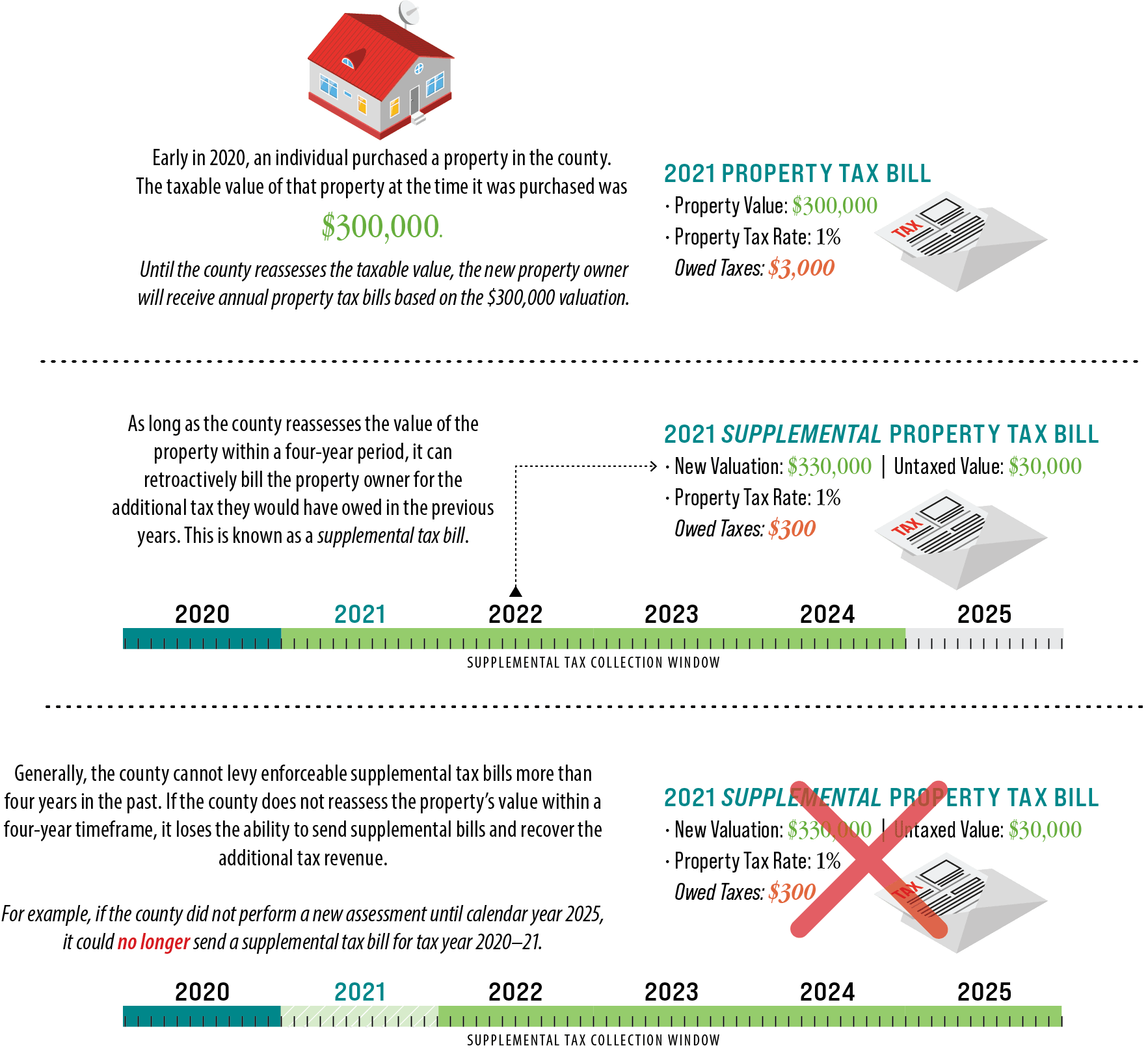
The figure creates a hypothetical scenario where an individual purchased a property worth $300,000 in 2020. Until the value of the property is reassessed, the new property owner will receive property tax payments based on this $300,000 value. If the property tax rate was 1%, they would owe $3,000 the year they purchased the property.
As long as the county reassesses the value of the property within a four-year period, it can retroactively bill the property owner for the additional tax they would have owed in the previous years. This is known as a supplemental tax bill.
If the county were to reassess the $300,000 property as being worth $330,000 after the individual purchased it, there would be untaxed value of $30,000 that the county could collect via a supplemental property tax bill. Given the 1% property tax rate from the hypothetical, this would mean the individual would owe another $300 on top of the original $3,000 paid.
The county cannot levy enforceable supplemental tax bills more than four years in the past. If the county does not reassess the property’s value within a four-year timeframe, it loses the ability to send supplemental bills and recover the additional tax revenue.
For example, in the hypothetical scenario being described, if the county did not perform a new assessment until calendar year 2025, it could no longer send a supplemental tax bill for tax year 2020–21.
Source: State law as applied to a hypothetical example.
We asked the county whether it has taken longer than four years to complete assessments, but the county was unable to provide an answer based on data from its property tax system. The county provided us with workload reports showing that its staff had more than 7,300 assessments to perform. However, after meeting with the county’s staff and comparing information in these reports to other information in the county’s property tax system, we determined that the workload reports could not tell us or the county how long these assessments had been pending completion. In other words, the reports the county can produce from its property tax system cannot help the county manage its workload in a strategic way. In the absence of being able to rely on more useful reports from the system, the assistant assessor provided examples of annotated work reports some staff create to triage their work, and the assistant assessor explained that other staff just work their assigned items in batches.
Although the county was unable to provide reliable data showing how many properties are at risk of not being appraised before the four-year deadline, the assistant assessor explained her belief that there are assessments that are past the four-year period, meaning that it is too late for the county to collect some of the tax revenue from those properties. The lack of reliable information about the workload the county faces is a significant hinderance to its ability to strategically manage its property tax assessments. The assessor shared with us that after meeting with us about this issue, another county contacted Mendocino and shared a reporting tool that the Assessor’s Office is planning to explore using to better manage its workflow. As of the conclusion of our audit, the Assessor’s Office was planning on implementing this tool sometime in 2026.
In addition to struggles with the property tax system, the assistant assessor explained that staffing challenges have contributed to the county’s delays in completing assessments. Specifically, she cited the loss of 10 assessment staff before the county converted to its new property tax system. She stated that the county went from 12 assessment staff to only two for a variety of reasons, including resistance to the new property tax system, but that the office since increased its size to 11 staff.
Compounding these problems, the assistant treasurer-tax collector indicated that the issues with the property tax system have distracted efforts to collect past due taxes from property owners. The list of properties in default status as of December 2025 that the county provided to us identifies that taxpayers owed $30.6 million in uncollected property taxes, penalties, interest, and fees pertaining to about 4,200 properties. $17.5 million of this owed amount was attributable to tax years 2023 through 2025. The assistant treasurer‑tax collector explained that she and her staff spend time developing solutions to issues with the property tax system, and that issues related to the property tax system cause delays to billings, payment plans, and other tasks. We noted that data published by the State Controller’s Office (SCO) demonstrates that Mendocino has had declining property tax receipts when compared to the total taxes charged over the last few fiscal years. Specifically, the county received 97.7 percent of the tax revenue it charged in fiscal year 2021–22 within that fiscal year, but that percentage declined in the following years, reaching 94.3 percent in fiscal year 2023–24.
The county could hold a property tax auction, at which it could auction off defaulted properties, to help recover some of its uncollected property tax revenue. In fact, state law requires county tax collectors to attempt to sell properties that are in tax default for a period of five years or more, or three years or more in the case of nonresidential commercial properties. However, as of November 2025, Mendocino had not held an auction since June 2019, which has been the longest period without an auction among all counties in California except for one other according to publicly available information about each county in the State.
When we asked the ACTTC and the assistant treasurer-tax collector why the county had not held an auction in recent years, they cited the COVID-19 pandemic, and the ACTTC explained that the county lost staff who were knowledgeable about conducting auctions. The assistant treasurer-tax collector also explained that concerns about the reliability of the property tax system’s data have delayed the county’s efforts to hold an auction. She stated that experiencing and addressing issues in the property tax system takes time, and the county must research each defaulted property individually to ensure that it has met all mandatory requirements needed to auction the property.
Nonetheless, Mendocino has begun to take steps to hold a property tax auction and expects it may do so by October 2026. For example, the ACTTC told us her office recently hired a position to research and familiarize themselves with the auction process. Additionally, the assistant treasurer-tax collector provided a timeline she created showing the steps the county must complete before conducting an auction, such as receiving board approval for the sale of properties. Although this timeline plans for the county to hold the auction in October 2026, the assistant treasurer-tax collector indicated that delays could push the actual date back to June 2027. Given the amount of time that has passed since Mendocino’s last property tax auction, we believe the county should continue taking the steps necessary to meet its target date of October 2026 and, if it encounters further barriers that result in delays, consider using an external contractor to assist in its efforts to hold the auction.
In addition to conducting a property tax auction, the county could benefit from creating its own written policies and procedures for conducting property assessments. The Assessor’s Office confirmed that it does not have such policies and procedures, although staff we spoke with stated that their creation would help decrease the county’s workload and reduce delays. Although the assessor and the assistant assessor told us that the Assessor’s Office plans to address the lack of policies and procedures when it has time, they also mentioned that they were not sure when they will do so. According to the office’s leadership, the office’s priority is entering and correcting property characteristics into the property tax system so the county can continue to collect property tax revenue. We acknowledge the importance of having correct information within its property tax system. However, the county’s overall effectiveness in performing property tax-related tasks would benefit from the establishment of consistent expectations and standards for how staff perform their work.
To Address Its Budget Deficit, Mendocino Will Need to Consider Increasing Revenue and Further Cutting Its Expenditures
Mendocino has had a persistent budget deficit that presents a challenge the county has not yet fully addressed. Specifically, for the past three fiscal years, Mendocino has faced increasing budget deficits ranging from $6.4 million in fiscal year 2023–24 to $17.8 million in fiscal year 2025–26. In response, Mendocino had planned to use one-time funding and defer costs, among other budgetary assumptions, to ensure that it adopted a balanced budget as state law requires. For example, to address a portion of its 2024–25 budget deficit, Mendocino planned to defer $1.2 million in information technology related costs and draw $3.3 million from funding it had set aside to respond to potential adjustments to retirement costs that it may need to make.
Although Mendocino has not needed to use some of these measures, the county remains at risk of having to do so in the future. Mendocino has not needed to draw from some one‑time funding sources it had budgeted for, such as the retirement funding described above. However, at the time the chief executive officer’s (CEO) office proposed the county’s budget for fiscal year 2025–26, the county projected it would have a general fund budget deficit of about $16 million in fiscal year 2026–27.5 Accordingly, the county will again need to consider how to close its deficit, including whether it needs to make spending cuts that could be detrimental to its services.
Many of the steps the county has taken to date to address its budget deficit have been attempts to control its costs. As part of its normal budget process, departments make annual budget proposals from which the county subsequently eliminates millions of dollars to align planned revenue and expenditures. Further, according to the testimony the CEO provided to the board in June 2025, the county has a backlog of deferred maintenance of about $8 million. In its budget for fiscal year 2024–25, the county noted that its facilities were in need of attention in its next capital improvement plan because they had reached critical stages and needed significant reinvestment in systems and structures. The county has also instituted what it calls a “strategic hiring process” that will limit how easily departments can fill vacant positions, and it has offered employees an incentive to resign from county employment—two measures that the county expects to result in cost savings.
However, key cost savings measures the county has used are temporary in nature or could ultimately result in increased costs in the future. For example, offering incentives to employees to separate from county employment and pausing non-essential hiring delay spending that will eventually occur if the county finds that it cannot operate effectively without filling those vacancies. Further, delayed maintenance on county assets or equipment will not necessarily result in long-term cost savings. A potential outcome is that the necessary maintenance will cost more if the county performs it behind schedule because of the worsened condition of the asset or equipment or increases to the price of repairs. To reset its base level of spending and truly affect the rate of growth in its expenditures, the county must consider ending some services or operations.
Although the county will likely need to continue to examine its spending to determine other areas in which it can achieve savings, we believe that it will also need to consider solutions that would increase its revenue. Mendocino’s sales tax rate is 7.875 percent, and it has a transient occupancy tax of 10 percent. Both rates place Mendocino near the middle of a group of 12 northern counties that we reviewed. We believe that the county will struggle to address its long-term fiscal instability without considering and applying revenue generating solutions such as, but not limited to, raising its tax rates to increase tax revenue.
Mendocino faces a persistent deficit that is unlikely to change without further strategic action. We acknowledge the board’s decision to employ a strategic hiring process, in which departments that want to fill vacant positions must first obtain board approval, as a significant step toward trying to manage county costs. However, the county cannot close its budget deficit solely through this one action. Until the county takes more comprehensive action to structurally balance its budget—such as expenditure reductions by ending or pausing certain operations or revenue increases through raising tax rates—the county will face annual uncertainty about the level of services it can provide to its residents. Accordingly, it would be in the county’s best interest to begin engaging with its residents—through a variety of approaches such as town hall meetings or surveys—about both revenue- and expenditure-related solutions to its fiscal problems.
Recommendations
To ensure that it maintains a reserve balance sufficient to facilitate its operations during emergencies and serve as a buffer during economic downturns, the county should, before its board adopts its 2026–27 budget, revise its policy on its general fund reserve to incorporate a new target reserve level. In doing so, the county should consider the stability of its revenue sources, the likelihood of unexpected expenditures, and the guidance published by the GFOA. At a minimum, the county’s new reserve level should be no less than the minimum recommended by the GFOA of two months of expenditures.
To ensure that the county does not lose property tax revenue because of delayed assessments, the Assessor’s Office should, by March 2026, develop tools such as aging reports showing the length of time since qualifying events, to assist in the management of its assessment workloads. These tools should, at a minimum, allow staff and managers to identify which properties are at highest risk for lost property tax revenue if the county does not assess them in a timely fashion.
To recoup unpaid property tax payments to the degree possible, the ACTTC should continue to take steps to resume holding regular default tax property auctions by October 2026. If the ACTTC’s Office needs external assistance to hold the auction on time, it should obtain such assistance.
To ensure its staff’s ability to appropriately and efficiently resolve issues with its property tax system, the Assessor’s Office should, by June 2026, document clear policies and procedures pertaining to property tax assessments and the management of property tax-related information in its system.
To ensure that it addresses its persistent budget deficit, the board should, by March 2026, create a schedule outlining the steps it will take to address its stagnant tax revenue and increasing expenditures. This schedule should include board meetings or town halls with the express purpose of discussing the spending areas the county wishes to prioritize for reduction and options for the county to increase revenue, such as by increasing tax rates. The board’s goal should be for the 2026–27 budget it adopts to reflect the results of this process to the maximum extent possible.
The County’s Procurement and Financial Reporting Processes Leave It Vulnerable to Waste, Fraud, and Abuse of Public Funds
Key Points
- We found problems with the supporting documentation for nearly half of the 30 expenditures we reviewed. Specifically, we noted that county departments did not consistently obtain required approvals for purchases, such as purchases from online retailers, or document the reasons for purchases, such as for a television, making it unclear if they were made for justifiable reasons.
- Mendocino has not exercised adequate oversight of the Sheriff’s Office’s and District Attorney’s Office’s use of asset forfeiture funds. We found that each office made donations to private entities without adequate safeguards, had violated prohibitions against direct funding of religious organizations, and that the District Attorney’s Office made a gift of public funds by spending $3,600 on an end-of-year gathering and dinner event for its staff and their guests.
- County departments have not justified their use of sole-source agreements for services. Of the 20 sole-source agreements we reviewed, 14 did not have justifications that adequately explained why a sole-source procurement was necessary. Also, the county has split contract agreements over multiple years and therefore has not had to seek competitive bids or board approval of certain agreements. For example, the county executed four separate one-year agreements, each for $25,000, with the same vendor for the same services. Had the county combined these procurements into a single agreement, it would have required board approval.
- The ACTTC’s Office has not ensured that the county’s financial statements are audited and published in a timely manner and must still take corrective actions to address deficiencies in its procedures and practices that previous reviews have highlighted as problematic, such as the absence of policies directing staff to reconcile bank records.
Mendocino Has Weak Processes for Ensuring That Department Purchases Are Necessary and Appropriate
Documenting and adhering to clear policies and procedures for spending funds are critical steps a public entity must take to effectively guard against waste, fraud, and abuse. Such policies and procedures should establish clear rules for who can spend funds, who must approve these expenditures, and the documentation that the entity will keep to demonstrate that its spending is appropriate. To establish such a system of safeguards, public entities can consult a variety of sources of best practices, including the GFOA and the U.S. Government Accountability Office.
Mendocino has two primary policies that address expenditures of county funds. The first relates to the acquisition of goods and services. Mendocino has established a single policy governing purchasing, leasing, and contracting, as well as a set of guidelines that further define the county’s related processes. These documents establish the various mechanisms by which the county’s staff can make purchases, such as using county issued purchase cards (p-cards). They also create spending limits for the different purchasing mechanisms and describe who is involved in the review and approval of specific types of purchases. The second main policy relates to how the county will pay for travel- and meal-related costs pertaining to county business. Like the parameters established by the purchasing policy, the travel and meals policy creates rules governing when travel is reimbursable, what meals will be paid for during county travel and other functions, and the processes for getting travel and travel-related costs approved.
To review Mendocino’s adherence to its expenditure policies and assess its vulnerability to waste, fraud, and abuse, we reviewed a selection of a total of 30 expenditures made by three county departments from fiscal year 2020–21 through fiscal year 2024–25. These departments were the Mendocino County Department of Social Services (Social Services), the Mendocino County District Attorney’s Office (District Attorney’s Office), and the Mendocino County Sheriff’s Office (Sheriff’s Office). We reviewed expenditures from Social Services and from the Sheriff’s Office because they were among the largest in the county’s budget and, in the case of the District Attorney’s Office and the Sheriff’s Office, we reviewed these offices because they do not report to the CEO.
We focused our selection on expenditures that each department made within its delegated purchasing authority or as part of travel. Specifically, we judgmentally selected 10 expenditures each department’s staff made using p-cards, as a part of travel, or through purchase orders. P-card and purchase order purchases are expenditures departments can make with less scrutiny by external reviewers or approvers, such as the CEO’s Office or board. By their nature, these types of expenditures individually are small dollar amount transactions compared to other expenditures the county makes. However, we focused our review on these expenditures because of our determination that the control environment made them more susceptible to waste, fraud, or abuse of public funds. These expenditures were also relatively common occurrences. For example, the p-card and travel expenditure data we obtained showed that these three departments spent at least $2.5 million through 9,800 purchases over the five-year period we reviewed. In addition, we selected expenditures when the nature of the expenditures made them higher-risk in our professional judgment. For example, we selected travel-related expenditures incurred by county employees and expenditures from vendors that seemed different from a department’s normal spending patterns or that offered goods that seemed unrelated to the department’s general business needs.
Our review identified concerns in 13 of these 30 expenditures, which Table 1 lists. The problems we found reveal gaps in Mendocino’s oversight of spending that leave it vulnerable to waste, fraud, and abuse. The problematic expenditures generally had weaknesses in their supporting documentation or were missing required approvals. For example, Social Services spent about $500 at an online retailer. The expenditure approval form the county prepared for this purchase stated that it bought seat cushions for three employees. However, Social Services did not have an itemized receipt that confirmed what it actually purchased. Additionally, the approval form was missing one of the two required approval signatures. Although this purchase may have been reasonable and appropriate, the lack of documentation and approval raises concerns about the nature of the purchase and the potential misuse of public funds.
In two other examples totaling about $370, the county provided Sheriff’s Office employees with advance payments for travel expenses but could not show that it had later reconciled these payments to the employees’ actual travel costs. The county’s meal policy says that employees who receive an advance payment must provide receipts for their expenses within 30 days of the end of their trip. However, we did not see this happening in these two cases, which were the only travel advances we selected for review. For example, the Sheriff’s Office provided one of its staff with $200 in advance of a trip they were scheduled to take. The office calculated this amount using the maximum possible reimbursement for which the employee was eligible under the county meal policy. However, the Sheriff’s Office had no evidence that it had, after the trip, followed up to ensure that the employee had taken the trip and remained eligible for the costs for which the office had prepaid. If the Sheriff’s Office does not reconcile travel advances to the employees’ actual travel, it risks inappropriate payment to its employees.
In another example, the county did not maintain documentation that would ensure that it could demonstrate the reasonableness of its purchase. In this case, the District Attorney’s Office used a p-card to obtain a 75-inch television for $1,099. The corresponding documentation did not include a justification for the acquisition or indicate that any staff followed up with questions about this purchase when reviewing it. The District Attorney’s Office explained to us that the television was a replacement for a broken unit in its conference room—an explanation that we found reasonable. However, we would have expected the office to include that justification in the supporting documentation for the initial payment request, thereby reducing the risk that someone could make such a purchase for personal gain. Governments should guard against the public perception that employees are wastefully or fraudulently spending public funds by maintaining thorough documentation of the reasons for the purchases they make.
Our findings indicate that the county does not have an effective structure to fully document and approve delegated purchases. As a result, the county is unnecessarily vulnerable to wasteful, abusive, or fraudulent spending for these types of procurements.
We also determined that four of the expenditures we reviewed were questionable uses of public funds, and they all involved a source of funds known as asset forfeiture, which is a specialized funding source. Because of the nature of these expenses and Mendocino’s lack of oversight of them, we expanded our review to include 40 additional expenditures from this funding source. We describe our concerns about these expenditures and Mendocino’s oversight in the next section.
The County Lacks Adequate Controls to Ensure the Appropriate Use of Its Asset Forfeiture Funds
Both the Sheriff’s Office and the District Attorney’s Office receive and use asset forfeiture funding, which the text box defines. As of June 2025, these two offices collectively held about $1.5 million in asset forfeiture funding. These funds were funds seized under the parameters of California’s Uniform Controlled Substances Act (Substances Act).
Asset Forfeiture Funding
Asset forfeiture refers to cash, property, and other items associated with a criminal offense (assets) that the government seizes and liquidates. The net proceeds are distributed according to state law, as Figure 7 details.
Source: State law and a 2024 report from the Legislative Analyst’s Office.
Asset forfeiture funds are especially sensitive public funds for at least two reasons. The first is how the county comes to possess the funding. Unlike other government revenue, asset forfeiture funding derived from the Substances Act is the result of a seizure of someone’s property. The Substances Act establishes several safeguards over the seizure of assets, including that the principal objective is law enforcement, that seizing agencies must avoid the appearance of impropriety in the acquisition and sale of property, and that the potential for revenue must not jeopardize the due process rights of citizens. The GFOA recognizes that asset forfeiture funding is sensitive to public perceptions, noting that if seizing assets generates revenue for government agencies, those agencies have an incentive to seize more.
In addition, asset forfeiture funding is especially sensitive to public perception because the Substances Act places few restrictions on its use, as Figure 7 shows. The GFOA highlights that if the agencies that seize property get to use the funds in whatever way they want, it creates an incentive to seize additional assets. Thus, an agency’s appropriate use of asset forfeiture funding is critical to maintaining the public’s trust in government. Because of the sensitive nature of asset forfeiture funding, the GFOA recommends that governments adopt financial policies that define the proper use of these funds. However, Mendocino does not have a policy specifically about asset forfeiture funds and, aside from requiring fixed assets over $5,000 to be procured through the county’s requisition process regardless of funding source, its general purchasing policy does not specify any criteria particularly for asset forfeiture funds.
Figure 7
State Law Prescribes How Asset Forfeiture Funding Is Allocated
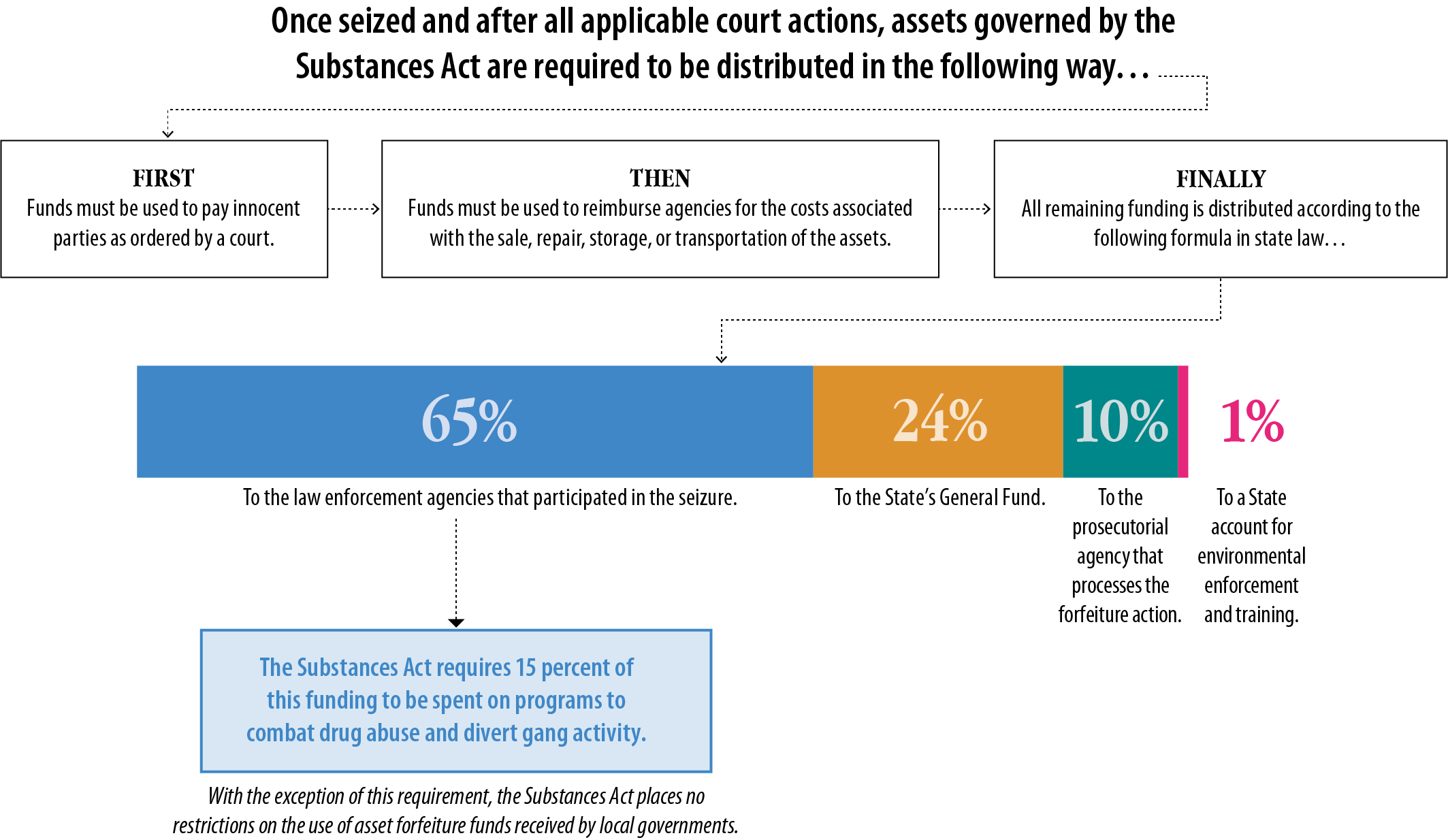
The figure shows how asset forfeiture funds are divided.
Once funds have been seized and any application court actions, assets governed by the substances act are required to be distributed by the following formula.
First, the funds must be used to pay innocent parties as ordered by a court.
Secondly, any remaining funds are used to reimburse agencies for the costs associated with the sale, repair, storage or transportation of the assets.
Finally, all funds that remain after the first and second payouts are distributed according to the following formula in state law.
65% of the remaining funds go to the law enforcement agencies that participated in the seizure. Of this 65%, 15% is required to be spent on programs to combat drug abuse and to divert gang activity. With the exception of this requirement, the substances act places no restrictions on the use of asset forfeiture funds received by local governments.
24% of the remaining funds go to the State’s General fund.
10% of the remaining funds go to the prosecutorial agency that processes the forfeiture action.
Finally, the last 1% goes to a State account for environmental enforcement and training.
Source: State law.
As we note in the previous section, four of the expenditures we determined were problematic were made with asset forfeiture funds. Because of these expenditures, the overall sensitive nature of these funds, and our assessment of the lack of controls related to these funds, we expanded our review of the Sheriff’s Office’s and District Attorney’s Office’s use of asset forfeiture funds. We randomly selected 20 additional expenditures from each office from July 2020 through June 2025. In total, from these 40 expenditures and the judgmentally selected expenditures we referred to in the previous section, our review included 22 asset forfeiture expenditures made by the Sheriff’s Office and 24 made by the District Attorney’s Office. Overall, our review found three main categories of expenditures.
More than half of the expenditures we reviewed from each office represented the category of purchases that appeared reasonably connected to the offices’ business needs. These included tactical gear for the Sheriff’s Office, office equipment for the District Attorney’s Office, and the publication of public announcements in connection with asset forfeiture activities. The county’s accounting system did not consistently include documented reasons for these purchases, with supporting documents sometimes being only an invoice for the purchase. However, we concluded from the nature of the expenditures and other supporting documents and explanations that the offices subsequently provided to us at our request that the expenditures were likely reasonable uses of the asset forfeiture funds.
The second category consisted of two expenditures made by the District Attorney’s Office that had questionable public value or connection to the office’s mission and purpose. The District Attorney’s Office spent more than $570 on 40 water bottles from the California District Attorneys Association and also purchased a satchel from an antique store for about $70. The documentation for these purchases did not convey what business or public purpose they served. When we asked the District Attorney’s Office about the satchel expenditure, it stated that the district attorney had made this purchase after finding the satchel at an antique store. The District Attorney’s Office explained that this was an evidence collection satchel that was embossed with the seal of a law enforcement department from Lake County. According to the District Attorney’s Office, the district attorney purchased the satchel because it should not be possessed by non-law enforcement personnel, and then he returned the item to the Lake County law enforcement agency. Despite this explanation, we question this purchase because it was not connected to an ongoing investigation or prosecution or for the benefit of the District Attorney’s Office or the citizens of Mendocino.
Finally, the third category of expenditures involved donations of asset forfeiture funding that the Sheriff’s Office and the District Attorney’s Office made to private entities, which Table 2 lists. Providing public funds to private organizations as donations raises questions about whether these public funds are being provided as a gift, which is prohibited under California’s constitution. In general, the distribution and use of public funds must be for a public purpose. We are concerned about these donations because they indicate that public funding is being provided to private entities with little oversight or accountability. In fact, none of the donations we reviewed appeared to place any restrictions on the recipient to use the donated funds for only specified public purposes. Further, the offices do not appear to have established certain safeguards that would protect the county from making a gift of public funds in the form of a donation.
Instead, we found procedural weaknesses in the way these offices made these donations. Both offices have an application form that they ask organizations that are seeking a donation to complete. The form requires prospective recipients to provide information such as the name of the organization and its tax-exempt status, a description of its purpose, specific details about why it is seeking a donation, and financial details. However, among the 10 total donations we reviewed as part of our selections, only four had substantively completed applications. The remainder did not include details about the organization, the organization’s financial information, or for three donations the application form did not exist. These inconsistencies indicate that the process for considering the applications is not rigorous or uniform.
Moreover, these donations were not considered and approved in a manner similar to other county awards. When a county department decides to execute a contract and provide funding to a vendor, the CEO and county counsel must also approve of the agreement. Additionally, for personal services contracts exceeding certain dollar thresholds, the contract award results from a review of proposals by an evaluation committee made up of more than one individual. Each of these steps ensures that no single individual controls who is awarded public funding. Although these donations were processed administratively like other county payments, neither the Sheriff’s Office nor the District Attorney’s Office could demonstrate that the donations resulted from a structured process like that used to award contracts. Instead, the evidence we reviewed indicated that the sheriff and the district attorney had decided on the recipient and amount for each of their respective donations.
Consequently, the offices lack safeguards to prevent donations that are motivated by political or personal financial interests. When we reviewed the campaign disclosures and personal financial interest disclosures that both the sheriff and the district attorney had filed with the county, we found no evidence that the donations we reviewed were connected to either the sheriff’s or the district attorney’s political or personal financial interests. However, in the absence of procedural safeguards, the offices risk such inappropriate activity.
Two donations we identified separately from our selected expenditures emphasize the importance of safeguards over the use of these funds. During our review of expenditure records, we found that the Sheriff’s Office and the District Attorney’s Office each made a $5,000 donation of asset forfeiture funds to a local religiously affiliated school in February 2024. We believe that these donations violated state and federal constitutional prohibitions on direct funding for religiously affiliated schools. The offices made these donations without conditions for how the school must use the funding, and they did not provide the funding to the school through an established governmental program. In effect, these donations were direct subsidies of a religiously affiliated school, a prohibited activity. We observed no pattern in the data we reviewed of the Sheriff’s Office using asset forfeiture funds to regularly support religious organizations during the period we reviewed and observed in those data that the District Attorney’s Office had provided one other donation to the same religiously affiliated school and another to a church, the circumstances of which we did not review in detail. Nonetheless, the donations to the religiously affiliated school reveal the types of improper spending that can occur when only limited safeguards are employed to ensure proper spending.
Moreover, the Sheriff’s Office and the District Attorney’s Office each made one donation that was connected to fundraisers that raised questions about whether they received benefits in return, such as meals or drinks at the fundraising event. For example, the District Attorney’s Office made a $560 donation to a fundraiser, the exact amount advertised as being for a table of eight attendees who would receive lunch. The fundraiser flyer advertised that a portion of the proceeds from the event would benefit a charity. We could not determine whether the District Attorney’s Office attended the event or received the meal consideration for the donation it had made. Similarly, the Sheriff’s Office made a $500 donation to a local organization’s annual fundraiser, an amount advertised to include tickets for one dinner and one drink at the event. The sheriff informed us that his office did not receive a ticket in return for the donation, but the documentation we reviewed did not specify whether the office received or declined tickets to the event.
In another instance, we believe that one expenditure we reviewed constituted a gift of public funds. In February 2025, the District Attorney’s Office used $3,600 of asset forfeiture funding to pay for room space and dinner service for an end-of-year staff gathering—which the office described as a continuing legal education and team building business meeting—at a steakhouse. The office paid based on the number of individuals in attendance, and its records indicate, and the District Attorney’s Office acknowledges, that attendees included both its office’s staff and their guests. The District Attorney’s Office shared its perspective with us that including spouses and significant others at this event fosters a more inclusive and positive work environment. It also stated that the CEO preapproved this expenditure, although we saw no independent evidence of that approval.
Determinations about whether an entity’s expenditures serve public purposes must be made by a governing legislative body. None of the records we reviewed showed that the State’s Legislature or the county board approved of the expenditure of public funds for the end-of-year gathering. Because of this, we believe that it constitutes a gift of public funds. Such gifts are violations of the California Constitution’s prohibition of gifts of public funds. This use of asset forfeiture funds is another example of why Mendocino must take steps to better control and oversee this funding.
As we previously describe, Mendocino has not adopted a county policy regarding the use of asset forfeiture funds; instead, it has deferred to the judgment and standards of the district attorney and the sheriff. An administrative services manager at the Sheriff’s Office said that state law offers little guidance as to how asset forfeiture funds may be used, so the sheriff relies on guidelines published by the U.S. Department of Justice (USDOJ) to guide its spending. These standards provide examples of permissible and impermissible uses of asset forfeiture funds, some of which the text box shows.
Examples From USDOJ Guidance on the Use of Asset Forfeiture Funding
Allowable Uses
- Law enforcement related training and education, equipment, and awards or memorials
Improper Spending
- Food and beverages
- Political or personal use
- Donations to community-based organizations
Source: USDOJ’s March 2024 Guide to Equitable Sharing for State, Local, and Tribal Law Enforcement Agencies.
The Sheriff’s Office noted that before an update in March 2024, the USDOJ guidelines it follows allowed for asset forfeiture funds to be used to make donations. The administrative services manager stated that the Sheriff’s Office is no longer making donations because of the change to these guidelines. However, we note that the Sheriff’s Office made one of our selected donations in November 2024.
The district attorney stated that he relies on guidance from a variety of sources, such as the California District Attorneys Association and legal analysis prepared by staff in the District Attorney’s Office. The district attorney also shared his belief that the Substances Act grants him or his designee broad discretion to determine what expenditures are law enforcement-related or otherwise appropriate.
Throughout our audit, the District Attorney’s Office shared its perspective on many of the expenditures we reviewed, and it provided after-the-fact explanations of why it believed that the expenditures were appropriate uses of asset forfeiture funding. We considered the comments the District Attorney’s Office provided, and we reached our conclusions presented in this section based on those perspectives and the evidence it provided. As we note earlier, more than half of the expenditures we reviewed were reasonable uses of the asset forfeiture funding and, in some instances, the District Attorney’s Office’s explanation about the expenditures provided sufficient support for justifying the reasonable use. However, at other times we found that the reasons the District Attorney’s Office provided were not sufficient to demonstrate that its use of asset forfeiture funding was appropriate.
Because of the number and nature of the problems that we found during our review, we believe that Mendocino would be better positioned to address the special nature of asset forfeiture funding if it took three key steps. First, the county should adopt a policy governing the allowable uses of these funds. Our review of expenditures of asset forfeiture funding demonstrates that the county is passively allowing a wide range of spending to occur because it has not adopted such restrictions. However, not all of these expenditures had clear public purpose, and some violated the state constitution. Without constraints or rules in place, the county risks the appearance of favoritism or impropriety in its use of public funding.
The second action the county could take is to directly budget for its use of asset forfeiture funds. State law assigns the board the responsibility to supervise the official conduct of all county officers insofar as that conduct pertains to, among other activities, the disbursement of public funds. In fact, the law grants the board budgetary authority over the Sheriff’s Office and the District Attorney’s Office, so long as the board does not obstruct the investigative function of the sheriff or the investigative and prosecutorial functions of the district attorney. Nonetheless, Mendocino’s budget does not show that the board is considering expenditures of asset forfeiture funding when it sets its annual budget. Sheriff’s Office and District Attorney’s Office staff stated that they do not include all asset forfeiture funding in their budgets. GFOA guidance cautions that exempting certain pools of money from the budget process increases the potential for wasteful spending and explicitly recommends that asset forfeiture spending be planned through the regular budget process like any other revenue.
Finally, state law allows the board to request an audit of asset forfeiture accounts, including expenditures. However, the county is not regularly directing such audits nor is it clear whether one has ever been performed. Regular audits can ensure that expenditures do not violate applicable laws or regulations, and they minimize risk by identifying internal control deficiencies that could lead to waste, fraud, and abuse. Because of the sensitive nature of asset forfeiture funds, regular audits can be particularly helpful to the county in maintaining accountability and ensuring greater transparency. Additional accountability and transparency would occur if the county required the departments that use asset forfeiture funds to publicly report annually about their use.
Moreover, during our audit, we observed that the Substances Act does not restrict to any particular purpose the use of most of the asset forfeiture funds provided to local governments. If it intends for asset forfeiture funds to be constrained to only specific types of expenditures, such as those directly related to law enforcement, the Legislature will likely need to amend the Substances Act to specify such restrictions.
Mendocino’s Oversight Has Not Stopped Questionable Sole-Source Agreements or the Splitting of Contracts
Mendocino’s procurement policy establishes general requirements for its purchases and agreements and is supplemented by procedure documents for purchasing and contracting. Collectively, these documents establish certain requirements to which county departments must adhere when entering into agreements for services. For example, the county has established approval authority thresholds wherein increasingly higher levels of approval are required for higher dollar amount contracts, as the text box shows. Mendocino employs a purchasing agent for the oversight and management of its procurement activity. The purchasing agent establishes methods and procedures for purchasing and is assigned key responsibilities that we discuss throughout this section.
Service Agreement Procurement Requirements and Level of Approval Authority by Contract Value
Agreements at or under $25,000:
Competitive bidding not required, department head approval
Agreements over $25,000 through $50,000:
Competitive bidding required, county purchasing agent approval
Agreements over $50,000:
Competitive bidding required, board approval
Source: Mendocino’s procurement policy.
To obtain competitive bids, Mendocino’s departments generally undertake a request for proposal (RFP) process. The RFP process requires the requesting department to create a document in which, among other things, the department clearly lists its needs. The county then publicly advertises the RFP. Vendors can then prepare proposals in the format prescribed by the RFP document. The requesting department will then form an impartial evaluation committee of at least three members to independently evaluate the proposals based on the criteria in the RFP. The county must award the contract to the vendor whose proposal best meets the department’s requirements as the evaluation committee determines.
However, under some circumstances, the county’s policies do not require a competitive bidding process. For example, in addition to procurements at or below the $25,000 threshold, Mendocino’s competitive procurement policy does not apply to the procurement of services needed by the Sheriff’s Department or the District Attorney’s Office to conduct a criminal investigation or prosecution, nor to the procurement of services required by a court order. We do not take issue with these exemptions. In addition, Mendocino’s procurement guidelines establish a sole-source contracting process by which departments can contract with vendors without going through the competitive bidding process. This process requires departments to submit an exception to bidding form to the purchasing agent that justifies the reason competitive bidding is not feasible, and Mendocino’s purchasing agent must sign the form before the associated contract is finalized.
To evaluate Mendocino’s contracting policy and guidance documents, we compared them to the California Department of General Services’ (DGS) checklist for state department procurement policies. Although this guidance is directed toward state agencies, it outlines elements of procurement that policies should address, and its content is generally applicable for procurements at the county level. To conduct our assessment, we identified 20 elements from the DGS checklist that we determined were especially important or relevant to the county’s procurement activities. Of these 20 elements, we found that Mendocino’s procurement policies and guidance documents fully addressed only nine. Table 3 shows a summary of the results of our review.
For example, DGS’s best practices explain that state agencies should establish their policy for maintaining sufficient separation of duties to reduce the risk of error or fraud in procurement. However, Mendocino’s policies and guidelines only explain the county’s approach to separation of duties in a limited way through a single reference to how individuals who issued contract advertisements should not be the ones to receive vendor’s proposals. Additionally, the county’s policies and guidelines contain only limited guidance about the county’s expectation that employees will not split contracts to avoid competitive bidding. As we explain below, during our review we found that the county was entering into multiple successive one-year agreements with the same vendor and in effect avoiding competitive bidding or board approval for these contracts.
Our review also included an assessment of 13 contracts the county issued after advertising an RFP. Social Services, the Behavioral Health Department, and the Sheriff’s Office issued these contracts, which collectively totaled about $30 million. We did not find any issues in our review that were significant, as we concluded that these departments were generally adhering to key county requirements.
We also identified problems with Mendocino’s use of sole-source agreements. Mendocino’s procurement guidelines state that sole-source procurement should not be used without clear and convincing evidence that only one vendor exists to fulfill the county’s requirements. The guidelines also state that formal justification for sole‑source procurements is required.
However, we reviewed 20 exception to bidding forms and found that the county approved several sole-source procurements despite weak or limited justifications. Of the 20 exception to bidding documents we reviewed, 14 did not include narrative adequately explaining why a sole-source procurement was necessary. For example, we found that the county entered into a $43,000 sole-source agreement for the services of a registered nurse with the justification merely noting that the individual had the required educational degree and “unique experience” without explaining how the requesting department knew there was no one else available with similar experience. Other exception to bidding forms we reviewed were also for services that did not appear to be available from only one source, such as homelessness service coordination, personality assessments for county staff, a county employee engagement survey, and background investigation services for law enforcement hiring efforts. None of the justifications provided for these contracts explained why the requested vendor was the only vendor able to provide these services, which are not proprietary or not likely limited to a single provider.
Additionally, Mendocino repeatedly used multiple agreements with the same vendor. As we discuss earlier in this section, when a contract’s value exceeds certain thresholds, it requires additional approvals or may be subject to competitive sourcing requirements. However, the county’s contracting data show several cases in which a department entered into an agreement with a value below key thresholds such as the board approval threshold; the department would then enter into a consecutive new contract, usually the next year, with the same vendor for the same or similar amount.
For example, Mendocino entered into four agreements with a food service provider, each worth $25,000—the exact threshold at which competitive bidding is not required. Although these agreements collectively covered a four-year period, each contract was for only one year. Because of their value, these contracts were not subject to Mendocino’s competitive bidding requirements and only needed department-level approval. In this instance, if the county had advertised that it was seeking services for a four-year period, it might have reached a broader pool of vendors. Further, because the department split the services among multiple agreements, the board had reduced visibility into the contractual agreements than county policy likely intends. Had this been a single contract, it would have required board approval.
Mendocino could better guard against the issues we found with sole-source contracts and contract splitting by adopting changes to its procurement policy and guidance. The current county guidelines for procurement likely encourage staff to consider sole‑source agreements as a commonly acceptable option because they state that contractors who have developed expertise through past performance for the county can be awarded subsequent contracts for related work. However, the guidance also indicates that this allowance should be limited to a single project without further defining the parameters of what is considered a “project.” The county guidelines also do not provide examples of acceptable or unacceptable sole-source justifications that could be used to educate county staff about those situations that merit a sole-source agreement. Further, the county has not adopted a definition of contract splitting that considers year-over‑year agreements with the same vendor as split contracts, nor has it assigned anyone the responsibility of monitoring its contracts data for agreements of this nature.
The county has drafted a revised version of its procurement policy and has presented that policy to its board. However, that draft policy does not address the concerns we describe above. In fact, with respect to contracts that are exempt from competitive bidding, the draft policy includes a specific provision that likely would facilitate county departments in continuing to engage in the noncompetitive contracting we observed during our review of sole-source agreements. This provision creates a “single source” procurement method that allows county departments to choose a vendor through noncompetitive methods. The provision specifies that this option is available when more than one vendor could provide the sought after services but the department selects one vendor over the others for reasons such as its desire to work with the vendor because of the vendor’s expertise or because the county has had previous experiences with the vendor. Therefore, we believe there are additional opportunities for the county to improve its policy and the procedural guidance it provides to its staff for administering contracts.
The ACTTC’s Office Has Not Consistently Fulfilled Its Critical Role in County Government
As the Introduction explains, Mendocino’s ACTTC’s Office is responsible for several tasks that are essential to the functioning of the county’s government. Mendocino consolidated the offices of the auditor-controller and treasurer-tax collector into a single office in 2022, and the office experienced other changes in leadership during the past several years, as Figure 8 shows. Although each of the tasks the ACTTC’s Office is responsible for are important, its core function is to ensure that the county properly accounts for all of its financial activities so that accurate and timely financial information is available to county officials and the public.
Figure 8
Mendocino’s ACTTC’s Office Has Experienced Leadership Changes Over the Past Four Years
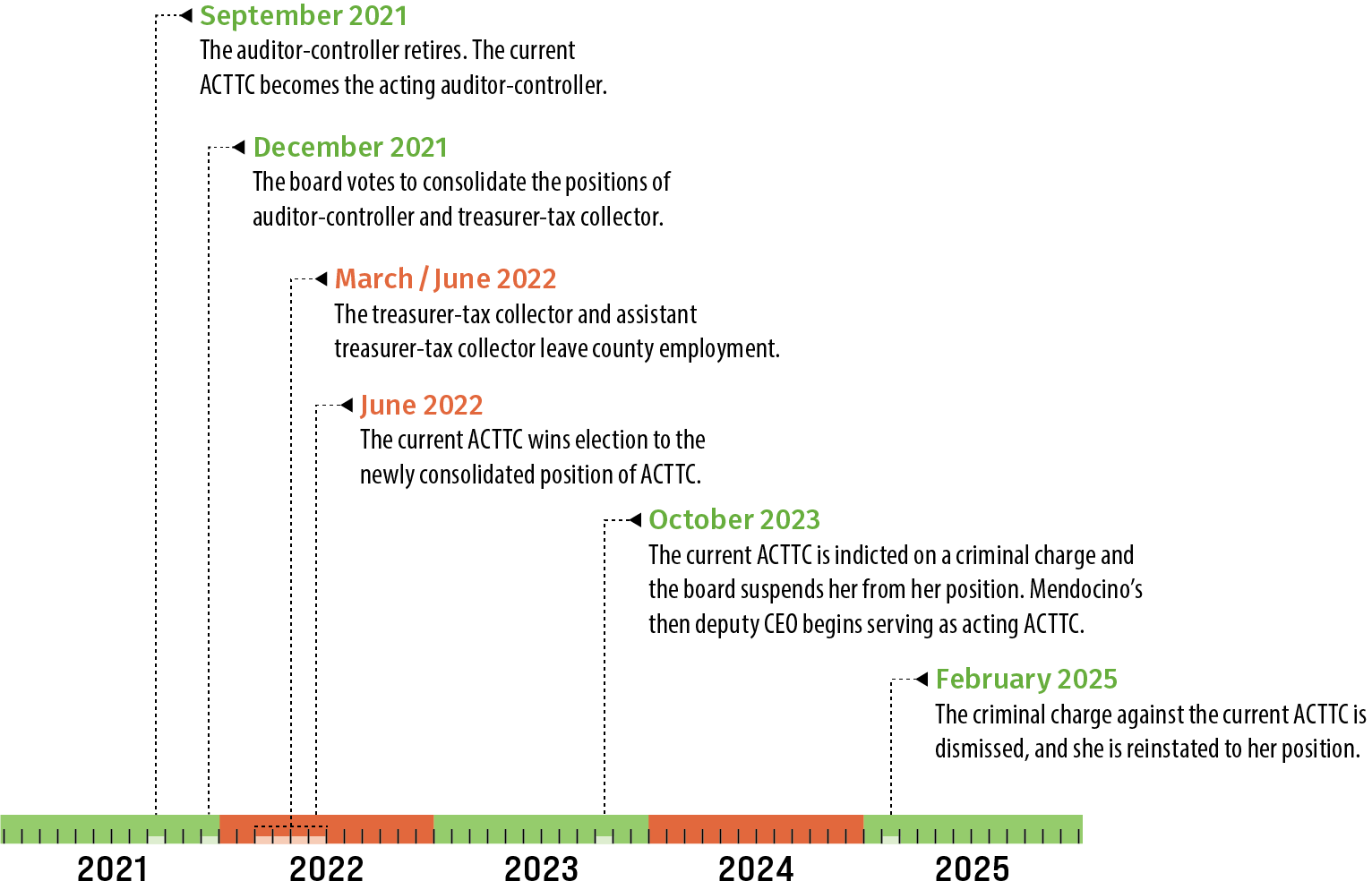
This figure presents a timeline of leadership changes in Mendocino County’s Auditor-Controller Treasurer-Tax Collector office from 2021 to 2025:
In September 2021, The Auditor-Controller retires. The current Auditor-Controller Treasurer-Tax Collector becomes the acting Auditor-Controller.
In December 2021, the county board votes to consolidate the positions of Auditor-Controller and Treasurer-Tax Collector.
From March to June 2022, The Treasurer-Tax Collector and Assistant Treasurer-Tax Collector leave county employment.
In June 2022, the current Auditor-Controller Treasurer-Tax Collector wins election to the newly consolidated ACTTC position.
In October 2023, the current Auditor-Controller Treasurer-Tax Collector is indicted on a criminal charge. The board suspends her, and the Deputy CEO begins serving as acting Auditor-Controller Treasurer-Tax Collector.
In February 2025, the criminal charges against the Auditor-Controller Treasurer-Tax Collector are dismissed, and the Auditor-Controller Treasurer-Tax Collector is reinstated to her position.
Source: Board meeting minutes, correspondence, and court records.
To meet some of the State’s financial reporting requirements, the ACTTC’s Office prepares Mendocino’s Annual Comprehensive Financial Report (ACFR), which provides detailed information on the county’s financial condition for a specific fiscal year. The county’s ACFR contains its basic financial statements, and Mendocino contracts with an independent accounting firm to conduct an external financial audit of the ACFR. The timely publication of the ACFR assists county government and stakeholders, such as the public, in understanding the financial health of the county. Because it receives and spends federal funding, Mendocino is required to produce an audit of its financial statements, and if it does not, the federal government is permitted to withhold funding. The state-level reporting requirements that Mendocino fulfills through its ACFR lack a calendar-date deadline for completion; however, the SCO stated in a July 2024 review of Mendocino that to be relevant and useful, the ACFR should be completed within nine months of the fiscal year’s end.
However, over the past several years, the ACTTC’s Office has been unable to consistently fulfill its responsibilities with respect to timely financial reporting. Specifically, Mendocino was delayed in its financial reporting in fiscal years 2021–22 and 2022–23.6 Mendocino published its ACFR for fiscal year 2021–22 about eight months after the nine-month deadline and its ACFR for fiscal year 2022–23 more than two months after this deadline.
When we asked the ACTTC about these delayed financial reports, she identified several factors that she believes played a role, including the consolidation of the Auditor‑Controller’s and Treasurer-Tax Collector’s Offices. According to the ACTTC, both offices lost experienced employees who had institutional knowledge critical for financial reporting following the consolidation. Both the former treasurer-tax collector and assistant treasurer-tax collector left county employment after the board voted to consolidate the offices. In addition to these changes, the ACTTC cited other causes—including upgrades to the county’s accounting system and audits by the SCO—as reasons for the delayed financial reporting. Finally, the ACTTC explained that upgrades to the county’s property tax system were a barrier that contributed to delayed financial reporting, and the ACTTC’s Office lacks the staff necessary to implement two specific accounting standards and account for changes in fixed asset balances throughout the fiscal year.
Because of its late financial reporting, the county has had two recent external reviews of the ACTTC’s Office. The SCO released a report based on the previously mentioned July 2024 review that examined Mendocino’s internal controls over financial reporting during the period from July 2020 through June 2022. In addition, Mendocino contracted with Regional Government Services (RGS) to, in part, provide an assessment of the ACTTC’s Office; RGS provided its report to the county in February 2025. Both entities reported on the ACTTC’s Office’s lack of policies and procedures and also discussed concerns with the appropriateness of how Mendocino recorded key financial transactions, including that the county recorded some transactions outside of its accounting software. The RGS report further stated that Mendocino was underutilizing its accounting software and recommended that the county take steps to make better use of it.
The county generally expressed agreement with the recommendations that both of these reports made to improve the operations of the ACTTC’s Office and the county’s overall accounting of its financial matters. In light of the importance of strong control systems for the functions that these reports reviewed, we focused our audit on whether the ACTTC’s Office had adequately addressed the reports’ observations and recommendations in three key areas. However, as Figure 9 shows, we found that it has not yet adequately addressed those areas.
Figure 9
Mendocino’s ACTTC’s Office Must Improve Its Operations in Three Key Areas
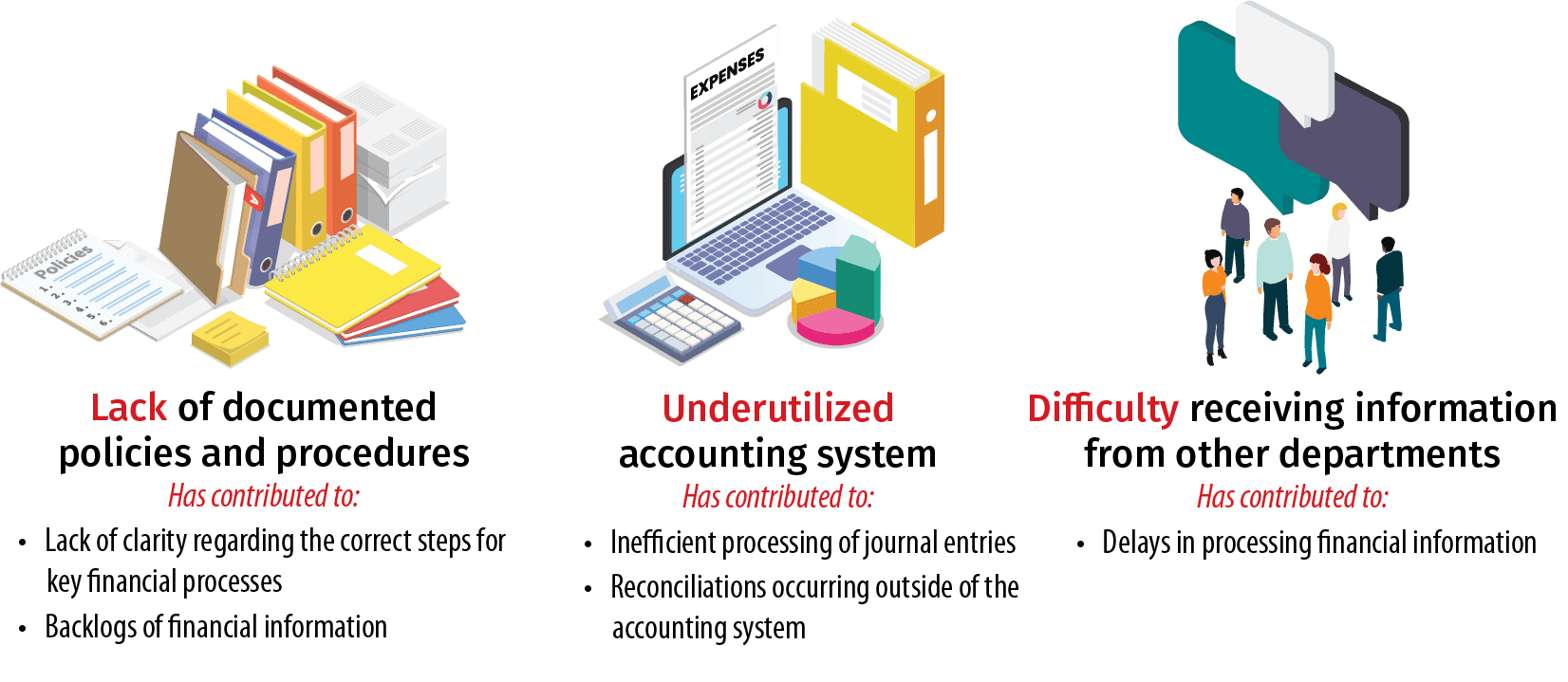
The figure is divided into three areas where the Auditor-Controller Treasurer-Tax Collector’s Office needs improvement.
The first area is its lack of documented policies and procedures, which have contributed to a lack of clarity regarding the correct steps for key financial processes and created backlogs of financial information.
The second area is the underutilization of its accounting system. This has contributed to inefficient processing of journal entries and reconciliations occurring outside of the accounting system.
The third area is the difficulty it has receiving information from other departments, which has contributed to delays in processing financial information.
Source: ACTTC’s office policies, analysis of internal documentation of financial processes, and interviews with county staff.
The first area in which the ACTTC’s Office has not yet made significant progress is finalizing its policies and procedures. In October 2024, in response to the recommendations from the SCO report, the then-acting ACTTC provided the SCO with a corrective action plan that listed 29 proposed policies and procedures Mendocino planned to create or update by June 2025. However, as of October 2025, the ACTTC’s Office was able to provide only one finalized policy that it had developed as part of its corrective action plan. It also provided us with two other policies that were not listed on the corrective action plan that it created prior to the release of the SCO report and the corrective action plan.
When we asked the ACTTC about the current status of the corrective action plan, she explained that she was not serving as the ACTTC when the county created the plan and shared her belief that, on her return to her position, the county had limited her ability to collaborate with the individual who had developed the plan. The ACTTC clarified that at present, her access to this individual is much improved but that they have had little to no discussion about the implementation of the corrective action plan. Nonetheless, the ACTTC noted that she is considering areas of the plan, and she is dedicating staff resources to ensuring the timely and accurate completion of the year-end closing procedures, responding to the county’s financial audit, publishing the county’s financial statements, and providing the State with required financial reports, all of which she considers her highest priority.
Although we believe that the ACTTC’s priorities are reasonable, the ACTTC’s Office must ensure that it takes action to avoid continued gaps in high-risk areas. For example, the office currently lacks up-to-date formal policies for how staff reconcile county bank balances to the county treasurer’s accounting records. This activity can help identify unallowable activities and assist in providing accurate point-in-time financial information and should be thoroughly documented. However, our review found that the ACTTC’s Office lacks a current formalized policy outlining its commitment to conducting these reconciliations and the frequency with which it will complete them. When we spoke to the individual at the ACTTC’s Office responsible for these reconciliations, she stated that she completes them monthly but does not produce any reports that document that she has done so. Absent a policy requiring such documentation, the ACTTC’s Office lacks assurance that it has a strong process for reconciliation and that its staff are following this process.
The ACTTC’s Office also lacks a formalized policy for processing journal entries from other county departments. County departments submit journal entries to record specific financial activities within their span of responsibility. They also provide backup documentation that supports those journal entry amounts to the ACTTC’s Office, which they additionally scan into the accounting system. The ACTTC’s Office must then review and post the journal entries into the county’s accounting system. The SCO report noted that a key cause of Mendocino’s delayed financial reporting was its backlog of unprocessed journal entries. Although the ACTTC’s Office drafted a policy for processing journal entries in August 2024, the office has yet to finalize this policy.
When we spoke to the individual at the ACTTC’s Office primarily responsible for reviewing journal entries, she stated that she was generally caught up on processing them. However, she also noted that the circumstances that led to the earlier backlog still exist; the office needs more staff to process the entries and has not adopted formal policies in this area, including a documented procedure for how department staff can submit correct journal entries.
In addition to a lack of documented policies and procedures, both the ACTTC’s Office and the county more broadly have not maximized the functionality of the county’s accounting system, leading to inefficiencies in their completion of certain steps related to financial reporting. For example, although the ACTTC’s Office explained that it can complete its review of journal entries without printing out hard copy information, it still requires county departments to provide hard copies of backup documentation, which staff at the ACTTC’s Office then review. At times, ACTTC’s Office staff who review journal entries must wait for department staff to print and send entries and supporting documentation to the ACTTC’s Office, which can delay the process of finalizing journal entries. Similarly, the individual at the ACTTC’s Office responsible for reconciling the county’s bank statements against the treasurer’s records explained that she conducts this work outside of the county’s accounting system because the system is not properly configured to complete this work. As we previously explained, this approach has resulted in the ACTTC’s Office’s inability to provide evidence that it actually completes these reconciliations.
The corrective action plan the ACTTC’s Office established in response to the SCO review stated that the county was reviewing the functions of its accounting system so that it could gain efficiencies by automation, and the plan specifically highlighted reconciliations as one of the processes on which the county would initially focus. However, staff at the ACTTC’s Office explained that efforts to automate the reconciliation process have stopped. When we asked the ACTTC about this, she reiterated that the reason efforts have stopped is largely because she is focusing on the timely preparation of the county’s financial statements given the importance of completing this task.
Finally, the ACTTC’s Office has at times not received the information it needs to process transactions or compile financial reports. For example, the individual at the office responsible for journal entries explained that she frequently receives incorrect journal entries from staff at other county departments and needs to request resubmission of journal entries or related documentation, which she documented for us by providing emails demonstrating this pattern. Although the ACTTC’s Office has provided some informal guidance and a recent training to county departments on journal entry submission, it has not established a formal procedure for this process. In addition, the ACTTC’s Office provided evidence that it faced significant delays in receiving lease information from the CEO’s Office that it needed to address the requirements of a new accounting standard. Emails show that staff took several months to provide this information to the ACTTC’s Office, which the ACTTC confirmed constituted a major barrier in implementing this new accounting standard in its preparation of the county’s ACFR.
Related to this issue of obtaining information from departments, we determined that the ACTTC’s Office lacks a documented plan for how it will respond to new accounting standards involving the presentation of its financial condition. The ACTTC explained that implementation of future accounting standards would be affected by whether the standards require information from other county departments or just the ACTTC’s Office. Some new accounting standards, like the standard pertaining to county leases we describe above, could require the ACTTC’s Office to collect information from county departments that it has not previously needed to obtain.
The GFOA has established certain best practices for timely financial reporting, including that government entities take steps to prepare for and facilitate new accounting standards, such as monitoring for changes to the standards and determining the steps required to implement new standards. When we spoke to the ACTTC, she explained that the implementation of three new accounting standards contributed to the delays in financial reporting in fiscal years 2021–22 and 2022–23 and noted that the county’s previous auditor-controller did not take action to assist the county in becoming compliant with a specific accounting standard before he retired. As we explain earlier in this section, the ACTTC’s Office has at times faced difficulty when obtaining information from other county departments necessary to implement new accounting standards. Because of these struggles, we believe that the ACTTC’s Office should implement the GFOA’s best practice of preparing for new accounting standards by establishing a plan for the steps it will take to successfully implement future accounting standards.
To address the effect these significant control weaknesses have had on its ability to promptly and accurately report on its financial condition, the ACTTC’s Office must take additional action in partnership with the CEO’s Office. In addition to limiting public transparency and accountability, delayed financial reporting can hinder the ability of the county’s board to make well-informed decisions regarding the county’s financial direction. The ACTTC’s Office must prioritize addressing the weaknesses that its reviewers and auditors have repeatedly identified to ensure its ability to report on the county’s financial condition in a timely manner.
Recommendations
Legislature
If the Legislature wishes to restrict to certain purposes local governments’ use of asset forfeiture funds, it should amend the Substances Act to specify those purposes. For example, the Legislature could restrict the use of these funds to only law enforcement purposes.
Mendocino
To enhance its safeguards against waste, fraud, and abuse, the county should, by June 2026, amend its purchasing policies to include clearer requirements for the documentation that departments must maintain to support their purchases. These new requirements should include an expectation that departments maintain a receipt or invoice record of what they purchased, they should document the reasons for the purchase, and they should reconcile payments for travel that they made in advance of the trip.
To ensure that it uses asset forfeiture funds only for allowable purposes and to provide transparency and promote accountability for that use, the county should adopt a county policy by June 2026 that does the following:
- Describes the appropriate and inappropriate uses of asset forfeiture funding. The policy should specifically address whether the county allows donations of these funds to private entities, and if it does allow such donations, it should include the ways in which the county will ensure that it protects against political or personal interests influencing such donations.
- Requires that all applicable offices and departments include asset forfeiture funds in the county’s annual budget with a clear description of their intended use.
- Mandates that all offices and departments that receive and use asset forfeiture funding produce an annual report that identifies how they used such funds. The county should make this report available to the public and discuss it at a public board meeting.
- Directs the ACTTC to regularly perform audits of the use of asset forfeiture funds at a prescribed interval, with no more than three years passing between audits.
To ensure that it closely adheres to advisable contracting practices, the county should, by June 2026, consider sources of best practices, such as the DGS procurement checklist, and revise its contracting and purchasing policies to align with such practices as applicable.
To ensure that departments justify all sole-source agreements, the county should, by June 2026, develop a sole-source justification expectations document and distribute it to departments. The expectations document should refer to county policy on sole-source procurement and provide examples and explanations of adequate and inadequate justifications.
To ensure that departments properly advertise all contracts for bid and submit those contracts for board consideration, the county should, by March 2026, begin tracking when a department enters into successive contracts with the same vendor for the same services and take action to address such situations with the responsible departments.
To ensure the consistency and efficiency of its operations, the ACTTC’s Office should revise its timeline for creating policies and procedures for key responsibilities, including bank reconciliations and journal entries, by March 2026. It should then follow this timeline.
To maximize the county’s accounting system’s capabilities and to ensure consistent documentation of the work its staff perform, the CEO’s Office and the ACTTC’s Office should, by September 2026, collaboratively develop a plan for using more of the system’s capabilities. At a minimum, the plan should address electronic processing of journal entries and bank reconciliations. It should also include goals for how the county will use the system, assign responsibility to specific staff for managing the county’s efforts to reach those goals, and create deadlines for achieving the goals.
To ensure that the ACTTC’s Office receives necessary information from departments in a timely manner, the CEO’s Office and the ACTTC’s Office should, by June 2026, collaborate on a protocol that outlines the key expectations for the timeliness and content of these communications. These offices should meet monthly to coordinate and share information about requests that have gone unfulfilled and to identify successful approaches to sharing information that they can replicate.
To ensure that the county is fully prepared to address future changes resulting from new accounting standards, the ACTTC’s Office should, by June 2026, establish a plan for how it will approach these changes. At a minimum, the plan should designate which staff in the ACTTC’s Office are responsible for monitoring changes in relevant standards and specify how the office will communicate with other county departments about their responsibilities for gathering, analyzing, and providing required information.
A Vendor Mistake and a Weak County Process Caused Ballot Errors in the 2024 Primary Election
Key Points
- During the 2024 presidential primary election (2024 primary election), the ballot printing vendor Mendocino used to create and distribute ballots to its voters provided the wrong ballot to nearly all voters in the county. Mendocino responded quickly to this error, but 691 voters ultimately cast votes using the incorrect ballot.
- Shortly after resolving the misprinted ballot issue, the county discovered that it had not placed some voters in the correct supervisorial voting districts and had to redistribute another corrected ballot to 177 voters it determined that it had misplaced.
- Our audit found that the county has still not placed all voters in the correct voting precincts, which means that these voters may receive incorrect ballots in future elections.
Nearly All County Voters Received Incorrect Primary Ballots Because of a Vendor’s Printing Error
As we describe in the Introduction, the Assessor-Clerk-Recorder’s Office (Elections Office) oversees Mendocino’s elections.7 That office is responsible for activities related to voter registration, campaign-related filings, and the administration of elections. It is essentially responsible for ensuring that registered voters in the county are provided an opportunity to vote and have their vote counted. Effective 2022, the State permanently made vote-by-mail a default option for all elections. Therefore, during the 2024 primary election, which occurred from February 5, 2024, through March 5, 2024, the Elections Office was responsible for ensuring that about 52,600 registered voters received a mailed ballot. Mendocino’s published election results for the 2024 primary show that most voters used their mailed ballots to vote in that election.
Because of the lead time required to print and send ballots to every county voter, the Elections Office used the services of a vendor to print and distribute almost all of the ballots for the 2024 primary election. The Elections Office told us that for the 2024 primary election, it printed and distributed the ballots for overseas and military voters because of the relatively low number of those ballots and that it also provides ballots to voters under other circumstances, such as when voters register to vote close to Election Day or when they update their voter information. To distribute the remaining ballots, the Elections Office used the services of a certified ballot printing vendor. The Secretary of State (SOS) has issued regulations that establish that no ballot printer may manufacture ballots for use in a California election unless they are certified as a ballot printer by the SOS. According to the county’s elections official, the county had used this vendor for 15 years before the 2024 primary election except from 2020 to 2022 when it used another ballot printing vendor in an attempt to use the services of the same vendor that manages the county’s elections software.8
During a primary election, voters should receive ballots that correspond both to their registered party preference for the presidential primary race and to the nonpartisan local races that are applicable to them. The races that appear on a voter’s ballot are determined by that voter’s assigned voting precinct. Precincts are subdivisions of the county that must not cross over the various voting district boundaries. Therefore, the precinct to which a voter is assigned determines the voting district to which that voter belongs. Mendocino is split into many voting districts, including five supervisorial districts, each of which is represented by a member of the board. By assigning voters to the correct precincts, the county can ensure that their ballot includes only the races for which they are eligible to vote. For example, the ballot should give voters in one of Mendocino’s five supervisorial districts the opportunity to vote in the county supervisor race that corresponds to their district but not in a race taking place in another district.
Figure 10 shows how counties should distribute ballots to voters and contrasts that process with the error that occurred in the 2024 primary election. As the figure indicates, in February 2024, Mendocino’s vendor printed and mailed to every registered voter residing in the county incorrect ballots for the 2024 primary election. Although the county sent the vendor the correct files to print and verified the ballot proofs the vendor provided for verification, the vendor nevertheless printed the ballots incorrectly and did not identify the error before mailing the ballots. Specifically, every ballot the vendor distributed was for a specific precinct in the 1st district and, more precisely, for voters from that precinct who were registered as Republican. In addition, according to the Elections Office, the bar codes on the ballots were printed incorrectly, making it impossible to use the ballots even for Republican voters from that precinct.
Figure 10
Mendocino Voters Received Incorrect 2024 Primary Election Ballots
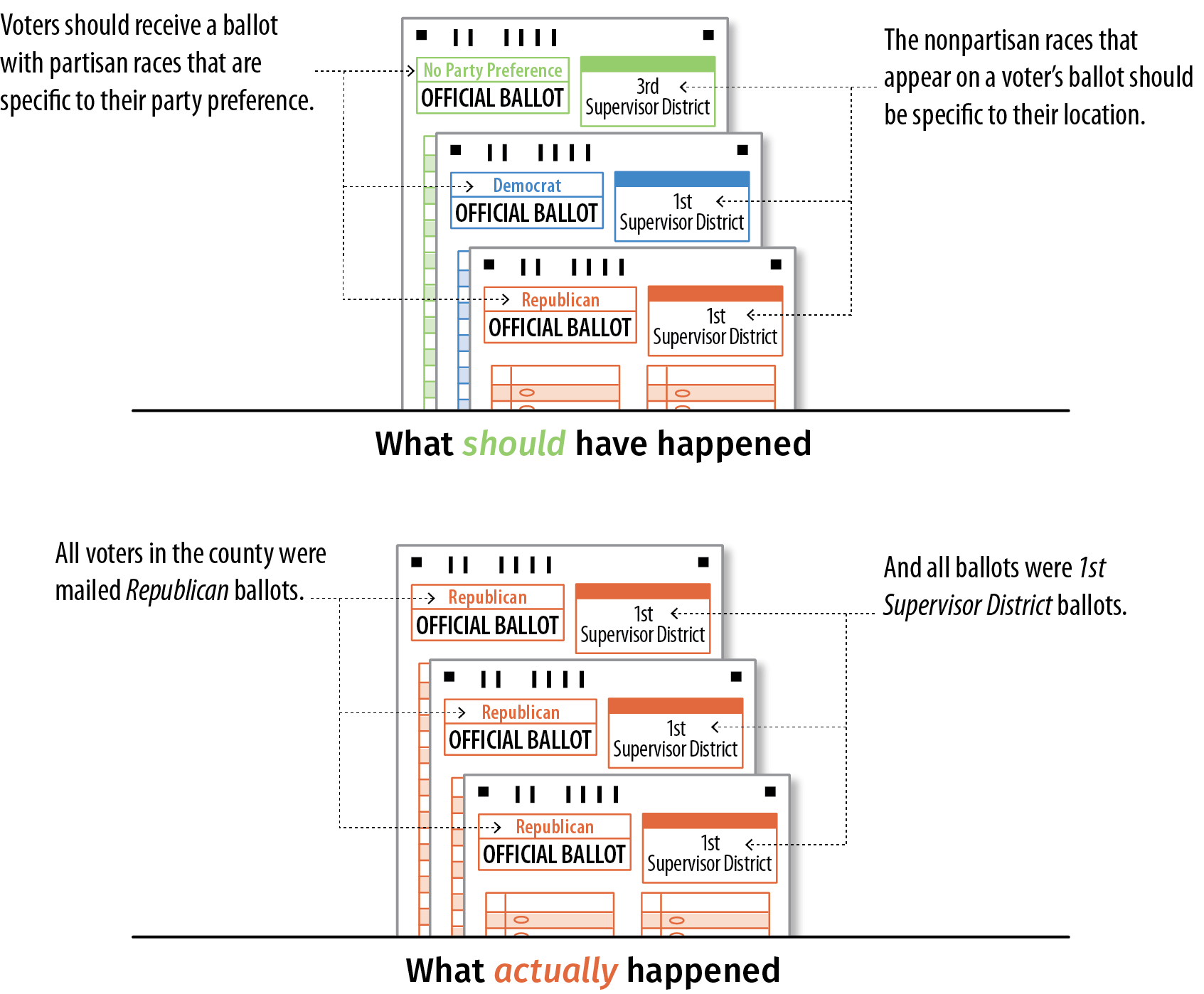
The figure depicts voting ballots under two different scenarios what was supposed to happen and what actually happened.
What was supposed to happen is that each voter should have received a ballot with partisan races specific to their party preferences and should have had nonpartisan races that were specific to their location. The ballots depicted show different supervisor districts and party preferences.
What actually happened is that every voter was mailed a Republican ballot with nonpartisan races for the 1st Supervisor district. The ballots depicted are all Republican ballots from the 1st Supervisor district.
Source: State law, Mendocino’s elections records, press releases, and emails.
The Elections Office took steps to immediately respond to and correct the printing error. Figure 11 shows a timeline of when the office first learned of the error and the steps it took to resolve the issue.
Figure 11
Mendocino’s Elections Office Responded Quickly When It Learned That Incorrect Ballots Had Been Sent to County Voters in the 2024 Primary Election

The figure depicts a timeline showing the dates of various actions taken by the Elections Office once it was made aware of the error.
On February 5th, Mendocino’s ballot vendor mails out incorrect ballots to all county voters.
On February 7th, Mendocino learns of the ballot errors when voters begin receiving their ballots.
On February 8th through 9th , Mendocino issues press releases regarding the error and works with its ballot vendor to mail replacement ballots to voters
On February 13th, Mendocino’s ballot vendor mails out replacement ballots to Mendocino voters.
On February 15th and 16th, Mendocino works with its ballot vendor to mail a post card to voters with information on the ballot error, Mendocino announces that voters should begin receiving replacement ballots.
On March 5th, Election day. Voters’ mail-in ballots must be postmarked by this date in order to be counted in the election.
Source: Mendocino’s elections records, press releases, and emails; SOS website.
When the Elections Office began to receive ballots returned by voters, it took steps to ensure that it counted only votes from corrected ballots. The elections official stated that after learning about the printing error, she notified staff at the SOS and informed them of Mendocino’s plans to address incorrect ballots that voters might submit. Specifically, the Elections Office planned to store any incorrect ballots and first determine, during the counting of votes, whether the voters who submitted incorrect ballots also subsequently submitted corrected ballots. For any voters who submitted only an incorrect ballot, the Elections Office planned to remake the ballot.
As the text box shows, there are specified circumstances in which state law directs elections officials to create a duplicate ballot for a voter to ensure that votes are counted. The Elections Office indicated to us that it considered the misprinted ballots similar to provisional ballots. A provisional ballot is a ballot cast by a voter claiming to be properly registered to vote but whose qualifications or entitlement to vote cannot be immediately established. State law requires that the provisional ballot of a voter who is otherwise entitled to vote cannot be rejected because the voter did not cast their vote from their assigned precinct. Instead, in effect, the law requires that an elections official count the votes that the voter cast for all races in which the voter would have ordinarily been able to vote, had they voted using a ballot from their assigned precinct. Figure 12 shows how the Elections Office used this process to count votes and how it ensured that it did not count incorrect votes. The elections official told us that, during the ballot remake process, staff worked in pairs to fill out and review the new ballot.
“In preparing voted ballots for processing, any ballot that is torn, bent, or otherwise defective shall be corrected so that every vote cast by the voter shall be counted by the automatic tabulating equipment. If necessary, a true duplicate copy of the defective ballot shall be made and substituted therefor, following the intention of the voter insofar as it can be ascertained from the defective ballot.”
Source: Elections Code section 15210.
Figure 12
Mendocino Remade Certain Ballots to Count as Many Votes as Possible After the Ballot Printing Error
The figure shows two scenarios in which a mistaken ballot was initially received and shows how the County responded in both scenarios to count the votes on these ballots it could count.
If a voter submitted both a misprinted ballot and the corrected ballot, or if the voter submitted only the corrected ballot, the county only counted the votes from the corrected ballot.
However, if the voter submitted only a misprinted ballot, Mendocino created a new ballot for that voter and transferred the votes for all races the voter was eligible to vote in onto the new ballot (leaving out races that were not applicable due to party preference or location).
For example: if a voter submitted a misprinted ballot with a vote for 1st District Supervisor and they were eligible to vote for that race, the county made a new ballot with that vote counted.
Source: Interviews with Elections Office staff.
After remaking the incorrect ballots, the Elections Office organized and stored them separately in a secure space. It also recorded the number of remade ballots on a ballot log. According to this ballot log, the county remade 691 incorrect ballots.9
One race up for vote in the 2024 primary election was potentially affected by the voters who cast ballots that did not include the proper races. The race was for the board of supervisor position in the 2nd district. One hundred thirty-seven 2nd district voters used a misprinted ballot to vote, meaning that they cast ballots that did not include the 2nd district supervisor race. The margin of victory in this race was 116 votes, 21 fewer than the number of 2nd district voters who used misprinted ballots. When the Elections Office remade the 137 incorrect ballots, it generally would not have been able to transfer and count votes for the 2nd district supervisor race because that race did not appear on the misprinted ballots used by those voters. Instead, the Elections Office would have been dependent on whether the voters wrote in their vote for the 2nd district supervisor race. Because of our inability to know how the 137 voters would have voted if they had used the correct ballot, we do not make any conclusions about whether the error affected the outcome of that race.
Although the Elections Office took appropriate steps to resolve the printing error, it exposed the county to significant risk by not having a contractual agreement with its ballot printing vendor. Without a contract that assigned clear responsibilities and detailed performance standards and remedies for issues, the Elections Office was reliant on the vendor to voluntarily address the error and accept financial responsibility for it. In this instance, the elections official noted that the ballot printing vendor resolved the error at its own expense. However, the vendor could have decided not to do so.
According to the elections official, state law allows her office to operate without a contract for election services. However, she agreed that having a contract with the ballot printing vendor would have been helpful. Shortly after the printing error, the SOS decertified the vendor Mendocino had been working with. As a result, the Elections Office needed to identify a new ballot printing vendor, which it did. The Elections Office has since drafted a contract for its new ballot printing vendor and told us that it hopes to have a finalized contract by the end of 2025.
Additionally, the error resulted in the county remaking ballots without a clear set of procedures for doing so. Although the Elections Office had written procedures for processing regular and absentee ballots, it did not have procedures for remaking ballots when the printing error occurred. After we spoke with the Elections Office about this issue, it created procedures for remaking ballots, addressing our concern.
In a Second Ballot Error, the Elections Office Assigned at Least 177 Voters to Incorrect Voting Precincts
Shortly after the Elections Office resolved the ballot printing error, it discovered an additional error. The Elections Office told us it received phone calls on February 20, 2024, from a voter and a candidate running for office about voters being assigned to incorrect supervisorial districts. After looking further into these concerns, the county determined that it had assigned 177 voters to the wrong precincts and, because of that, the wrong supervisorial districts.
Consequently, these voters received ballots with incorrect information about the district supervisors for which they could vote. For example, the county mistakenly sent a voter who resided in the 1st supervisorial district a ballot that gave them the chance to vote only in the 2nd district supervisor race. Of the 177 voters the county identified, the most common error was that the county sent 5th district ballots to 89 voters who lived in the 1st district. These ballots did not present these 89 voters with an option for voting for supervisor, even though the voters should have been presented with an option to vote in the 1st district supervisor race. The text box summarizes the incorrect placement of all 177 voters.
The Elections Office Misplaced at Least 177 Voters
89 1st district voters were sent 5th district ballots.
70 5th district voters were sent 1st district ballots.
13 4th district voters were sent 3rd district ballots.
4 1st district voters were sent 2nd district ballots.
1 5th district voter was sent a 4th district ballot.
Source: Elections Office records.
These incorrect ballots resulted from errors that the Elections Office made after the county’s 2021 redistricting effort. State law requires counties to revise voting district boundaries every 10 years to account for changes in population, a process that Mendocino undertook after the 2020 census. The resulting supervisorial district boundary lines were different from those that had previously existed, meaning that some voters who had once been in one supervisorial district now lived in a new district. Because of this, the Elections Office needed to reassign the affected voters to new precincts.
However, the Elections Office’s approach to assigning voters to new precincts proved to be incomplete. Elections Office staff described to us that they visually inspected maps of the county to determine when voters registered at specific addresses were now located in new districts. The Elections Office staff explained that they then inputted the corresponding adjustments to voter precinct assignments into the office’s elections management system and only later realized that the changes they had entered for some voters had not taken effect. This process left at least 177 voters in incorrect voting precincts—for reasons we will more fully describe in the next section. Figure 13 shows the effect this had on a hypothetical voter during the 2024 primary election.
Figure 13
The Elections Office Did Not Assign All Voters to the Proper District After the 2021 Redistricting Process

The figure depicts two maps to show that the county did not properly move all voters into the correct district after the 2021 redistricting. The first map shows the district lines before redistricting, and the second map shows the district lines after redistricting.
The first map shows that, before redistricting, a voter was on the border of District 5 and District 1 and was correctly assigned to District 5.
The second map shows that, after redistricting, the voter’s proper district had moved to District 1, but the voter was not reassigned to District 1 and instead incorrectly received a District 5 ballot in 2024.
Source: GIS maps, Mendocino’s elections records, and interviews with Elections Office staff.
Like the ballot printing error, when the Elections Office discovered the second error, it quickly took steps to fix the problem. To help the Elections Office determine how many voters were affected, the county’s Geographical Information Systems (GIS) administrator developed lists of precincts that redistricting had caused to be split between districts. GIS is a mapping software that allows the county to plot voters’ registered addresses against supervisorial district boundaries to determine in which districts voters live. The Elections Office told us it then reviewed the information provided by the GIS administrator to identify any additional addresses assigned to the wrong district and determined that it had not correctly moved 177 voters. On the same day it learned of the second error, the office began to create and mail replacement ballots. The Elections Office told us it voided the incorrect ballots so that it would be certain not to count them.
According to Elections Office staff, the office was able to mail out all replacement ballots over the course of three days. In addition, the Elections Office published a press release the day after discovering the error to inform voters that some may have received ballots corresponding to incorrect voting districts, and it distributed a letter to voters affected by this error. To ensure that it would not make future errors, Elections Office personnel also reassigned the 177 voters to the correct precincts. However, as we describe in the next section, these were not the only voters assigned to the incorrect precincts or districts.
Mendocino Does Not Have Complete Assurance That It Assigns Voters to the Correct Precinct
To gain assurance that the 177 voters we describe above were the only voters who the Elections Office misassigned, we judgmentally selected 20 addresses at which registered voters lived to see whether the Elections Office had assigned the voters to the correct supervisorial district. We purposefully selected addresses that had shifted from one district to another after the 2021 redistricting and that were not the residences of any of the 177 voters the county had already identified.
We found that the county had assigned 19 of the 20 addresses to the proper district by the time we conducted our review. However, one address was still misassigned to a precinct in the 3rd district, rather than the 4th district. After we brought this error to the Elections Office’s attention, it reported to us that it reviewed surrounding areas and identified more addresses assigned to the incorrect precinct. The county provided documentation showing that it found 29 addresses at which voters lived that were assigned to the wrong precinct, two of which were assigned to the incorrect supervisorial district because of the precinct misassignment.10 The fact that the county identified these additional misassigned addresses after we brought this issue to its attention in June 2025 leads us to conclude that the voters at the addresses were assigned to incorrect precincts for both the 2024 primary and general elections.
Although a majority of these addresses were assigned to the correct supervisorial district, being in a different precinct may still have an effect on a voter’s ability to vote in other races. For example, a trustee area in the Mendocino-Lake Community College District held an election in November 2024 for a governing board member. We found that one of the 29 misplaced addresses we describe above was incorrectly placed within this trustee area. Its correct placement was in a different trustee area that was not holding an election that year. Therefore, the voter at this address was likely provided the opportunity to vote in a race in which their residence did not qualify them to vote.
Additionally, we are concerned that there are still voters in Mendocino assigned to incorrect precincts. The Elections Office looked for these incorrectly assigned voters only after we brought this issue to its attention, and the office told us it looked only at areas surrounding the single address we identified as misplaced. However, we have no reason to believe that the problems we found were isolated to that single geographic location in the county. Therefore, some risk remains that other voters are also not placed in the correct precincts and are susceptible to receiving incorrect ballots in future elections. To have better assurance that it has assigned voters to the correct precinct, the county should fully review the placement of all county voters.
Further, these continued errors suggest the need for a more robust and formalized process for reassigning addresses when district boundaries change. The Elections Office does not have such internal procedures. Without a more robust process for reassigning voters than the one used by the Elections Office after the 2021 redistricting, the Elections Office is vulnerable to similar errors happening in the future. As we describe above, the manual effort used by the Elections Office and the approach the GIS administrator used to assist the Elections Office can both result in errors. Accordingly, the county would be best positioned to assure itself and voters that it is placing them in the correct voting precincts if it also employed a procedure to verify the placements of a sample of voters in higher‑risk areas of the county where the district boundary lines have shifted most significantly.
Recommendations
To safeguard the county against poor performance by elections-related vendors, the Elections Office should, as soon as possible, secure a contract agreement with its ballot printing vendor that specifies the compensation the vendor will receive and how the county will address poor contractor performance.
To provide assurance that it has placed all voters in the correct precinct, the Elections Office should review all voter precinct assignments and verify that they are correct before the next county election. The Elections Office should prioritize reviewing the placement of voters who live in areas of the county that may be at higher risk of misplacement, such as areas where voting district boundaries have changed recently. When it completes this review, the Elections Office should report the results to the board and identify the potential impact on any previous elections.
To ensure that it assigns voters to the correct precincts when voting district boundaries change, the Elections Office should, by June 2026, create procedures for responding to district boundary changes. These procedures should include using automated assistance from GIS or similar automated approaches to making assignments. They should also identify the steps that Elections Office staff will take to review a sample of assignments from high-risk areas to determine whether voters’ placements are correct.
We conducted this performance audit in accordance with generally accepted government auditing standards and under the authority vested in the California State Auditor by Government Code section 8543 et seq. Those standards require that we plan and perform the audit to obtain sufficient, appropriate evidence to provide a reasonable basis for our findings and conclusions based on the audit objectives. We believe that the evidence obtained provides a reasonable basis for our findings and conclusions based on our audit objectives.
Respectfully submitted,
GRANT PARKS
California State Auditor
December 18, 2025
Staff:
Bob Harris, Audit Principal
Grayson Hough, Senior Auditor
Brandy Roberts
Dominik Baer
Julie Magana
Roxanna Jarvis
Legal Counsel:
Heather Kendrick, Assistant Chief Counsel
Michael Sorich
Appendix
Government Code section 8546.11 requires our office to conduct an audit of Mendocino to evaluate any potential waste, fraud, abuse, and mismanagement, the county’s administration of elections in 2024, and its contracting and procurement. The table lists the objectives we developed in response to the statutorily required scope of the audit and the methods we used to address those objectives. Unless otherwise stated in the table or elsewhere in the report, statements and conclusions about items selected for review should not be projected to the population.
Responses
- Mendocino County Chief Executive Officer
- Mendocino County Assessor-Clerk-Recorder
- Mendocino County Auditor-Controller-Treasurer-Tax Collector
- Mendocino County District Attorney
- Mendocino County Sheriff
Mendocino County Chief Executive Officer
December 4, 2025
Auditor of the State of California
Attn: Grant Parks
621 Capitol Mall, Suite 1200
Sacramento, CA 95814
Dear Mr. Parks:
On behalf of the County of Mendocino, I would like to extend our sincere gratitude to you and your team for the time, effort, and professionalism you dedicated to working with us throughout the recent audit process. The County of Mendocino appreciates the opportunity to work with your office to identify areas for improvement. The County takes the recommendations from the State Auditor seriously. The County anticipates fully addressing the areas directed towards the Executive Office and Board of Supervisors by the recommended dates, if not sooner. The County is committed to the path of improvement and recognizes there is concurrence with your office on recommendations contained in Report 2025-049. The Board of Supervisors and Executive Office’s responses to the recommendations are outlined in the following pages.
Once again, thank you for your support and for the constructive spirit in which this audit was conducted.
Sincerely,
Darcie Antle
Chief Executive Officer
Mendocino’s Financial Condition is Gradually Declining and Requires Corrective Action
- Recommendation: To ensure that it maintains a reserve balance sufficient to facilitate its operations during emergencies and serve as a buffer during economic downturns, the county should, before its board adopts its 2026-27 budget, revise its policy on general fund reserves to incorporate a new target reserve level. In doing so, the county should consider the stability of its revenue sources, the likelihood of unexpected expenditures, and the guidance published by the GFOA. At a minimum, the county’s new reserve level should be no less than the minimum recommended by the GFOA of two months of expenditures.
Responsible Department: Executive Office
County Response: The Board of Supervisors and Executive Office agree with the recommendation to adopt a revised policy on general fund reserves, including setting a new target reserve amount which is more in line with current trends. The county has set an internal goal to have the policy amended by June 30, 2026.
① The Executive Office would like to provide additional clarity regarding the more expansive definition of General Fund Reserve used in this audit report being equivalent to the County’s unrestricted general fund balance. The Executive Office understands the more expansive definition is the combination of assigned and unassigned fund balances as presented in the Annual Comprehensive Financial Reports (ACFR), under the General column on the Balance Sheet – Governmental Funds page. The Executive Office also understands the more expansive definition aligns with the Government Finance Officers Association (GFOA) definition of unrestricted funds. However, the Executive Office would like to note, the General column throughout the County’s ACFR is comprised of more than the County’s discretionary General Fund. The General Column also captures other funds such as Realignment, Social Service Public Assistance, Child Support, and Landfill Closure funds to name a few. While there are balances within these funds, the funds are assigned to specific uses such as Public Assistance and Landfill remediation and are not fully discretionary. The Executive Office also recognizes the calculation for the General Reserve limit will change if the Auditor-Controller/Treasurer-Tax Collector chooses to, in the future, categorize these additional funds as Special Revenue vs General. The Executive Office will work with the Auditor-Controller/Treasurer-Tax Collector to understand how the data will be presented in the future, when updating the policy. - Recommendation: To ensure that the county does not lose property tax revenue because of delayed assessments, the Assessor’s Office should, by March 2026, develop tools such as aging reports showing the length of time since qualifying events, to assist in the management of its assessment workloads. These tools should, at a minimum, allow staff and managers to identify which properties are at highest risk of lost property tax revenue if the county does not assess them in a timely fashion.
Responsible Department: Assessor-Clerk Recorder
County Response: This recommendation is directed towards an independently elected official. While the recommendation is directed at the Assessor-Clerk Recorder, the Board of Supervisors and Executive Office agree with the recommendation. The Board of Supervisors over the last several years has continuously voiced concerns regarding delayed assessments. The Board of Supervisors through the Executive Office has made and continues to make the Information Technology division available to help with implementation and creation of tools. The Board of Supervisors and Executive Office look forward to collaborating with the department to help ensure the recommendation is addressed. - Recommendation: To recoup unpaid property tax payments to the degree possible, the ACTTC should continue to take steps to resume holding regular default tax property auctions by October 2026. If the ACTTC’s Office needs external assistance to hold the auction on time, it should obtain such assistance.
Responsible Department: Auditor-Controller/Treasurer-Tax Collector
County Response: This recommendation is directed towards an independently elected official. While the recommendation is directed at the Auditor-Controller/Treasurer-Tax Collector, the Board of Supervisors and Executive Office agree with the recommendation. The Board of Supervisors over the last several years has expressed concerns about the lapse of an auction and has offered support to move the process along. The Board of Supervisors and Executive Office look forward to collaborating with the department to help ensure the recommendation is addressed. - Recommendation: To ensure its staff’s ability to appropriately and efficiently resolve issues with its property tax system, the Assessor’s Office should, by June 2026, document clear policies and procedures pertaining to property tax assessments and the management of property tax-related information in its system.
Responsible Department: Assessor-Clerk Recorder
County Response: This recommendation is directed towards an independently elected official. While the recommendation is directed at the Assessor-Clerk Recorder, the Board of Supervisors and Executive Office agree with the recommendation. The Board of Supervisors over the last several years has continuously voiced concerns regarding the property tax system and has made various resources available through the Executive Office. One such resource was a process improvement team, which was created in early 2023 and has subsequently been disbanded, to help with county initiatives. This team in November 2023 created a process workflow to help assist the Assessor’s Office with the creation of policy and procedures. The Board of Supervisors recommends the Assessor’s Office review the workflow documents provided. The Board of Supervisors and Executive Office look forward to collaborating with the department to help ensure the recommendation is addressed. - Recommendation: To ensure that it addresses its persistent budget deficit, the board should, by March 2026, create a schedule outlining the steps it will take to address its stagnant tax revenue and increasing expenditures. This schedule should include board meetings or town halls with the express purpose of discussing the spending areas the county wishes to prioritize for reduction and options for the county to increase revenue, such as by increasing tax rates. The board’s goal should be for the 2026-27 budget it adopts to reflect the results of this process to the maximum extent possible.
Responsible Department: Board of Supervisors
County Response: The Board of Supervisors and Executive Office agree with the recommendations to create a schedule outlining the steps it will take to address the stagnant revenue and increasing expenditures. The Board of Supervisors will be holding a public workshop in the middle of January which will discuss various topics, including this audit and recommendations. Additionally, the budget team will be holding several budget workshops in early 2026 prior to budget adoption.
② The Board of Supervisors agrees the County needs to address stagnant revenues. The Board of Supervisors is concerned about the feasibility of increasing taxes for various reasons. The first reason is the fact that two of the four cities within Mendocino County are capped on max allowable tax that can be charged to residents and narrowing a tax to the unincorporated area would not likely generate significant revenue. A second reason is that a voter-initiated ballot measure may not be politically feasible as indicated in recent polling by the Mendocino Council of Governments. A third concern is there are potentially competing tax initiatives which are already being discussed publicly, one measure being for public safety, and another being for Fire/Emergency Medical Services.
The Board of Supervisors is committed to trying to increase revenue, but due to State tax limits and regulations, increasing revenue in a rural community is difficult. The Board of Supervisors is also committed, by utilizing their Legislative Platform, to pushing back on unfunded mandates directed by the State and Federal governments.
The County’s Procurement and Financial Reporting Process Leave It Vulnerable to Waste, Fraud, and Abuse of Public Funds
- Recommendation: If the legislature wishes to restrict to certain purposes local governments’ use of asset forfeiture funds, it should amend the Substances Act to specify those purposes. For example, the Legislature could restrict the use of these funds to only law enforcement purposes.
Responsible Department: State Legislature
County Response: The Board of Supervisors agrees counties could benefit from more specific direction from the State Legislature on allowable uses of state-law-derived asset forfeiture funds, similar to the more instructive federal guidelines found in the “Guide to Equitable Sharing for State, Local, and Tribal Law Enforcement Agencies” issued by the U.S. Department of Justice with the U.S. Department of Treasury.” - Recommendation: To enhance its safeguards against waste, fraud, and abuse, the county should, by June 2026, amend its purchasing policies to include clearer requirements for the documentation that departments must maintain to support their purchases. These new requirements should include an expectation that departments maintain a receipt or invoice record of what they purchased, they should document the reasons for the purchase, and they should reconcile payments for travel that they made in advance of the trip.
Responsible Department: Executive Office
County Response: The Board of Supervisors and Executive Office agree with the recommendation to amend its purchasing policies to include clearer requirements including expectations around documentation.
The Executive Office will be bringing forward to the Board of Supervisors for adoption, an amended Policy 1 (Purchasing, Leasing, and Contracting Policy) on December 16, 2025. The amended policy will not go into detail around documents required, as that will be documented in the Procedural Guide. The Procedural Guide will be distributed to all staff involved in any aspect of purchasing, including but not limited to contracting for services, leases, or procuring goods. The Executive Office will be reaching out to departments in December to set up training for all staff involved in purchasing activities to review the new policy and expectations.
③ The Executive Office will begin working on Policy 18 (Travel and Meal Policy) with the goal of having an amended policy by the recommended date. The Executive Office will reach out to the Auditor’s Office to collaborate on updating the policy. - Recommendation: To ensure it uses asset forfeiture funds only for allowable purposes and to provide transparency and promote accountability for that use, the county should adopt a county policy by June 2026 that does the following:
a. Describes the appropriate and inappropriate uses of asset forfeiture funding. The policy should specifically address whether the county allows donations of these funds to private entities, and if it does allow such donations, it should include the ways in which the county will ensure that it protects against political or personal interests influencing such donations.
b. Requires that all applicable offices and departments include asset forfeiture funds in the county’s annual budget with a clear description of their intended use.
c. Mandates that all offices and departments that receive and use asset forfeiture funding produce an annual report that identifies how they used such funds. The county should make this report available to the public and discuss it at a public board meeting.
d. Directs the ACTTC to regularly perform audits of the use of asset forfeiture funds at a prescribed interval, with no more than three years passing between audits.
Responsible Department: Executive Office
County Response: The Board of Supervisors and Executive Office agree with the recommendations to adopt a policy around asset forfeiture funds. The Executive Office will begin working on a Policy with assistance of County Counsel and the affected departments with a goal of having a policy brought forward by the recommended date.
As to the appropriate and inappropriate uses of asset forfeiture funding, the County agrees there is some ambiguity in state law which defers generally to “law enforcement” related purposes. (Cal. Health & Safety 11469). Therefore, in light of the more specific or instructive federal “Guide to Equitable Sharing for State, Local, and Tribal Law Enforcement Agencies” issued by the U.S. Department of Justice with the U.S. Department of Treasury, (hereinafter “US DOJ Guidance”) most recently updated March 2024, the County intends to develop a policy that complies with the state law and includes review and consideration of the US DOJ Guidance as to specific “permissible” and “impermissible uses”, including acknowledging, for example, that “funds may not be used to pay for food and beverages. . . [except for that] included in per diem for official travel” and that “funds may not be donated to or used to purchase items for community-based organizations.”
The County agrees policies should be clarified to require all applicable offices and departments to include asset forfeiture funds in the county’s annual budget process, subject to carefully following federal and state supplantation limitations so as not to jeopardize funding and tracking the distribution percentages outlined for example, in state law, i.e., Health and Safety Code section 11489.
The County agrees that all county offices and departments which receive asset forfeiture funds produce a report accompanying a public meeting which identifies the uses of asset forfeiture funds. The County also agrees that the use of asset forfeiture funds should be audited at no less than three-year intervals and will work with the affected departments as to this aspect of the policy. - Recommendation: To ensure that it closely adheres to advisable contracting practices, the county should, by June 2026, consider sources of best practices, such as the Department of General Services procurement checklist, and revise its contracting and purchasing policies to align with such practices as applicable.
Responsible Department: Executive Office
County Response: The Board of Supervisors and Executive Office agree with the recommendation to amend its purchasing policy with consideration of applicable components of the Department of General Services (DGS) checklist. The Executive Office will be bringing forward to the Board of Supervisors for adoption, an amended Policy 1 (Purchasing, Leasing, and Contracting Policy) on December 16, 2025. The amended policy addresses additional components of the DGS checklist. The Executive Office will work with County Counsel to continue reviewing Policy 1 to incorporate additional components of the DGS’ checklist as may be applicable, with the goal of having a subsequent amended policy by the recommended date. - Recommendation: To ensure that departments justify all sole-source agreements, the county should, by June 2026, develop a sole-source justification expectation document and distribute to departments. The expectations document should refer to county policy on sole-source procurement and provide examples and explanations of adequate and inadequate justifications.
Responsible Department: Executive Office
County Response: The Board of Supervisors and Executive Office agree with the recommendation to amend its purchasing policy to include clearer requirements around exceptions to bids such as sole sourcing.
The Executive Office will be bringing forward to the Board of Supervisors for adoption, an amended Policy 1 (Purchasing, Leasing, and Contracting Policy) on December 16, 2025. The amended policy will include updated justifications for Exception to bids, including an updated definition of Single Source. Expectations around adequate justifications will be documented in the Procedural Guide. The Procedural Guide will be distributed to all staff involved in any aspect of purchasing, including but not limited to contracting for services, leases, or procuring goods. The Executive Office will be reaching out to departments in December to set up training for all staff involved in purchasing activities to review the new policy and expectations.
Additionally, the Executive Office would like to note, with the implementation of the amended Policy 1, the process for documenting Exception to Bids will become automated through the contracting system, Cobblestone. Departments will be required to answer prompts and/or provide documentation for the exception. Documentation and/or written explanations will include but is not limited to the circumstances leading to the selection of the vendor, including alternatives considered, the department’s rationale for selecting the specific vendor, and the basis upon which the department determined the cost to be reasonable. - Recommendation: To ensure that departments properly advertise all contracts for bid and submit those contracts for board consideration, the county should, by March 2026, begin tracking when a department enters into successive contracts with the same vendor for the same service and take action to address such situations with the responsible departments.
Responsible Department: Executive Office
County Response The Board of Supervisors and Executive Office agree with the recommendation to amend its purchasing policy to include clearer expectations around contract splitting to ensure contracts are properly advertised for bid and brought to the Board of Supervisors for consideration.
The Executive Office will be bringing forward to the Board of Supervisors for adoption, an amended Policy 1 (Purchasing, Leasing, and Contracting Policy) on December 16, 2025. The amended policy will address the issue of contract splitting. Expectations around contract splitting will also be documented in the Procedural Guide. The Procedural Guide will be distributed to all staff involved in any aspect of purchasing, including but not limited to contracting for services, leases, or procuring goods. The Executive Office will be reaching out to departments in December to set up training for all staff involved in purchasing activities to review the new policy and expectations. - Recommendation: To ensure the consistency and efficiency of its operations, the ACTTC’s Office should revise its timeline for creating policies and procedures for key responsibilities, including bank reconciliations and journal entries, by March 2026. It should then follow this timeline.
Responsible Department: Auditor-Controller/Treasurer-Tax Collector
County Response: This recommendation is directed towards an independently elected official. While the recommendation is directed at the Auditor-Controller/Treasurer-Tax Collector, the Board of Supervisors and Executive Office agree with the recommendation.
The Board of Supervisors through the Executive Office has made and continues to make resources available to the Auditor-Controller/Treasurer-Tax Collector’s Office. Resources include contracts for services and hiring of additional staff. The Executive Office entered into a contract with Regional Government Services (RGS) in October 2022 to help the Auditor-Controller/Treasurer-Tax Collector’s Office to review current fiscal practices and processes. This contract was not utilized until November 2023 at which time it was amended to include a larger scope of work. Additionally, the Executive Office entered into a contract with Client First Technology Consulting in October 2022, which in part included Recurring Munis Improvement Project Oversight, Munis Improvements Initiation and Planning for 2022-2023, and Additional “As Needed” Activities. Included in this scope was the ability for Client First Technology to develop implementation acceptance plans, creation of end-user training plans, and assistance with the development of process documentation. Additionally, a second contract with Client First Technology was executed in February 2024 in part for Year End Close Processing, Bank Reconciliation Processing, Recurring Munis Improvements Project Oversight, and Additional “As Needed” Activities. Included in this scope was the ability for Client First Technology to develop implementation acceptance plans, creation of end-user training plans, and assistance with the development of process documentation.
The Board of Supervisors and Executive Office look forward to collaborating with the department to help ensure the recommendation is addressed. - Recommendation: To maximize the county’s accounting system’s capabilities and to ensure consistent documentation of the work its staff perform, the county executive’s office and the ACTTC’s Office should, by September 2026, collaboratively develop a plan for using more of the system’s capabilities. At a minimum, the plan should address electronic processing of journal entries and bank reconciliations. It should also include goals for how the county will use the system, assign responsibility to specific staff for managing the county’s efforts to reach those goals, and create deadlines for achieving the goals
Responsible Department: Executive Office and Auditor-Controller/Treasurer-Tax Collector
④ County Response: This recommendation is in part directed towards an independently elected official, and the Board of Supervisors has limited oversight. The Board of Supervisors and Executive Office agree with the recommendation for the Executive Office and the Auditor-Controller’s Office to work collaboratively to create a plan to utilize the financial system to its capabilities to ensure as much work as possible occurs within the financial system, Munis. The Executive Office over the last several years has been utilizing a Munis Initiative Tracker which outlines key initiative with target dates, key personnel, and status of initiative. The tracker has been shared previously with the Auditor-Controller/Treasurer-Tax Collector’s Office.
The Board of Supervisors through the Executive Office has made and continues to make resources available to the Auditor-Controller/Treasurer-Tax Collector’s Office. Resources include contracts for services and hiring of additional staff. The Executive Office entered into a contract with Regional Government Services in October 2022 to help the Auditor-Controller/Treasurer-Tax Collector’s Office to review current fiscal practices and processes. This contract was not utilized until November 2023 at which time it was amended to include a larger scope of work. Additionally, the Executive Office entered into a contract with Client First Technology Consulting in October 2022, which in part included Recurring Munis Improvement Project Oversight, Munis Improvements Initiation and Planning for 2022-2023, and Additional “As Needed” Activities. Included in this scope was the ability for Client First Technology to develop implementation acceptance plans, creation of end-user training plans, and assistance with the development of process documentation. Additionally, a second contract with Client First Technology was executed in February 2024 in part for Year End Close Processing, Bank Reconciliation Processing, Recurring Munis Improvements Project Oversight, and Additional “As Needed” Activities. Included in this scope was the ability for Client First Technology to develop implementation acceptance plans, creation of end-user training plans, and assistance with the development of process documentation.
Additionally, the Board of Supervisors has continuously expressed desire for the County to move towards a paperless environment. The Board of Supervisors recommends all departments fully utilize the systems available to them in an effective and efficient manner, which includes implementing workflow processes and eliminating the need to print documents. - Recommendation: To ensure that the ACTTC’s Office receives necessary information from departments in a timely manner, the county executive’s office and the ACTTC’s Office should, by June 2026, collaborate on a protocol that outlines the key expectations for the timeliness and content of these communications. These offices should meet monthly to coordinate and share information about requests that have gone unfulfilled and to identify successful approaches to sharing information that they can replicate.
Responsible Department: Executive Office and Auditor-Controller/Treasurer-Tax Collector
County Response: This recommendation is in part directed towards an independently elected official, and the Board of Supervisors has limited oversight. The Board of Supervisors and Executive Office agree with the recommendation for the Executive Office and the Auditor-Controller’s Office to work collaboratively to create a communication protocol. The Executive Office will collaborate with the ACTTC to create a communication protocol which outlines the necessary information, expectations, and timeliness for the information that is set by the ACTTC. - Recommendation: To ensure that the county is fully prepared to address future changes resulting from new accounting standards, the ACTTC’s Office should, by June 2026, establish a plan for how it will approach these changes. At a minimum, the plan should designate which staff in the ACTTC’s Office are responsible for monitoring changes in relevant standards and specify how the office will communicate with other county departments about their responsibilities for gathering, analyzing, and providing required information.
Responsible Department: Auditor-Controller/Treasurer-Tax Collector
County Response: This recommendation is directed towards an independently elected official. While the recommendation is directed at the Auditor-Controller/Treasurer-Tax Collector, the Board of Supervisors and Executive Office agree with the recommendation. The Board of Supervisors and Executive Office look forward to collaborating with the department to help ensure the recommendation is addressed.
A Vendor Mistake and a Weak County Process Caused Ballot Errors in the 2024 Primary Election
- Recommendation: To safeguard the county against poor performance by elections-related vendors, the Elections Office should, as soon as possible, secure a contract agreement with its ballot printing vendor that specifies the compensation the vendor will receive and how the county will address poor contract performance.
Responsible Department: Registrar of Voters
County Response: This recommendation is directed towards an independently elected official. While the recommendation is directed at the Registrar of Voters, the Board of Supervisors and Executive Office agree with the recommendation. The Board of Supervisors recommends the Registrar of Voters follow Policy 1 regarding contracting for services, including utilizing the County’s standard boilerplate template for contracting. While the Registrar of Voters is not required to follow Policy 1 for certain contracts pursuant to Elections Code 13001 and 14100, utilizing the boilerplate template ensures that County’s liability is limited and allows the County to address performance concerns. The Board of Supervisors and Executive Office have been informed that the Registrar of Voters is utilizing county contracting processes for its current ballot vendor and looks forward to continued collaboration with the department to help ensure the recommendation is addressed. - Recommendation: To provide assurance that it has placed all voters in the correct precinct, the Elections Office should review all voter precinct assignments and verify that they are correct before the next county election. The Elections Office should prioritize reviewing the placement of voters who live in areas of the county that may be at higher risk of misplacement, such as areas where voting district boundaries have changed recently. When it completes this review, the Elections Office should report the results to the board and identify the potential impact on any previous elections.
Responsible Department: Registrar of Voters
County Response: This recommendation is directed towards an independently elected official. While the recommendation is directed at the Registrar of Voters, the Board of Supervisors and Executive Office agree with the recommendation. The Board of Supervisors through the Executive Office has made and continues to make the Information Technology’s Geographic Information System (GIS) team available to help where needed. The Board of Supervisors and Executive Office look forward to collaborating with the department to help ensure the recommendation is addressed.
Responsible Department: Registrar of Voters - Recommendation: To ensure that it assigns voters to the correct precincts when voting district boundaries change, the Elections Office should, by June 2026, create procedures for responding to district boundary changes. These procedures should include using automated assistance from GIS or similar automated approaches to making assignments. They should also identify the steps that Elections Office staff will take to review a sample of assignments from high-risk areas to determine whether voters’ placement are correct.
Responsible Department: Registrar of Voters
County Response: This recommendation is directed towards an independently elected official. While the recommendation is directed at the Registrar of Voters, the Board of Supervisors and Executive Office agree with the recommendation. The Board of Supervisors through the Executive Office has made and continues to make the Information Technology’s Geographic Information System (GIS) team available to help where needed. The Board of Supervisors and Executive Office look forward to collaborating with the department to help ensure the recommendation is addressed.
California State Auditor’s Comments on the Response From the Mendocino County Chief Executive Officer
To provide clarity and perspective, we are commenting on the response to our audit report from the CEO’s Office. The numbers below correspond with the numbers we have placed in the margin of its response. Additionally, we note that the CEO’s Office and the board responded to recommendations that we did not make to them. During our follow-up on this audit’s recommendations, we will obtain updates from the entities to which we directed our recommendations.
① Throughout the narrative on the general fund reserve and in the notes to Figure 4, our report clearly explains the methods we used to calculate the amount of the county’s general fund reserve, including citations to the elements of the county’s ACFR that we used. We acknowledge the CEO’s Office’s characterization that the general fund as presented in the ACFR represents a consolidation of multiple funds the county keeps for different purposes. Nonetheless, the reserve amounts in Figure 4 are comprised solely of funding designated as unrestricted in the county ACFR. Therefore, we stand by our description and calculation of the county’s general fund reserve.
② The board expresses its concern about raising taxes. To be clear, our recommendation does not exclusively focus on raising taxes. Rather, the recommendation includes tax increases as a possible measure the board could take to raise revenue. As we state in the report, without further strategic action, the county will likely continue to face persistent deficits.
③ We believe that the CEO’s Office is referring to the ACTTC’s Office, and not the State Auditor, when it states that it will reach out to the Auditor’s Office to collaborate on updating its travel policy. To adhere to the audit standards we are statutorily required to follow, we do not engage in management activities such as establishing policy.
④ The CEO’s Office describes an initiative tracker to address improvements to its accounting system, and it provided this tracker to us for our review during our audit. However, we found that the tracker was not kept up to date and generally had more activities marked as “To Be Determined” when referencing the target completion date than it had activities with dates. Accordingly, we stand by our recommendation that the CEO’s Office and the ACTTC’s Office collaborate to develop a plan to use more of the accounting system’s capabilities.
Mendocino County Assessor-Clerk-Recorder
December 5, 2025
Mr. Grant Parks
California State Auditor
621 Capitol Mall, Suite 1200
Sacramento, CA 95814
Subject: Responses to Recommendations made by the State Audit team in the Assessor’s Office and Registrar of Voters Office
Dear Mr. Parks:
I would like to thank you for the learning opportunity provided during the audit of the Assessor and Elections Offices. The audit team was very professional and respectful, and listened to our concerns, and the audit process and report were informative.
The Assessor and Elections Offices concur with the audit findings and the resulting recommendations. Attached are the Assessor and Election Office’s responses to the audit team recommendations.
We are available to discuss our responses.
Sincerely,
Katrina Bartolomie
Assessor, Clerk Recorder
Mendocino County Assessor, County Clerk, Recorder, Registrar of Voters Responses to Recommendations made by State Auditors
ASSESSOR’S DIVISION:
Recommendation: To ensure that the county does not lose property tax revenue because of delayed assessments, the Assessor’s Office should, by March 2026, develop tools such as aging reports showing the length of time since qualifying events, to assist in the management of its assessment workloads. These tools should, at a minimum, allow staff and managers to identify which properties are at highest risk for last property tax revenue if the county does not assess them in a timely fashion. To ensure its staff’s ability to appropriately and efficiently resolve issues with its property tax system, the Assessor’s Office should, by June 2026, document clear policies and procedures pertaining to property tax assessments and the management of property tax-related information in its system.
① Response: The Assessor’s Office has been working with the County’s Information Technology Division (“IT”) to create an “aging” or “workflow” report based on the “Event Date” (issue date of a permit or the date of a change in ownership). IT has been working with other counties that use Aumentum, the County’s property tax software. One of the counties (Solano) has created a “dashboard” of sorts (a spreadsheet) that shows actual issue/event dates. Mendocino County is evaluating whether the dashboard used by Solano County would also work for Mendocino County to create an accurate “aging” or “workflow” report. This tool will allow Assessor’s Office staff to sort properties by issue date or by parcel number, whatever is appropriate at the time. The County hope to be able to include “change in ownerships” by June 2026. The Assessor’s Office anticipates that this will be a very helpful tool that can be used in multiple instances, not only as an aging report.
ELECTIONS DIVISION:
Recommendation: To safeguard the county against poor performance by elections-related vendors, the Elections Office should, as soon as possible, secure a contract agreement with its ballot printing vendor that specified the compensation the vendor will receive and how the county will address poor contract performance.
Response: The Elections Office agrees that a contract with its ballot printer would be beneficial. A contract with a ballot printing vendor is currently being processed. The Elections Office plans to incorporate language into this contract regarding performance standards and remedies for errors.
Recommendation: To provide assurance that it has placed all voters in the correct precinct, the Elections Office should review all voter precinct assignments and verify that they are correct before the next county election. The Elections Office should prioritize reviewing the placement of voters who live in areas of the county that may be at higher risk of misplacement, such as areas where voting district boundaries have changed recently. When it completes this review, the Elections Office should report the results to the board and identify the potential impact of any previous elections. To ensure that it assigns voters to the correct precincts when voting district boundaries change, the Election Office should, by June 2026, create procedures for responding to district boundary changes. These procedures should include using automated assistance from GIS or similar automated approaches to making assignments. They should also identify the steps that Elections Office staff will take to review a sample of assignments from high-risk areas to determine whether voters’ placements are correct.
Response: The Elections Office has contracted with a consultant who is assisting with redistricting for AB 604 – Congressional Redistricting, which is currently being processed. The Elections Office also intends to use this consultant to review all voting districts within the County to ensure that all voters are assigned the correct precincts. Additionally, Elections Office staff recently met with the County’s GIS Administrator to see what can be done to create a mapping system to use for responding to district boundary changes that will make it easier to identify changes in district boundary lines.
California State Auditor’s Comment on the Response From the Mendocino County Assessor-Clerk-Recorder
To provide clarity and perspective, we are commenting on the response to our audit report from the Assessor’s Office. The number below corresponds with the number we have placed in the margin of its response.
① The Assessor’s Office does not indicate the actions it plans to take to address our second recommendation, which is to document clear policies and procedures pertaining to property tax assessments and the management of property-tax related information in its system. We look forward to reviewing its progress in addressing this recommendation during our regular audit follow-up process.
Mendocino County Auditor-Controller-Treasurer-Tax Collector
December 5, 2025
Grant Parks
California State Auditor
621 Capitol Mall, Suite 1200
Sacramento, CA 95814
Re: Mendocino County 2025-049-Confidential Draft Audit Report
Dear Grant Parks:
① Thank you for the opportunity to review and provide a response to the California State Auditor’s (CSA) partial draft of their confidential audit report. It is important to note that I only received a highly redacted portion of the draft report, which contained the recommendations specifically related to the Auditor-Controller/Treasurer-Tax Collector’s (ACTTC) office operations and included minor additional portions (also redacted) of the report which directly relate to those recommendations.
The CSA audit methodology for this audit was siloed by department. Departments were directed to keep their respective audit discussions confidential to their office. The CSA team was given read-only access to the county finance system to search for information and obtain records without going through my office.
The CSA was very professional and took many steps to learn about ACTTC operations. I largely agree with the CSA draft report sections I was provided with. I would like to submit the following for additional context:
- The ACTTC Office performs several other critical tasks in addition to those that are outlined by the CSA list of Roles and Responsibilities, such as collection of Transient Occupancy Taxes, Business Improvement District fees, Business Licenses and County Victim Restitution payments, the payment of all County and many Special District’s vendor payments, preparation of the annual budget schedules, apportionment and payment of property tax, special assessment and school bond revenues just to name a few additional roles and responsibilities.
- ② There were a couple of subject areas that the CSA reviewed that relate to ACTTC Office that are unique to California counties. The most significant and likely hardest to fully grasp is how property taxes are assessed, billed, collected, and distributed in California. ACTTC staff tried to explain the roles and processes that are performed by ACTTC and provided additional resources and references to assist CSA with their review. While CSA made a good effort to learn about many of the intricacies, it is widely known among counties that it takes several years for someone to fully understand property taxes in California.
- ③ The delays due to data, software and the development of new property tax-related business processes resulted in numerous delays in processing tax bills. The delayed processing also changed the recent timing of sending out corrections, supplemental and escape bills which impacted the volume of delinquent tax bills in the last three years. The dollar value of delinquent bills fluctuates throughout the tax year as the annual bills and backlog of bills that have recently been generated over the last two years increased the amount transferred from delinquent to defaulted. That transfer takes place in July each year. Many taxpayers will pay their defaulted bill within the year after the bill becomes defaulted. The CSA did not provide a discussion of what an acceptable dollar value or range would be for defaulted bills given the various attributes of Mendocino county, such as number of parcels, total assessed value, special district direct and school bond assessments, functionality of property system, nor did CSA include what an acceptable amount or range would be for any other county.
- ④ The CSA makes the statement that Mendocino has not collected property tax revenue in a timely manner. The CSA does not define timely in the version of the report provided to ACTTC. The ACTTC acknowledges that the Mendocino collection rate has declined recently. Two factors that may have contributed to a reduction in the collection rate and the current balance of defaulted tax bills are: 1. the recent increase in the number of correction bills being sent out that had previously been held up by processing issues in Aumentum and 2. the sharp decline over the last few years in the local cannabis market which may have impacted the collection of tax for properties that were involved in the cannabis trades.
- The CSA did briefly mention some of the changes the ACTTC Office has experienced over the last five years. However, it is not possible to truly appreciate the challenges encountered and the magnitude of the dedication and effort of staff to persevere during very challenging times within the ACTTC Office. While the ACTTC Office was able to fill two positions in the last year, the Office was understaffed for most of the reviewed period and experienced several changes in leadership, the loss of decades of institutional knowledge and changes in leadership styles and priorities. The Property Tax System upgrade, conversion, and after conversion issues resulted in key staff being assigned significant additional work on top of routine duties, with that increased workload lasting well beyond the initial conversion process. There are four positions that are currently regularly working in excess of regular full-time hours in order to maintain the level of service that has been achieved during these difficult times.
- While the Mendocino County Board of Supervisors has been taking steps to encourage a reduction in workforce and does not generally support budgeting overtime, ACTTC’s Office has tried to meet statutory requirements through current staff available and through contract services, which the Board of Supervisors has also recently directed be reduced in order to meet budget requirements. The Board direction to reduce the county workforce, the Board directed hiring freeze and direction to reduce contract services, does impact the timeliness and accuracy of information submitted to the ACTTC, as well as by the ACTTC to outside agencies.
- The ACTTC Office has played a significant role in more than 13 audits or reviews in the last three years (State Controller’s Office Court Revenue Audit Years 2017-2021, State Controller’s Office Property Tax Audit Years 2015-2022, State Controller’s Office Internal Controls Audit 2023, County Financial Audits Years 2022, 2023, 2024, 2025, County Single Audits for Federal Awards Years 2022, 2023, 2024, 2025, Regional Government Services Review of ACTTC, and California State Auditor Audit (the subject of this response)). The ACTTC is still working to implement the recommendations from a few of these recent audits.
CSA Recommendation: To recoup unpaid tax payments to the degree possible, the ACTTC should continue to take steps to resume holding regular default tax property auctions by October 2026. If the ACTTC’s Office needs external assistance to hold the auction on time, it should obtain such assistance.
ACTTC Response: ACTTC agrees with this recommendation and is actively working towards this goal. ACTTC has informed the Mendocino County Board of Supervisors that some contract services will be required to complete the auction process.
CSA Recommendation: To ensure consistency and efficiency of its operations, the ACTTC’s Office should revise its timeline for creating policies and procedures for key responsibilities, including bank reconciliations and journal entries, by March 2026. It should then follow this timeline.
ACTTC Response: ACTTC agrees with this recommendation and timeline.
CSA Recommendation: To maximize the county’s accounting system capabilities and to ensure consistent documentation of the work its staff perform, the county executive’s office and the ACTTC’s Office should, by September 2026, collaboratively develop a plan for using more of the system’s capabilities. At a minimum, the plan should address electronic processing of journal entries and bank reconciliations. It should also include goals for how the county will use the system, assign responsibility to specific staff for managing the county’s efforts to reach those goals, and create deadlines for achieving the goals.
ACTTC Response: ACTTC agrees with this recommendation. ACTTC will request information about the status of the bank reconciliation and journal entry automation projects and make staff available to pursue the completion of these two tasks. ACTTC remains open to discussion about other possible efficiencies that may be realized through system automation. It should be noted that the successful completion of this recommendation is also dependent on successful collaboration with the county executive office and information services.
CSA Recommendation: To ensure that the ACTTC’s Office receives necessary information from departments in a timely manner, the county executive’s office and the ACTTC’s Office should, by June 2026, collaborate on a protocol that outlines the key expectations for timeliness and content of these communications. These offices should meet monthly to coordinate and share information about requests that have gone unfulfilled and to identify successful approaches to sharing information that they can replicate.
ACTTC Response: ACTTC agrees with this recommendation. It should be noted that successful completion of this recommendation is also dependent on successful collaboration with the county executive office.
CSA Recommendation: To ensure that the county is fully prepared to address future changes resulting from new accounting standards, the ACTTC’s Office should, by June 2026, establish a plan for how it will approach these changes. At a minimum, the plan should designate which staff in the ACTTC’s Office are responsible for monitoring changes in relevant standards and specify how the office will communicate with other county departments about their responsibilities for gathering, analyzing, and providing required information.
ACTTC Response: ACTTC agrees with this recommendation.
Overall, we accept the California State Auditor’s recommendations and thank them for their dedication to fulfilling the charge they were given. We would like to thank the CSA audit team for their professionalism, thorough review, and willingness to discuss their observations and recommendations with our team.
Sincerely,
Chamise Cubbison
Auditor-Controller/Treasurer-Tax Collector
County of Mendocino
California State Auditor’s Comments on the Response From the Mendocino County Auditor-Controller-Treasurer-Tax Collector
To provide clarity and perspective, we are commenting on the response to our audit report from the ACTTC’s Office. The numbers below correspond with the numbers we have placed in the margin of its response.
① We provided the ACTTC’s Office with all portions of the final draft audit report necessary for it to respond to the findings, conclusions, and recommendations about its operations and about the financial trends the county has experienced. In keeping with our standard practice of maintaining the confidentiality of information related to an ongoing audit, we did not provide the ACTTC’s Office with the portions of the report related to other entities we audited.
② The ACTTC’s Office suggests that, because we do not have years of experience, our understanding of property taxes is limited. However, the ACTTC’s Office does not specify any information from our report that it believes is inaccurate. We stand by the information we present in our report and the conclusions we reach based on this information.
③ The ACTTC’s Office indicates that our report lacks the context needed to understand the $30.6 million in unpaid property taxes, interest, penalties, and fees that we discuss. We believe our report contains the appropriate context. In the report we describe that the county’s increase in property tax revenue in fiscal year 2023–24 was the result of an effort the county made to issue backlogged bills. Our report provides other context for the recency of these unpaid taxes and related charges. We report that of the $30.6 million owed, $17.5 is attributable to the three most recent tax years. The ACTTC’s Office also indicates that our report lacks context because we do not compare the total unpaid property taxes, interest, penalties, and fees in Mendocino to amounts from other counties or define an “acceptable” amount of unpaid taxes, interest, penalties, and fees given Mendocino’s specific characteristics. We disagree that such comparisons are necessary. The office’s response itself acknowledges that because the county has recently issued backlogged bills, the amount owed that is in default is higher than it would otherwise be.
④ As the ACTTC’s Office acknowledges, Mendocino’s property tax collection rate has declined recently. We report on this fact where we indicate that the percentage of taxes the county collects within the year of charging the taxes has declined from 97.7 percent in fiscal year 2021–22 to 94.3 percent in fiscal year 2023–24. This trend shows that the county is collecting property taxes in a less timely manner than it had in the past. Moreover, as we report staff we spoke with at the ACTTC’s Office indicated that issues with the property tax system have resulted in delays in collecting property taxes. Lastly as we note in the report, Mendocino has not held a property tax auction—an effort that can help the county recover some uncollected property taxes and related charges—since 2019, which is the longest period without an auction for all but one California county. Given the entirety of this evidence, we stand by our conclusion that Mendocino has not collected property tax revenue in a timely manner.
Mendocino County District Attorney
The District Attorney’s Office provided a lengthy response to our audit report. The response questioned the accuracy of the conclusions we reach about the District Attorney’s Office, disputed our understanding of federal and state law, and contained several comments that did not directly address the conclusions and recommendations in our audit report. Because of its substantial length, we have included only the concluding statement of the response. A full copy of the response is available on request.
Concluding Statement
① ② The Mendocino County District Attorney’s Office, as a constitutionally established entity under Article XI of the California Constitution and pursuant to Government Code sections 24000 and 26500 et seq., has demonstrated compliance with all applicable statutory and regulatory mandates governing its financial operations governed by Constitutional principles and applicable state law. While there are disagreements noted by both the state auditors and the District Attorney as to state law relating to state asset forfeiture, the recent audit nevertheless confirmed the absence of waste, fraud, abuse, or mismanagement in taxpayer-funded monies. As emphasized in the audit’s own findings, no improper payroll practices, financial irregularities, or personal enrichment by District Attorney staff were uncovered, and all transactions were supported by at least some degree of documentation. All transactions passed through appropriate internal protocols and then were submitted to the county auditor for final approval and payment. All transactions submitted to the county auditor received final approval and were paid, which were appropriate outcomes under all applicable laws.
① All points of contention identified by the state auditors seem to relate solely to the DA’s lawful and community-based use of asset forfeiture funds, which remain within the prosecution core functions and discretion afforded to elected district attorneys statewide pursuant to California’s asset forfeiture laws.
③ Accordingly, the District Attorney reaffirms his commitment to maintaining rigorous internal controls, safeguard public resources, and exercise prosecutorial independence and discretion consistent with constitutional separation of powers. The District Attorney and his staff will continue to evaluate the audit’s recommendations, implement improvements where appropriate, and ensure that all financial and operational practices remain firmly within the bounds of law, legislative intent, and the overarching duty to promote justice and public safety in Mendocino County.
California State Auditor’s Comments on the Response From the Mendocino County District Attorney
To provide clarity and perspective, we are commenting on the excerpt of the District Attorney’s Office’s response to our audit report. The numbers below correspond with the numbers we have placed in the margin of the excerpt of its response.
① The District Attorney’s Office asserts that its use of asset forfeiture funding has been lawful. However, as our report notes the office’s use of asset forfeiture funding has violated state and federal constitutional prohibitions on direct funding for religiously affiliated schools, as well as the California Constitution’s prohibition on gifts of public funds.
② The District Attorney’s Office has not accurately summarized our findings regarding the presence of waste, fraud, abuse, and mismanagement with respect to the office’s expenditures. As Table 1 shows, we noted that some of the District Attorney Office’s expenditures had weaknesses in their supporting documentation, such as undocumented justification for its purchase of a television. These issues place Mendocino and the District Attorney’s Office at greater risk of waste, fraud, and abuse. Accordingly, we recommend that the county amend its policies to address these gaps.
③ We do not direct any of our recommendations to the District Attorney’s Office. Based on the results of our review of the District Attorney’s Office, we directed recommendations to the county and the board.
Mendocino County Sheriff
December 4, 2025
Grant Parks, California State Auditor.
621 Capitol mall, Suite 1200
Sacramento, CA.
95814
Regarding: Response to Mendocino County – Sheriff’s Office Audit Recommendations for 2025
Auditor Parks,
On behalf of the Mendocino County Sheriff’s Office, I would like to thank you and your team for working with my staff on the 2025 Mendocino County Audit. I appreciate the effort and understanding your team invested while we navigated many years of records to deliver necessary documentation from Mendocino County and Sheriff’s Office fiscal records systems.
① According to the report, your audit team had no findings or corrective actions for the Sheriff’s Office. However, there were two noted areas, suggesting five specific recommendations to improve those areas for future audit purposes.
- Training Documentation and Reconciliation
- Better documentation and consistency
- Reconciliation of documentation
- Sheriff’s Office Asset Forfeiture
- Development of a County Policy
- Budgeting
- Annual Reports
- 3-Year Audit Cycle Implementation
1 – Training Documentation
① State’s Recommendation – Better Documentation and Consistency
- Consistent documentation of approvals of travel purchases and supporting backup to include more details and more concise information.
Sheriff’s Office Response:
- Sheriff’s Office agrees with the recommendation and will train staff in the following: retaining documents, memorializing approvals and expenses through follow-up email documentation to include copies of pertinent training-related materials as well as all invoices and receipts.
① State’s Recommendation – Reconciliation of Documentation
- Reconciliation of all documents for travel expenses and per diem allowances
Sheriff’s Office Response:
- Sheriff’s Office will update the Mendocino County’s Travel Policy to add language requiring staff receiving advanced per diem to complete a form verifying necessary information for the duration of county business for each travel. As it reads currently, the policy says if advanced per diem is received the traveler must bring all meal receipts at the conclusion of travel. Since per diem is provided at a set IRS rate, receipts for meals aren’t necessary and can easily be lost. It is more important that the traveler verify they stayed at the location and attended the training for the entire time the per diem covered. If they did not, they County would be entitled to recoup the per diem when the employee did not attend. A verification form attesting to travel could be used to recoup any advanced unused per diem and would hold the employee accountable for any misrepresented attendance.
2 – Sheriff’s Office Asset Forfeiture
Special Note – Regarding State Asset Forfeiture (Equitable Sharing) funds, there are no existing State guidelines or County policy related to use of Asset Forfeiture funds.
① State’s recommendations – Development of a County Policy
Sheriff’s Office Response
- ② Currently, the Sheriff’s Office (at the Sheriff’s discretion) follows the Department of Justice (DOJ) Federal Guidelines for Equitable Sharing since there are no State guidelines for spending Asset Forfeiture funds. The DOJ Federal guidelines changed in 2024, and donations were removed from the list of allowable expenditures (this change was rolled out mid-year). In alignment with the DOJ’s guidelines, the Sheriff’s Office use discretion to contribute to support anti-drug, anti-gang related projects, activities, and community outreach as well as prevention. These funds are also used under discretion to purchase unbudgeted law enforcement equipment and training needs. This aligns with DOJ’s objectives for use of equitable sharing funds and prevents supplantation of General Funds.
- I have no objection to the State’s recommendation of the adoption of a county policy for the Sheriff’s Office use of Asset Forfeiture funds. However, since there are several Asset Forfeiture fund accounts Countywide, the Sheriff’s Office specific Asset Forfeiture policy adopts the Federal Equitable Sharing guidelines and provides the Sheriff’s discretion to use the funds for purposes that align with the DOJ’s Federal Guidelines for Equitable Sharing.
① State’s recommendations – Budgeting
Sheriff’s Office Response:
- The State recommended that Asset Forfeiture funds be budgeted each year. I have no objection to an annual Asset Forfeiture budget. I would like these funds to be budgeted separately from the Sheriff’s Office budget because Asset Forfeiture funds are restricted and not taxpayer contributions. There is also a risk of the appearance of supplantation if they are combined with other funds. In the DOJ’s Equitable Sharing Guidelines, the Sheriff’s Office overall budget is also taken into consideration in order to determine whether supplanting has occurred. For these reasons, it makes sense to keep these funds separated during the budget process.
① State’s recommendations – Annual Reports
Sheriff’s Office Response:
- The State recommended the use of Asset Forfeiture funds be reported out on to the BOS annually. The Sheriff has no objection to this recommendation and can provide an annual report of Asset Forfeiture revenues and expenditures at the end of each fiscal year.
① State’s recommendations – 3 Year Audit Cycle
Sheriff’s Office Response:
- ③ The State recommended that the Asset Forfeiture fund be audited every 3 years by the ATTC. I have no objections to regular audits, but I would like the audit to be performed by an independent auditor. The DOJ Federal Equitable Sharing Guidelines allow for the expense to be charged to Asset Forfeiture funds so it would not cost the County any General Fund dollars to use an independent contractor for this purpose.
① In closing, we appreciate the feedback from the 2025 Mendocino County – Sheriff’s Office Audit Report and plan to use the information to enhance our internal practices. Our goal is to accept the recommendations as noted above to improve the areas for future audit purposes. Please let me know if you have any questions about our response.
Sincerely,
Matthew C. Kendall
Sheriff-Coroner
California State Auditor’s Comments on the Response From the Mendocino County Sheriff
To provide clarity and perspective, we are commenting on the response to our audit report from the Sheriff’s Office. The numbers below correspond with the numbers we have placed in the margin of its response.
① We do not direct any of our recommendations to the Sheriff’s Office. Based on the results of our review of the Sheriff’s Office, we directed recommendations to the county and the board.
② The Sheriff’s Office indicates that it removed donations from its list of allowable asset forfeiture expenditures in mid-2024 in response to a 2024 change in the USDOJ’s federal guidelines for asset forfeiture funding. Nonetheless, as we note in the report we found that the Sheriff’s Office made a donation in November 2024 using asset forfeiture funds.
③ We note in the report that state law allows the board to request audits of asset forfeiture accounts, including expenditures. Specifically, state law authorizes the board to request that the ACTTC conduct these audits, which is why our recommendation specifies that the board direct the ACTTC to regularly perform these audits.
Footnotes
- Other than expenditures, funding flowing out of the general fund during these years pertained exclusively to transfers. We included transfers out of the general fund because we concluded that the nature of Mendocino’s transfers was operational. Mendocino’s transfers were nearly entirely in support of its governmental activities, including debt service. Nevertheless, the rate of growth in expenditures over the period we reviewed is still greater than the growth in revenue even when excluding the transfers. ↩︎
- Unlike the other references in our report to the county’s general fund, these figures are derived from the county’s accounting system and not its ACFR. Accordingly, they cannot be compared directly to the information shown in Figures 3 or 4. ↩︎
- It was beyond the scope of our audit to determine whether the problems with the county’s property tax system were related primarily to the quality of the software or the data. Similarly, we did not assess the integrity of the data that the county imported to the new property tax system to determine whether the data were of high quality before being placed into the new system. ↩︎
- During our audit, we evaluated whether Mendocino’s property tax system was capable of identifying the total number of times that the county encountered some of the problems we describe in this section. Because of the nature of the problems, we determined that the system was not able to do so. Accordingly, our review was based on the reported experiences of the staff who use the system and examples of the problems they described that they were able to provide to us. ↩︎
- Mendocino’s fiscal year 2023–24 ACFR indicates that the county will retire the debt related to its pension obligation bonds in fiscal year 2026–27. Although the elimination of that debt service payment will relieve some of the budgetary pressure that Mendocino has experienced, it is not likely to be enough on its own to resolve the county’s budget deficit. The county’s deficits have been larger than the debt payments on the pension obligation bonds, and as we indicate in this section, the county has deferred other costs that will likely need to be addressed in future budget years. ↩︎
- Mendocino released its ACFR for fiscal year 2020–21 three months after the nine-month deadline. However, we did not consider this report as late because the federal Office of Management and Budget provided a six-month extension for single audit reports from that year and the SCO report on Mendocino’s financial reporting also indicates this fiscal year’s ACFR had an extended deadline, meaning that this ACFR was not late. ↩︎
- We refer to this same office as the Assessor’s Office earlier in this report when discussing its role in assessing the taxable value of properties in the county. Because the office has election-related responsibilities distinct from its role in property assessments, we refer to it as the Elections Office when discussing its elections-related responsibilities. ↩︎
- Earlier in this report, we refer to this same individual as the county assessor. As her role in county government includes responsibilities for property assessments and election administration, we refer to her here as the county elections official when describing her perspective on and involvement with the 2024 primary election. ↩︎
- State law prohibits the Elections Office from unsealing ballots that have been counted except to destroy them after the statutory retention period or to permit inspection during an election challenge or election-related criminal prosecution. Accordingly, our office was unable to independently verify that the number of remade ballots was the same as the total recorded by county staff on the ballot log. ↩︎
- The Elections Office identified an additional 16 addresses, at which no registered voters lived, that were assigned to the incorrect precinct, two of which meant that the office had placed the address in the incorrect district. ↩︎