

2024-104 Housing Choice Voucher Program
Households Face Long Wait Times for Vouchers and Potential Housing Loss When an Emergency Housing Program Ends
Published: March 19, 2026Report Number: 2024-104
March 19, 2026
2024-104
The Governor of California
President pro Tempore of the Senate
Speaker of the Assembly
State Capitol
Sacramento, California 95814
Dear Governor and Legislative Leaders:
As directed by the Joint Legislative Audit Committee, my office conducted an audit of the housing agencies serving the counties of Orange, Riverside, and Sacramento. Our audit focused on the U.S. Department of Housing and Urban Development’s (HUD) Housing Choice Voucher program (HCV) and three related programs serving specific populations.
We found that each of the housing agencies we reviewed lack sufficient federal funding to meet their jurisdictions’ need for HCV vouchers, which leads households to experience long wait times. To provide vouchers to all their potentially eligible applicants, we estimate that the three housing agencies alone would need almost $2 billion in additional federal funding annually. The current limited federal funding, combined with the actual cost of vouchers that fluctuates depending on the unique circumstances of each household—such as their income and the rent charged by their landlord—can cause housing agencies to fully spend available funds before they can use all allocated vouchers.
We found that the three housing agencies have different approaches to administering their HCV waiting lists—as federal regulations allow—and generally complied with HUD’s waiting list and relevant fair housing requirements. Nevertheless, we identified an area in which Riverside could enhance its processes to better comply with disability accessibility requirements.
Importantly, one of the three related programs we reviewed—the Emergency Housing Voucher program (EHV)—is set to end in 2026. This program supports those experiencing homelessness and those fleeing domestic violence. Sacramento and 12 other housing agencies in California are at risk of not transitioning EHV participants into HCV because they may lack adequate funding, putting at risk roughly 2,300 households that may face homelessness. The State could consider creating or expanding existing state programs to assist or prioritize those affected by the end of EHV.
Respectfully submitted,
GRANT PARKS
California State Auditor
Selected Abbreviations Used in This Report
| CoC | Continuums of Care |
| EHV | Emergency Housing Voucher program |
| FUP | Family Unification Program |
| FYI | Foster Youth to Independence Initiative |
| HCV | Housing Choice Voucher program |
| HUD | U.S. Department of Housing and Urban Development |
| VAWA | Violence Against Women Act |
Summary
Key Findings and Recommendations
Congress established the Section 8 Housing Program in 1974, and amendments in the 1990s led to what is now known as the Housing Choice Voucher program (HCV). HCV provides rental assistance to households that meet income limits and other eligibility requirements. The U.S. Department of Housing and Urban Development (HUD) is responsible for issuing regulations and allocating HCV funding to public housing agencies (housing agencies). Housing agencies then administer HCV by creating waiting lists of interested applicants, prioritizing applicants based on local preferences, and, when funding and vouchers are available, evaluating those applicants’ eligibility and issuing vouchers to use for rental housing. In 2023, the Orange County Housing Authority (Orange) opened its HCV waiting list to applicants for the first time in 11 years. The Joint Legislative Audit Committee (Audit Committee) requested a review of Orange’s processes for administering HCV, a comparison of Orange’s processes with those of two other agencies, and a review of the three agencies’ efforts to house foster youth or former foster youth and their administration of the Emergency Housing Voucher program (EHV).
Three Housing Agencies Have Different Approaches to Administering Their HCV Waiting Lists, Which Federal Regulations Allow
The three housing agencies we reviewed for this audit—Orange, the Housing Authority of the County of Riverside (Riverside), and the Sacramento Housing and Redevelopment Agency (Sacramento)—used different approaches to administer their waiting lists. Federal guidance provides that housing agencies may determine how long to keep their waiting list open but cautions against doing so for limited periods such as a single day. Orange and Sacramento opened their waiting lists to applicants for a period of 12 and 29 days, respectively, and also used a lottery process to limit the size of their most recent waiting list openings. Riverside took a different approach and chose to leave its waiting list open for 10 years and included every applicant.
Sacramento and Orange complied with key HCV requirements related to their waiting lists, including notifying the public when their waiting lists opened. We could not review Riverside’s compliance because it no longer had the necessary records available due to the length of time that had passed since it opened its waiting list. Additionally, the three housing agencies’ compliance with fair housing requirements was sufficient. However, Orange and Riverside could improve their compliance in certain fair housing areas. For example, Riverside does not have a section 504 coordinator and risks not adequately addressing applicants’ accessibility needs or performing appropriate outreach.
The Three Housing Agencies Lack Sufficient Federal Funding to Meet Their Jurisdictions’ Need for HCV Vouchers, Leading Households to Experience Long Waits
Although HUD annually allocates each housing agency a maximum number of vouchers, it also establishes an annual limit on the total amount of funding available. A single housing voucher does not correspond to a fixed dollar amount. Rather, the cost to support a voucher varies based on factors such as household income, household size, and monthly rental costs. A housing agency can only issue a voucher to an applicant when it has funding necessary to support that voucher. Consequently, the funding that housing agencies receive may not be sufficient to cover all the vouchers they have been allocated. This lack of available federal funding means that applicants on a housing agency’s waiting list will often wait years or even decades before receiving assistance. To provide vouchers to all of the potentially eligible applicants on their waiting lists, we estimate that the three housing agencies we reviewed would in total need almost $2 billion in additional funding annually. The length of time an applicant will remain on a waiting list also varies depending on the preferences—such as for households with veterans—the housing agency has established. As a result, households that do not meet a preference wait longer than ones that do.
During our audit period of 2022 through 2024 (audit period), after applicants were selected from the waiting list, their success in obtaining an HCV voucher differed by agency. Orange issued vouchers to 67 percent of the applicants it evaluated while Riverside approved 14 percent because applicants did not respond to its requests for information. At both Orange and Riverside, 72 percent of applicants who received a voucher ultimately obtained housing by the end of the audit period. We identified inconsistencies and discrepancies about its applicant evaluations in Sacramento’s HCV data that made us question the data’s accuracy and reliability, and we determined the data were insufficient for addressing some of the audit objectives, such as determining the rate at which the housing agency approved applicants. However, we note that there is no HCV requirement for housing agencies to calculate and report these metrics that the Audit Committee requested.
The Three Housing Agencies’ Processes for Administering Special Purpose Voucher Programs Complied With Key Requirements
Special purpose voucher programs operate under HCV’s rules and regulations, but provide focused support to certain groups. HUD administers several of these programs. The three special purpose voucher programs we reviewed in this audit are the Family Unification Program (FUP), the Foster Youth to Independence Initiative (FYI), and EHV.
All three housing agencies complied with key federal requirements when administering FUP and the FYI program, including appropriately partnering with public child welfare agencies to receive referrals. FUP serves families whose inadequate housing is the cause of—or may result in—the separation of children from their families, as well as youth aged 18 to 24 who are aging out of foster care and may face homelessness. The FYI program also supports this latter population. We found that Orange and Sacramento approved the majority of their FUP and FYI program applicants to receive vouchers while Riverside approved less than half of their applicants. We found that approved FUP and FYI program applicants at the housing agencies obtained housing more than half of the time, with the exception of Riverside’s FYI program’s approved applicants who obtained housing 42 percent of the time during our audit period.
Congress created EHV during the COVID‑19 pandemic to provide housing to individuals who were at risk of or experiencing homelessness and those fleeing domestic violence, among others. All three housing agencies implemented processes that complied with EHV requirements. We found that the three housing agencies approved EHV applicants more than 70 percent of the time and that approved EHV applicants obtained housing more than half of the time during our audit period.
About 2,300 Households in California May Lose Their Housing When EHV Ends in 2026
When Congress created EHV, it appropriated $5 billion to remain available until September 30, 2030. However, HUD informed housing agencies in March 2025 that this funding will be fully expended sometime during 2026. Although HUD created a process to ease the transition of EHV households to another program by allowing housing agencies to issue the households HCV vouchers, our review found that 13 of the State’s housing agencies, including Sacramento, likely lack the federal funding necessary to accommodate displaced recipients from EHV due to the agencies’ projected shortfall status.
Shortfall results when HUD projects that a housing agency will not have sufficient funds to support all of its voucher recipients through the end of a calendar year. If these 13 agencies reach the point of shortfall in 2025, they will not be able to issue any HCV vouchers to EHV households. These 13 housing agencies currently serve about 2,300 EHV households who are likely at risk of becoming homeless when the program ends. We estimate that the 13 housing agencies would need a total of about $52 million annually to continue to provide assistance to these households. State intervention may be necessary to keep these families from becoming homeless.
Orange and Riverside expect to be able to fully transition all of their EHV households to HCV, but as part of Orange’s phased approach to the transition, it has not yet individually contacted all of its EHV households. Sacramento, as an agency projected to be in shortfall, lacks the approximately $7.6 million in annual funding it would need to transition its EHV households. Sacramento’s HCV director explained that the housing agency is in shortfall because of several factors, including federal funding limitations and rising rental costs. Sacramento provided us with its plans to pursue cost‑savings measures such as ceasing the issuance of HCV vouchers, which is consequently limiting Sacramento’s ability to transition EHV households to HCV. Nonetheless, Sacramento has not directly informed its EHV households that they may soon lose their rental assistance because it believes such a communication may be unnecessarily alarming.
Summary of Recommendations
To mitigate the impact that the end of EHV is likely to have on households throughout the State, we recommend that the Legislature consider requiring housing agencies that administer EHV to publish transition plans for their voucher recipients and other stakeholders. We further recommend that it consider establishing a temporary state program or allocate additional funding to existing state programs to provide assistance to current EHV households that are unable to transition to HCV in a timely manner because of funding constraints.
Additionally, to address the findings from this audit, we made recommendations to all three housing agencies we reviewed. Specifically, we recommend that Riverside designate a section 504 coordinator to comply with federal regulations and that it update its processes to improve its processing of its HCV waiting list applicants. We recommend that Orange and Sacramento identify any EHV households to which they may no longer be able to provide rental assistance when EHV ends and that they immediately inform those households of the date that their rental assistance may stop. We further recommend that Sacramento work with its authorizing agencies and its community partners to identify potential areas of funding it could use to help its EHV households.
Agency Comments
Orange and Riverside agreed with our recommendations. However, Sacramento disagreed with our recommendations related to the importance of immediately informing EHV households of the date their housing assistance may end and to work with stakeholders to identify potential funding to assist these households. Sacramento indicated that it believes its existing communications about EHV have been sufficient.
Introduction
Background
HCV—also known as Section 8—is the federal government’s largest rental assistance program for low‑income households. Congress first established the program in 1974 through an amendment to the U.S. Housing Act of 1937. Further amendments in the 1990s led to what is known as HCV today. HUD issues regulations, allocates funding, and monitors performance of HCV. However, housing agencies are responsible for the administration of the program at the local level. Under federal regulations, a housing agency is any state, county, municipality, or other government entity or public body authorized to administer federal housing programs.
In California, housing agencies typically cover cities or counties. They administer HCV by reviewing applicants and making payments to landlords, as well as performing other functions such as those the text box describes. The three entities that we reviewed for this audit are all separate legal entities under state law and not departments within the cities and counties they serve. We discuss the housing agencies we selected for review below. While operating HCV, housing agencies must comply with federal laws and regulations. Further, HUD requires each housing agency to maintain a written administrative plan that outlines their policies and procedures for operating HCV. As of September 2025, 90 housing agencies were responsible for administering HCV in California.
Examples of Housing Agency Administration Activities
- Managing waiting lists
- Reviewing applications and verifying eligibility
- Conducting inspections
- Submitting payments to landlords
Source: Federal regulations.
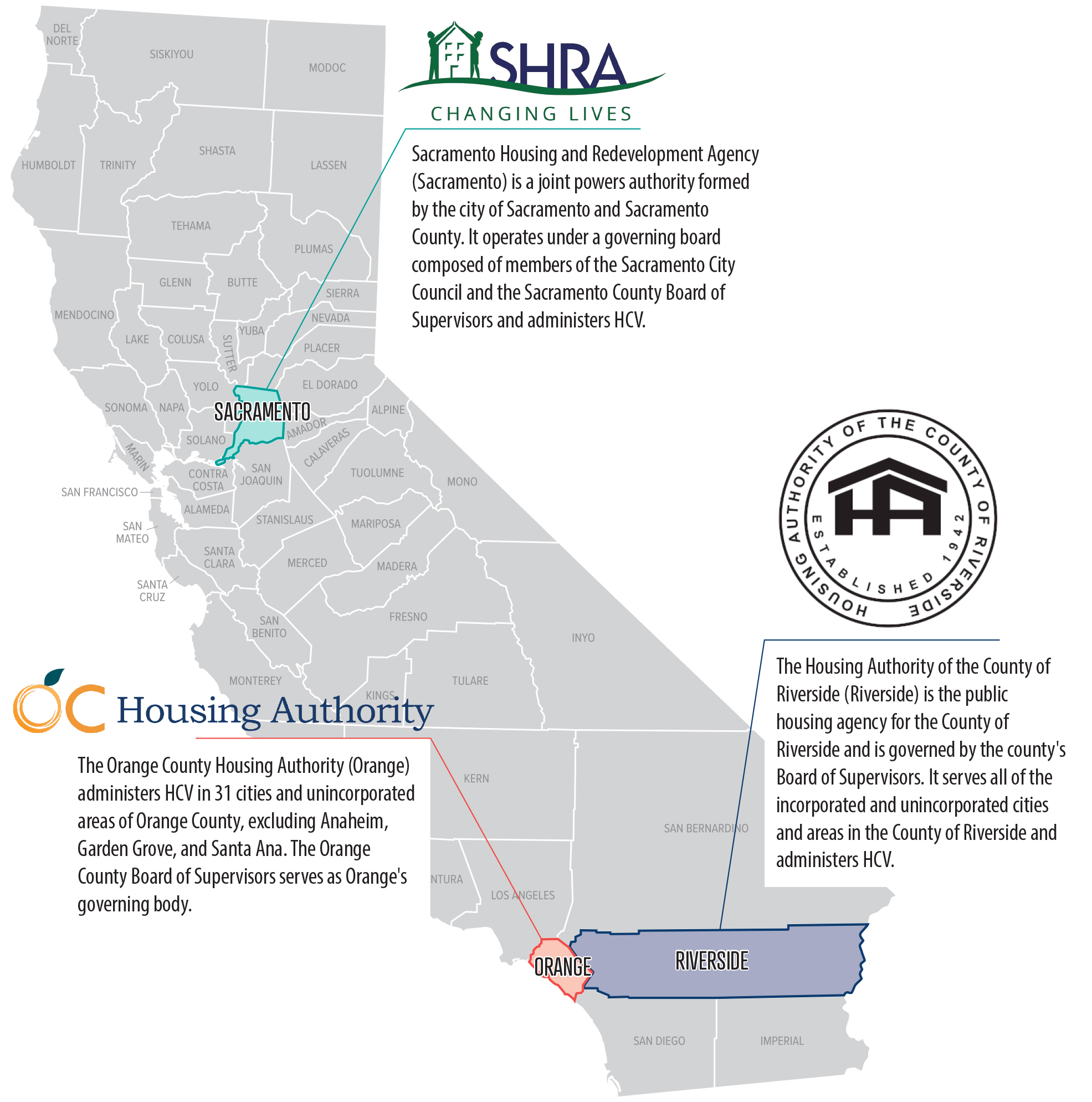
In 2023, Orange opened its waiting list for HCV. As a result, households in Orange County were able to apply for federal rental assistance for the first time in 11 years. As part of this audit request, the Audit Committee asked that we review Orange’s processes for opening its waiting list and compare its processes to those of two other agencies. We selected Riverside and Sacramento because of their similar size and structure. Figure 1 shows the three housing agencies’ locations and briefly describes their governance structures.
Figure 1
The Three Housing Agencies We Reviewed Have Distinct Jurisdictions
Source: Housing agencies’ administrative plans and websites.
The three housing agencies we reviewed include:
• The Sacramento Housing and Redevelopment Agency, which is a joint powers authority formed by the city of Sacramento and Sacramento County is located in the middle of the state. It operates under a governing board composed of members of the Sacramento City Council and the Sacramento County Board of Supervisors, and administers the Housing Choice Voucher program.
• The Orange County Housing Authority, which administers the Housing Choice Voucher program in Orange County, excluding Anaheim, Garden Grove, and Santa Ana, is located on the south coast. The Orange County Board of Supervisors serves as its governing body.
• The Housing Authority of the County of Riverside is the public housing agency for the County of Riverside located in inland southern California and is governed by the county’s Board of Supervisors. It serves all of the cities and areas in the County of Riverside and administers the Housing Choice Voucher program.
HCV Eligibility and Waiting Lists
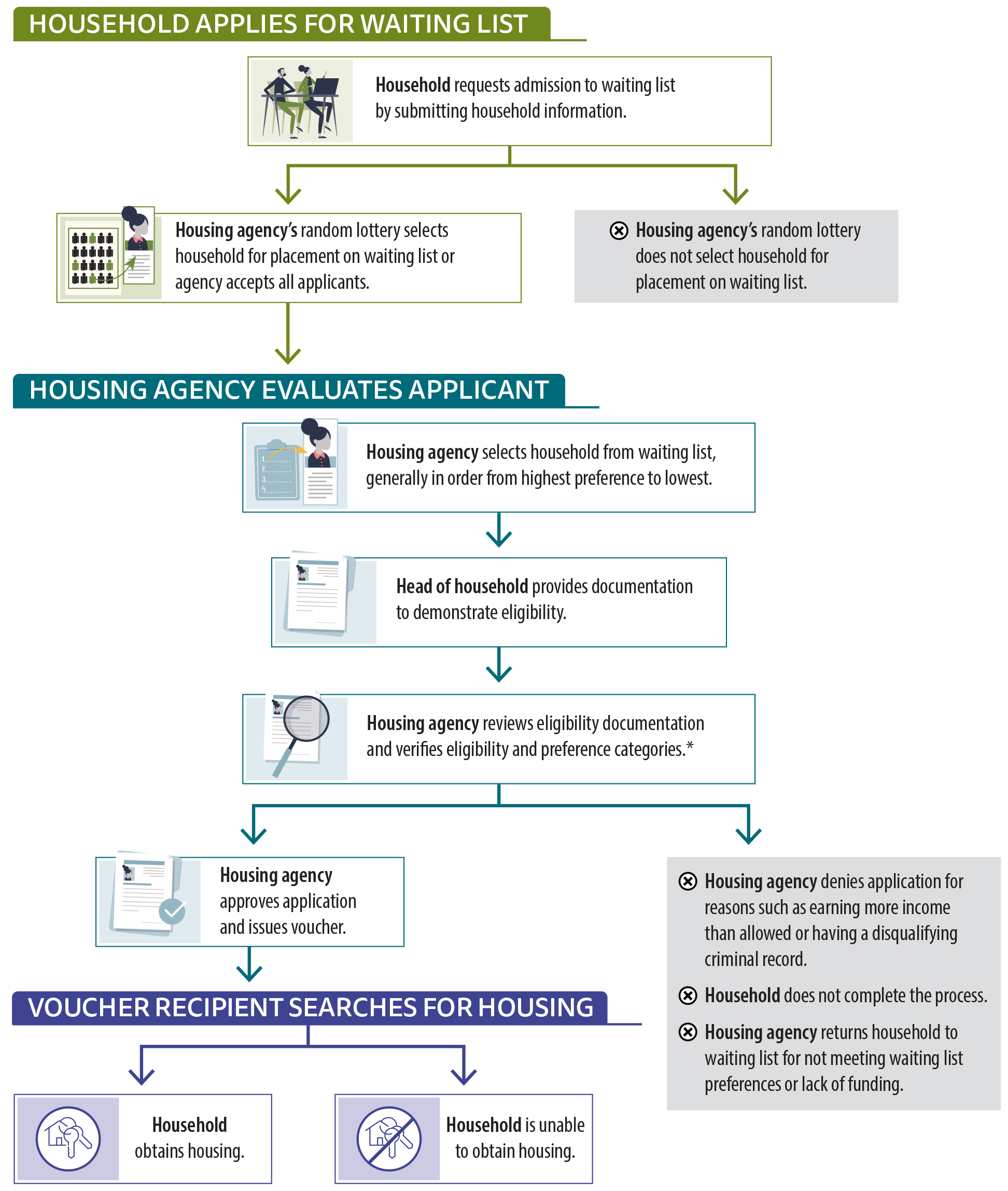
HCV provides primarily tenant‑based rental assistance to eligible households. Figure 2 provides an overview of the application process. To qualify, households must meet income limits set by HUD and satisfy other eligibility requirements, which the text box describes. When a housing agency determines a household is eligible for the program, it issues that household a voucher that it can use to rent a housing unit on the private market.
Figure 2
The HCV Application Process Includes Multiple Steps
Source: Orange, Riverside, and Sacramento’s administrative plans.
* Federal regulations allow housing agencies to prioritize the applications of some households, such as applications from persons with disabilities or from persons who are elderly.
Household Applies for Waiting List:
• Household requests admission to waiting list by submitting household information.
– Housing agency’s random lottery does not select household for placement on waiting list, or
– Housing agency’s random lottery selects household for placement on waiting list or agency accepts all applicants.
Then the Housing Agency Evaluates Applicant:
• Housing agency selects household from waiting list, generally in order from highest preference to lowest.
• Then Head of household provides documentation to demonstrate eligibility.
• Then Housing agency reviews eligibility documentation and verifies eligibility and preference categories.
• Then,
– Housing agency denies application for reasons such as earning more income than allowed or having a disqualifying criminal record, or
– Household does not complete the process, or
– Housing agency returns household to waiting list for not meeting waiting list preferences or lack of funding, or
– Housing agency approves application and issues voucher.
Lastly, if the household receives a voucher, the Voucher Recipient Searches for Housing:
• Household then obtains housing, or
• Household is unable to obtain housing.
HCV Eligibility Requirements
- A household’s annual income must be under income limits, which vary by location.
- An applicant must be either a U.S. citizen or eligible non‑citizen as defined by HUD.
- The head of the household must have a valid Social Security number.
- The applicant cannot have been convicted of certain crimes.
Source: HUD website.
Federal regulations require housing agencies to establish waiting lists for households interested in participating in HCV.1 Each housing agency must establish its own policies and procedures for opening and closing its waiting list, accepting applications, and selecting applicants. HUD requires that when opening its waiting list, a housing agency must provide public notice with information about where and when to apply.
When Orange opened its waiting list in 2023 for 12 days, it received more than 57,000 applications. As we discuss later in Table 2, some housing agencies add every household that applies to their waiting list, while others, including Orange, use a lottery system to limit the length of their waiting list. Table 1 shows the number of households on the waiting list at the three housing agencies we selected for review.
Federal regulations allow housing agencies to establish a system of local preferences to determine the order in which applicants on their waiting lists receive vouchers when funding becomes available. For example, a housing agency may establish a preference for veterans in which veteran applicants are placed higher on the list than applicants who are not veterans. Housing agencies may not discriminate against applicants based on protected characteristics, such as race. However, they may prioritize applicants who live and work in the city or county. HUD requires housing agencies to state these preferences in their administrative plans, which the housing agencies’ governing bodies must formally adopt.
HCV Funding and Vouchers
Congress appropriates funds for HCV, and HUD then allocates those funds and identifies the number of vouchers available to housing agencies across the country. HCV funding uses a structure known as renewal funding. HUD allocates renewal funding to housing agencies based on their previous year’s leasing and cost data, adjusted for inflation. If Congress does not appropriate sufficient funding for the program in a given year, HUD may adjust the allocations to all housing agencies. If Congress appropriates additional funding for the program, HUD awards new vouchers and funding—known as incremental vouchers—to housing agencies that are most able to use them to serve extremely low‑income and very low‑income households.
Federal law generally prohibits housing agencies from using other sources of funding, such as state or local funds, to expand HCV or mitigate funding limitations.2 In addition, HUD allocates separate funding to housing agencies for their administrative costs. Housing agencies can use this funding only for certain purposes. HUD calculates the fee amount based on geographic area, changes in wage data, and other objectively measurable data that reflects the costs of administering the program.
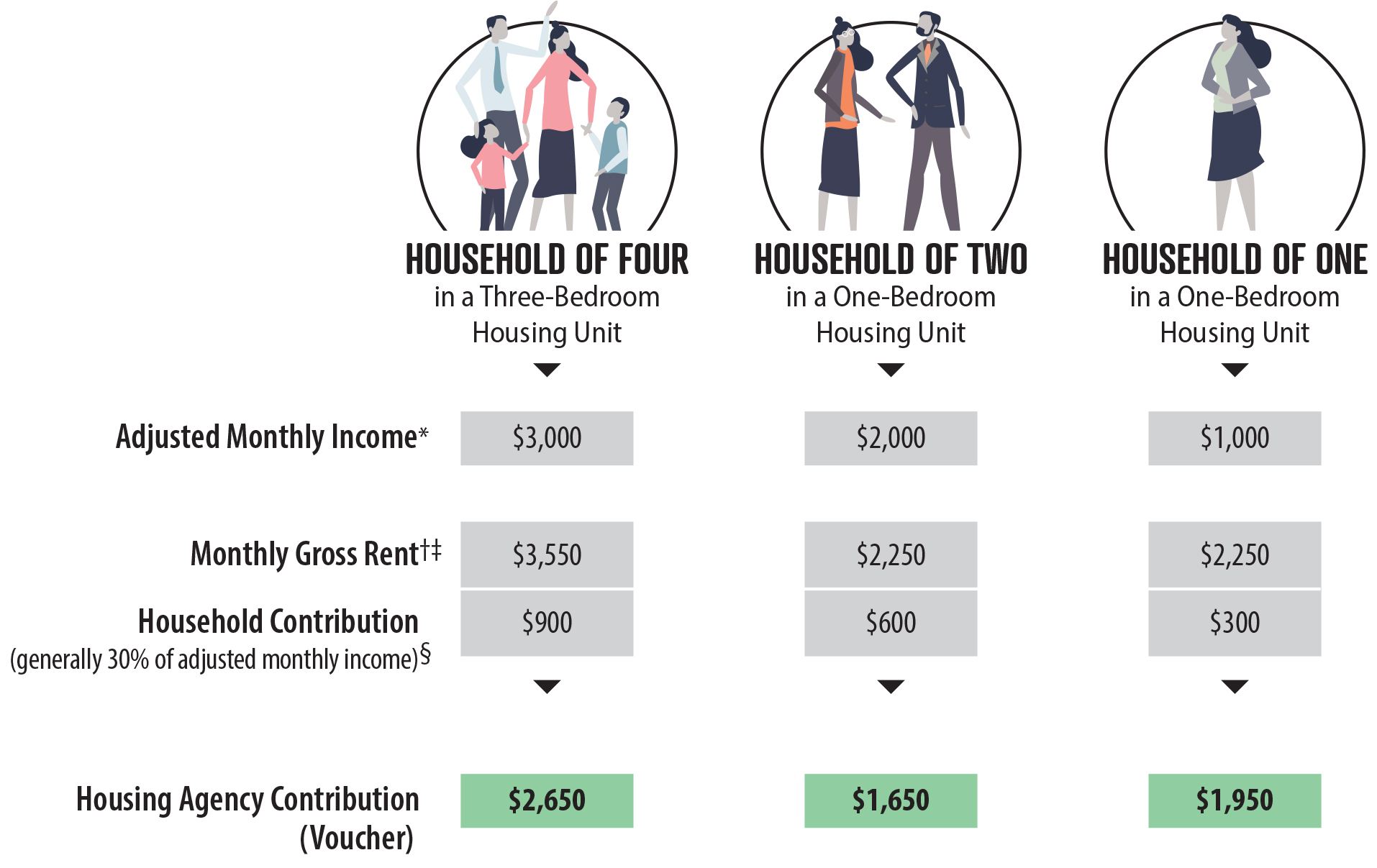
The amount of funding a housing agency pays for each voucher varies based on the household and housing unit. The voucher subsidizes the household’s rent, with the household generally paying 30 percent of their adjusted income toward rent, while the program pays the remaining portion—up to a specified limit—directly to the landlord, which we call the rental assistance limit.3 The text box provides the average rental assistance limits for the three housing agencies we reviewed, and Figure 3 shows hypothetical examples of how vouchers can provide different levels of support.
Average HCV 2025 Rental Assistance Limits
| Orange | ||
| Riverside | ||
| Sacramento |
Source: Orange, Riverside, and Sacramento websites.
Note: Orange’s rental assistance limits generally vary by city, while Sacramento’s vary based on ZIP code. We provide the averages in this text box.
Figure 3
Hypothetical Examples of How a Voucher Can Provide Different Levels of Support for Program Participants
Source: Housing agency payment standards for Orange in 2025, HUD income limits for Orange County in 2025, and HCV regulations.
Note: The monthly income and rent amounts above are hypothetical values.
* Adjusted monthly income is defined as a household’s monthly income after making some mandatory deductions, such as a deduction for a dependent.
† In all three hypothetical monthly rent amounts, the monthly rent is equal to or less than housing agency payment standards, which we refer to as rental assistance limits in the report, for Orange in 2025. If the monthly rent were higher than the payment standard, then the household contribution would be larger.
‡ Gross rent is the sum of the rent to the owner plus any utility allowance.
§ When a housing agency issues a voucher to a household, the household generally pays 30 percent or more of their adjusted income on rent, and the housing agency pays the rest to the landlord.
Several factors influence the amount of assistance that vouchers can provide to households. Some hypothetical examples include the following:
Household of Four in a Three-Bedroom Housing Unit
Adjusted Monthly Income: $3,000
Monthly Gross Rent: $3,550
Household Contribution (generally 30% of adjusted monthly income): $900
Housing Agency Contribution (Voucher): $2,650
Household of Two in a One-Bedroom Housing Unit
Adjusted Monthly Income: $2,000
Monthly Gross Rent: $2,250
Household Contribution (generally 30% of adjusted monthly income): $600
Housing Agency Contribution (Voucher): $1,650
Household of One in a One-Bedroom Housing Unit
Adjusted Monthly Income: $1,000
Monthly Gross Rent: $2,250
Household Contribution (generally 30% of adjusted monthly income): $300
Housing Agency Contribution (Voucher): $1,950
The Family Unification Program and Foster Youth to Independence Initiative
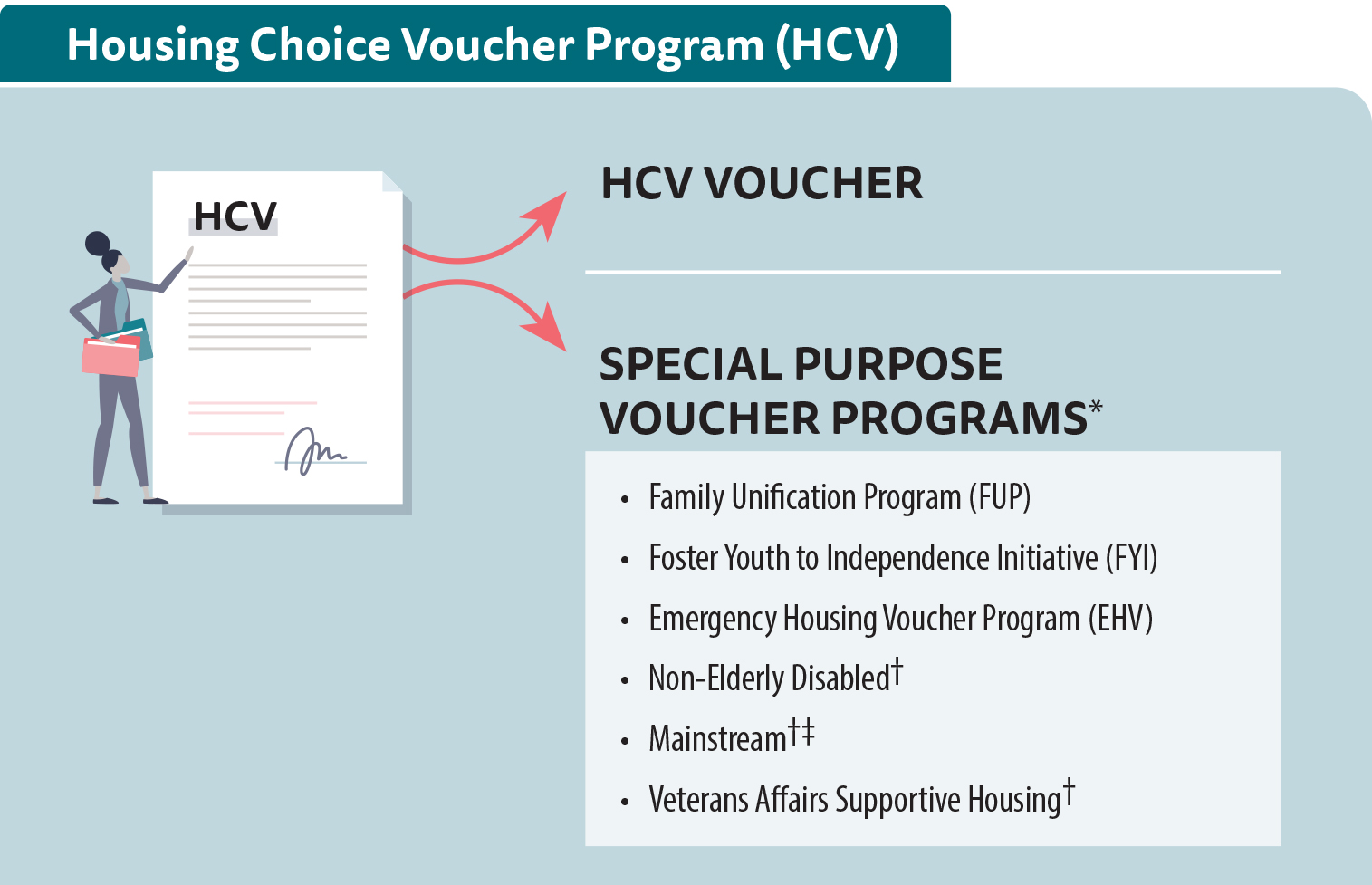
As Figure 4 shows, HCV includes different special purpose voucher programs that provide focused support to certain groups. For example, Veterans Affairs Supportive Housing program vouchers provide rental assistance to veterans experiencing homelessness, while Mainstream vouchers generally assist non‑elderly people with disabilities. Both of these programs—and the others listed in Figure 4—operate under HCV’s rules and regulations.
Figure 4
As Part of HCV, HUD Administers Several Special Purpose Voucher Programs
Source: HUD.
* The special purpose voucher programs listed in the figure provide rental assistance to targeted populations, but recipients must also meet HCV’s income requirements.
† We did not include Non-Elderly Disabled, Mainstream, and Veterans Affairs Supportive Housing programs in our review.
‡ Mainstream vouchers serve families that include a person with a disability who is at least 18 years of age and not yet 62 years of age and prioritize serving those eligible persons who are transitioning out of institutional or other segregated settings, experiencing homelessness, among others.
The Housing Choice Voucher Program Includes:
HCV Voucher, and
Special Purpose Voucher Programs We Reviewed:
• Family Unification Program
• Foster Youth to Independence Initiative
• Emergency Housing Voucher Program
Special Purpose Voucher Programs We Did Not Review:
• Non-elderly disabled
• Mainstream
• Veterans Affairs Supportive Housing
Two of the special purpose voucher programs we reviewed in this audit are: FUP and the FYI program. Established in 1990, FUP provides rental assistance to families whose inadequate housing causes or risks the separation of children from their families. For a maximum of 36 months, if there are no extensions, FUP also provides assistance to youth aged 18 to 24 who age out of foster care and may face homelessness.4 To support this latter group with additional resources and assistance, HUD began the FYI program in 2020. Because the FYI program is limited to a portion of the FUP’s population, we refer to the programs together throughout this report.
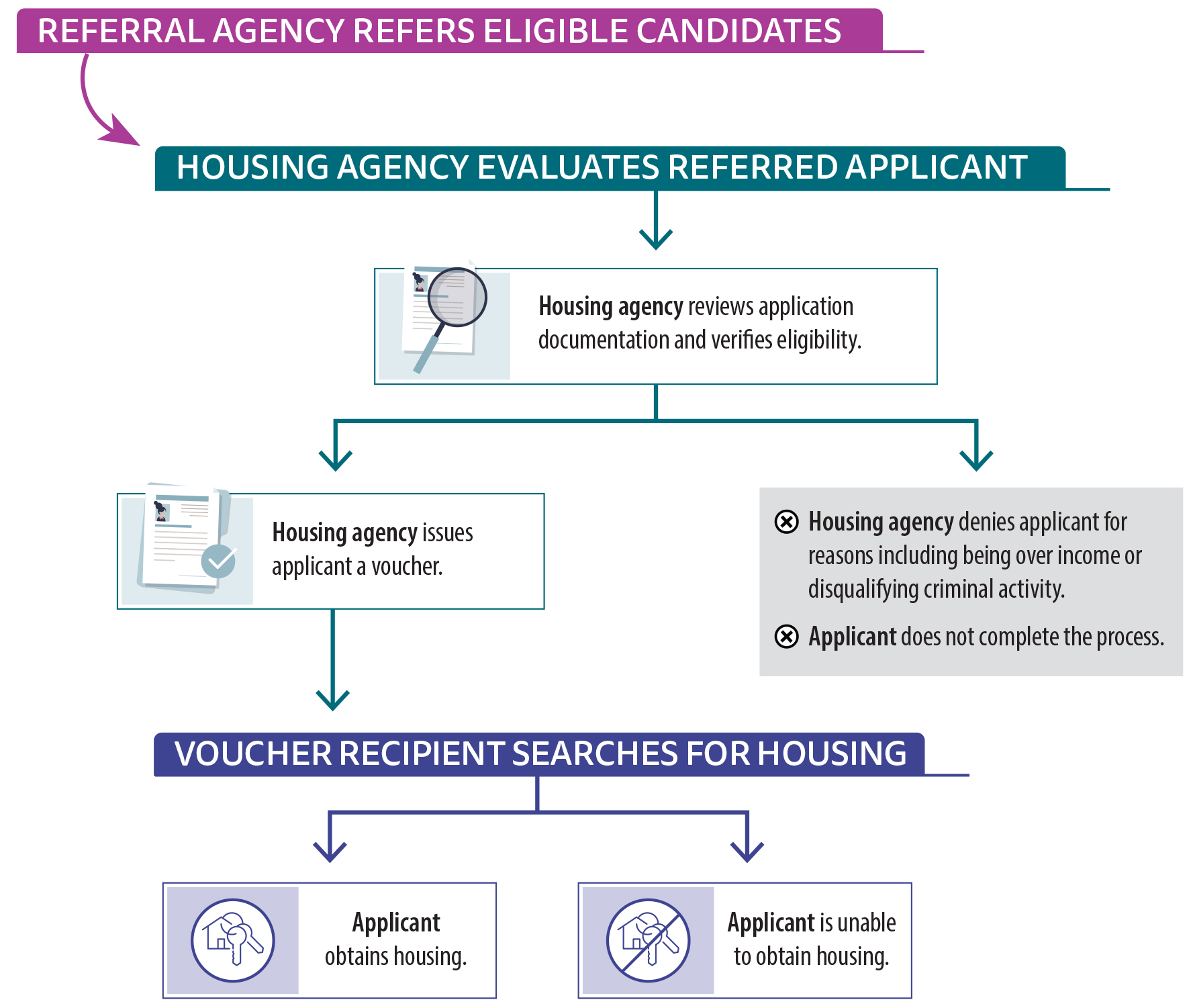
FUP and the FYI program operate with a referral‑based system, as Figure 5 shows. When a local public child welfare agency refers a household to the housing agency, the housing agency requires the household to complete the application process to determine its eligibility for a voucher. If the household is eligible, the housing agency will issue a voucher to the household, which then uses it to obtain housing.
Figure 5
The Housing Agencies Receive Applicants From Referral Agencies for FUP, the FYI Program, and EHV
Source: HUD notices, housing agency data, and housing agencies’ administrative plans.
Note: For the housing agencies we reviewed, the referral agency for FUP and the FYI program is the public child welfare agency. For EHV, the referring agency is the CoC.
Referral Agency Refers Eligible Candidates,
Then the Housing Agency Evaluates Referred Applicant:
The Housing agency reviews application documentation and verifies eligibility. Then, the housing agency:
• Issues applicant a voucher, or
• Does not issue applicant a voucher.
– The housing agency may deny an applicant for reasons including being over income or disqualifying criminal activity, or
– The applicant does not complete the process.
If referred applicant receives a voucher, the Voucher Recipient Searches for Housing:
Then the Applicant obtains housing, or Applicant is unable to obtain housing.
The Emergency Housing Voucher Program
In response to the COVID‑19 pandemic’s impact on housing stability, Congress used the American Rescue Plan Act of 2021 to create a new special purpose voucher program: EHV. EHV provides rental assistance to individuals and families who meet the criteria listed in the text box. When creating EHV, Congress provided it with one‑time funding. HUD required housing agencies to form partnerships with Continuums of Care (CoCs), which are local organizations responsible for coordinating services and service providers under the federal McKinney Vento Homeless Assistance Act. Further, HUD allocated more funding to housing agencies that demonstrated the ability to implement the program quickly.
EHV Eligibility Requirements
Individuals and families who meet HCV eligibility requirements and meet one of these four categories:
- Experiencing homelessness.
- At risk of experiencing homelessness.
- Fleeing, or attempting to flee, domestic violence, dating violence, sexual assault, stalking or human trafficking.
- Recently experienced homelessness, and for whom providing rental assistance will prevent the family’s homelessness or having high risk of housing instability.
Source: Federal regulations.
Similar to HCV, households that receive an EHV voucher can use it to rent housing in the private market. However, in addition to rental assistance, EHV provides funding for supportive services that may include housing search support, landlord incentives, and application fees to help households successfully lease a unit. EHV operates through a referral‑based system similar to the FYI program and FUP, as Figure 5 shows. The partner CoC refers a household to the housing agency when a voucher becomes available. As with HCV, the housing agency then requires the household to complete its application process to ensure eligibility. If the household is eligible, the housing agency issues the voucher to the household to use it to obtain housing. After September 30, 2023, HUD required housing agencies to stop reissuing EHV vouchers, thereby limiting new participants in EHV.
Audit Results
- Three Housing Agencies Have Different Approaches to Administering Their HCV Waiting Lists, Which Federal Regulations Allow
- The Three Housing Agencies Lack Sufficient Federal Funding to Meet Their Jurisdictions’ Need for HCV Vouchers, Leading Households to Experience Long Waits
- The Three Housing Agencies’ Processes for Administering Special Purpose Voucher Programs Complied With Key Requirements
- About 2,300 Households in California May Lose Their Housing When EHV Ends in 2026
Three Housing Agencies Have Different Approaches to Administering Their HCV Waiting Lists, Which Federal Regulations Allow
Key Points
- The Orange County Housing Authority (Orange) and the Sacramento Housing and Redevelopment Agency (Sacramento) complied with key federal requirements related to public notices of waiting list openings.
- When Orange and Sacramento most recently opened their Housing Choice Voucher program (HCV) waiting lists, they kept them open for less than one month. In contrast, the Housing Authority of the County of Riverside (Riverside) kept its waiting list open for 10 years.
- The three public housing agencies’ (housing agencies) compliance with fair housing requirements was sufficient, but Orange and Riverside could improve their compliance in certain areas.
- The three housing agencies’ application processes align with their administrative plans. However, we identified an instance where Riverside did not follow its policy when communicating with applicants.
Orange and Sacramento Complied With Key Federal Waiting List Notification Requirements
As Figure 2 explains, housing agencies open waiting lists to receive applicants that potentially can be selected for HCV. Federal regulations require that the housing agencies notify the public about where and when they can apply to participate in HCV. Regulations further require housing agencies to publish a public notice in a local newspaper of general circulation and to provide further public notice through minority media. The regulations also allow housing agencies to take steps such as posting information on their websites and social media accounts. We did not identify any requirements in the regulations that state for how long or how far in advance of the waiting list opening a housing agency must post the public notice.
We were not able to review Riverside’s efforts, but Orange and Sacramento complied with federal requirements when delivering their public notices. For example, Orange publicized where and when applicants could apply to its waiting list in the Orange County Register, a local newspaper of general circulation. The notice stated that applications could be submitted online or through a paper application beginning September 18, 2023, through September 29, 2023. Similarly, Sacramento published where and when applicants could apply in the Sacramento Bee. We were unable to review Riverside’s efforts since its waiting list opened more than a decade ago and its data retention policy calls for Riverside to keep documents such as public notices for only two years after the end of the calendar year in which they were created.
In addition to these newspaper notices, Orange and Sacramento both took additional steps to reach out to potential applicants. In the text box, we describe the measures Orange took to notify the public. For example, it published notices in the Spanish language newspaper La Opinión and on social media. Similarly, Sacramento published notices in various languages—such as Spanish, Russian, and Vietnamese—and on social media. Sacramento also publicized the opening of its waiting list through news platforms such as ABC10, the Sacramento Bee, and KDEE, a local radio station, as well as performing outreach to various community service providers.
Orange’s Waiting List Outreach Efforts
- News articles published in English and non-English news media.
- A post on the official County of Orange Instagram account in multiple languages.
- A toolkit of documents for the County Board of Supervisors to use to promote the opening of the waiting list.
- Outreach to local welfare centers, public libraries, and nonprofits, including homeless and domestic violence shelters and minority-serving institutions.
Source: Orange and publicly available media.
Orange and Sacramento Both Opened Their HCV Waiting Lists More Recently Than Riverside, Which Kept Its List Open for a Decade
We did not identify federal requirements in HCV regulations regarding how long a housing agency must keep its waiting list open. In fact, federal guidance provides that housing agencies may determine whether to keep their waiting lists open indefinitely or for defined periods. In 1998, Congress declared that deregulating and decontrolling public housing agencies and providing them more flexible use of federal assistance would further the purpose of HCV, which was to increase the supply of affordable homes to low‑income families in a safe and healthy environment. However, federal guidance cautions housing agencies against opening their waiting list and accepting applications for limited periods, such as a single day. Table 2 shows when the three housing agencies we reviewed opened their waiting lists and how long they kept them open.
The housing agencies we reviewed each offered their own explanation for the length of time it left its waiting list open. For example, Orange’s housing manager stated that that the housing agency opened its waiting list for 12 days because it understood two weeks as standard practice. Similarly, Sacramento’s director stated that the housing agency initially intended to open its 2022 waiting list for two weeks but extended the period to four weeks to provide an additional application option to the public. Sacramento did so in response to fair housing concerns it received from the U.S. Department of Housing and Urban Development (HUD) about not offering paper applications and providing additional information about offering reasonable accommodations. In contrast, Riverside’s deputy director explained that the housing agency decided to keep its waiting list open for 10 years because it wanted to fully reflect the community’s need for affordable housing and thus increase its chances of receiving available funding from HUD. Additionally, Riverside’s principal development specialist explained that potential applicants may react negatively to a waiting list being closed.
Orange’s housing manager explained that the housing agency did not open its waiting list for over a decade before it did so in 2023 because it did not have a need to do so. Prior to Orange opening its waiting list in 2023, it confirmed that it had last done so in 2012. Orange’s housing manager explained that it took a long time to review applicants on the 2012 waiting list because at that time, the housing agency had accepted all applicants for its waiting list, rather than conducting a lottery to reduce the 50,000 applications it received to a more manageable number. We reviewed how Orange’s waiting list size changed from 2014 through 2018 and found that Orange reduced the list by about 2,300 households per year. We also reviewed 2022 and 2023 and found that it reduced the list by about 900 households each year.5 Because the housing agency did not have federal funding to provide more HCV vouchers, Orange’s housing manager explained the housing agency was unable to more rapidly reduce its waiting list. In addition, Orange noted that due to the COVID‑19 pandemic, a large portion of program participants experienced declines in their incomes, thereby requiring Orange to increase its contributions to tenants’ rental payments and subsequently delay its proposed plan to open its waiting list again in 2020. We found that the federal funding Orange needed to support its vouchers increased from an average of less than $1,000 in 2015 to $1,750 in 2025. As a result of these additional expenses, Orange identified a need to delay opening a new waiting list.
Riverside’s decision to leave its waiting list open for 10 years can contribute to a long wait for assistance. Federal guidance states that when housing agencies are choosing how to administer their waiting lists, they should carefully consider circumstances such as whether a waiting list’s length will lead to an unreasonably long wait for housing. In fact, Riverside’s deputy director explained that the housing agency eventually decided to close its waiting list because the waiting period for households on the list had extended to over 10 years. However, if one assumes that funding and voucher levels remain constant and that 14 percent of the households on Riverside’s waiting list are eligible for vouchers—which has been the case in the past—we estimate Riverside would need about 26 years to work through its current waiting list. We are concerned that applicants may not have an accurate understanding of the amount of time they may wait because Riverside does not provide estimates on its website about average or potential wait times. Riverside does not currently have plans for how it will efficiently work through the households on its waiting list in a timely manner.
The Three Housing Agencies’ Compliance With Fair Housing Requirements Was Sufficient
Federal regulations and state law establish the fair housing requirements that housing agencies must follow when administering HCV, including their waiting lists. We reviewed federal regulations and HUD guidance for HCV to identify key fair housing requirements such as federal regulations which generally require housing agencies to provide reasonable accommodations for applicants’ disabilities and a best practice in HUD guidance for housing agencies to include their reasonable accommodation policies in their administrative plans. Additionally, federal regulations state that any public agency that receives federal financial assistance from HUD and that employs 15 or more people must designate at least one person to coordinate its efforts to comply with regulations related to accommodating disabilities (section 504 coordinator). We also evaluated the housing agencies’ plans, policies, and procedures for HCV to determine if they complied with those requirements. For example, we reviewed whether the housing agencies provided information on federal, state, and local equal opportunity laws to applicants selected to participate in the program as federal regulation requires.
The policies and procedures of all three housing agencies generally complied with the fair housing requirements we identified, as Table 3 shows. For example, federal regulations require housing agencies to adopt an emergency transfer plan under the Violence Against Women Act (VAWA), and each housing agency has adopted such plans.6 However, when we tested select requirements, we found that both Orange and Riverside could improve their compliance in providing certain information to applicants. For example, we found that neither housing agency provided applicants with adequate information on state and local equal opportunity laws. As a result, applicants may not have been appropriately notified of all their protections under the law, such as the right under California law to seek and obtain housing without discrimination because of an applicant’s marital status. After we shared the results of our review with the housing agencies, Orange committed to providing additional documents related to state and local equal opportunity laws to approved applicants in the future. Riverside stated that it compiled such information for voucher recipients in January 2026.
Additionally, Riverside does not have a section 504 coordinator as required by federal regulations. Section 504 coordinators are responsible for performing duties such as reviewing reasonable accommodation requests, contributing to marketing and community outreach for housing and employment, and ensuring compliance with accessibility requirements. Riverside explained that it does not have a need to designate one individual to perform such tasks full time. According to Riverside, it has a three‑member committee that is responsible for reviewing reasonable accommodation requests and communicating with applicants about their requests. Riverside further stated that it has trained certain staff to address applicants’ reasonable accommodation requests. However, the section 504 coordinator’s responsibilities include more than just processing reasonable accommodation requests, as we explained above, and Riverside confirmed that it did not perform outreach to community groups that serve people with disabilities when it opened its waiting list in 2015. Without a section 504 coordinator, Riverside risked not adequately addressing applicants’ accessibility needs or performing appropriate outreach, such as when it opened its waiting list in 2015. Noncompliance could also put the agency at risk of suspension of the federal financial assistance it receives.
Housing Agencies’ Application Processes Align With Their Administrative Plans
The application processes for all three of the housing agencies we reviewed aligned with their administrative plans. Federal regulations require housing agencies to administer HCV in accordance with their administrative plans. We reviewed compliance with sections in administrative plans where the housing agencies discussed their voucher application, waiting list management, including removals, and applicant selection processes. For example, when we reviewed a sample of applicant selections the housing agencies made from their waiting lists, we found that the housing agencies selected applicants in accordance with the preference categories in their administrative plans. Additionally, the lottery processes that Orange and Sacramento used for their most recent waiting list openings aligned with their administrative plans. For example, Orange’s administrative plan established that if it received more than 12,000 applications, its software would perform a random selection to determine which 12,000 applications would be placed on the waiting list. We found that Orange did perform the random selection and selected 12,000 applications for its 2023 waiting list.
However, we identified one area in which Riverside did not follow its administrative plan. Riverside’s administrative plan states that households have 30 days to respond to the agency’s mailing or Riverside will remove them from the waiting list. Nonetheless, we identified over 1,300 instances in which Riverside provided households with less than 20 days to respond to a mailing related to their removal from its waiting list. Riverside staff explained that their mailings including a 15‑day deadline for applicants’ responses was likely an oversight and that the mailings should have been updated to reflect the 30‑day policy. Riverside staff also explained that although the mailing established a 15‑day deadline, the housing agency usually provided additional time for applicants to respond. Nevertheless, as a result of this administrative error, some households may not have had adequate time to respond before Riverside may have inappropriately removed them from the waiting list.
The Three Housing Agencies Lack Sufficient Federal Funding to Meet Their Jurisdictions’ Need for HCV Vouchers, Leading Households to Experience Long Waits
Key Points
- The housing agencies we reviewed are unable to issue all of the HCV vouchers available to them in a given year because they lack the federal funding necessary to cover the costs associated with those vouchers. Federal funding is not directly connected to the number of vouchers provided to housing agencies, but rather based on a housing agency’s expenditures from the previous year.
- To immediately provide HCV vouchers to all of the applicants on their waiting lists, we estimate the three housing agencies together would require more than a billion dollars in additional federal funding. In the absence of such funding, many applicants are likely to spend years, if not decades, waiting for a voucher.
- All three housing agencies have established preferences for selecting applicants from their waiting lists that affect how long applicants wait for a voucher.
- The available data show that Orange approved about 67 percent of the applicants it evaluated for HCV vouchers, but around 80 percent of the applicants whom Riverside evaluated did not complete the application process, leading to an approval rate of 14 percent. Sacramento does not maintain sufficiently reliable data on certain aspects of the evaluation process, but rather maintains its evaluations in individual case notes or files.
Housing Agencies Do Not Have Enough Federal Funding to Issue All of Their Vouchers
As we describe in the Introduction, a single housing voucher does not represent a set dollar amount. Rather, the amount of federal funding a housing agency distributes for a voucher varies based on factors such as household income, household size, and monthly rental costs. Orange noted that when incomes of program participants fall, the rental assistance cost increases. Additionally, as rental costs have increased over the last several years, so have the housing agencies’ rental assistance costs, as we discuss below. Because the housing agencies distribute different amounts for a voucher depending on these variables, and HUD funding reflects prior year spending with an inflation factor, the allocated funding can limit how many vouchers the housing agencies issue.
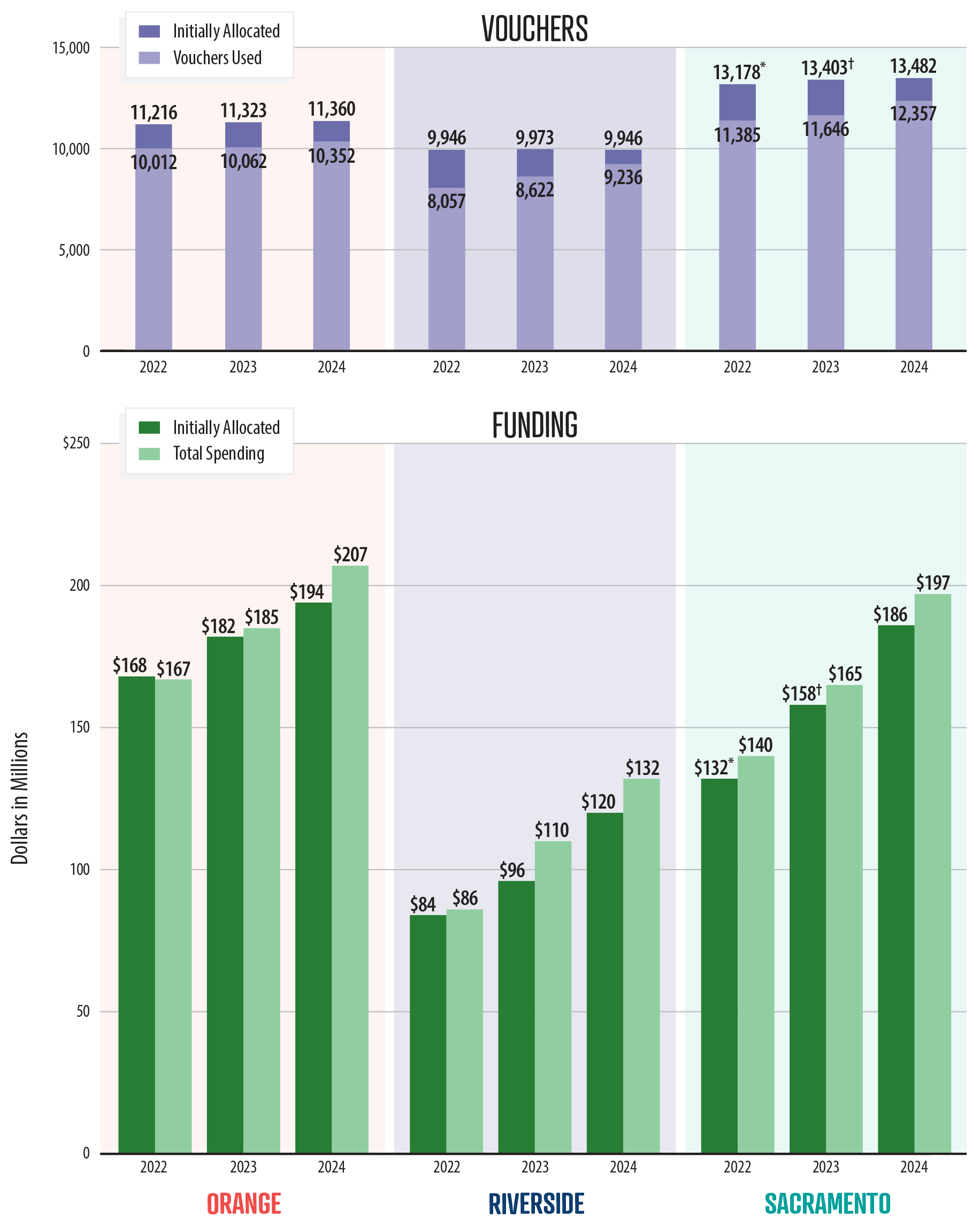
The housing agencies we reviewed do not issue all the vouchers they receive from HUD because they reach their spending limit first. As we explained in the Introduction, HUD allocates funding and voucher amounts to housing agencies. Generally, the amount of funding and the number of vouchers that HUD allocates to a housing agency are the maximum that it can spend and issue, respectively. Figure 6 shows the funding and voucher amount by housing agency from 2022 through 2024. Even though HUD allocated a certain number of vouchers to a housing agency, that agency cannot issue all of those vouchers if it runs out of funding first.
Figure 6
Because of Funding Constraints, None of the Three Housing Agencies Issued All of Their Allocated Vouchers From 2022 Through 2024
Source: HUD.
Note: Funding amounts were rounded to the nearest million. HUD provides the additional funding above the initial allocation as necessary.
* Sacramento did not provide us with the HUD funding letters showing its funding and voucher amounts for 2022. HUD did not respond to our request for Sacramento’s funding letters. Therefore, the funding and voucher numbers for 2022 are based on a HUD financial report instead of funding letters.
† Allocated number of vouchers and funding for Sacramento in 2023 is a minimum.
Vouchers and Funding
Two sets of bar graphs show the effects of funding constraints on voucher issuance that housing agencies experience. The graphs are separated for each housing agency we reviewed.
Orange
• In 2022, Orange was initially allocated 11,216 vouchers but could not issue 1,204 of those vouchers. In the same year, Orange was initially allocated 168 million dollars but spent 167 million dollars.
• In 2023, Orange was initially allocated 11,323 vouchers but could not issue 1,261 of those vouchers. In the same year, Orange was initially allocated 182 million dollars but spent 185 million dollars.
• In 2024, Orange was initially allocated 11,360 vouchers but could not issue 1,008 of those vouchers. In the same year, Orange was initially allocated 194 million dollars but spent 207 million dollars.
Riverside
• In 2022, Riverside was initially allocated 9,946 vouchers but could not issue 1,889 of those vouchers. In the same year, Riverside was initially allocated 84 million dollars but spent 86 million dollars.
• In 2023, Riverside was initially allocated 9,973 vouchers but could not issue 1,351 of those vouchers. In the same year, Riverside was initially allocated 96 million dollars but spent 110 million dollars.
• In 2024, Riverside was initially allocated 9,946 vouchers but could not issue 710 of those vouchers. In the same year, Riverside was initially allocated 120 million dollars but spent 132 million dollars.
Sacramento
• In 2022, Sacramento was initially allocated 13,178 vouchers but could not issue 1,793 of those vouchers. In the same year, Sacramento was initially allocated 132 million dollars but spent 140 million dollars.
• In 2023, Sacramento was initially allocated at least 13,403 vouchers but could not issue 1,757 of those vouchers. In the same year, Sacramento was initially allocated at least 158 million dollars but spent 165 million dollars.
• In 2024, Sacramento was initially allocated 13,482 vouchers but could not issue 1,125 of those vouchers. In the same year, Sacramento was initially allocated 186 million dollars but spent 197 million dollars.
None of the housing agencies we reviewed were able to issue all their allocated vouchers in the audit period. For example, Orange issued only 10,352 of its 11,360 available vouchers in 2024, but used all of its available funding to support those 10,352 vouchers. In fact, Orange explained it had to rely on reserves held by HUD to cover additional spending beyond its allocation from HUD that year.
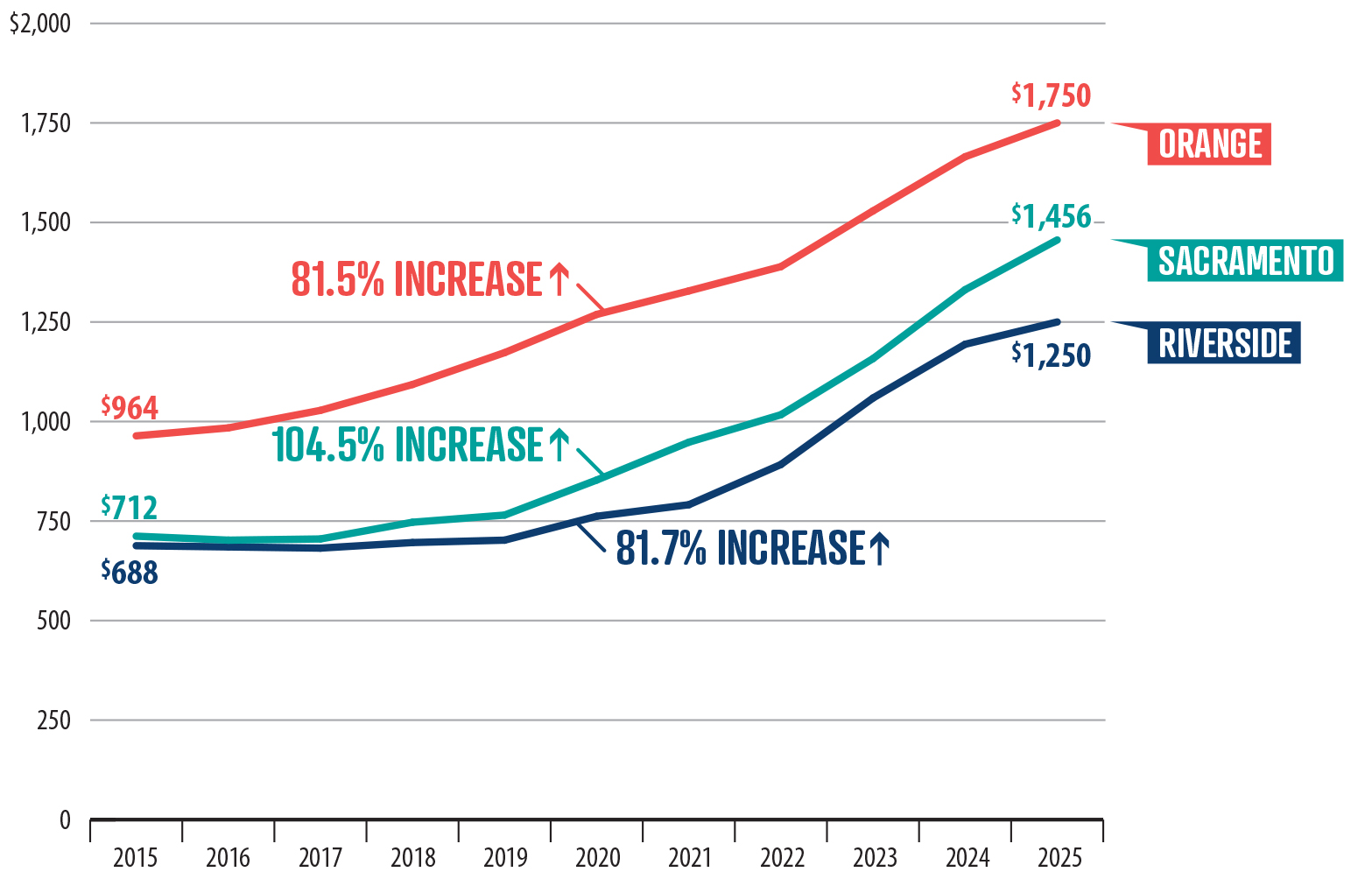
The housing agencies would have needed significant additional funding in the audit period to issue all of their available vouchers because of rising rental assistance costs. For example, we estimate that Orange would have needed over $21 million in additional funding in 2024 to issue all of its allocated vouchers. Based on the housing agencies’ average cost per voucher and remaining allocated vouchers, we estimate the total cost to fund all vouchers for all three housing agencies we reviewed would have been more than $51 million in 2024. We are able to attribute much of this gap in funding to the increase in the housing agency’s average cost per voucher.7 From 2015 to 2025, the average per‑voucher cost has doubled or nearly doubled at all three housing agencies we reviewed, as Figure 7 shows. For example, Orange’s average per‑voucher cost increased nearly 82 percent during these 10 years, from $964 to $1,750. Both Riverside and Sacramento saw similar increases. These increases mirror increases in rent in California over a similar time period. Research published by the Public Policy Institute of California shows that rental prices in California increased 71 percent from 2010 through 2023. Because HUD generally allocates funding based on housing agency spending in the prior year, rather than matching funding to the number of approved vouchers or the size of the waiting list, the increase in rental assistance costs have reduced the number of vouchers these housing agencies can issue.
Figure 7
The Three Housing Agencies’ Average Per Voucher Costs Have Increased Significantly Over the Past 10 Years
Source: HUD HCV dashboard.
Note: Research from the Public Policy Institute of California shows rent prices in California increased 71 percent from 2010 through 2023, which generally aligns with increases in costs depicted in the figure.
A line graph shows the increase in voucher costs since 2015 for each of the housing agencies we reviewed.
From 2015 to 2025:
Orange’s average per voucher costs rose from 964 dollars to 1,750 dollars, which is an 81.5% increase.
Riverside’s average per voucher costs rose from 688 dollars to 1,250 dollars, which is an 81.7% increase.
Sacramento’s average per voucher costs rose from 712 dollars to 1,456 dollars, which is a 104.5% increase.
The Housing Agencies’ Lack of Sufficient Funding Prevents Them From Reducing Waiting Lists Quickly
To immediately serve all of the applicants on their waiting lists, the housing agencies we reviewed would need more than a billion dollars in additional funding. To estimate the amount of additional funding the housing agencies would need, we used the agencies’ average monthly costs per voucher and the total size of their waiting lists. Table 4 identifies our estimates for each of the three housing agencies, assuming a 70 percent eligibility rate. We found that Orange would need around $205 million in additional annual funding to serve all its applicants on its waiting list, while Riverside would need around $1.5 billion. Moreover, these estimates—which the housing agencies agreed were reasonable—are likely lower than their communities’ actual need for housing, especially for Orange and Sacramento because those two housing agencies reduced the sizes of their waiting lists through a lottery process.
Because the housing agencies do not have sufficient funding to issue more vouchers, applicants on their waiting lists may experience significant waiting times. At current funding levels and rates of voucher approvals, it would take Riverside around 26 years to get through its waiting list. Both Orange and Sacramento similarly explained that without additional funding, they will likely not be able to issue vouchers to everyone on their waiting lists in the near future.
Established Preferences for Selecting Applicants From HCV Waiting Lists Affect How Long Applicants Wait for a Voucher
Federal regulations allow housing agencies to establish a system of local preferences for selecting applicants from their waiting lists based on local housing needs and priorities. The housing agencies must identify their selection preferences in their administrative plans—which their governing bodies must approve—and ensure that the preferences are consistent with fair housing and civil rights laws. For example, a housing agency may adopt a residency preference that prioritizes applicants who reside in a specified city or county, but it may not establish a requirement that applicants must be residents of a specific area. Additionally, a housing agency’s preferences cannot discriminate based on characteristics such as age, race, religion, and disability, among others.
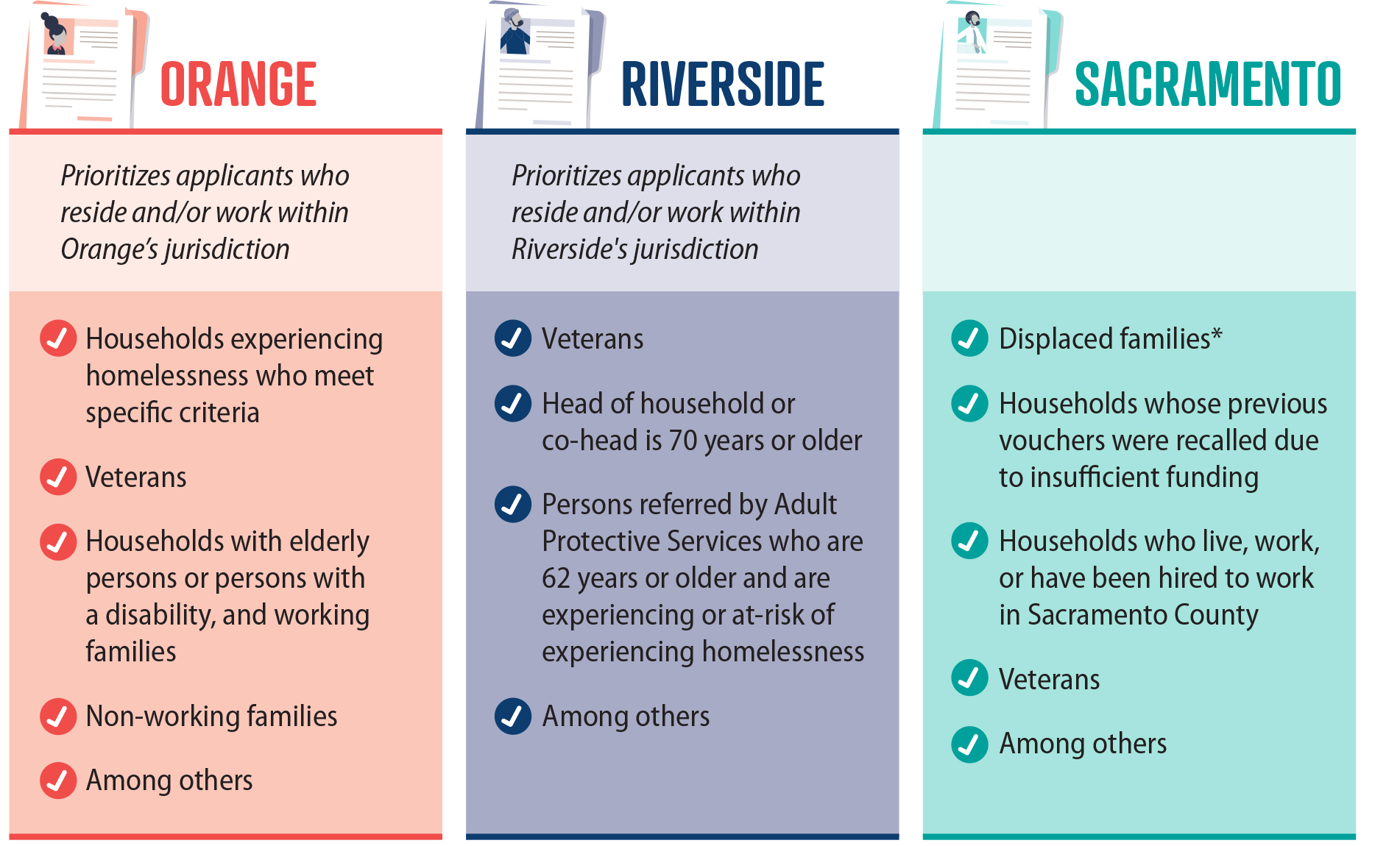
As Figure 8 shows, all three housing agencies we reviewed have established local preferences in their administrative plans. The housing agencies select applicants who meet the preference criteria first. For example, Orange’s administrative plan directs it to select an applicant who is an Orange County resident and a veteran before an applicant who is not an Orange County resident and not a veteran.
Figure 8
The Three Housing Agencies Have Established Preferences for Selecting Applicants From Their Waiting Lists
Source: Orange, Riverside, and Sacramento’s administrative plans.
Note: The preferences listed for each housing agency are not exhaustive.
* Displaced families include households that are displaced by government action or as a result of a disaster.
Orange
Orange prioritizes applicants who reside and/or work within its jurisdiction. Additionally, Orange has waiting list selection preferences for households experiencing homelessness who meet specific criteria; veterans; households with elderly persons or persons with a disability, working families; and non-working families; among others.
Riverside
Riverside prioritizes applicants who reside and/or work within its jurisdiction. Additionally, Riverside has waiting list selection preferences for veterans; households in which the head of household or co-head is 70 years or older; and persons referred by Adult Protective Services who are 62 years or older and are experiencing or at-risk of experiencing homelessness; among others.
Sacramento
Sacramento has waiting list selection preferences for displaced families; households whose previous vouchers were recalled due to insufficient funding; households who live, work, or have been hired to work in Sacramento County; and veterans; among others.
The data we evaluated show that applicants who met a higher preference category generally spent less time on the waiting list than applicants who met a lower preference category. We evaluated the waiting list and applicant data that we received from the housing agencies to determine if preferences affected the length of time an applicant remained on the waiting list. We found that applicants with a higher prioritized preference category generally spent less time on the waiting list than applicants with a lower prioritized preference category. Specifically, we found that at Orange, the applicants in a higher preference category—veterans who live or work locally—spent a median of nearly three years on the waiting list, which was 77 percent less time than applicants in a lower preference category—non‑working families living or working locally—who spent a median of more than 11 years on that waiting list. Additionally, at Riverside, the applicants in its higher preference category—veterans who live or work locally—spent a median of four months on the waiting list, which was 84 percent less time than applicants in a lower preference category—extremely elderly who live or work locally—who spent a median of more than two years on the waiting list.
Orange Issued Vouchers to Most Evaluated Applicants, but Riverside Approved a Lower Percentage Because Applicants Did Not Respond
The Joint Legislative Audit Committee (Audit Committee) directed us to determine the number and rate of applications the housing agencies approved and denied, as well as the time it took the housing agencies to make the determinations and secure housing for approved applicants. The Audit Committee also directed us to determine, to the extent possible, the demographic breakdown of the housing agencies’ approved and denied applications and the agencies’ reasons for denying applications. To meet these objectives, we obtained waiting list and applicant data from the housing agencies we reviewed. However, in some instances, the housing agencies were unable to provide us with data, or we determined that the data they provided were unreliable, as we describe later in this report.
We did not identify any requirements in federal HCV regulations for housing agencies to regularly report data for households on the waiting list or households that are evaluated but not approved for a voucher. In contrast, federal HCV regulations require housing agencies to report information on households that are approved for a voucher and obtain housing. We also did not identify any requirements in federal HCV regulations for housing agencies to calculate the time necessary to evaluate applicants or for those applicants to obtain housing. Table 5 shows the lack of certain information reporting requirements in federal HCV regulations. Likely due to the lack of requirements, two of the housing agencies we reviewed, Sacramento and Riverside, were unable to provide certain data the Audit Committee requested, as discussed in Audit Objective 2 in Table D. However, we present the data that were available in this report.
Orange Approvals During the Audit Period
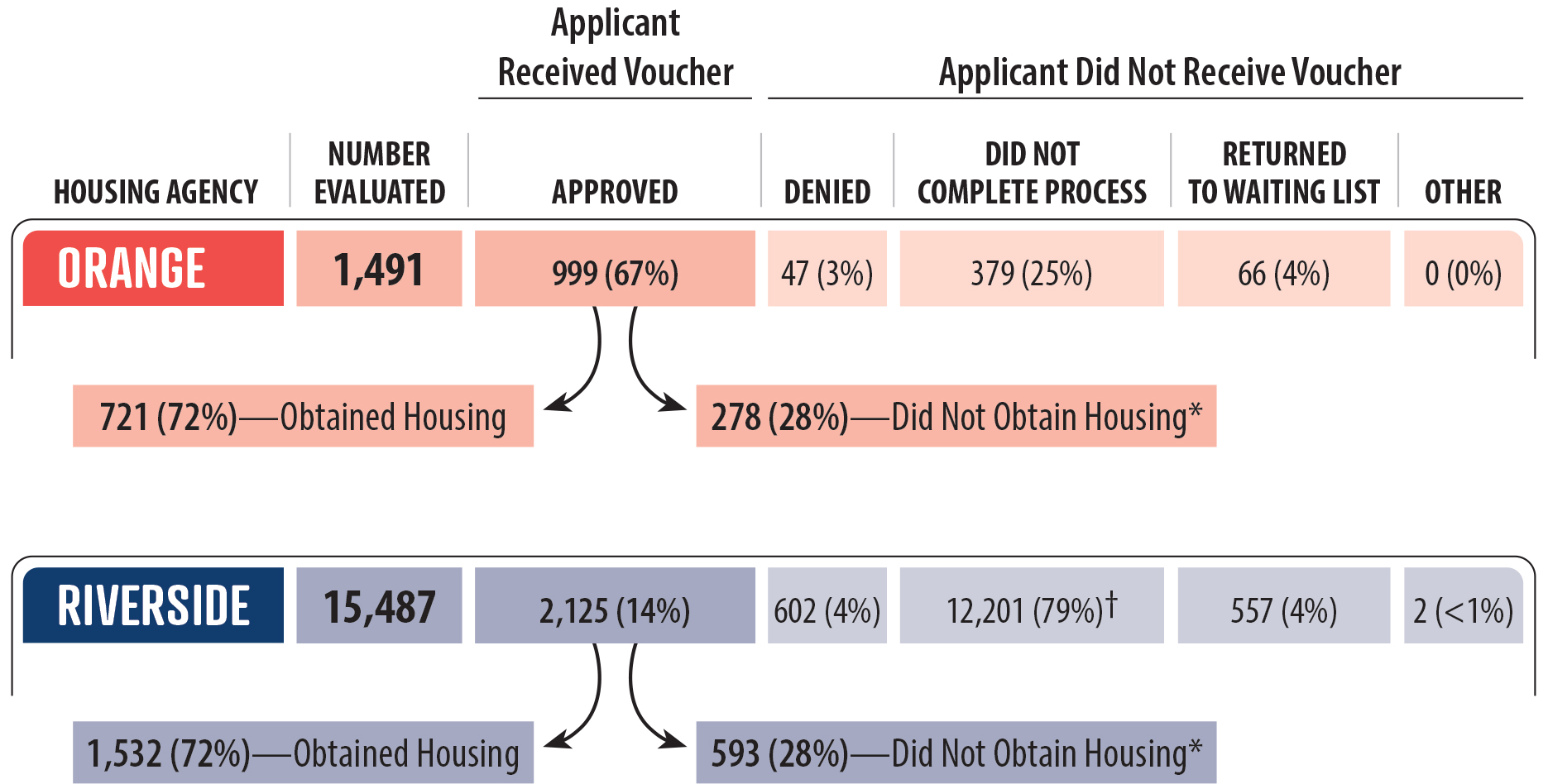
Orange approved for a voucher the majority of applicants it evaluated during the audit period, and most applicants who did not receive a voucher were those who did not complete the application process. As Figure 9 shows, Orange approved 67 percent of the 1,491 applications it evaluated during the audit period. 25 percent of the applicants did not receive a voucher because they did not complete the application process. Orange denied a voucher for only 3 percent of applicants, or 47 applicants. Of those that Orange denied, Orange determined around 83 percent, or 39 applicants, earned more than the maximum allowable income and 13 percent had criminal activity that made them ineligible. As Figure 9 shows, 72 percent of approved applicants at Orange obtained housing during the audit period, whereas 28 percent did not. Appendix A provides demographic information for the applicants Orange evaluated and those who obtained housing.
Figure 9
From 2022 to 2024, Most of the Applicants Riverside Evaluated Did Not Complete the HCV Application Process, but 72 Percent of Approved Applicants at Both Orange and Riverside Obtained Housing
Source: Housing agencies’ application data.
Note: Because Sacramento’s data did not consistently record whether it approved or denied HCV applications, we do not present the data for Sacramento. Percentages may not add to 100 due to rounding.
* Approved applicants may have obtained housing after the end of calendar year 2024, but that information was outside of the time period of our review.
Orange evaluated 1,491 applicants from 2022 through 2024. Of these applicants, 67 percent were approved for a voucher, 3 percent were denied, 25 percent did not complete the process, and 4 percent were returned to the waiting list. Of the 999 approved applicants, 72 percent obtained housing and 28 percent did not obtain housing.
Riverside evaluated 15,487 applicants from 2022 through 2024. Of these applicants, 14 percent were approved for a voucher, 4 percent were denied, 79 percent did not complete the process, 4 percent were returned to the waiting list, and less than 1 percent did not receive a voucher for other reasons. Of the 2,125 approved applicants, 72 percent obtained housing and 28 percent did not obtain housing.
Orange explained that it does not have information available to support the cause of households failing to obtain housing after receiving HCV vouchers. However, staff observed that several factors may be involved, including a general lack of affordable housing and competition from other renters. According to Orange, applicants themselves may not know why a landlord rejected their rental application. In an effort to help voucher recipients obtain housing, Orange has implemented a landlord incentive program that uses funds from the county to incentivize landlords to rent to HCV voucher recipients. Specifically, when a new owner agrees to rent to a household with a voucher, the owner is eligible to receive a $1,000 payment.
Riverside Approvals During the Audit Period
The majority of applicants Riverside evaluated during the audit period did not complete the process, but over 70 percent of approved applicants obtained housing. As Figure 9 shows, nearly 80 percent of the more than 15,000 applicants Riverside selected from its waiting list for evaluation during our audit period did not complete the evaluation process. Riverside approved 14 percent of the more than 15,000 applicants for a voucher and denied a voucher to only 4 percent of applicants. Of the 602 applicants denied a voucher, Riverside determined that 94 percent were over the allowable income limit and 6 percent had criminal activity that made them ineligible. As Figure 9 shows, of the more than 2,100 applicants Riverside approved for a voucher, 72 percent obtained housing while 28 percent did not, a ratio equal to Orange’s applicants. Appendix B presents the demographic information of Riverside’s approved applicants who obtained housing.
When we presented the results of our analysis to Riverside’s staff, they explained that most applicants who did not complete the process did not respond to Riverside’s requests for information. Riverside staff explained that applicants might not have responded because they no longer needed support or they had found housing through other means. Additionally, some applicants filled out the initial application but did not respond to Riverside’s follow‑up communications requesting additional documents. Riverside further noted that it does not evaluate the reasons why approved applicants do not obtain housing, and it is not required to do so. We reviewed federal HCV regulations and did not identify any requirements to evaluate or determine the reasons an applicant does not obtain housing.
Time Frames for Evaluations and Housing Placement
As Table 6 shows, Orange’s evaluation process generally took about twice as long as Riverside’s. This difference in time could, in part, be the result of Orange approving most of the applicants it evaluated, while many of the applicants Riverside reviewed did not complete the process. Therefore, Riverside would have required less time to review its applicants. The table also shows the time voucher recipients took to obtain housing. We discuss Sacramento’s data in the next section.
We did not identify any federal HCV regulations requiring housing agencies to evaluate applicants within a specified time frame. Federal HCV regulations state that the initial term of a voucher must be at least 60 calendar days. However, housing agencies may grant one or more extensions to this initial voucher term in accordance with their administrative plan policies. Both Orange and Riverside attested that they provide such extensions.
Sacramento Data
We determined that Sacramento’s data for evaluated applicants during the audit period were not sufficiently reliable for certain audit purposes and that federal HCV regulations do not require them to maintain such data in electronic databases. Audit standards require us to assess the sufficiency and appropriateness of computer‑processed information we use to support our findings and conclusions. In our review of Sacramento’s waiting list and applicant data for certain applicants, we identified inconsistencies and discrepancies that made us question the data’s accuracy and reliability. We identified several hundred applicants who Sacramento selected for eligibility evaluation but for whom Sacramento did not record the results of its evaluation in its data. We reviewed several of these applicants with Sacramento, and they reported that the applicants had actually been denied or were put on hold. Sacramento explained that staff did not always close out applications in its electronic data system after it sent them determination letters. As a result, we determined that Sacramento’s data for evaluated applicants during the audit period were not sufficiently reliable to calculate the number and rate of HCV applications Sacramento approved or denied. We reviewed federal HCV regulations and did not identify any requirements that housing agencies update their electronic data systems in these instances.
While the data Sacramento provided does not contain certain elements needed to calculate some of the information that the Audit Committee requested, Sacramento does maintain more information within individual household case notes or files—of which there are thousands. To obtain an appropriate sample of these files, we would have had to extend the audit significantly. As a result, we do not present data for evaluated applicants at Sacramento.
Additionally, we identified a limitation in Sacramento’s data for approved applicants who obtained housing. For example, an application in the data was listed as an HCV waiting list application, and the applicant subsequently received a voucher. The supporting documentation for this applicant indicated that the applicant received a special purpose program voucher. Sacramento asserted that it pulled some applicants off the waiting list and gave them special purpose program vouchers as HUD required for that program. We therefore determined that Sacramento’s data for approved HCV applicants who obtained housing were of undetermined reliability. We present these data for informational purposes only in Appendix C.
The Three Housing Agencies’ Processes for Administering Special Purpose Voucher Programs Complied With Key Requirements
Key Points
- The three housing agencies we reviewed complied with key federal regulations to partner with public child welfare agencies (child welfare agencies) to receive Family Unification Program (FUP) and Foster Youth to Independence Initiative (FYI) program referrals. Orange’s applicants received vouchers and obtained housing at higher rates than those in Riverside, in part due to the assistance external housing navigators provide to voucher recipients in their search for housing.
- The three housing agencies established processes that complied with HUD’s Emergency Housing Voucher program (EHV) requirements, including verifying applicant eligibility and maintaining applicant documentation.
The Three Housing Agencies Administered Foster Youth Voucher Programs in Alignment With HUD’s Key Requirements
Housing agencies apply to HUD to receive FUP and FYI program vouchers and receive funding to administer those vouchers. As we describe in the Introduction, FUP and the FYI program provide rental assistance to families whose inadequate housing causes or risks the separation of children from their families, and it assists youth who are aging out of foster care and are at risk of or experiencing homelessness. To receive funding, housing agencies apply to Notices of Funding Opportunity that HUD issues. Table 7 shows the amount of FUP and FYI program vouchers available to each of the three housing agencies we reviewed.
HUD requires housing agencies to partner with child welfare agencies to receive referrals for FUP or FYI program vouchers, and we found the three housing agencies complied with this HUD requirement. After a housing agency receives a referral, generally in response to a voucher becoming available, the housing agency is responsible for determining whether the applicant is eligible for a voucher. When we reviewed the three housing agencies’ processes for administering FUP and the FYI program, we found that each had a memorandum of understanding with their partnered child welfare agency that outlines the responsibilities of both entities. We also found evidence that the housing agencies are making determinations on whether applicants met program requirements.
Applicant Evaluations
In addition to examining the administrative processes for these programs, we also reviewed the housing outcomes for evaluated applicants and voucher recipients at the three housing agencies during our audit period of 2022 through 2024. As Table 8 shows, Orange approved 72 percent of FUP applications and 80 percent of the FYI program applicants it evaluated. Sacramento approved 100 percent of FUP applicants and 85 percent of FYI program applicants. In contrast, Riverside approved only 29 percent of FUP applications and 46 percent of the FYI program applications it evaluated.
One reason for the difference in approval rates is that roughly 20 percent of Orange’s applicants and about half of Riverside’s applicants did not complete the application process. Orange asserted that despite its streamlined application that only asks for what HUD requires it to collect, the application process is time‑consuming, invasive, and may be uncomfortable for some applicants. Riverside’s principal development specialist did not know why applicants do not complete the process. The principal development specialist explained that when a case worker refers an applicant to Riverside, it sends the application to both the applicant and the referring case worker to assist the applicant. However, they also stated that the housing agency lacks the funding to provide assistance directly. Although Sacramento’s data did not include the reasons that it did not issue a voucher for FUP and FYI program applicants, the housing agency does maintain these reasons in individual case notes or files.
We also evaluated the amount of time it took the housing agencies to evaluate applicants and found that they take months to do so. Because FUP and the FYI program are special purpose voucher programs under HCV, there are similarly no HUD regulations related to the length of time a housing agency may take conducting its FUP and FYI program application evaluations. Our analysis found that Orange took a median of around three months to evaluate referred applicants, while Riverside took a median of around two months to evaluate referred applicants, as Table 9 shows. Orange’s housing manager explained that Orange operates special purpose voucher programs with extreme flexibility, and as a result its reviews can take time to complete as applicants experience barriers or hardships while completing the process. According to Riverside’s principal development specialist, Riverside does not have a designated caseworker for FUP and the FYI program to facilitate application reviews, and the length of its evaluation process for a FUP or FYI program applicant depends on the number of referrals it receives. Because Sacramento’s data did not include the date that Sacramento denies applicants for FUP and the FYI program, we cannot compare it to the other housing agencies in regard to evaluation timing.
Applicant Housing Outcomes
Most of Orange’s FUP and FYI program voucher recipients obtained housing, while Sacramento and Riverside’s voucher recipients had less consistent success during the audit period, as Table 10 shows. The percentage for Orange’s FUP voucher recipients obtaining housing is slightly lower than for its FYI program voucher recipients. Orange’s housing manager explained that FYI program voucher recipients have access to housing navigators outside of the housing agency who can assist applicants with finding available rental units, leading to greater success in obtaining housing. Table 10 shows that about two‑thirds of both Sacramento and Riverside’s FUP voucher recipients obtained housing. More than half of Sacramento’s FYI program voucher recipients obtained housing while less than half of Riverside’s FYI program voucher recipients did. Both Orange and Riverside explained that FUP and FYI program voucher recipients may face numerous barriers to obtaining housing, such as having challenging credit and rental histories and lacking sufficient incomes to meet housing application requirements.
The amount of time necessary for voucher recipients to obtain housing varied by housing agency and program. Table 9 shows that it took a median of 86 days for Orange’s FUP voucher recipients and 66 days for its FYI program voucher recipients to obtain housing. When we asked about this difference, Orange again referenced the FYI program housing navigators, explaining that they provide a unit selection process that differs from the typical rental search experience. It noted that this process saves time and increases success rates for the FYI program population. Riverside stated that finding an affordable unit takes time, especially when one accounts for the economic circumstances of the populations the programs serve. It also added that it offers extensions to any voucher recipient who asks for one and noted that it lengthened its voucher extensions from 60 days to 180 days in fiscal year 2022–23.
The Three Housing Agencies Followed Federal Guidelines When Administering EHV
As the Introduction describes, Congress created EHV as part of its response to the COVID‑19 pandemic. In choosing how to award allocations of EHV vouchers, HUD’s allocations were designed to direct emergency vouchers to housing agencies operating in areas where EHV‑eligible populations had the greatest need, while also considering housing agency capacity and ensuring geographic diversity, including rural areas. Table 11 shows the number of EHV vouchers in use at each of the three agencies we reviewed and the spending associated with those vouchers during our audit period.
The three housing agencies implemented processes that complied with program requirements for EHV. For example, HUD requires housing agencies administering EHV to verify that applicants meet the program’s eligibility requirements, which include income level, homelessness status, Social Security number, U.S. citizenship or eligible immigration status, and date of birth. We assessed the housing agencies’ processes for meeting these requirements by interviewing staff knowledgeable about EHV, reviewing procedure documentation and comparing EHV application files against key program requirements for each housing agency we reviewed. For example, we assessed whether the sample EHV files contained documentation substantiating the applicant’s income. Our review of files from each of the three housing agencies found that the files contained documentation substantiating the key program requirements we examined. Moreover, the processes the housing agencies established to issue EHV vouchers are largely similar and comply with program requirements.
Applicant Evaluations
As Table 12 shows, Orange approved 92 percent of the EHV applicants it evaluated, while Riverside and Sacramento both approved 73 percent during our audit period of 2022 through 2024. However, Orange’s evaluation process took less than half the time of Riverside’s. As Table 13 indicates, the median length of the evaluation process was 49 days for Orange and 119 for Riverside. The median length of the evaluation process for Sacramento was 77 days, however, that value only considers the time it took Sacramento to evaluate applications it approved. According to Riverside, their communications with EHV applicants were facilitated by the referring Continuum of Care (CoC), which led to delays in communication while the referring agency connected with applicants, ultimately leading to longer evaluation times.
Applicant Housing Outcomes
Table 14 shows that 82 percent of Orange’s EHV voucher recipients obtained housing, whereas only 54 percent of Riverside’s and 52 percent of Sacramento’s voucher recipients did so during our audit period. However, Table 13 shows that Orange’s voucher recipients took nearly twice as long as Riverside’s voucher recipients to obtain housing and Sacramento’s median time was 15 days shorter than Orange’s. Orange noted that EHV primarily serves individuals who are experiencing chronic homelessness and that such individuals generally had the most challenges to overcome in locating housing. In particular, it noted that some of these voucher recipients have past evictions and prior criminal activity. It also stated that the majority of EHV voucher recipients are one‑person households and that Orange County has a lower inventory of one‑bedroom units. As a result, Orange noted that the rental application process for those housing units is more competitive than for other sizes.
About 2,300 Households in California May Lose Their Housing When EHV Ends in 2026
Key Points
- The end of EHV puts households at risk of the return to homelessness or housing insecurity because there is no more federal funding for their vouchers, unless housing agencies can transition the EHV households to HCV.
- Orange and Riverside are currently taking steps to transition their EHV households to HCV. However, Sacramento lacks the HCV funding necessary to facilitate such a change for its 417 EHV households.
- We estimate that 2,300 households in the State are at risk of losing their rental assistance in 2026 because their housing agencies may not be able to transition them to HCV due to a lack of funding.
- Sacramento has not notified households individually about the ending of EHV and is relying on the 2026 federal budget to resolve the problem since it believes it will receive additional federal funding for EHV households.
HUD Estimates That It Has Sufficient Funds to Make Rental Assistance Payments for EHV Households Through Only Part of 2026
HUD projects that EHV funds will run out in 2026, which will bring EHV to an end earlier than generally anticipated. Under the American Rescue Plan Act of 2021, Congress appropriated $5 billion in EHV funds to remain available until September 30, 2030. However, in March 2025, HUD notified housing agencies that the available funding for EHV was insufficient to cover families through 2026, citing historic increases in rental prices that have resulted in higher cost per voucher. HUD’s EHV dashboard indicates that more than 14,000 households across California are receiving rental assistance through EHV from 72 housing agencies, as of December 2025.
To ensure that EHV voucher recipients do not lose access to housing when EHV ends, HUD created a process that allows housing agencies to request a waiver to add all EHV households to their HCV waiting lists and to prioritize those recipients for HCV vouchers as they become available. HCV regulations generally require a household to be on the HCV waiting list before a housing agency selects it for HCV. As a result, HUD developed a streamlined process by which housing agencies may apply for a regulatory waiver that, if approved, would permit housing agencies to place all of their EHV households on their HCV waiting list. This waiver allows housing agencies to transfer EHV households to HCV without issuing public notice of opening the waiting list. In June 2025, HUD issued a letter to housing agencies that encouraged them to transition EHV households to HCV so that the EHV voucher recipients would not lose assistance and face potential homelessness.
Orange and Riverside Are Taking Steps Toward Transitioning EHV Voucher Recipients to HCV, but Sacramento Lacks the Funding Necessary to Do So
The housing agencies we reviewed are either preparing to amend their HCV waiting list preferences to prioritize EHV households or have already done so. As Table 15 shows, each of the three housing agencies we reviewed received a HUD regulatory waiver allowing it to place all EHV households on their HCV waiting list without requiring an application. The housing agencies could choose to place EHV households on their waiting lists and, if their selection preferences allow, assign them a high priority. Orange updated its administrative plan in November of 2025 to prioritize, subject to funding availability, individuals at risk of losing rental assistance. Riverside stated that it had not yet updated its administrative plan to prioritize EHV families at risk of termination, but it plans to do so. Sacramento updated its administrative plan in September of 2025 to prioritize EHV households affected by funding loss.
Placing EHV households on their HCV waiting lists with a high priority will naturally lead to longer wait times for those already on the lists. As shown previously in Figure 6, each of the housing agencies we reviewed spent more funding in 2024 than HUD initially allocated to them. Consequently, because funding is limited, these housing agencies must wait until an existing HCV household leaves the program before providing a voucher to a transitioning EHV household, subject to available funding. Plans to absorb EHV households into HCV will result in households on the HCV waiting lists facing longer wait times because of the immediate need to transition EHV households.
Orange and Riverside expect to transition all of their EHV households to HCV by the time they exhaust their respective EHV funding. Orange is implementing a phased approach to this transition. Specifically, it laid out a process in September 2025 to its governing board to transfer 100 EHV households to HCV during 2025 and gradually transition the remaining households through July 2028. According to Orange, this phased transition should allow it to fully use the EHV administrative funds available to it instead of those funds reverting to HUD. Orange intends that its approach will allow it to resume selection of households from the HCV waiting list in June 2026, rather than those households waiting until all EHV households have an HCV voucher. Riverside stated that it also intends to use a phased approach and that it anticipates being able to transition its EHV households to HCV prior to December 2026. However, the housing agencies explained that to the extent they do not receive adequate funding, they may not be able to make these transitions.
Sacramento anticipates having enough funding for EHV only through September 2026 and, thereafter, that it will not be able to transition its EHV households to HCV. In 2025, Sacramento’s HCV was in shortfall, which is a financial condition indicating that HUD projected the housing agency would have not have sufficient funds to support all of its HCV households through the end of the calendar year. Sacramento’s HCV director explained that the housing agency’s HCV is in shortfall because of several factors, including federal funding limitations and rising rental costs. As a result, Sacramento noted that it cannot currently issue vouchers to any households from its HCV waiting list, and that it does not expect to be able to do so into the foreseeable future. Consequently, Sacramento does not anticipate that it will have enough HCV vouchers to accommodate the transition of any of its EHV households to HCV. We reviewed Sacramento’s plan for addressing its shortfall, which HUD required it to produce, and found that Sacramento had reasonable plans to manage the shortfall by pursuing cost‑savings measures, such as no longer issuing new vouchers and using reports to uncover fraud or overpayments. We discuss Sacramento’s lack of a clear plan for the end of EHV and its communications with EHV voucher recipients in a later section.
Ensuring That EHV Households Do Not Lose Their Housing May Require State Intervention
After identifying Sacramento’s challenges transitioning EHV households into HCV, we reviewed HUD financial reports, which provide information regarding the projected future financial condition of housing agencies, to identify the extent of this issue statewide. We found that 12 housing agencies, in addition to Sacramento, may also be in shortfall by the end of calendar year 2025. To the extent this occurs, the housing agencies will not be able to issue any HCV vouchers to EHV households. As of December 2025, these 13 housing agencies were providing EHV rental assistance to more than 2,300 households. Table 16 shows these housing agencies and the estimated annual funding they would need to continue serving EHV households. These households are in regions across the State, such as the city and county of San Francisco, the city of South Gate, and Kings County. We estimate, based on HUD data on voucher costs and the number of EHV households, the housing agencies will need about $52 million annually to maintain the rental assistance payments they currently provide to EHV households.
Other than Sacramento, the 12 housing agencies do not appear to have communicated the potential end of EHV rental assistance on their websites. Because HUD guidance emphasizes the importance of communication with stakeholders and EHV households regarding the risk of termination of rental assistance because of lack of funding, we reviewed the public‑facing websites of these housing agencies, including both their home pages and EHV‑ or HCV‑specific pages. We determined that, other than Sacramento, the housing agencies that may be in shortfall did not include any mention that EHV is ending. Without timely and transparent communication, affected households may be unprepared for the loss of assistance, increasing their risk of housing instability and potential homelessness.
Housing agencies could consider using existing partnerships through their CoC to address the housing needs of EHV households. HUD notes that the CoC program is designed to promote communitywide commitment to the goal of ending homelessness by providing funding for efforts by nonprofit providers and state and local governments. Thus, housing agencies may be able to find housing solutions for EHV households that do not require federal vouchers by working with their local CoC.
Another possible option is that California’s Legislature could appropriate funds to support EHV households directly or expand existing programs that could do so. Although federal regulation normally does not allow augmentation of HCV funding from outside sources, it provides an exception to prevent the termination of assistance to current participants with prior HUD approval. This approach would provide an avenue through which the Legislature could directly assist affected households. Alternatively, the Legislature could expand an existing state program, such as the CalWORKs Housing Support Program, with the goal of having that program serve households whose assistance will end.8 In the absence of action by either the housing agencies or Legislature, housing agencies will likely be forced to terminate rental assistance payments to all or some of these 2,300 households. If that should occur, it may place the individuals whom EHV has helped at risk of returning to homelessness.
Sacramento Has Taken Only Limited Steps to Obtain Alternative Funding or Inform Its EHV Households That They May Soon Lose Their Vouchers
Sacramento stated that it would need about $700,000 a month, or just over $8 million per year, to continue to provide vouchers to its EHV households, but it has not requested such funding from its authorizing agencies. According to Sacramento, local replacement funding is unlikely to materialize given the current city and county budget situations. However, we are concerned that Sacramento has not adequately communicated to decision makers the urgency of its situation. The budget information that Sacramento provided to the city council and board of supervisors in November 2025 noted that it anticipates having EHV funding available to support the households in question until mid‑2026 and that it is working with national housing organizations and HUD to find a means to continue to support these families. However, Sacramento did not take the opportunity to inform the board that affected households could lose their housing, leading to an increase in the jurisdiction’s homelessness, nor did it request additional funding to provide alternatives for the households impacted. Sacramento stated that it did not do so because it was awaiting the passage of the federal budget for the program, in which it understood additional funding to support EHV households would be included. In February 2026, Congress appropriated $601 million, including a portion for tenant protection vouchers. Some of these vouchers may be available to housing agencies who would need to terminate assistance for their EHV households due to their lack of funding. However, until HUD issues guidance, it remains unclear how much of this funding might be available to Sacramento and whether funding will be available after calendar year 2026.
In addition to notifying decision‑makers about problems supporting EHV households, a 2025 HUD notice regarding the end of EHV emphasized the need for housing agency communication with EHV households about the ending of funding for this program, specifically the risk of termination of rental assistance due to the lack of permanent EHV funding. If housing agencies are unable to transition households from EHV to HCV, this lack of communication could increase the risk of housing instability if households are unable to plan for the transition. Without timely notice, households may face sudden loss of assistance, which could lead to eviction or homelessness.
In line with HUD’s guidance, Orange and Riverside stated that they communicated by mailing a notice to EHV households regarding the end of EHV funding. Riverside sent a letter to its EHV households informing them that EHV was ending, they would transition the household to HCV, and there would be no interruption to their rental assistance. Similarly, Orange sent a letter to its first 100 EHV voucher recipients notifying them that it would place them on the HCV waiting list under a special priority, their rent will continue to be paid, and there would be no interruption to rental assistance. Orange posted a frequently asked questions page on its website to address additional questions and plans to send letters to its remaining EHV households about the end of the program as HCV vouchers become available. These communications may help to ensure that EHV households understand the transition process and avoid uncertainty about the continuation of their rental assistance.
However, Sacramento has not communicated directly to individual EHV households about the end of EHV. When we asked it about HUD’s guidance, Sacramento directed us to a page on its website for EHV. The page contained the following advisory:
Housing agencies have received notice that, due to the increasing cost of rents throughout the country, the funds set aside to support this program are not sufficient to last the 10 years that was initially projected. HUD is looking into options. We don’t have any further information at this time. Your caseworker will not have any new or additional information. Please check back here for any updates as we will post information here as we receive it.
When we asked Sacramento in early 2026 why it has not communicated with EHV households directly about the potential end of their rental assistance, it provided two perspectives. The first is that it stated that there is a legislative proposal that would include funding in the federal budget that would extend EHV assistance, and it wants to limit any unnecessary alarm that such communication may cause to EHV households. Sacramento later also noted that it wants to keep its landlords supporting the program. However, as we described earlier, it is unclear whether this legislation will provide lasting assistance to EHV households. The second perspective is that Sacramento does not anticipate being able to provide solutions or resources to potentially affected households and therefore notification would not help EHV households respond to the end of funding for their vouchers. However, a lack of clear and timely communication with EHV stakeholders could be detrimental, especially for those households to which Sacramento anticipates being unable to continue providing rental assistance payments, because they will not necessarily be able to make alternative housing plans.
Recommendations
Legislature
To ensure that affected households, other stakeholders, and the public clearly understand the potential impacts of the end of EHV, the Legislature should consider requiring each housing agency in the State that administers EHV to publish a transition plan that clearly outlines when and how it will transition affected households to HCV, as well as when it expects to run out of its EHV funding.
To mitigate the risk that households throughout the State may become homeless after EHV ends, the Legislature could either establish a temporary state program to provide direct assistance to impacted households or could allocate additional funding to existing state programs that address housing insecurity, such as the CalWORKs Housing Support Program, specifically for the purpose of providing assistance to households affected by the end of EHV.
Orange and Sacramento
If Orange or Sacramento determines that it either will not or may not be able to transition all of its EHV households to the HCV program, it should immediately notify impacted EHV households and provide them with the expected date that their housing assistance will end. It should also immediately notify its stakeholders and the public.
Riverside
To ensure compliance with federal requirements and to serve as a resource for applicants who have disabilities, Riverside should immediately designate a section 504 coordinator.
To ensure that its administration of its HCV waiting list aligns with its administrative plan and that it does not inappropriately remove households from its waiting list, Riverside should, by September 2026, update its communications to applicants to accurately reflect the deadlines it has established regarding how long applicants may take to respond to communications from the housing agency.
Sacramento
To address its expected inability to promptly transition its EHV households to the HCV program before the EHV program ends, Sacramento should immediately work with its authorizing agencies and CoC to identify potential sources of funds that could provide timely housing assistance to these individuals and families.
We conducted this performance audit in accordance with generally accepted government auditing standards and under the authority vested in the California State Auditor by Government Code section 8543 et seq. Those standards require that we plan and perform the audit to obtain sufficient, appropriate evidence to provide a reasonable basis for our findings and conclusions based on the audit objectives. We believe that the evidence obtained provides a reasonable basis for our findings and conclusions based on our audit objectives.
Respectfully submitted,
GRANT PARKS
California State Auditor
March 19, 2026
Staff:
Jim Adams, MPP, Audit Principal
Myra Farooqi, Team Leader
Logan Blower, CFE
Eduardo Moncada
Erika Schoenborn
Miriam Son
Data Analytics:
R. Wade Fry, MPA
Aren Knighton, MPA
Shauna Pellman, MPPA, CIA
Legal Counsel:
Joe Porche, Senior Staff Counsel
Appendices
- Appendix A—Supplemental Information for the Orange County Housing Authority
- Appendix B—Supplemental Information for the Housing Authority of the County of Riverside
- Appendix C—Supplemental Information for the Sacramento Housing and Redevelopment Agency
- Appendix D—Scope and Methodology
Appendix A
Supplemental Information for the Orange County Housing Authority
The Audit Committee requested us to determine, to the extent possible, the demographics of each housing agency’s approved and denied HCV applications. In the following tables, we present the demographics for the heads of households listed on the HCV applications that Orange evaluated from 2022 to 2024, the outcome of the evaluations, and the number of voucher recipients who obtained housing from 2022 through 2024.
Table A.1
Table A.2
Table A.3
Table A.4
Table A.5
Table A.6
Table A.7
Table A.8
Appendix B
Supplemental Information for the Housing Authority of the County of Riverside
In the following tables, we present the demographics for the heads of households listed on the HCV applications that Riverside approved and who also obtained housing from 2022 through 2024.
Table B.1
Table B.2
Table B.3
Table B.4
Appendix C
Supplemental Information for the Sacramento Housing and Redevelopment Agency
In the following tables, we present the demographics for the heads of households listed on the HCV applications that Sacramento approved and who also obtained housing from 2022 through 2024.
Table C.1
Table C.2
Table C.3
Table C.4
Appendix D
Scope and Methodology
The Audit Committee directed the California State Auditor to conduct an audit of Orange to analyze its implementation of HCV, EHV, and programs for foster youth or former foster youth. The Audit Committee further directed our office to compare Orange’s administration of these programs to two other counties. We selected Riverside and Sacramento. Table D lists the objectives that the Audit Committee approved and the methods we used to address them. Unless otherwise stated in the table or elsewhere in the report, statements and conclusions about items selected for review should not be projected to the population.
Assessment of Data Reliability
The U.S. Government Accountability Office, whose standards we are statutorily obligated to follow, requires us to assess the sufficiency and appropriateness of computer‑processed information we use to support our findings, conclusions, or recommendations. In performing this audit, we relied on electronic data files from Orange, Riverside, and Sacramento. To evaluate these data, we reviewed information about the data, interviewed staff knowledgeable about the data, performed dataset verification, conducted electronic testing of key data elements, reviewed selected system controls, and conducted accuracy testing. As a result of our work, we found Orange’s and Riverside’s data to be of undetermined reliability for the purposes of calculating statistics related to applications and outcomes. Further, as we discuss in the report, we found Sacramento’s data for evaluated applicants for HCV was not sufficiently reliable, while we found its data for approved applicants who obtained housing for HCV and for statistics related to applications and outcomes for EHV, FUP, and the FYI program to be of undetermined reliability. Although we recognize that data limitations may affect the precision of the numbers we present, there is sufficient evidence in total to support our audit findings, conclusions, and recommendations.
Responses
- Orange County Housing Authority
- Housing Authority of the County of Riverside
- Sacramento Housing and Redevelopment Agency
Orange County Housing Authority
February 26, 2026
Grant Parks
California State Auditor
621 Capitol Mall, Suite 1200
Sacramento, CA 95814
Re: Responses to Audit Report: Orange County – Housing Choice Voucher Program
Dear Mr. Parks,
The Orange County Housing Authority (OCHA) appreciates the opportunity to respond to the California State Auditor’s recent review of OCHA’s administration of the Housing Choice Voucher (HCV) Program, Family Unification Program (FUP), Foster Youth to Independence (FYI) program, and Emergency Housing Voucher (EHV) program. We value the collaborative nature of this review and the opportunity to further strengthen OCHA’s service to Orange County residents.
OCHA is encouraged that the audit affirms our compliance with key federal requirements across all program areas, including HCV waiting list administration, FUP and FYI processes, and EHV implementation. We also acknowledge the recommendations provided and welcome the opportunity to improve our administrative practices.
Attached is OCHA’s detailed response to each audit recommendation, including actions taken and commitments for ongoing improvement.
Sincerely,
Julia Bidwell
Executive Director
Orange County Housing Authority
Attachment A: Orange County Housing Authority (OCHA) Response to Audit Findings and Recommendations
Audit Result: OCHA’s compliance with fair housing requirements was sufficient, but OCHA could improve compliance in certain areas.
Audit Reference: OCHA did not provide adequate information to applicants regarding state/local equal opportunity laws or the housing discrimination complaint form.
OCHA Response:
OCHA appreciates the audit’s recognition that our policies and procedures generally complied with federal fair housing requirements. We also acknowledge the observation regarding dissemination of state and local equal opportunity materials.
To address this finding, OCHA initiated the purchase of a subscription service on August 19, 2025, that provides ongoing, up-to-date, fair housing compliance support. This service includes:
- Continuously updated state and local fair housing obligations
- Documentation templates and complaint forms
- Training modules appropriate for applicants and participants
- Updates pushed when regulations change
OCHA will incorporate these materials into our existing applicant briefings and digital resources to ensure we remain fully compliant in real time with all federal, state, and local fair housing requirements. This will ensure ongoing and future compliance without delay when laws or regulations change.
Audit Result: OCHA must identify any EHV households at risk if the EHV program ends and notify households and stakeholders.
Recommendation: If OCHA determines that it may not be able to transition all EHV households to HCV assistance, it must immediately notify:
1) Impacted households of the expected end date of assistance
2) Stakeholders and the public of potential changes
Audit Reference: HUD projected EHV funds will be exhausted in 2026, requiring transition planning and communication. Auditors recommended immediate notification if OCHA cannot transition all EHV households to the HCV program.
OCHA Response:
OCHA has already taken significant and extensive actions to prepare for the EHV program sunset, including updating our Administrative Plan, implementing a phased transition strategy through 2028, and communicating early with the first cohort of EHV recipients. OCHA fully understands the importance of clear and timely communication to mitigate risk of housing instability.
To address the audit recommendation, OCHA agrees to immediately notify all impacted EHV participants, community partners, and public stakeholders if OCHA experiences any significant change in our ability or plan to transition EHV households to HCV assistance. This includes:
- Written notices to EHV households
- Public updates through OCHA’s website and community partners
- Direct communication with local governments, service providers, and housing advocacy organizations
This commitment ensures transparency and supports proactive planning for affected households.
CONCLUSION
OCHA appreciates the audit’s findings and recognizes the value of continued improvement in our programs and services. We remain committed to:
- Ensuring fair housing compliance at all times through new subscription tools and updated applicant materials
- Protecting EHV households through clear communication and a robust transition plan
- Strengthening administrative practices while serving Orange County residents with integrity, accountability, and compassion
Housing Authority of the County of Riverside
February 27, 2026
Grant Parks
California State Auditor
621 Capitol Mall, Suite 1200
Sacramento, CA 95814
Re: Responses to Audit Report 2024-104 – Housing Choice Voucher (HCV) Program
Dear Mr. Parks:
On behalf of the Housing Authority of the County of Riverside (HACR), I would like to express our sincere appreciation to you and your team for the time, dedication, and professionalism you demonstrated while working with us throughout the audit process.
We appreciate the acknowledgement that the allocated funding received from the US Department of Housing and Urban Development (HUD) is not sufficient to address all the registrants on our waiting list and with the combination of the rising cost of rents has contributed to longer wait times for assistance. Despite these barriers, your audit showed that of those selected and determined eligible for assistance, 72% were able to secure housing.
To address the two (2) audit findings the HACR will:
1) Designate one of our program managers to serve as the Section 504 Coordinator to ensure compliance with the Rehabilitation Act of 1973, prohibiting disability discrimination in federally assisted housing and effective communication with individuals with disabilities.
2) The program manager for the Intake Team has reviewed and updated our procedures to improve the processing of HCV waiting list applicants that includes the following:
a. Designated an intake clerical staff member to log in all applications received and assign the applications to intake housing specialists to review and determine eligibility.
b. The close out of the selections made from the waiting lists will not occur until all applications received as been logged in and assigned to a housing specialist.
Once again, thank you for the support during this audit process.
Sincerely,
Heidi Marshall
Executive Director
Sacramento Housing and Redevelopment Agency
February 27, 2026
Grant Parks
California State Auditor
621 Capitol Mall, Suite 1200
Sacramento, CA 95814
Re: Response to Draft Audit Report 2024-104 Orange County – Section 8 Program
Dear Grant Parks,
First, I want to thank you for your efforts responding to the Joint Legislative Audit Committee’s request. Your team spent an incredible amount of time with us here at Sacramento Housing and Redevelopment Agency (SHRA) to learn and understand the federal statutes and regulations and the local policies that provide structure to the housing programs you audited. I appreciate that these federal programs exist outside the purview of the State and so there was a steep learning curve for the team as they reviewed the complex programs.
Second, as requested, I am responding to a few points made in the draft report with the hope that the final document published presents the conclusions in greater context. Please note that, while most of the report was redacted, we did our best to offer further clarity to your comments.
For example:
1) The title: HOUSING CHOICE VOUCHER PROGRAM: Household Face Long Wait Times for Vouchers and Potential Housing Loss When an Emergency Housing Program Ends. ① I would hope that the title reflects more of the scope of the requested audit. ② The assignment, as stated on page 2 of the draft document and on the State Auditor’s web site, was to review and compare Orange County Housing Authority’s HCV administrative processes with two other agencies, and a review of three organization’s implementation of programs housing previous foster youth and the Emergency Housing Voucher (EHV) program. The title does not reflect this assignment. For clarity and alignment with the approved audit objectives, we respectfully request that the title be revised to more accurately represent the full scope of the audit.
2) There was language describing Sacramento’s data collection as “insufficient,” “incomplete and outdated”, “made us question the data’s accuracy and reliability,” ② (page 4, 29) and “undetermined reliability” (page 30). The report did include a sentence (page 5) “. . . .we note that there is no federal requirement for housing agencies to collect these data.”
③The auditors are holding Sacramento to a standard that is not reasonable given the work and the federal requirements of the program. Sacramento is fully compliant with federal regulations, even though the data that the state is requesting is outside the normal practices. By characterizing the absence of non-required data as “insufficient” or “incomplete,” the report effectively applies a retrospective or elevated standard that was never communicated as a requirement and is not grounded in governing federal program rules. This framing risks creating the inaccurate impression that Sacramento failed to meet established compliance obligations, when in fact it has met all applicable federal requirements.
③ If the State believes additional data collection would be beneficial for future oversight purposes, that recommendation should be clearly presented as a prospective policy enhancement rather than a deficiency in program administration. We respectfully request that the report’s language be revised to clarify that Sacramento’s data practices are compliant with federal requirements and that any identified gaps relate only to data elements not required under current federal law or regulation.
3) ④ The auditors reported that they are “concerned that Sacramento has not adequately communicated to decision makers the urgency of its situation.” ② (page 42). This is an opinion. SHRA did notify the governing bodies (the Sacramento Housing and Redevelopment Commission, the Sacramento County Board of Supervisors and the Sacramento City Council) of the ending of funding for the Emergency Housing Voucher program and on January 15, 2026, and I provided power points from these public meetings where this was discussed. Specifically, EHV was discussed with the County of Supervisors in a public meeting on November 4, 2025m and at the City Council meetings on April 8, 2025, and November 18, 2025.
In addition, the previous Executive Director met regularly with each of the Board and Council members and consistently provided updates regarding the status and projected future of the EHV program.
We also submitted documentation demonstrating that discussions occurred with senior leadership at both the City and the County concerning the funding challenges for the program. These discussions included projected timelines for when funding constraints could require the program to wind down, the estimated annual funding needed to sustain the program, and the number of families being assisted.
④ While the auditors concluded that the communication did not convey the gravity of the situation in the manner they would have preferred, I respectfully disagree. The record reflects that substantive, ongoing, and direct communication occurred with appropriate governing and executive stakeholders regarding the program’s financial outlook and associated risks.
4) ⑤ The auditors felt that Sacramento should have sent notifications to each EHV family about the ending of the EHV funding and cite a 2025 Notice. Section 3 of PIH Notice 2025-19 discusses transitioning EHV families to the HCV program. It states:
HUD strongly encourages PHAs to transition EHV families to the HCV program so that EHV families do not lose assistance and potentially face homelessness. PHAs that choose this option should provide clear information to EHV families about the process for applying to the HCV waiting list under an EHV preference, the status of EHV funding, and why the PHA is adopting an EHV preference. PHA communication to EHV families should also clearly explain that choosing to apply and be transitioned to the HCV program is optional for the family. Further, communication to families should explain the potential consequences of remaining on EHV assistance, including the risk of termination of assistance due to lack of permanent EHV funding.
It has been stated that there are about 700 Housing Authorities in the country (out of more than 3,000) that are in shortfall at this time, which means that there is not sufficient funding to support the families currently receiving rental assistance. Sacramento’s HCV program is one of these jurisdictions in shortfall and HUD has directed us not to issue any new HCV program vouchers and to take other cost-saving measures to protect the current funding. Sacramento does not have the ability to transition EHV families into the HCV program.
Additionally, Sacramento has applied and been approved for a waiver that will allow all EHV families to be added to the top of the HCV wait list. Again, this is not a benefit until there is funding to make vouchers available.
⑤ There continues to be discussions at the national level about future funding for the remaining EHV families. This has been widely discussed during the FY2026 federal budget process. In fact, there was additional funding allocated for tenant protection vouchers which are used to support families whose rental assistance is ending. It is widely anticipated that these vouchers, or the funding for these vouchers, will be used to support families whose EHV funding is ending. Sacramento is very involved with the national discussions with HUD, directly and through such national organizations as the National Association of Housing and Redevelopment Officials (NAHRO) and the Council of Large Public Housing Authorities (CLPHA). The future is too uncertain at this point, to be able to give a clear message to the participating families and recommend any action steps they can take.
⑤ During the meetings with the auditors, it was explained that when the cost and benefits were weighed about sending notices to all the families that they may lose their housing assistance at some point in the future without providing any options to them about how they can continue to remain housed, does not seem appropriate at this time and could result in unintended adverse consequences. This national situation has received wide public attention in the news media and we have responded by putting information on the EHV page of our website: www.shra.org/EHV. This page was fully populated with information and tools for families when we first initiated the EHV program and families knew to check here for updates. We will continue updating the information here concerning the EHV program as information becomes available. As we have more certain information to share with the families, or specific action they can take to remain housed, we will share that information.
Additionally, we have communicated the uncertain future for this program to the landlords who are housing EHV program participants in the semi-annual landlord workshops. We have utilized this venue to keep them informed as to the information we have but have responded to their questions and concerns by advising them not to terminate the leases for program participants at this point—wait until we have clear information about future funding. The HCV program depends on the support and participation of the landlord community. We could not provide rental assistance if landlords refused to participate. Again, we are weighing the cost and benefits of our actions.
In my 30+ years of work with Housing Authorities, I have never seen HUD terminate rental assistance for families due to a lack of funding. Based on that experience, as well as ongoing communication with national housing partners, I do not anticipate such action occurring within the EHV program. Accordingly, I am exercising careful judgment in how we communicate with landlords and program participants regarding this program to ensure messaging is responsible, measured, and informed by both experience and communication with others at the national level.
Thank you for your consideration.
Sincerely,
MaryLiz Paulson
HCV Director
SHRA
California State Auditor’s Comments on the Response From the Sacramento Housing and Redevelopment Agency
To provide clarity and perspective, we are commenting on the response to our audit report from Sacramento. The numbers below correspond with the numbers we have placed in the margin of Sacramento’s response.
① Sacramento misunderstands the purpose of our report title. Specifically, the title is intended to succinctly convey our report’s key conclusions—not our conclusions related to every objective in the audit’s scope.
② We provided a redacted copy of the draft report to Sacramento for review; therefore, the page numbers and wording that Sacramento cites in its response do not align with this final report.
③ Sacramento misconstrues our conclusion regarding the quality of its data. The Audit Committee directed us to identify specific metrics, such as HCV application approval rates, for the three housing agencies we reviewed. To do so, we assessed Sacramento’s HCV data for its sufficiency and appropriateness as required by the U.S. Government Accountability Office, whose standards we are statutorily obligated to follow. As noted in our report, we found that Sacramento’s HCV data were not sufficiently reliable for this purpose. However, as we describe in the report and depict in Table 5, there is no federal requirement for housing agencies to calculate and report certain metrics, and therefore we made no recommendation that Sacramento modify its data practices for our audit.
④ Although we acknowledge that Sacramento has communicated some information regarding EHV to its authorizing agencies, we remain concerned that it is not adequately communicating the urgency of its situation. For example, in its response, Sacramento states that EHV was discussed with the County Board of Supervisors in a public meeting in November 2025; however, as we describe in the report, the information it provided in that meeting indicated that it would have EHV funding available to support the EHV households until mid-2026. We explain that Sacramento did not use this opportunity to inform the board of supervisors that affected households could lose their housing, leading to an increase in the jurisdiction’s homelessness, nor did it request additional funding to provide alternatives for the households impacted. Thus, we stand by our recommendation that it immediately work with its authorizing agencies to identify potential sources of funds that could provide timely housing assistance to these individuals and families.
⑤ We do not believe that Sacramento’s response sufficiently acknowledges the importance of communicating directly with EHV households about the potential end of their rental assistance. Sacramento indicates in its response that the information it provides on its website regarding the end of EHV is sufficient. However, this approach does not align with HUD’s guidance that, as we describe in the report, recommends the housing agency’s communications with EHV households highlight the risk of the termination of assistance due to the lack of permanent EHV funding. It also contrasts with the actions taken by Orange and Riverside, both of which mailed notices to EHV households related to the end of EHV. We therefore stand by our recommendation that Sacramento immediately notify its EHV households. Moreover, we disagree with Sacramento’s assertion in its response that the uncertainty of federal funding justifies its limited communication with EHV households. It is precisely for these reasons that Sacramento should communicate directly with EHV households.
Footnotes
- The exception to this requirement is for special admissions, such as when HUD targets assistance to households in specified units, such as households residing in housing units that HUD sells. ↩︎
- HUD may provide an exception for housing agencies that do not have adequate funds and are at risk of terminating assistance for current participants, but agencies must seek its prior approval in such instances. ↩︎
- If a household’s rent exceeds the payment standard, or rental assistance limit, for the local housing market, the family pays a larger share of the rent. ↩︎
- Eligible youth may receive an extension of the 36‑month limit of assistance for up to an additional 24 months if they meet certain education, workforce development, or employment activity requirements, or meet certain statutory exceptions, such as being a youth who is also a parent. ↩︎
- Orange also reduced its waiting list by an additional 3,700 households in December 2022, after it contacted these households and determined that they were no longer interested in remaining on the waiting list. ↩︎
- An emergency transfer under VAWA refers to an emergency relocation of a tenant who has experienced and is under threat of imminent harm from domestic violence, dating violence, sexual assault, or stalking, to another unit. ↩︎
- HUD has a publicly available HCV dashboard that publishes various information for housing agencies and their programs. The dashboard shows the average per‑unit cost, or the average monthly payment a housing agency makes for a voucher. ↩︎
- The CalWORKs Housing Support Program assists families in the CalWORKs program who are at risk of or experiencing homelessness through rental assistance and other supportive services. ↩︎