
2025-117 Victim Restitution
Improved Coordination and Consistency Would Ensure State and Local Collection Entities Collect and Disburse More Restitution
Published: April 16, 2026Report Number: 2025-117
April 16, 2026
2025‑117
The Governor of California
President pro Tempore of the Senate
Speaker of the Assembly
State Capitol
Sacramento, California 95814
Dear Governor and Legislative Leaders:
As directed by the Joint Legislative Audit Committee, my office conducted an audit of the California Department of Corrections and Rehabilitation (CDCR), the Franchise Tax Board (FTB), the California Victim Compensation Board (CalVCB), and the local collection entities of three counties—Kern, San Diego, and Contra Costa—regarding their administration of victim restitution programs. In general, we determined that state and local entities have implemented inconsistent processes that reduce the effectiveness of victim restitution.
We identified multiple instances in which the state and local entities involved in the victim restitution process lacked coordinated and consistent practices. For example, because many local collection entities did not coordinate effectively with CDCR, CDCR is unable to disburse restitution to victims for 60 percent of the restitution order payments it collected. We also found that state and local collection entities did not consistently refer delinquent debt to FTB for collection, potentially depriving victims of their restitution payments. Additionally, although state law requires that restitution orders include the payment of interest to victims, we found that some courts had frequently omitted interest from the orders they imposed or acted on differing interpretations of the law. As a result, victims might receive and individuals might owe different amounts of restitution depending on the county in which the case was heard. Finally, we noted that the entities we reviewed collected less than 11 percent of the restitution for which they were responsible from fiscal years 2014–15 through 2024–25, in part because individuals who owed restitution may lack the financial means to pay their debts.
Our report identifies recommendations to the Legislature including steps it could take to strengthen data collection and reporting, clarify how interest should apply to restitution orders, improve the consistency and efficiency of restitution collection, and facilitate coordination among involved entities.
Respectfully submitted,
GRANT PARKS
California State Auditor
Selected Abbreviations Used in This Report
| CalVCB | California Victim Compensation Board |
| CDCR | California Department of Corrections and Rehabilitation |
| DOJ | U.S. Department of Justice |
| FTB | Franchise Tax Board |
| GAO | U.S. Government Accountability Office |
| JCC | Judicial Council of California |
| JPA | Joint powers authority |
| OVSRS | Office of Victim and Survivor Rights and Services |
| PRCS | Postrelease Community Supervision |
| USAO | U.S. Attorney’s Office |
Summary
Key Findings and Recommendations
The California Constitution guarantees the right of all victims of crime to restitution, or reimbursement, for economic losses resulting from those crimes.1 Restitution takes two forms: restitution orders and restitution fines. A restitution order is the amount that a court orders an individual convicted of a crime to pay to that crime’s victim or victims as reimbursement for any economic losses they suffered as a result of the crime, such as replacing damaged property or receiving medical care for injuries. A restitution fine is the amount that a court orders an individual convicted of a crime to pay to the State, and these funds are used by the California Victim Compensation Board (CalVCB) to pay victims’ compensation claims.
Multiple state agencies have a role in ensuring that individuals convicted of crimes pay their restitution orders and fines. For example, the California Department of Corrections and Rehabilitation (CDCR) collects restitution orders and fines from individuals sentenced to state prison. In contrast, superior courts, county revenue offices, and county probation departments (which we collectively refer to as local collection entities) decide which local entity collects restitution orders and fines from individuals sentenced to jail or probation. In addition, the Franchise Tax Board (FTB) collects restitution debt upon referral of another state or local collection entity, while CalVCB uses funds from restitution fines to support crime victims.
The Joint Legislative Audit Committee directed our office to provide a comprehensive operational and fiscal review of California’s restitution system. In particular, it requested that we examine concerns related to equity, transparency, fiscal efficiency, and outcomes for both victims and individuals convicted of crimes. In alignment with the audit request, we focused our analysis primarily on six entities that collect restitution orders and fines: CDCR; the Office of Revenue and Recovery of the County of San Diego (San Diego Office of Revenue); the Superior Court of California, County of San Diego (San Diego Superior Court); Superior Court of California, County of Contra Costa (Contra Costa); the Superior Court of California, County of Kern (Kern Superior Court); and the Kern County Probation Department (Kern Probation). In addition, we examined FTB and CalVCB’s roles in the restitution and compensation process. Our analysis found that underlying barriers and inefficiencies leave many victims without full repayment, while individuals with criminal convictions often carry lifelong restitution debt they cannot pay.
State and Local Collection Entities Often Struggle to Collect Restitution Orders and Fines
State law grants CDCR and local collection entities the authority to collect restitution orders from individuals who have been convicted of crimes. However, from fiscal years 2014–15 through 2024–25, the entities we reviewed collected only a small percentage of the restitution orders for which they were responsible. For example, during this period, the San Diego Office of Revenue and Contra Costa collected only about 9 percent of their restitution orders, for a combined average of $1.8 million of the $20 million imposed per year. Further, CDCR collected only $53 million, or 3 percent, of the $1.9 billion that individuals sentenced to its supervision owed in restitution orders during the same period. Low collection rates are not a problem that is unique to our selected entities: the Government Accountability Office recently reported that many individuals convicted of crimes do not have the ability to pay the restitution they owe. However, low collection rates limit the benefits that restitution orders might otherwise provide victims.
Further, two entities we reviewed—Kern Probation and the San Diego Superior Court—were unable to determine the percentage of restitution orders they collected from a given year because of the limitations of their legacy case management systems (systems).2 As a result of these systems’ limitations, calculating the percentage of owed restitution orders they collect out of the amount imposed in a given year would require their staff to manually tabulate sums for thousands of cases. The San Diego Superior Court transitioned to a new system in February 2026, and Kern Probation is actively taking steps to upgrade its system to include this functionality. However, as of fiscal year 2023–24, at least 13 other counties throughout the State reported similar system limitations that render them unable to track the effectiveness of their collection efforts.
State and Local Collection Entities Lack Consistent, Coordinated Practices for Collecting and Disbursing Restitution Order Payments
In conducting this audit, we identified a number of instances in which the entities involved lacked coordinated, consistent practices, limiting the effectiveness of the restitution process. For example, from fiscal years 2014–15 through 2024–25, CDCR was unable to direct the disbursement to victims of 60 percent of the restitution order payments it collected. CDCR staff rely on local probation departments and district attorneys’ offices for victim information when internal efforts, such as reviewing case details in superior court‑provided legal documents, are unsuccessful. However, even when reports from law enforcement and local probation departments are available, CDCR staff assert that those reports rarely include contact details such as phone numbers or addresses or, in some instances, even the victims’ names. Consequently, many victims do not receive the restitution order payments to which they are entitled.
Additionally, although state law requires that restitution orders include the payment of interest to victims, we found that some courts have frequently omitted interest from the orders they imposed. For example, the Kern Superior Court presiding judge believes that the law automatically imposes interest on all restitution orders. However, Kern Probation believes that it lacks authority to collect interest unless a judge explicitly includes it in a restitution order. We identified other instances in which differing interpretations of the law similarly affected the collection of restitution order payments. As a result, if identical crimes with identical economic losses were handled by different sentencing courts, the victims might receive significantly different amounts of restitution and individuals who were convicted of the crimes could owe significantly different amounts.
Finally, we also identified discrepancies in state and local collection entities’ processes when an individual who owes restitution stops making payments. For example, state law permits CDCR to refer delinquent restitution orders to FTB for any individual who is or has been under CDCR’s jurisdiction for the purpose of collecting restitution orders on behalf of the victim. However, after an individual completes parole, CDCR does not have any enforcement authority to collect restitution fines. State law further permits local collection entities to refer delinquent court‑ordered debt—including restitution orders and fines—to FTB for collection, and it requires FTB to recover a percentage of the amount it collects to cover the cost of its services. However, state law does not indicate whether the victim, the individual convicted of the crime, or the referring entity should bear the cost of collection. Because each of our audited entities has interpreted these requirements differently, victims and individuals convicted of crimes in each of their jurisdictions face different outcomes.
CalVCB Has Generally Provided Valid Legal Reasons for Denying Victim Compensation Claims
Since fiscal year 2021–22, the State Restitution Fund has received an average of about $30 million in annual funding from the General Fund to replace declining revenue. It will likely require ongoing financial support in future fiscal years to remain fiscally solvent. CalVCB relies on the Restitution Fund to cover both its operational expenses and to pay compensation to victims. Compensation is financial assistance from CalVCB that helps eligible victims pay for many crime‑related expenses, such as counseling and medical fees, that can be paid even before an individual is sentenced and ordered to pay restitution. CalVCB determines victims’ eligibility for compensation, unlike restitution orders, which are imposed by a court. When we reviewed a selection of compensation claims that CalVCB denied, we found that its reasons for doing so aligned with state law.
Recommendations
As Figure 1 shows, state and local collection entities face many challenges under California’s current victim restitution system that, taken as a whole, significantly limit the system’s effectiveness. To address this audit’s findings and better ensure that the State’s restitution system serves the needs of victims without unnecessarily burdening individuals convicted of crimes, we have made recommendations to the Legislature that fall into three broad categories:
Efficiency
- Require CDCR and local collection entities to refer delinquent restitution orders and fines to FTB.
- Require or incentivize courts and counties to implement modern case management systems.
Equity
- Amend state law to require local collection entities to provide CDCR with victim contact information, unless the victim does not want this information shared.
- Revise state law to cease imposing or reduce interest on restitution orders, including by referring the matter to voters if a constitutional amendment is necessary.
Consistency
- Amend state law to require CDCR to continue collecting restitution fine payments both during and after an individual’s parole.
- If the Legislature chooses to continue to require individuals convicted of crimes to pay interest on restitution orders, specify how state and local collection entities should calculate and apply that interest.
- Determine how state and local collection entities should assign FTB’s costs of collection.
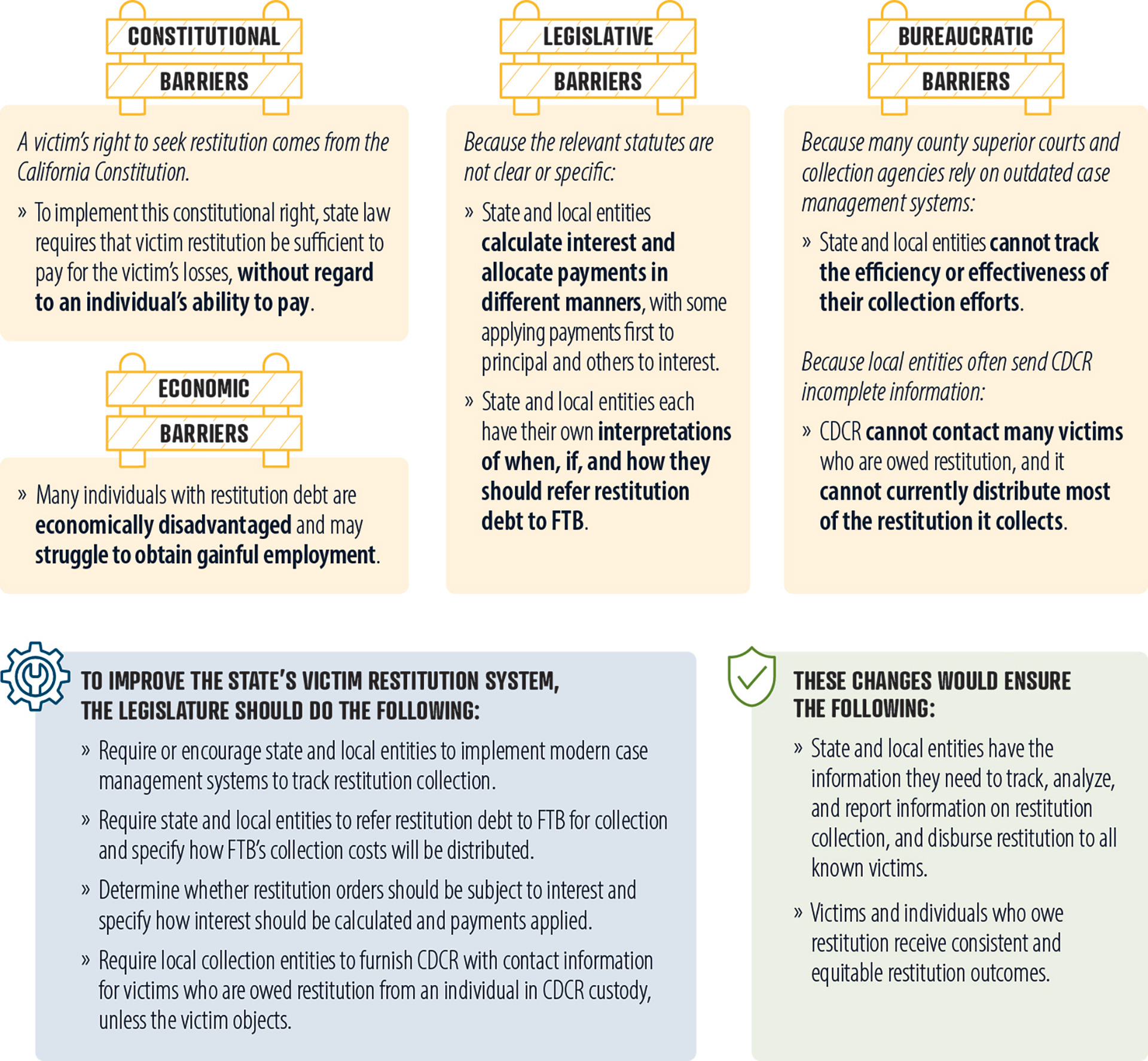
Figure 1
California’s State and Local Collection Entities Face Significant Barriers When Collecting and Disbursing Victim Restitution, but Legislative Changes Could Improve the Process
Source: State law and interviews, data, and procedural documents from CDCR, FTB, and San Diego, Kern, and Contra Costa counties.
Figure 1 explains that California’s state and local collection entities face significant obstacles in collecting and disbursing victim restitution and that legislative changes could improve the process. It states that improvements would ensure that state and local entities have the information needed to track, analyze, and report restitution collection and to disburse restitution to all known victims. It would also ensure consistent and equitable outcomes for victims and for individuals who owe restitution.
The figure lists actions the Legislature should take to improve the restitution system, such as:
• Requiring or encouraging state and local entities to implement modern case management systems to track restitution collection.
• Requiring state and local entities to refer restitution debt to the Franchise Tax Board (FTB) and specify how FTB’s collection costs will be distributed.
• Determining whether restitution orders should be subject to interest and establish how interest should be calculated and how payments are applied.
• Requiring local collection entities to provide the California Department of Corrections and Rehabilitation (CDCR) with contact information for victims who are owed restitution from an individual in CDCR custody unless the victim objects.
The figure then describes several categories of barriers:
• Bureaucratic barriers: Because many county superior courts and collection agencies use outdated case management systems, state and local entities cannot track the efficiency or effectiveness of their collection efforts. Because local entities often send CDCR incomplete information, CDCR cannot contact many victims who are owed restitution and currently cannot distribute most of the restitution it collects.
• Legislative barriers: Relevant statutes are not clear or specific, leading state and local entities to calculate interest and allocate payments differently. Entities also interpret differently when and how they should refer restitution debt to FTB.
• Economic barriers: Many individuals with restitution debt are economically disadvantaged and may struggle to obtain employment.
• Constitutional barriers: The California Constitution grants victims a right to seek restitution. To implement this right, state law requires that restitution be sufficient to pay for victims’ losses without regard to an individual’s ability to pay.
The Legislature can take steps to improve state and local entities’ ability to analyze their collection efforts, coordinate consistent practices, and efficiently disburse restitution collected. Implementation of these recommendations would improve the restitution system’s efficiency and ensure that victims and individuals who owe restitution orders and fines receive fairer and more consistent restitution outcomes, as Figure 2 outlines.
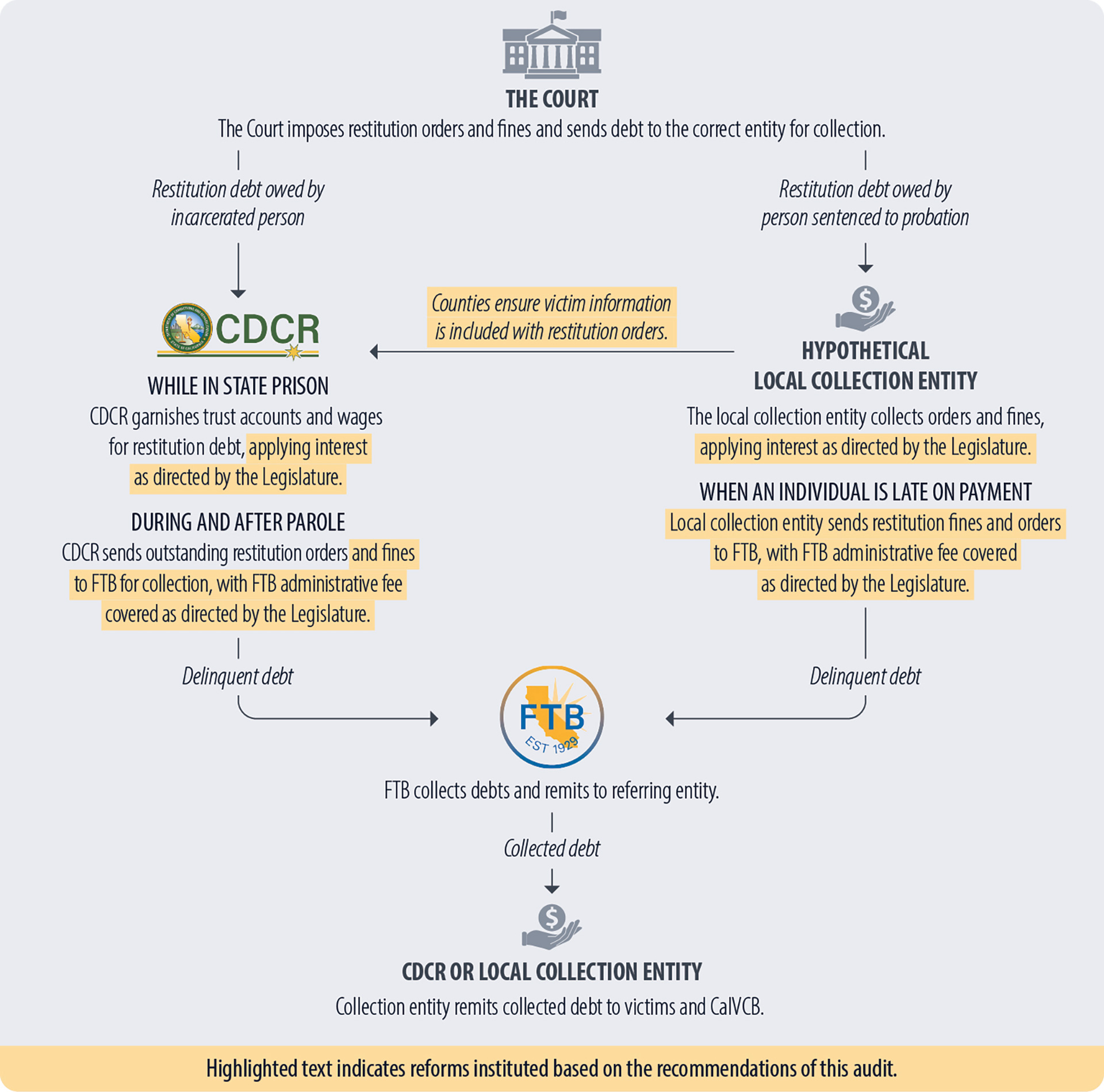
Figure 2
Examples of How, if Implemented, Our Recommendations Would Create a More Equitable, Efficient, and Consistent Restitution Collection Process
Source: State law, interviews with and procedural documents from CDCR and selected counties, and this report.
Figure 2 illustrates how the audit’s recommended reforms would function in practice to create a more consistent and equitable restitution collection process. It shows the roles of the court, local collection entities, CDCR, and the Franchise Tax Board (FTB), and how debts move between these entities.
The court would impose restitution orders and fines and forward the debt to the appropriate collecting entity. Counties would ensure victim information accompanies restitution orders. Local collection entities would collect orders and fines, applying interest as directed by the Legislature. They would also send delinquent restitution fines and orders to FTB for collection, with FTB’s administrative fee covered as the Legislature specifies. When CDCR is the collecting entity, it would garnish inmate trust accounts and wages during incarceration and apply interest as the Legislature directs. During and after parole, CDCR would send outstanding restitution orders and fines to FTB for collection. Once FTB collects restitution debt, it would remit the funds back to the referring entity, which would then disburse payments to victims and to the California Victim Compensation Board (CalVCB).
Introduction
Background
Restitution is the repayment of financial losses that result from criminal activity. The California Constitution guarantees the right of all victims of crime to restitution, or reimbursement, for economic losses resulting from the crime, such as replacing damaged property or receiving medical care for injuries.3 The purpose of California’s restitution law is to ensure that amends are made to society for a breach of the law and to act as a deterrent to future criminality. California courts have recognized that restitution acts as an effective rehabilitative penalty because it forces individuals to confront, in concrete terms, the harm their actions have caused.
In California, restitution takes two forms: restitution orders and restitution fines. The text box provides brief definitions of both of these types of restitution, as well as a definition of compensation. We explain each of these three terms in more detail in the pages that follow.
Overview of Terms
Restitution order: A court order requiring an individual convicted of a crime to reimburse a victim or victims for any economic losses they suffered as a result of the crime.
Restitution fine: State law generally requires the court to impose a restitution fine in every case in which a person is convicted of a crime. Restitution fines are paid to the State and are used by CalVCB to pay victim compensation.
Victim compensation: Compensation is financial assistance from CalVCB that helps eligible victims pay for many crime‑related expenses, such as counseling and medical fees that can be paid even before an individual is sentenced and ordered to pay restitution.
Source: State law and CalVCB materials.
Restitution Orders
A court orders restitution to victims—people who suffer physical, psychological, or financial harm as the result of a crime or an attempted crime. Restitution orders remain enforceable until paid in full. Further, the California Constitution requires all payments collected from an individual convicted of a crime to first be applied to that individual’s restitution order.
Courts typically determine the amount of restitution orders during the sentencing process. State law prohibits courts from taking an individual’s ability to pay into consideration when setting the amount of a restitution order, and it does not establish a maximum amount for a restitution order.4 Rather, state law requires the sentencing court to order restitution in an amount that will fully reimburse each victim for every determined economic loss incurred as the result of the crime, including but not limited to, stolen or damaged property, medical expenses, lost wages for time spent injured or as a witness, and interest. When the California Committee on Revision of the Penal Code analyzed restitution orders in six California counties, it found that the median restitution order from 2018 through 2020 was $1,200. However, some restitution orders may be millions of dollars when the crimes in question involved significant financial fraud or resulted in other significant monetary damage.
Restitution Fines
In addition to owing restitution directly to victims, individuals who are convicted of crimes also owe a debt to society. To address this debt, state law requires the court to impose a restitution fine in every case in which a person is convicted of a crime, unless the court finds compelling and extraordinary reasons for not doing so.5 Revenue collected from restitution fines is deposited in the State Restitution Fund (Restitution Fund). We discuss the purposes of this fund in more detail here.
Similar to the process for restitution orders, courts typically determine the amount of a restitution fine during the sentencing process. However, courts have more discretion when imposing restitution fines than when imposing restitution orders. Specifically, state law expressly directs that when setting a restitution fine in excess of the minimum amount specified in law, a sentencing court must consider any relevant factors, including the individual’s ability to pay and the seriousness and gravity of the offense. For individuals convicted of misdemeanors, restitution fine amounts range from $150 to $1,000, and for felonies, the range is $300 to $10,000. Recent changes to state law make unpaid restitution fines uncollectable and unenforceable 10 years from the date the court imposed them.
State and Local Entities Involved in the Restitution Process
Three state agencies—CalVCB, CDCR, and FTB—have roles in ensuring that individuals who are convicted of crimes pay their restitution orders and fines. In addition, superior courts, county revenue offices, and county probation departments—which we refer to collectively as local collection entities—are also critical to this process.
CalVCB
One of CalVCB’s responsibilities is the administration of the Restitution Fund. As we previously indicate, when individuals pay restitution fines, the payments are deposited into this fund. CalVCB then uses the Restitution Fund in part to pay compensation to qualifying victims of eligible crimes to help with expenses that result from the crimes. Compensation is different than restitution: although courts order restitution from an individual who is convicted of a crime, any eligible victim can receive financial assistance from CalVCB even before an individual is sentenced and ordered to pay restitution. The text box shows the types of harm that may qualify a victim for compensation and provides examples of eligible expenses. It is important to note that under state law, CalVCB must deny compensation if a victim does not reasonably cooperate with law enforcement in apprehending and convicting the individual who committed the crime. Further, if the victim was involved in the events leading to the qualifying crime, CalVCB may deny compensation.
Only Certain Crimes and Economic Losses Are Eligible for Compensation
To qualify for compensation, a crime must involve any of the following:
- Physical injury
- Emotional injury, in some circumstances
- Death
Only certain types of expenses qualify for compensation, including the following:
- Funeral or burial
- Crime scene cleanup
- Job retraining
- Home security system installation
- Relocation
Source: State law and CalVCB website.
CalVCB can recover the disbursed amount from the individual convicted of the crime as part of the court‑ordered restitution.
CalVCB also uses the Restitution Fund to support Trauma Recovery Centers, which provide support to crime victims at no cost, and to fund its own administrative expenses. In addition, the fund temporarily holds payments on restitution orders that CDCR collects from individuals under its supervision until CalVCB is able to distribute those payments to victims. In fiscal year 2024–25, the Restitution Fund received $56 million from restitution fines and orders. In this same fiscal year, it paid $50.5 million to victims.
CDCR
If individuals who owe restitution are sentenced to state prison, CDCR is responsible for collecting their restitution orders and fines during incarceration. CDCR generally deducts 50 percent of all wages or other deposits into incarcerated individuals’ trust accounts to pay toward their restitution orders and fines. As we describe above, CalVCB serves as the pass‑through agency for the restitution orders CDCR collects, while it deposits the restitution fines CDCR collects into the Restitution Fund.
According to state law, CDCR may continue to collect restitution fines and orders from individuals whom it releases to parole.6 The law also permits CDCR to refer to FTB restitution orders for collection for any individuals who are or were formerly under its jurisdiction. However, CDCR does not generally refer restitution fines to FTB, as we discuss in more detail in the audit results section.
FTB
State law directs FTB to collect delinquent court‑ordered debts, including restitution orders and fines, if a court, county, or state agency refers that debt to it. According to state law, the debt must have a balance of at least $100 and be at least 90 days delinquent. If the individual who owes the court‑ordered debt does not contact FTB to pay the amount in full or set up a payment plan, FTB’s system will search for available assets. If necessary, FTB can levy an individual’s wages and bank accounts to recover unpaid restitution orders and fines. To fund its collection program, state law requires FTB to recover its administrative costs from the payments it receives. Until July 2025, the law stated the Legislature’s intent that FTB’s administrative costs not exceed 15 percent of the revenue it collected. Beginning in fiscal year 2025–26, changes to state law allowed FTB to increase its fee to no more than 20 percent.
Local Collection Entities
Each of the counties we audited has established a comprehensive collection program in conjunction with the superior court in that county for the collection of court‑ordered debt. State law requires each court and county that maintains a comprehensive collection program to develop a cooperative plan to ensure prompt, efficient, and effective collection of court‑ordered debts, including restitution orders and fines. To satisfy this requirement, the Judicial Council of California (JCC) directs courts and counties to outline their respective collection responsibilities in a written agreement. In some counties, superior courts collect court‑ordered debt, while in others, the county revenue department or probation department is responsible for collection. State law also permits these local collection entities to contract with private debt collectors to collect court‑ordered debt.
Differences in Restitution Collection Processes
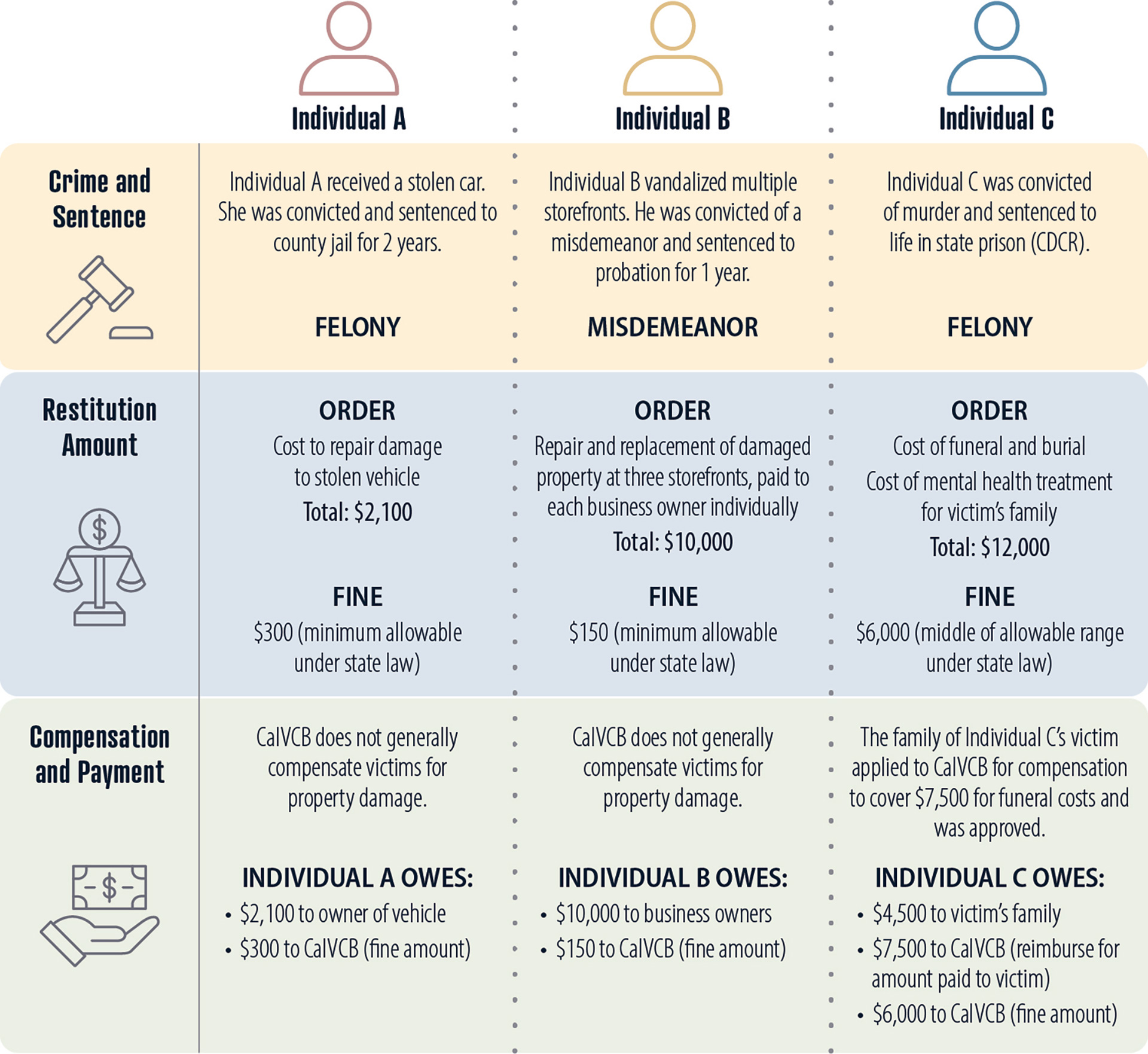
The process of collecting restitution orders and fines varies significantly depending on the crime an individual committed, their sentence, the county in which they were sentenced, and other factors. For example, the local collection entity administers the collection process for individuals sentenced to jail or probation and disburses restitution order payments to the victim. On the other hand, for individuals sentenced to a state prison, CDCR is responsible for this process, as we previously explain. Figure 3 shows the differences in the restitution ordering and payment process for three hypothetical individuals, one sentenced to state prison, one to county jail, and one to probation.
Figure 3
Restitution Orders and Fines Depend on the Circumstances of the Crime
Source: Hypothetical examples based on state law, Judicial Council of California bench publications, CalVCB compensation policies, and Superior Court minute orders and abstracts of judgments.
Figure 3 presents three hypothetical examples demonstrating how restitution orders and fines differ based on the type of crime, the damage caused, and whether the California Victim Compensation Board (CalVCB) provided compensation to victims.
Individual A received a stolen vehicle, was convicted of a felony, and sentenced to two years in county jail. CalVCB did not compensate for the property damage. Individual A owes $2,100 to the vehicle owner and a $300 fine.
Individual B vandalized multiple storefronts, was convicted of a misdemeanor, and sentenced to one year of probation. CalVCB did not compensate for the property damage. Individual B owes $10,000 to the business owners and a $150 fine.
Individual C was convicted of murder and sentenced to life in state prison. The victim’s family applied to CalVCB for $7,500 in funeral expenses and was approved. Individual C owes $4,500 to the victim’s family, plus $7,500 to reimburse CalVCB for its payment, and a $6,000 fine.
Each example includes the court‑ordered restitution amount, the corresponding fine amount allowed under state law, and the individual’s sentence, highlighting how restitution obligations vary by case.
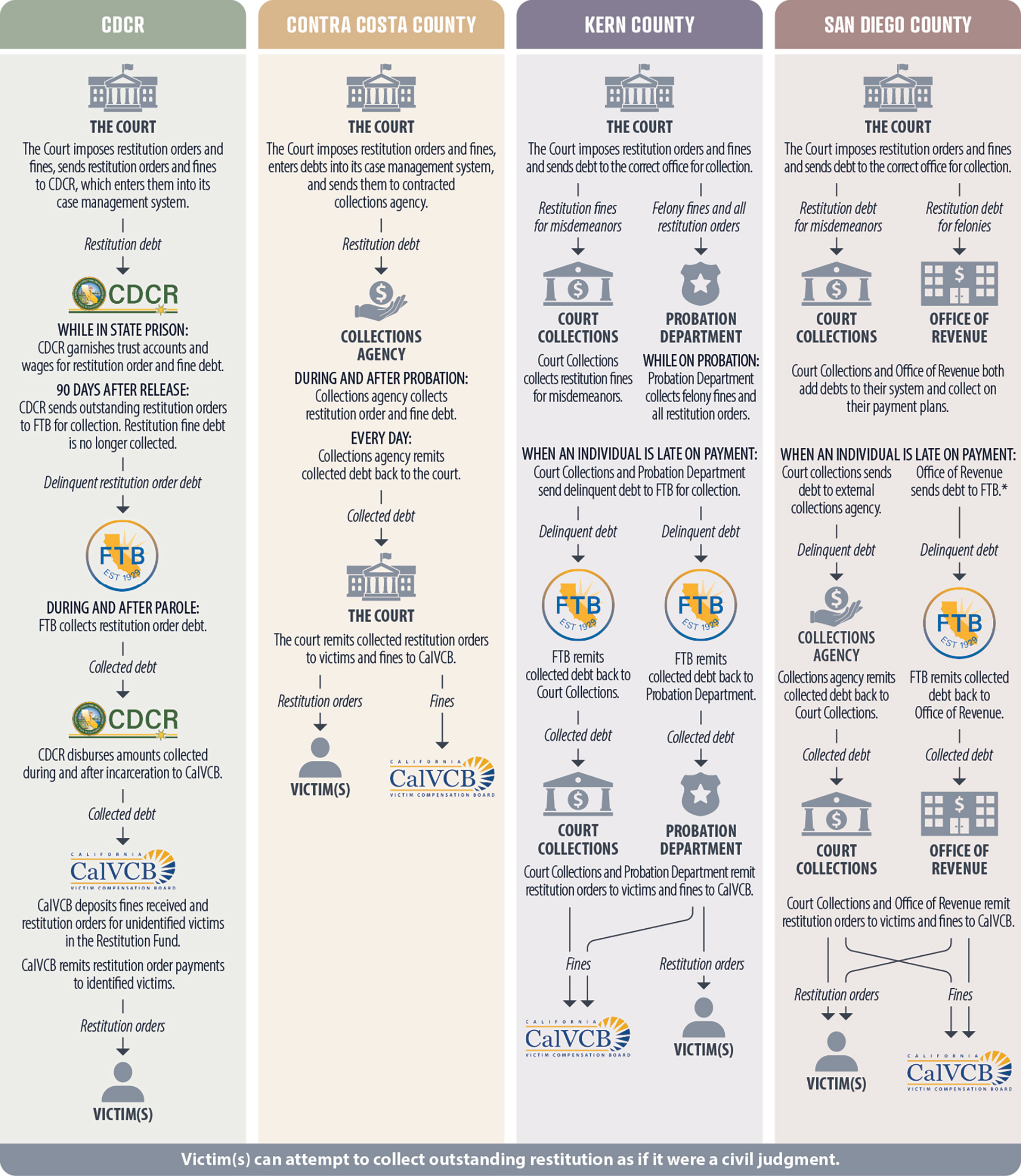
To understand how practices can vary across different county and court systems, we judgmentally selected local collection entities from three counties–Contra Costa, Kern, and San Diego–based on the counties’ geographic locations, the size of their populations, and the amount of restitution payments CalVCB reported sending to them during fiscal year 2023–24. The local collection entities at each of the counties we selected for review handle collection and disbursement responsibilities differently, as Figure 4 shows.
Figure 4
Examples of State and Local Processes for Administering the Collection of Restitution Orders and Fines
Source: State law, interviews with and procedural documents from CDCR and selected counties.
* San Diego Office of Revenue sends all delinquent debts to FTB Interagency Intercept Collections, but it only sends debts to FTB Court-Ordered Debt (COD) Collection with victim permission, as we discuss in Figure 12.
Figure 4 provides four examples—San Diego County, Kern County, Contra Costa County, and CDCR—demonstrating how restitution orders and fines move between courts, local collection entities, state agencies, and victims. It highlights which offices collect which debts, when debts are sent to the Franchise Tax Board (FTB) or collection agencies, and how payments ultimately reach victims or the California Victim Compensation Board (CalVCB).
CDCR: For individuals sentenced to state prison, the court sends restitution orders and fines to CDCR, which enters them into its system. CDCR collects restitution order and fine payments by garnishing inmate trust accounts and wages during incarceration. After release, CDCR sends outstanding restitution orders—but not fines—to FTB for collection. CDCR disburses collected funds to CalVCB, which then remits restitution to identified victims or deposits unclaimed orders into the Restitution Fund.
Contra Costa County: The court records restitution orders and fines in its case management system and sends the debts to a contracted collections agency. The agency collects restitution order and fine debt during and after probation and remits collected funds to the court daily. The court remits restitution order payments to victims and sends fines to CalVCB.
Kern County: The court sends restitution orders and fines to the Probation Department and Court Collections. During probation, the Probation Department collects felony fines and all restitution orders, while Court Collections collects misdemeanor restitution fines. When debt becomes delinquent, both offices refer it to FTB, which returns collected funds to them. Restitution orders are remitted to victims and fines to CalVCB.
San Diego County: The court sends restitution orders and fines to either the Office of Revenue or Court Collections. Both offices enter the debts into their systems and collect on payment plans, sending restitution payments to victims and fines to CalVCB. When individuals are late on payments, the Office of Revenue sends delinquent debt to FTB, while Court Collections sends delinquent debt to an external collections agency. FTB and the collections agency return collected funds to the referring entity.
In all counties, victims may also attempt to collect outstanding restitution as if it were a civil judgment.
Finally, as the text box shows, a victim may also choose to enforce a restitution order as a civil judgment.
To enforce the restitution order as a civil judgment . . .
. . . the victim obtains an Order for Victim Restitution from the sentencing court.
- If the individual convicted of the crime is unwilling to pay restitution as ordered, a victim is entitled to obtain information about that individual’s assets. For example, the victim can obtain a copy of the individual’s Statement of Assets filed with the court, which lists the individual’s personal information, employment, assets, income, and liabilities.
- The victim can then recover restitution in one of the following ways:
» Lien—the victim records an Abstract of Judgment for Restitution with the county recorder’s office to have money taken from the value of the individual’s real estate when that property is sold, transferred, or refinanced.
» Levy—the victim obtains a Writ of Execution with the court and delivers the order to the levying officer (county sheriff or marshal) with instructions identifying the individual’s property to levy, such as bank accounts, business receipts, and real or personal property.
» Wage garnishment—the victim obtains an Earnings Withholding Order from the court and delivers the order to the levying officer, who will serve the individual’s employer; the employer must withhold the correct amount of earnings from the individual and pay it to the levying officer.
Source: State law, forms adopted by the JCC, and guidance from San Diego County and Napa County.
Elimination of Administrative Fees for Restitution Collection
Until January 2022, state law permitted CDCR and local collection entities to charge administrative fees in specified amounts to cover the cost of collection. However, effective January 2022, legislative reform eliminated a range of administrative fees used to fund the criminal justice system, including the fees charged on restitution debts.7 Our audited entities collected these fees to offset a portion of their collection costs. Table 1 shows the fees the entities we audited collected from fiscal years 2014–15 through 2024–25. To backfill the funding lost from repealed fees including but not limited to those charged for collecting restitution orders and fines, the Legislature appropriated $50 million to counties annually commencing in fiscal year 2022–23.8
Table 2 shows the expenditures for FTB, CDCR, and the local collection entities we reviewed from fiscal years 2021–22 through 2023–24. We examine the cost effectiveness of these entities’ restitution collection efforts later in this report.
Audit Results
- State and Local Collection Entities Often Struggle to Collect Restitution Orders and Fines
- State and Local Collection Entities Lack Consistent, Coordinated Practices for Collecting and Disbursing Restitution Order Payments
- CalVCB Has Generally Provided Valid Legal Reasons for Denying Victim Compensation Claims
State and Local Collection Entities Often Struggle to Collect Restitution Orders and Fines
Key Points
- Only three entities we reviewed—the California Department of Corrections and Rehabilitation (CDCR), San Diego Office of Revenue, and Contra Costa—fully track data related to the restitution orders that they collect and disburse. These data show that the three entities collected only from 3 percent to 11 percent of their outstanding restitution orders from fiscal years 2014–15 through 2024–25. The entities’ limited collection of restitution orders is likely due in part to the fact that many individuals with criminal convictions lack the financial means to pay their debt.
- Almost all criminal convictions require the imposition of a restitution fine while restitution orders are generally limited to cases in which a victim has suffered an economic loss. Likely in part because restitution fines are more common, CDCR and the local collection entities we reviewed collected a larger percentage of restitution fines than restitution orders from fiscal years 2014–15 through 2024–25. However, if the Legislature chose to amend state law, it could likely increase CDCR’s collection of restitution fines.
- Two of the local collection entities we reviewed lack the means to report the total amount in restitution orders and fines that they have yet to collect because the entities rely on legacy case management systems (systems) that only track payment details on an account‑by‑account basis. This limitation is not unique to the entities we audited. System limitations at 13 other local collection entities across the State have caused them to be unable to report summarized restitution data to meet the Judicial Council of California’s (JCC) court‑ordered debt‑reporting requirements. The resultant lack of data impairs policymakers’ ability to track and analyze the total amount of outstanding restitution orders and fines across the State.
CDCR and the Local Collection Entities We Reviewed Collected Only a Small Percentage of Restitution Order Amounts
As the Introduction explains, CDCR and local collection entities collect restitution orders from individuals who have been convicted of crimes. However, from July 2014 through June 2025, these entities collected only a small percentage of the restitution orders for which they were responsible. For example, the Office of Revenue and Recovery of the County of San Diego (San Diego Office of Revenue) and Superior Court of California, County of Contra Costa (Contra Costa) collected a combined average of about 9 percent, or $1.8 million of the $20 million courts imposed per year from fiscal years 2014–15 through 2024–25. Table 3 shows the amount of restitution collected from fiscal years 2014–15 through 2024–25 for four of the entities we reviewed. Over this same 11‑year period, CDCR collected an average of only 3 percent of the restitution orders that individuals in its care owed to victims. Because the Kern County Probation Department’s (Kern Probation) data collection system has significant limitations, we present total dollar amounts of victim restitution ordered, collected, disbursed, and outstanding in Kern County, but not the percentage collected or outstanding.
It is common for restitution debt to have a high rate of nonpayment. Individuals owing restitution orders because of their criminal convictions may have reduced earning potential and opportunities for employment, especially if they are convicted of a felony and face incarceration. Further, the challenges of collecting restitution order debt are not unique to California. Federal courts may also order individuals with criminal convictions to pay restitution to victims, but the U.S. Department of Justice (DOJ) website warns that many such individuals do not have sufficient assets to repay their victims and that full recovery is rare. A 2018 U.S. Government Accountability Office (GAO) review of uncollected restitution orders imposed by federal judges found that of the $112.9 billion in restitution orders owed during federal fiscal years 2014–15 and 2015–16, the U.S. Attorney’s Office (USAO) collected only $2.9 billion. Of the remaining $110 billion of restitution order debt, the USAO determined that $100 billion, or 91 percent, was uncollectable because those who owed court debt were unable to pay. According to the GAO’s report, U.S. Sentencing Commission data indicated that 95 percent of the individuals the federal government ordered to pay restitution received a waiver for a court‑ordered fine, indicating their inability to pay orders or fines.
The USAO may suspend collection actions on debt it deems uncollectable, but in California, where state law makes restitution fines generally uncollectable after 10 years, that requirement does not apply to restitution orders, which remain collectable indefinitely.9 Nonetheless, as Table 4 shows, the rate of repayment for restitution orders we reviewed for Contra Costa generally remained low as the orders aged. Data provided to us by the financial services team at Contra Costa indicated that nearly 5,000 individuals it collects from were delinquent on their restitution order debt as of January 2026, collectively owing more than $70 million to more than 6,000 victims. We present the rate of repayment for CDCR and San Diego Office of Revenue in Table C.2 and Table C.4, respectively, in Appendix C at the end of this report. In Contra Costa, as restitution order debt ages, the amounts collected each year decrease.
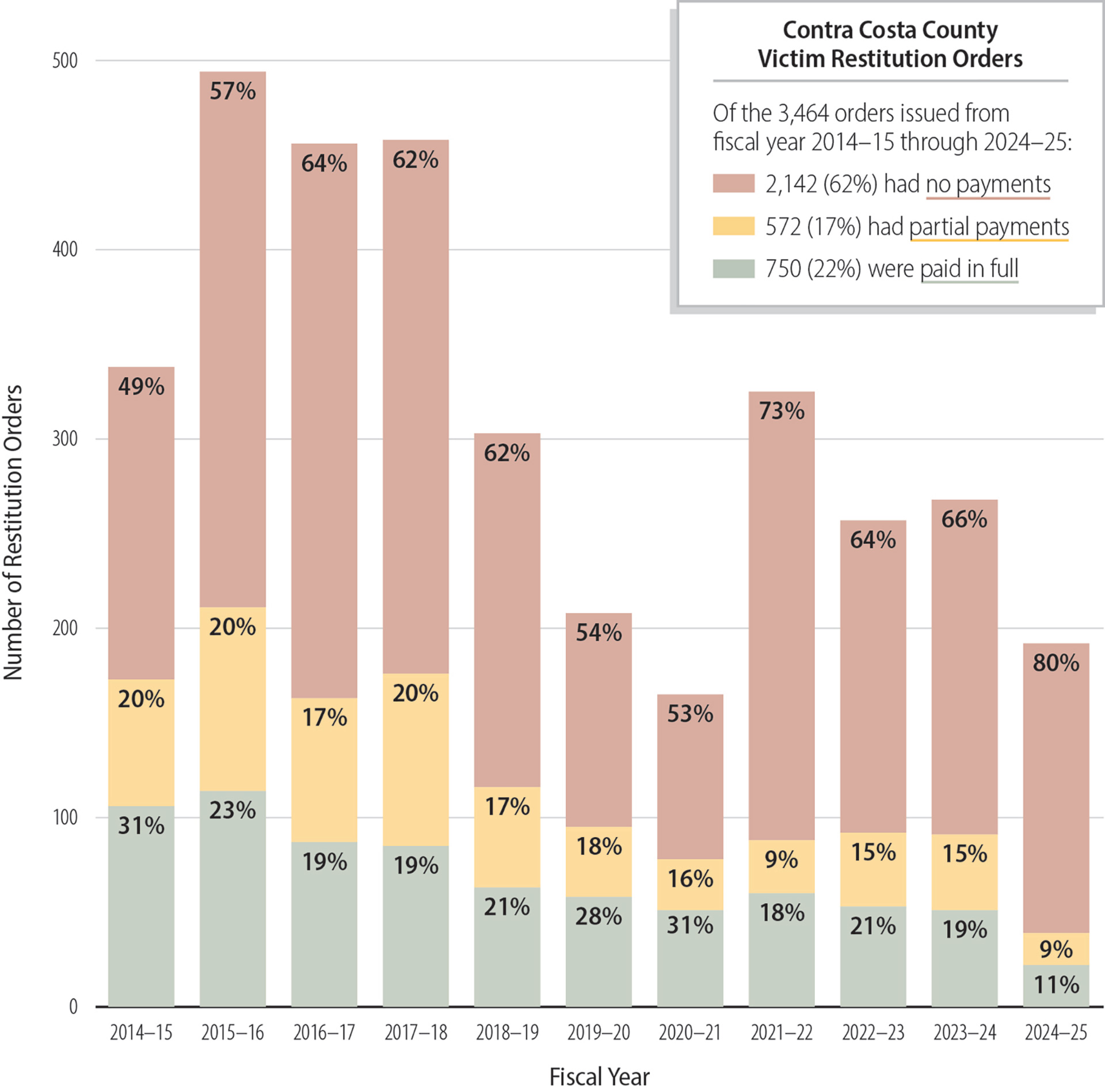
Further, the individuals overseen by the entities we reviewed rarely fully paid their restitution order debt, and many did not make a single payment. For example, as Figure 5 shows, only 22 percent of restitution orders in Contra Costa from fiscal years 2014–15 through 2024–25 had been paid in full as of June 30, 2025. Further, more than 2,100, or 62 percent, of the nearly 3,500 orders, had not received a single payment as of this date.
Figure 5
Less Than One Quarter of the Restitution Orders Contra Costa Imposed Between Fiscal Years 2014–15 and 2024–25 Were Paid in Full as of June 30, 2025
Source: Analysis of Contra Costa’s restitution data.
Note: Percentages may not add to 100 due to rounding.
Figure 5 presents a bar chart displaying the payment status of restitution orders imposed by Contra Costa County from fiscal years 2014–15 through 2024–25. For each year, the chart shows the percentage of orders paid in full, partially paid, or unpaid. Most years reflect that the majority of orders received no payments, smaller portions received partial payments, and even fewer were paid in full.
Across the entire 11‑year period, Contra Costa County issued 3,464 restitution orders, of which 2,142 (62%) had no payments, 572 (17%) had partial payments, and 750 (22%) were paid in full. The bars illustrate this trend annually, with the share of fully paid orders generally remaining below 31 percent.
The figure emphasizes that less than one quarter of restitution orders were fully paid as of June 30, 2025. Source information comes from Contra Costa County restitution data.
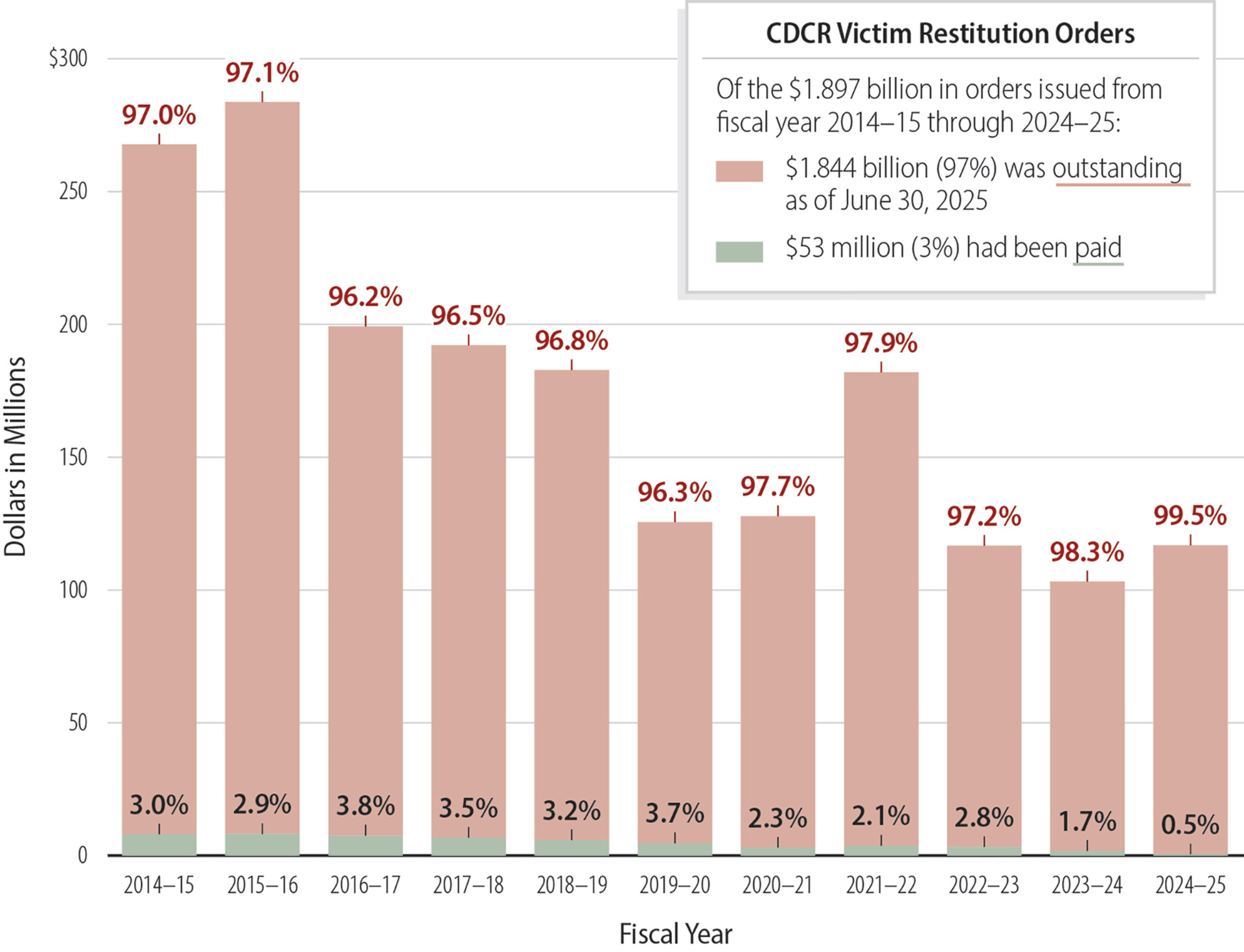
As Figure 6 shows, CDCR also collected only a small amount of restitution orders from fiscal years 2014–15 through 2024–25. However, more accounts under its supervision received one or more payments than in Contra Costa because CDCR automatically garnishes individual’s wages from in‑prison jobs as well as certain deposits into their trust accounts. This automated system leads to a higher number of individuals making at least one payment on their restitution debt. Nonetheless, CDCR had not collected a single payment for about 6,100, or 17 percent, of the more than 36,000 victim restitution orders from fiscal year 2014–15 through 2024–25 that were not paid in full as of June 30, 2025. We present restitution order payment status statistics for CDCR and San Diego Office of Revenue in Table C.1 and Table C.3, respectively, in Appendix C at the end of this report.
Figure 6
Individuals Sentenced to CDCR Have Not Paid Most of the Restitution Ordered to Victims From Fiscal Years 2014–15 Through 2024–25
Source: CDCR data.
Figure 6 displays a bar chart illustrating the percentage of restitution ordered by the California Department of Corrections and Rehabilitation (CDCR) that remained outstanding from fiscal years 2014–15 through 2024–25. Each bar shows two portions: the small percentage that had been paid each year and the much larger percentage that remained unpaid. Annual paid amounts range from about 0.5% to 3.8%, with unpaid portions consistently exceeding 96%.
Across the entire period, CDCR issued $1.897 billion in restitution orders. As of June 30, 2025, $1.844 billion (97%) remained outstanding, while $53 million (3%) had been collected.
The figure emphasizes that individuals sentenced to CDCR have paid only a small portion of their restitution obligations over the past decade. The data source for this figure is identified as CDCR.
As a result of low collection rates, victims did not receive most of the restitution orders owed to them during the last 10 years. However, when individuals did make payments on their restitution orders, Contra Costa and San Diego Office of Revenue each disbursed all of the amounts they collected to victims. In contrast, CDCR has had challenges disbursing restitution order funds to victims—an issue we discuss in more detail later in this report.
In part because of the low payment rates for restitution orders, some researchers have raised concerns about the effectiveness of the restitution system. According to a researcher from the Law Policy Advocacy Clinic at the University of California, Berkeley, some victims receive small payments that can feel like a monthly reminder of a traumatic event. Further, according to Initiate Justice, an organization that advocates for incarcerated individuals, the cost of paying victim restitution debt often falls on the family of the individual convicted of the crime, which impacts those involved financially and mentally. According to the researcher from the UC Berkeley Law Policy Advocacy Clinic, CDCR’s forcible collection of restitution payments by garnishing wages or seizing trust account deposits may come at the expense of incarcerated individuals’ basic needs. Similarly, FTB may generally levy up to 20 percent of nonincarcerated individuals’ disposable earnings.
Further, restitution is not dischargeable by bankruptcy under federal law, and under state law, judges cannot take an individual’s ability to pay into consideration when setting the amount of the restitution order. Consequently, some individuals may be ordered to pay victim restitution in excess of their ability to do so, but without any traditional avenues for discharging that debt, and because individuals continue to owe restitution orders until they are paid in full, some people will continue to owe indefinitely.
Changes to State Law Would Increase CDCR’s Collection of Restitution Fines
State law generally requires courts to impose restitution fines on each individual convicted of a crime, even if the crime does not warrant an order of restitution to any victims. For example, if an individual were convicted of possession of an illicit substance, the court would impose a restitution fine even if the individual did not owe restitution to any specific victim. Because virtually all criminal convictions require the imposition of a restitution fine whereas victim restitution is generally ordered in cases where a victim has suffered an economic loss, restitution fines are more common than victim restitution orders. At CDCR and the local collection entities we reviewed, the average number of annual cases with orders for restitution fines was 10 times greater than the average number of annual cases with restitution orders.
Likely in part because restitution fines are more commonplace, CDCR and the local collection entities we reviewed collected a larger percentage of restitution fines, which are paid to the State, than restitution orders, which are paid to victims, from fiscal years 2014–15 through 2024–25.10 During that time period, on average, CDCR collected more than $7 million, or 30 percent, of about $24 million in restitution fines annually. San Diego Office of Revenue collected an average of 23 percent of restitution fine debt imposed each year, while Contra Costa collected 40 percent of the fines ordered each year, as Table 5 shows.
The higher collection rate for restitution fines than for restitution orders was also likely due to the fact that restitution fines are generally for lower dollar amounts. Unlike restitution orders, which are based on the losses incurred by a victim and have no maximum amount, state law requires courts to impose restitution fines ranging from $150 to $1,000 for misdemeanors and from $300 to $10,000 for felonies. Consequently, as Table 6 shows, the median restitution fines in both Contra Costa and San Diego have generally been much smaller than the median victim restitution orders. This difference, combined with the near universality of fines applied to convictions, likely explains the lower percentage of outstanding restitution fine debt.
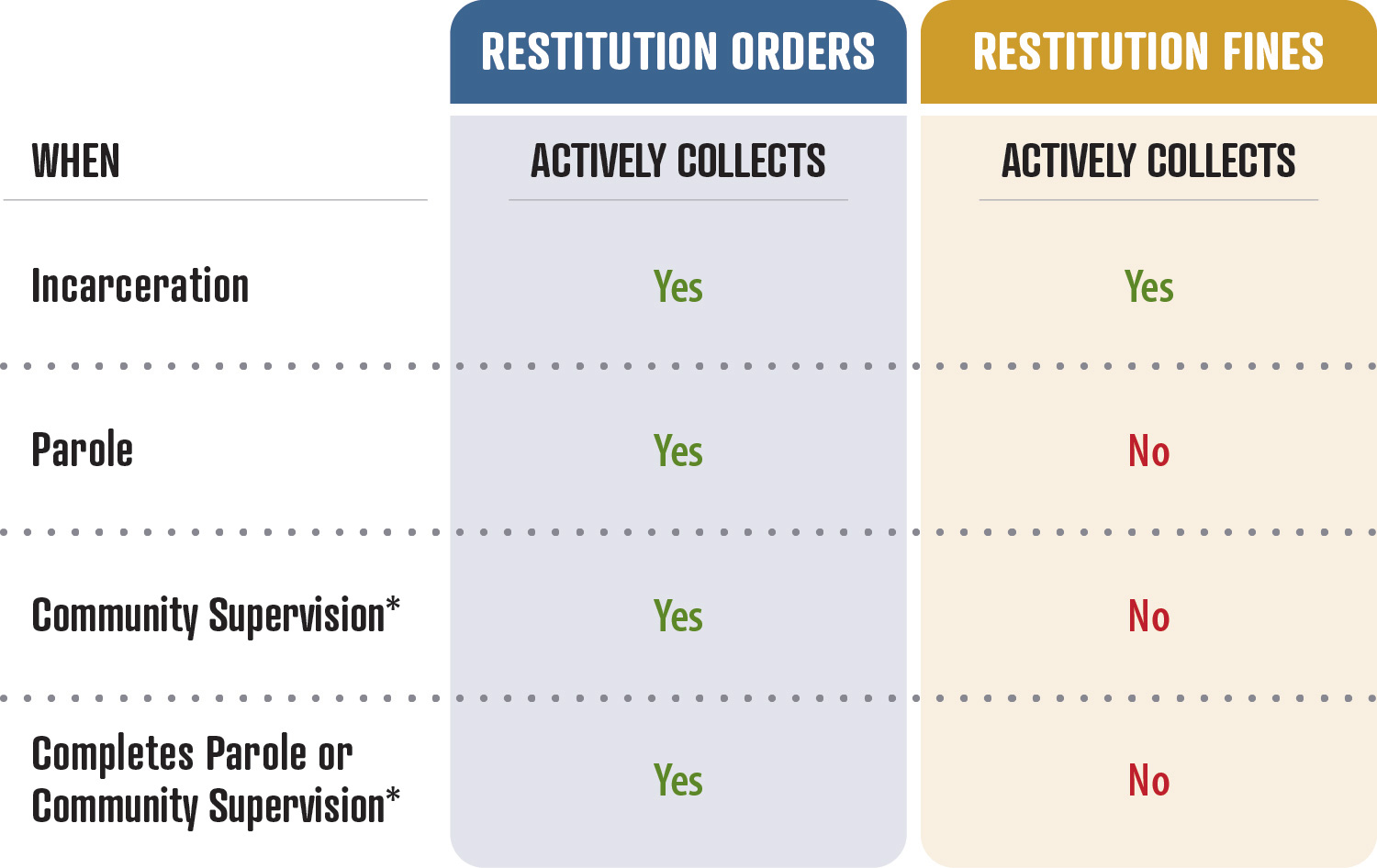
Although state law authorizes CDCR to collect restitution fines, CDCR does not do so after an individual is released from incarceration. State law requires CDCR to collect restitution fines during an individual’s incarceration; however, it indicates that CDCR may collect when individuals are on parole. According to CDCR, it collects restitution fine amounts from individuals only while they are incarcerated and does not make any collection attempts after the individuals are released to parole or a community supervision program, as Figure 7 shows.11
Figure 7
CDCR’s Authority and Collection Practices Differ for Restitution Orders and Restitution Fines After Incarceration
Source: State law, CDCR procedural documents, and interviews with CDCR staff.
Note: CDCR collects payments for restitution fines from formerly incarcerated individuals via voluntary payments made directly to CDCR or applied from overpayments made on restitution orders collected via FTB.
* CDCR is permitted to refer restitution orders to FTB for collection for individuals who are or were formerly under its jurisdiction.
Figure 7 summarizes when the California Department of Corrections and Rehabilitation (CDCR) is authorized or required to collect restitution orders and restitution fines after an individual leaves incarceration. It contrasts the authority with whether CDCR actively collects these debts during incarceration, while someone is on community supervision or parole, and after supervision ends.
For restitution fines, CDCR is required to actively collect them during incarceration. After release, CDCR is permitted to collect restitution fines from individuals on parole, but it does not actively collect restitution from them. CDCR is not permitted to collect restitution fines from individuals serving community supervision or from those who have completed parole or community supervision, and it does not do so.
For restitution orders, CDCR is required to collect during incarceration. After incarceration, parole, and community supervision, CDCR is permitted but not required to collect restitution orders from individuals owing restitution, and it continues to actively collect.
After an individual completes parole, CDCR does not have any enforcement authority to collect restitution fines. At that point, enforcement on the outstanding balance rests with CalVCB. According to information CalVCB provided, it once ran a pilot project to submit outstanding restitution fine balances of discharged individuals to FTB for collection. However, officials at CalVCB informed us that the pilot program ended in 2019 due to new legislation, court decisions, and shifting priorities within the criminal justice system as well as in CalVCB. Subsequent efforts in 2021 were discontinued because the COVID‑19 pandemic caused disruptions in the collections process. The officials further explained that CalVCB has not made any additional effort to collect fine amounts.
Thus, neither CalVCB nor CDCR make any attempt to collect restitution fines from formerly incarcerated individuals after CDCR releases those individuals from custody. The absence of such attempts may have contributed to the millions of dollars of unpaid debt. In fact, from fiscal years 2014–15 through 2024–25, nearly $184 million, or 70 percent, of restitution fines imposed on individuals sentenced to CDCR were outstanding.
CDCR’s restitution manager stated that it does collect restitution fines from individuals released from custody through voluntary payments made directly to CDCR or from overpayments made on restitution orders collected through FTB. If the Legislature required CDCR to refer restitution fines to FTB during and after an individual’s parole, officials stated that collecting restitution fines would be feasible but would require enhancement or modifications to its electronic database system. For instance, when referring a delinquent account containing both a restitution fine and a restitution order to FTB, the system would need the functionality to differentiate between the two so that FTB prioritizes collecting the order before the fine.
Because neither CDCR nor CalVCB actively pursues outstanding restitution fines after an individual is released from custody, the State is missing an opportunity to potentially collect some additional restitution fine payments. These payments could provide more critical funding to CalVCB, which in turn could reduce CalVCB’s reliance on General Fund transfers.
Some Local Collection Entities Are Unable to Track the Effectiveness of Their Collection Activities Because of Their Outdated Case Management Systems
Local collection entities throughout California—including two entities we audited—are unable to produce the data necessary for local collection entities and policy analysts to evaluate the effectiveness of restitution order and fine collection programs. As a result of these and other outdated systems, California is unable to determine the percentage of restitution orders and fines owed statewide. As we previously indicate, Kern Probation’s outdated system limits its ability to track its collection of restitution orders and fines and assess the effectiveness of its efforts. Kern Probation provided data to us identifying the total amounts of restitution orders and fines imposed, collected, and disbursed annually in the county, as well as the total outstanding balance. However, according to Kern Probation, its system is unable to produce reports on accounts opened in a given year or track the percentage of debt an individual has paid. Consequently, although Kern Probation can report the total restitution imposed in a year, it cannot determine the proportion it collected, thereby preventing an assessment of the effectiveness of its collection efforts.
This limitation stems from Kern Probation’s outdated system, which, according to department staff, has been in operation since the 1980s. Although the system only displays each individual’s outstanding balance, Kern Probation does maintain records of daily transactions that a more advanced system could use to track collection effectiveness. Department staff stated that they print and file daily transaction reports in binders designated for each type of transaction, such as billings, court orders, disbursements, and receipts. For every year, Kern Probation keeps 12 binders, each containing several hundred pages, for each transaction type, making the aggregation and use of these records cumbersome. Compiling transaction‑level data would require staff to manually sift through every binder, identify each court order that imposed a restitution order, and identify and record each payment transaction made on that specific debt.
Kern Probation staff agree that the current system has limited functionality. They further explained that this system is both difficult and expensive to maintain. For these reasons, Kern Probation is in the process of incorporating the components for restitution collection into a new, department wide system with increased functionality.
The San Diego Superior Court noted that until recently, it also used a legacy system that originated in the 1980s and has similar constraints. Although the San Diego Superior Court provided us with the total amounts of restitution orders and fines it imposed, collected, and disbursed during the audit period, it could not summarize and share account‑ or transaction‑level data that would allow us to calculate the percentage of restitution collected relative to the amount imposed in a given year. Similar to Kern Probation, the San Diego Superior Court stated that calculating the percentage of owed restitution it collects would require extensive manual tabulation. To address its former system’s limitations, in February 2026, the San Diego Superior Court transitioned to a new system that has these capabilities.
In addition, other local collection entities reported system limitations that constrain their ability to report their restitution order collection to the JCC. State law requires each county and superior court to jointly submit information about the collection of criminal fines and fees to the JCC each year and requires the JCC to annually report this information to the Legislature. The JCC requires counties and courts to report on restitution order collection separately from other court‑ordered debt, such as fines, fees, forfeitures, penalties, and assessments. According to the JCC’s 2023–24 Report on Court‑Ordered Debt Collection, 39 counties and courts were jointly unable to meet various reporting requirements related to all types of court‑ordered debt. As the text box shows, 13 of these local collection entities explicitly reported both system limitations and an inability to fulfill the restitution order‑specific reporting requirements.
Counties Reported Severe Limitations in Their Ability to Report Restitution Order Data
In the 2023–24 JCC Report on Court‑Ordered Debt Collections, 13 counties reported both system limitations and an inability to meet restitution order reporting requirements. These shortcomings include:
- Inability to track or report any restitution order data.
- Inability to report on specific fields required by the JCC, such as the dollar amount of restitution orders outstanding.
- Inability to separate restitution order information from other court‑ordered debt.
- Inaccurate restitution order ending balances due to system errors.
Source: JCC Report on Collection of Court‑Ordered Debt for Fiscal Year 2023–24.
While these system limitations do not hinder San Diego Superior Court or Kern Probation from accepting restitution payments and keeping account balances current, they leave entity staff and policy analysts unable to evaluate the effectiveness of local collection entities’ programs and policies. If these conditions reflect a statewide trend, outdated systems will likely continue to hinder the evaluation of collection efforts. Local collection entities operating under these constraints cannot distinguish year‑to‑year changes in the effectiveness of their collection efforts, making it difficult to assess the impact of procedural, legislative, or external variables on their collection rates. Moreover, until local collection entities resolve these limitations, the overall percentage of restitution orders collected statewide will remain unknown, limiting possibilities for statewide collection analysis.
Recommendations
Legislature
To reduce outstanding restitution fine debt, the Legislature should consider amending state law to require CDCR to continue collecting restitution fine payments both during and after an individual’s parole, in part by referring unpaid restitution fines to FTB.
To enable local collection entities to effectively track and assess the restitution orders and fines they collect, the Legislature should consider requiring or incentivizing courts and counties to modernize their systems. Any updated system should provide the data necessary for local collection entities to fulfill their reporting obligations to the JCC regarding court‑ordered debt. Specifically, these systems should be capable of distinguishing restitution fines from orders and of reporting key details, including the amount due, the amount and percentage collected, any interest accrued, and the amounts disbursed to CalVCB and to victims.
State and Local Collection Entities Lack Consistent, Coordinated Processes for Collecting and Disbursing Restitution Order Payments
Key Points
- CDCR is unable to disburse more than half of the restitution order payments it collects to victims, because local collection entities have not consistently coordinated with CDCR to provide it with victim contact information.
- Although state law requires judges to impose 10 percent interest on restitution orders, courts have not applied this requirement consistently. When courts have ordered interest, state and local collection entities have used varying methods to calculate and apply it.
- Differing interpretations of state law have led CDCR and the local collection entities we reviewed to take inconsistent and uncoordinated approaches to referring restitution debt to FTB, resulting in unequal effects for both victims and individuals who owe restitution.
- Until recently, the San Diego Superior Court did not fully comply with legislative reforms limiting its authority to impose administrative fees on individuals who owe restitution. Instead, it allowed the private collection agency it contracts with to collect administrative fees from such individuals.
Local Collection Entities Often Do Not Provide CDCR With the Information It Needs to Disburse Restitution to Victims
CDCR lacks victim contact information for about 60 percent of the restitution orders it collects. As a result, it cannot disburse payments to at least 11,000 victims. According to CDCR staff, it often receives legal court documents for individuals sentenced to its custody that lack sufficient information to identify victims who are owed restitution orders. State law requires CDCR to remit to CalVCB the payments on restitution orders that it collects from incarcerated individuals for disbursement to victims. If CDCR cannot provide CalVCB with victim contact information when remitting these orders, CalVCB is unable to in turn disburse the payments to the victims. When individuals who the courts sentence to state prison first arrive at a CDCR reception center for processing, staff enter restitution order amounts into an electronic database. State law requires sentencing courts to prepare restitution orders that, to the extent possible, identify each victim, specify each loss, and state a dollar amount sufficient to fully reimburse victims for economic losses resulting from the crime. However, our review found that CDCR’s data often lacked details needed to identify or contact victims. For example, we observed court documents that either omitted the victim’s name, provided only initials, or stated that restitution should be paid to the victim’s family without identifying the family.
According to CDCR’s restitution collection procedures, staff rely on local probation departments and district attorneys’ offices for victim information when internal efforts, such as reviewing case details in superior court‑provided legal documents, are unsuccessful.12 However, even when reports from law enforcement and local probation departments are available, CDCR staff assert that those reports rarely include contact details such as phone numbers or addresses. In fact, in some cases, the reports list generic identifiers, such as “Jane/John Doe” or “Victim #1/#2.” In our review of four months of 2025 restitution payment data—each of which consisted of payments to more than 25,000 victims that CDCR submitted to CalVCB—we identified at least 2,500 victims with generic victim name identifiers each month.
The lack of victim contact information results in many unclaimed court‑ordered payments. From fiscal years 2014–15 through 2024–25, CDCR officials asserted that it had victim contact information for only 40 percent of restitution orders. In our review of monthly restitution payment data, we found that among the payments collected for the more than 25,000 victims, over 11,000 (about 44 percent) lacked victim’s addresses and over 21,000 (about 84 percent) lacked victim’s phone numbers. To further illustrate the scope of this issue, individuals fully paid their restitution orders for 9,834 cases of the 46,254 cases with restitution orders during that period, or about 21 percent. However, CDCR estimates that it had contact details for only about 4,300 of those orders, or 44 percent. Consequently, CalVCB could not disburse nearly 60 percent of fully paid restitution order amounts it received from CDCR.
When CDCR cannot locate victims, state law directs CalVCB to hold restitution payments in trust until the end of the subsequent fiscal year. After that period, the funds revert to the Restitution Fund for CalVCB to use for compensation, although victims may claim restitution payments after this point if they contact CDCR. CDCR aims to reach more victims; however, its outreach efforts have yielded limited results. Through its Office of Victim and Survivor Rights and Services (OVSRS), CDCR has expanded outreach initiatives by delivering recurring trainings and presentations to district attorneys’ offices and communities statewide. According to CDCR, despite these efforts, the OVSRS reported that its rate of collecting victim contact information increased only 6 percentage points—from 18 percent in 2010 to about 24 percent in 2024. To further supplement outreach efforts, the OVSRS piloted an advanced project in three counties to obtain victim information directly from district attorneys’ offices immediately after case disposition. However, because of the discretionary nature of information sharing and the counties’ limited capacity, the project produced minimal results.
CDCR also provides restitution, compensation, and victim service information on the OVSRS’s public‑facing website, including instructions to victims for requesting or claiming restitution. The website notes that CDCR collects an average of $2 million per month but often lacks victim contact information to disburse collected funds. To address this missing victim information, the website offers an online portal where victims can submit their contact information. According to CDCR, from the years 2021 through 2025, it received more than 3,700 new victim requests through its unclaimed restitution portal.
CDCR officials explained that to address the challenges the department faces in disbursing restitution, they requested that the JCC establish a rule of court requiring local entities to automatically share victim information. However, in 2025, the JCC Criminal Law Advisory Committee declined to pursue this issue. The JCC told us that budget uncertainties caused the JCC to direct advisory bodies to prioritize assigned, mandated, or urgent proposals; consequently, the Criminal Law Advisory Committee deferred addressing CDCR’s court rule request to a future proposal cycle. Without automatic information sharing, the restitution process will continue to deny many victims their constitutional right to obtain restitution from those convicted of the crimes that caused the victims’ losses.
The Legislature is currently considering legislation to ensure that CDCR receives victim contact information. Assembly Bill 1681, introduced in February 2026, would require the court and the district attorney’s office, or other prosecuting agency, to ensure that the victim’s and the victim’s next of kin’s contact information is provided to CDCR at the time of sentencing in cases resulting in a state prison sentence.
Unclear State Law Has Resulted in State and Local Collection Entities Inconsistently Applying Interest to Outstanding Restitution Orders
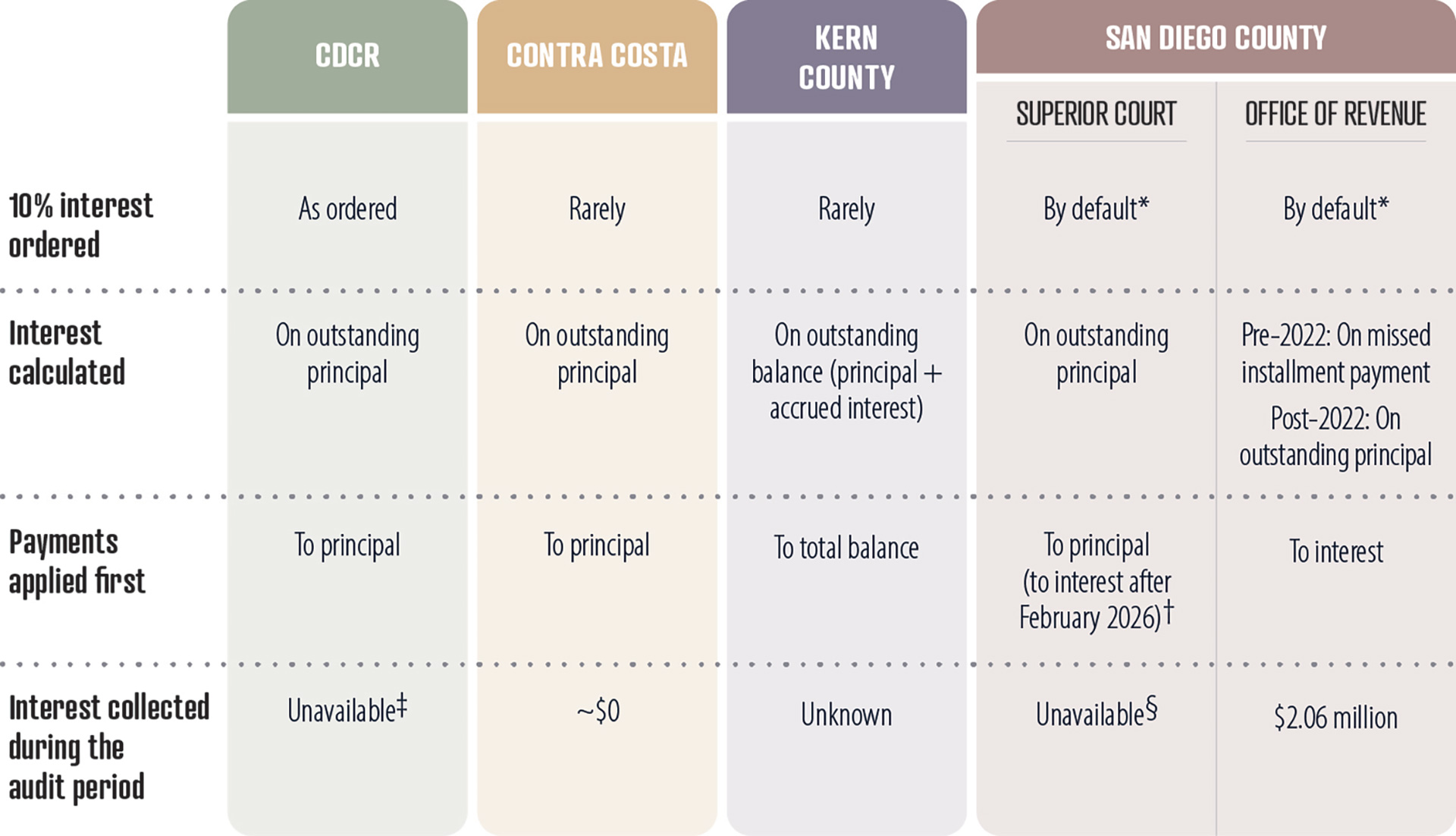
To fully reimburse victims for their economic losses, state law specifies that a court must include 10 percent annual interest as one of the costs restitution orders aim to recover. However, as Figure 8 shows, the state and local collection entities that we audited have applied and calculated interest in a variety of ways, resulting in victims receiving different amounts of interest and individuals convicted of crimes having different debt burdens depending on the court where the individuals were tried and the entity responsible for collecting the restitution order.
Figure 8
Although State Law Requires 10 Percent Annual Interest, Courts Order and Collecting Entities Calculate Interest Differently
Source: Local collection entity restitution data, forms, and manuals, interviews with superior court and collection agency staff and CDCR staff, and CDCR data.
* Court order forms in San Diego County include 10 percent interest as the standard on all restitution orders.
† San Diego Superior Court transitioned to a new Case Management System that can apportion payments to both interest and principal in February 2026.
‡ Active restitution orders for individuals sentenced to CDCR from fiscal years 2014–15 through 2024–25 have accumulated roughly $230 million in interest. According to CDCR, with the current functionality of its electronic system, the amount of interest collected on a restitution order cannot be fully realized until the order is paid in full. The system will only allow for a simple calculation that compares the total amount paid versus the original amount ordered.
§ Prior to February 2026, San Diego Superior Court tracked interest in individualized spreadsheets appended to each case. Calculating the total amount of interest collected during the audit period would have required staff to manually compile data from thousands of spreadsheets.
Figure 8 compares how five entities—CDCR, Contra Costa, Kern County, and San Diego County’s Superior Court and Office of Revenue—calculate interest on restitution debt and how they apply payments toward principal or interest. Although state law requires 10 percent annual interest on restitution, the figure shows that entities interpret this requirement differently.
At CDCR, interest is ordered at the statutory rate of 10 percent and calculated on outstanding principal. Payments are applied to principal. The figure notes that roughly $230 million in interest has accumulated on active restitution orders for individuals sentenced to CDCR between fiscal years 2014–15 and 2024–25, but CDCR’s system cannot fully determine how much interest was collected until an order is paid in full.
In Contra Costa County, interest is calculated on outstanding principal. Payments are applied to principal. Interest collections during the audit period were approximately zero.
In Kern County, interest is calculated on the outstanding balance, which includes both principal and accrued interest, and applies payments to the total balance. Interest collection amounts were rarely available.
At the San Diego County Superior Court, interest is ordered by default and calculated on the amount of principal outstanding. Payments are applied to the principal first. The figure shows that the county collected roughly $2.06 million in interest during the audit period. The total interest collected could not be determined because interest was tracked in thousands of individualized spreadsheets prior to the transition to a new case management system.
At the San Diego County Office of Revenue, interest is ordered by default. Before 2022, interest was calculated only on missed installment payments; after 2022, interest is calculated on outstanding principal. Payments are now applied to interest (previously to principal before February 2026). The San Diego Office of Revenue collected roughly $2.06 million in interest during the audit period.
Source information comes from local restitution data, forms, manuals, interviews with county and court staff, and CDCR data.
Significantly, we found that some courts have not consistently included interest in their restitution orders despite state law requiring that they do so, resulting in county‑to‑county variations in the receipt and payment of interest as a part of restitution. The local collection entities that we audited all believe that they should only collect amounts included in the court order. Consequently, if judges have not included interest in their orders, the entities have not applied and collected it.
In Kern and Contra Costa, staff reported that the court orders have almost never included interest. Because of this, local collection entities in Kern and Contra Costa rarely collected interest. When asked why so few restitution cases in Contra Costa have included interest, the presiding judge at Contra Costa Superior Court acknowledged that the parties responsible for formulating restitution orders have not always reminded judges to include interest. However, he stated that the court is now taking steps to ensure that judges do so in the future. In Kern, the presiding judge stated his belief that the law automatically imposes 10 percent interest. However, the probation department stated that it does not have authority to collect interest unless a court order explicitly includes it.
In contrast to Kern and Contra Costa, court order forms in San Diego County include 10 percent interest as the standard on all restitution orders. Further, both the San Diego Superior Court, which largely collects on restitution related to misdemeanors, and San Diego Office of Revenue, which largely collects on restitution related to felonies, followed the order and included interest in account calculations.
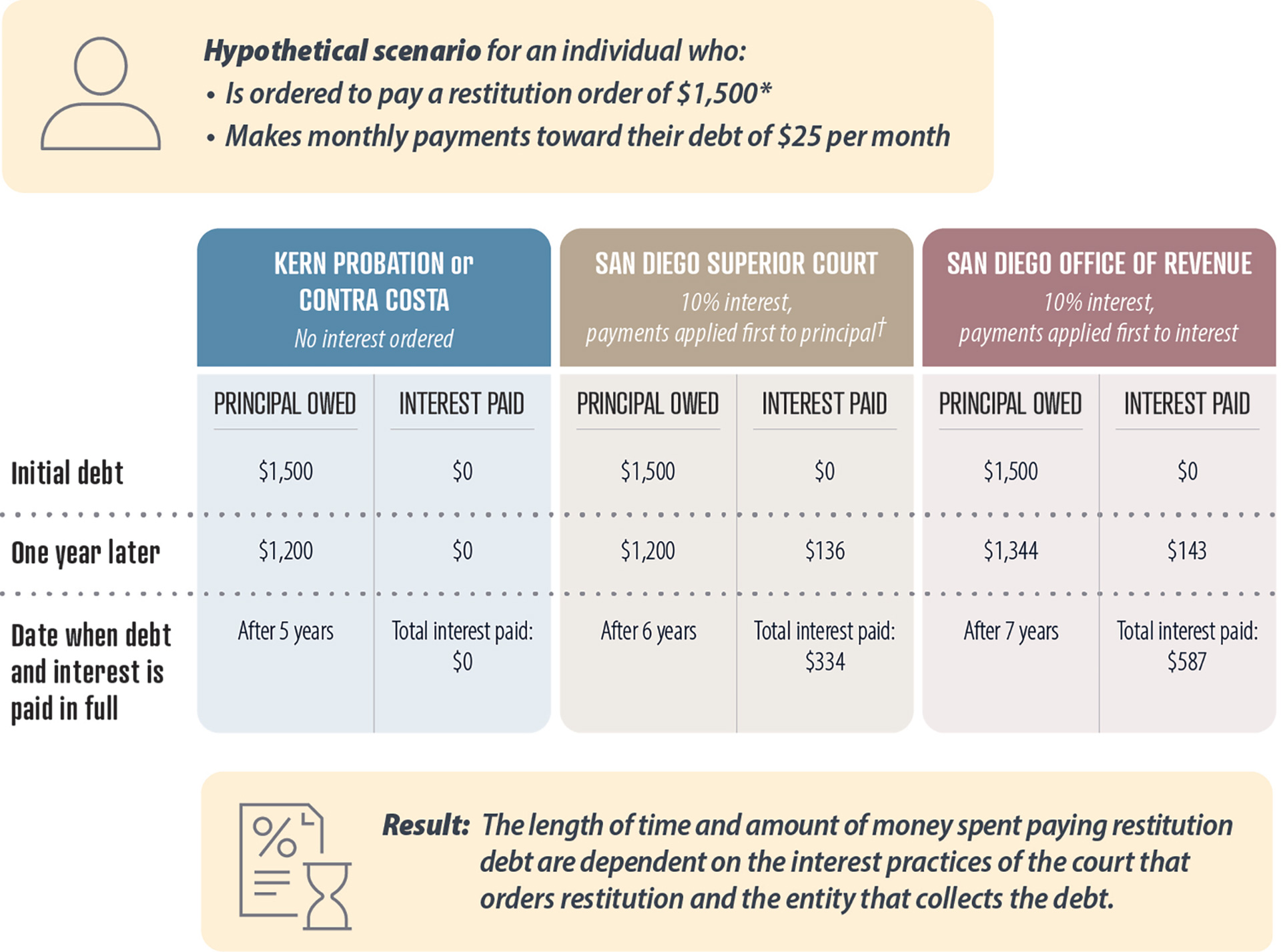
Whether courts order interest has consequences for both victims and individuals convicted of crimes. We found that the local collection entities we reviewed that collected interest disbursed it to victims. However, victims may not receive interest if a court does not order it. On the other hand, the debt of individuals convicted of crimes grew differently depending on the county in which they received their restitution order. Figure 9 demonstrates the difference in individuals’ payments over time, depending on whether their restitution order includes interest.
Figure 9
A Local Collection Entity’s Approach to Applying Interest Significantly Affects the Amount of Restitution an Individual Must Pay
Source: Local collection entities’ forms and manuals, interviews with staff, and San Diego Office of Revenue’s data as applied to a hypothetical example.
* The median restitution order for San Diego’s Office of Revenue is $1,500. The median restitution order for Contra Costa is $1,650. We do not have a median order amount for Kern Probation. To allow for comparison, we selected a single amount to use as the basis of our calculations.
† As of February 2026, San Diego Superior Court’s new Case Management System applies payments first to interest.
Figure 9 illustrates how the amount of restitution an individual pays varies depending on the interest practices of the entity collecting the debt. The figure compares how the debt of a hypothetical person owing $1,500 and paying $25 per month would vary based on the policies of the local collection entity. The figure demonstrates that the total amount of money paid and the length of time required to satisfy restitution depend on the interest policies of the ordering court and the collecting entity.
Under Kern Probation or Contra Costa, which do not order interest, the hypothetical individual pays no interest and finishes paying $1,500 in five years. Under the San Diego Superior Court, which also charges 10 percent interest but applies payments first to principal, the individual pays $334 in interest and finishes in six years. Under the San Diego Office of Revenue, which charges 10 percent interest and applies payments first to interest, the individual pays $587 in interest and finishes paying the debt in seven years.
The sources for this figure are local collection entities’ forms and manuals, interviews with staff, and San Diego Office of Revenue’s data as applied to a hypothetical example.
Researchers and legal advocates have found that individuals who must pay interest on their restitution orders often find such additional accruals paralyzing because they struggle to see their progress in paying down the principal of their debt. In fact, depending on how a judge structures an individual’s payment plan, individuals may instead see their outstanding balance grow rather than fall, as we show in Figure 10. Conversely, if individuals who owe restitution orders do not make interest payments, victims do not receive the full amount that the law intends.
Moreover, in counties where restitution orders included interest, individuals paid different amounts of interest depending on whether the local collection entity applied payments first to principal or to accrued interest. Unless otherwise specified, court‑ordered debt accrues simple rather than compound interest. The financial industry norm when dealing with debt is for a creditor to apply any payments first to accrued interest and then to principal. This can extend the payment period and increase the total balance due, especially if an individual’s payments are insufficient to cover interest costs. For example, if an individual owes $1,500 for a restitution order and makes $25 monthly payments, for the first year, $12 of their payment will go to paying interest and only $13 will go to paying down the principal. This is how the San Diego Office of Revenue, the entity largely responsible for collecting felony‑related restitution in San Diego County, has applied payments, as Figure 9 shows. If the initial debt is $3,500, as Figure 10 shows, a $25 monthly payment will not cover the monthly interest charge, and the debt will continue to grow.
Figure 10
Example Where Interest on Outstanding Balance Can Exceed Monthly Payment Despite an Individual Who Owes Restitution Adhering to Court Approved Payment Plan

Source: Court orders and procedural documents from San Diego Superior Court and Office of Revenue.
Figure 10 shows a hypothetical case in which an individual is ordered to pay $3,500 in restitution and is placed on a court‑approved payment plan requiring $25 per month. At sentencing, the outstanding principal is $3,500 and no interest has accrued yet. After one year of regular payments, the outstanding principal remains $3,475, outstanding interest totals $73, and the total debt is $3,548. By the end of year five, despite consistent payments, the outstanding principal remains $3,475 and accumulated interest reaches $263, bringing the total debt to $3,738. The figure explains that because 10 percent interest continues to accrue on the remaining balance—about $30 per month—the debt can grow indefinitely even when the individual meets the court‑approved payment plan.
The sources for this figure are court orders and procedural documents from San Diego Superior Court and Office of Revenue.
In contrast, CDCR and most of the other local collection entities we reviewed have put any payments they received toward the outstanding balance of the principal.13 They calculated interest as time passed but charged the individual who owed the restitution for it only after that individual had paid off the principal. In other words, if someone paid $25 on a $1,500 debt, all $25 would go toward the principal until that principal was paid off. As Figure 9 demonstrates, it would take a individual making payments to San Diego Office of Revenue an additional year and cost them an additional $250 in interest to pay off their restitution order in comparison to an individual making the same payments to the San Diego Superior Court. Because charging interest increases the debt burden on individuals who may be already struggling financially, some states have chosen either not to mandate interest or to be more flexible in its application. For example, Washington state law requires interest, but a court may elect not to impose it when considering, among other factors, an individual’s indigence or inability to pay. Several other states, such as Vermont, Delaware, Kentucky, and New Hampshire, prohibit the imposition of interest.
Although current California state law requires courts to include interest in restitution orders, these provisions do not specify whether state and local collection entities should apply restitution order payments first to principal or to interest. Until the Legislature clarifies its intent regarding interest payment and calculation, this lack of clarity will continue to result in disparities in how much individuals who owe restitution pay and victims receive.
CDCR and the Local Collection Entities We Reviewed Do Not Follow Consistent Practices for Referring Delinquent Restitution Debt to FTB for Collection
The state and local collection entities we reviewed have different practices for referring restitution debt to FTB for collection because they have differing interpretations of state law.14 When an individual is at least 90 days delinquent in paying a court‑ordered debt of at least $100, state law authorizes courts, counties, and state agencies to refer the debt to FTB, which has the authority to collect court‑ordered debts in the same manner as delinquent income tax, including by issuing earnings withholding orders and levies. This authorization provides an alternate avenue for collection for CDCR and local collection entities when their other efforts have been unsuccessful. State law also requires that FTB’s costs be recovered from the amounts collected, which we refer to as an administrative fee. Before July 2025, the law stated the Legislature’s intent that FTB’s administrative costs not exceed 15 percent of the revenue it collected. Effective July 2025, the Legislature increased the maximum to 20 percent.
Our review found that from fiscal years 2014–15 through 2023–24, FTB collected 5.4 percent of the amount of delinquent court‑ordered debt that state and local collection entities referred to it. Because the accounts referred to FTB for collection were delinquent, the collection entities were not collecting payments for these accounts before FTB’s efforts. FTB is generally efficient in its collections. As Figure 11 shows, during the audit period, FTB spent an average of only 12 cents to collect each dollar of court‑ordered debt, which includes victim restitution orders and fines. In comparison, each of the local collection entities we reviewed spent more than $1.25 to collect each dollar of restitution.
Figure 11
The Efficiency of Restitution Collection Varies by Collection Entity
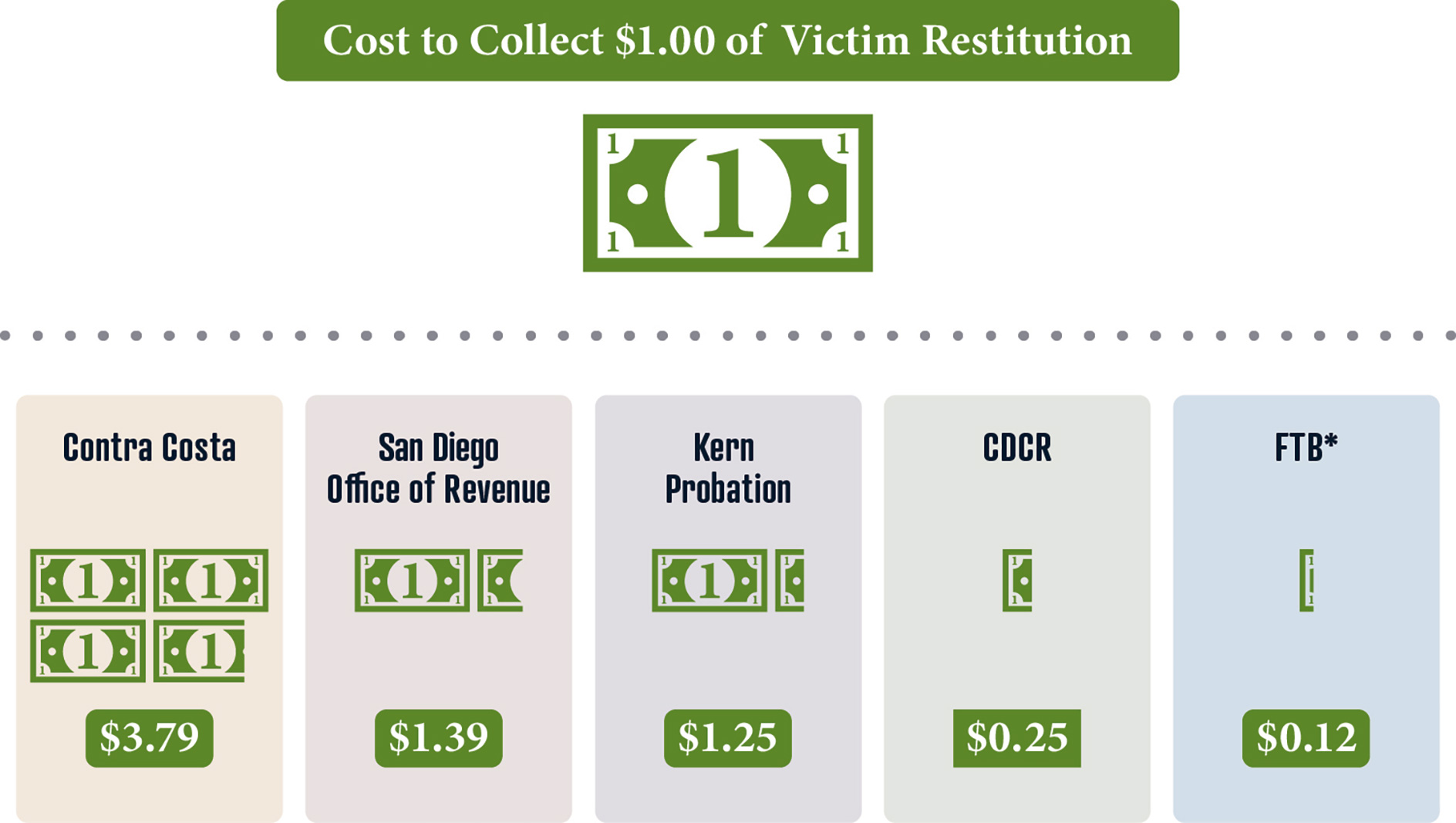
Source: Kern Probation, San Diego Office of Revenue, Contra Costa, CDCR, and FTB.
* FTB expenditures account for costs of collecting all court-ordered debt, not just debt related to restitution.
To collect $1.00 of restitution over the audit period, Contra Costa spent $3.79, San Diego Office of Revenue spent $1.39, Kern Probation spent $1.25, CDCR spent $0.25, and FTB spent $0.12. FTB expenditures account for costs of collecting all court-ordered debt, not just debt related to restitution.
However, as Figure 12 shows, the state and local collection entities we reviewed have varying policies for referring debt to FTB, selecting delinquent cases to refer, and covering the cost of FTB’s administrative fee. The law authorizes FTB to recover its administrative fee, but it does not clearly indicate whether the individual paying the debt, the victim, CDCR, or the local collection entities should ultimately bear the administrative cost of FTB’s collections.
Figure 12
The State and Local Collection Entities We Reviewed Use FTB’s Court‑Ordered Debt Collection Service Differently When Victim Restitution Orders Become Delinquent
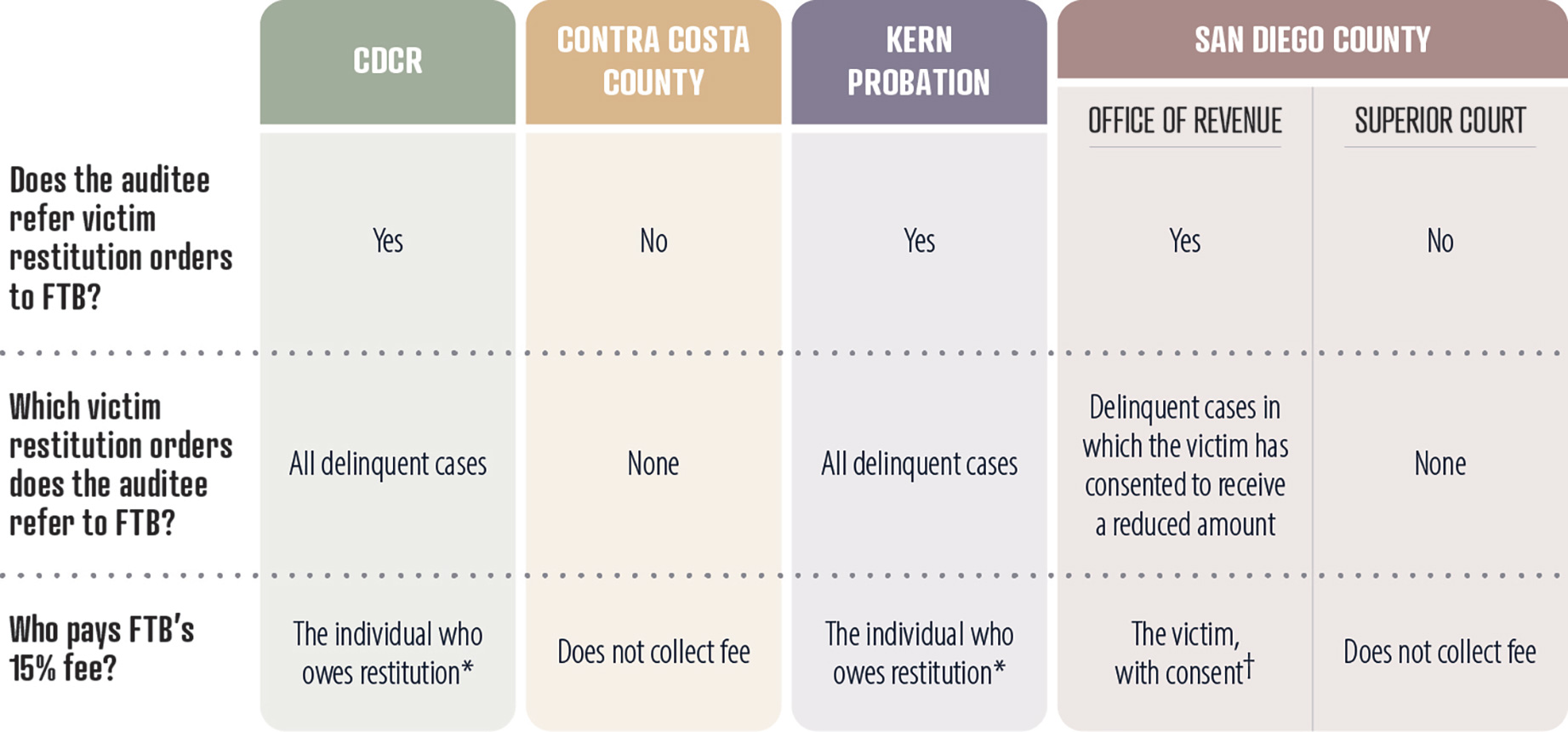
Source: Interviews with Contra Costa, San Diego Superior Court, San Diego Office of Revenue, Kern Probation, and CDCR.
* CDCR and Kern Probation increase the amount of restitution an individual must pay by the cost of FTB’s administrative fee.
† San Diego Office of Revenue seeks victim consent and reduces the amount it remits to victim by the cost of FTB’s administrative fee.
Figure 12 compares five entities—CDCR, Contra Costa, Kern Probation, the San Diego Office of Revenue, and the San Diego Superior Court—and shows how each uses FTB’s Court Ordered Debt Collection Service when restitution orders become delinquent. It summarizes whether each entity refers delinquent restitution orders to FTB, which cases they refer, and who pays FTB’s 15 percent administrative fee.
CDCR refers all delinquent restitution orders to FTB as well and increases the individual’s restitution balance to cover FTB’s administrative fee, meaning the person who owes restitution pays the additional cost.
Contra Costa does not refer delinquent restitution orders to FTB, does not send any cases, and does not charge or collect FTB’s administrative fee.
Kern Probation refers all delinquent restitution orders to FTB, and the individual who owes restitution pays FTB’s 15 percent fee because the amount owed is increased by that fee.
The San Diego Office of Revenue refers only delinquent cases where victims consent to receive a reduced amount. In these cases, the victim pays FTB’s fee by accepting a reduced restitution payment. If the victim does not consent, the case is not referred and no fee is collected.
The San Diego Superior Court does not refer delinquent restitution orders to FTB, does not send any cases, and does not charge or collect FTB’s administrative fee.
The figure shows that entities differ significantly in both the scope of referrals to FTB and in who bears the cost of FTB’s administrative fee. These differences create inconsistencies in how restitution debt is handled statewide. The source information comes from interviews with staff at the Contra Costa Superior Court, the San Diego Superior Court, the San Diego Office of Revenue, Kern Probation, and CDCR.
A series of changes to state law have resulted in ambiguity regarding who is responsible for bearing the cost of FTB’s administrative fee. Before 2022, the Penal Code allowed CDCR, courts, and counties to impose administrative fees to recover the cost of collecting restitution. According to separate state law in the Revenue and Taxation Code, the amounts local collection entities and state agencies refer to FTB may include an administrative fee and any amounts that the entity may add to the court‑imposed obligation resulting from the underlying offense, trial, or conviction. In 2021, the Governor approved Assembly Bill 177, which amended the Penal Code to repeal the authority of CDCR, courts, and counties to impose administrative fees for the collection of restitution, but it did not make any changes to the Revenue and Taxation Code provision that governs the inclusion of an administrative fee by the referring entity. As a result of these changes in law, some entities believe that they are now prohibited from adding administrative fees to the restitution amounts they refer to FTB, while others believe that they are authorized to do so.
Both CDCR and Kern Probation fall into the latter category and consequently increase the amount of the restitution order debt they refer to FTB by the value of FTB’s administrative fee. By increasing the amounts they refer to FTB, CDCR and Kern Probation ensure that after FTB retains its administrative fee, they receive enough revenue to pay victims the total amount they are owed. In these cases, the individuals convicted of the crimes bear the cost of the administrative fee.
Conversely, San Diego Office of Revenue refers the unaltered amount of its restitution orders to FTB when accounts become delinquent. Thus, victims in San Diego Office of Revenue receive the amount of the restitution order minus the cost of FTB’s administrative fee. Because the victim bears the cost of FTB’s administrative fee, San Diego Office of Revenue seeks permission from victims before referring delinquent restitution order cases to FTB. Following yet a third interpretation of the law, Contra Costa Superior Court believes that it is not allowed to reduce the amount a victim receives nor increase the amount the individual owes by FTB’s administrative fee. Thus, it does not refer victim restitution orders to FTB’s collection service. According to Contra Costa officials, if the court were to refer delinquent restitution order debt to FTB, it would have to bear the cost of FTB’s administrative fee itself. The finance director at Contra Costa Superior Court also stated that the court could send more restitution order cases to FTB and improve its collection efforts if it had a funding source to pay this administrative fee.
Because of these differing interpretations and practices, an individual owing restitution through Kern Probation or CDCR may pay fees in addition to the restitution order, a victim in San Diego may receive less than the restitution ordered, and a victim in Contra Costa County may not benefit from FTB’s ability to collect delinquent restitution. To address the disparate outcomes caused by these different interpretations of state law, we recommend that the Legislature clarify which party or entity—the individual convicted of the crime, the victim, or the referring entity—should bear responsibility for the cost of FTB’s administrative fee.
Finally, local entities that do not refer delinquent restitution orders to FTB may experience higher collection costs. The cost of indefinitely collecting restitution debt is high: from fiscal years 2021–22 through 2023–24, Contra Costa spent more than $6 million collecting from individuals after their probation was complete—more than six times as much as it spent collecting from individuals still serving probation. As of January 2026, Contra Costa was overseeing restitution order collection for nearly 5,000 individuals who had completed probation. These individuals owed more than $70 million to more than 6,000 victims. As shown in Figure 11, Contra Costa also spent more to collect each dollar of restitution than any other state or local collection entity we reviewed, incurring costs that were more than 31 times what FTB spent per dollar collected. If local collection entities referred restitution debt to FTB after individuals’ probation ended, more victims could receive more restitution and that restitution could be collected more efficiently.
The San Diego Superior Court Improperly Charged Individuals With Convictions a Fee for the Third‑Party Collection of Debt
Despite legislative reforms in 2022 that removed local collection entities’ authority to charge administrative fees related to collecting restitution order and fine debt, the San Diego Superior Court allowed the private collections agency with which it contracts to collect an administrative fee from individuals who were delinquent on their debt. While both the Contra Costa Superior Court and the San Diego Superior Court contract with private collections agencies, the Contra Costa Superior Court pays the private collections agency’s invoices itself, while the San Diego Superior Court passed the costs on to the individuals who owe the debts.
The San Diego Superior Court, which largely collects restitution order debt related to misdemeanors, uses a private collection agency (contractor) to collect delinquent court‑ordered debt, including restitution. It contracts through a master agreement between the contractor and the JCC. When an individual is more than 30 days late in making a restitution order or fine payment, the court transfers the account to its contractor. According to the contract, the contractor may only invoice the court for its fee after a restitution order is paid in full. Because the San Diego Superior Court believes a victim must receive 100 percent of the restitution order amount, it instructed the contractor to collect its fee from the individual convicted of a crime after that individual had fully paid the restitution they owed.
As a result of this practice, individuals who became delinquent on restitution orders or fines they were supposed to pay through the San Diego Superior Court received bills for an additional 10 percent to 15 percent more than the amount of their restitution orders and fines. In the last three years, the San Diego Superior Court has referred 1,160 delinquent restitution orders to the contractor for collections. Of those, 81 individuals fully paid their delinquent restitution orders through the contractor, resulting in the contractor charging them more than $10,000 in administrative fees.
When we brought this concern to the court’s attention, court staff reached out to the contractor, who agreed that this practice was counter to the legislative reforms implemented in 2022. Court staff and the contractor attributed the continuation of the fee to an inadvertent oversight by multiple parties involved in the process. The contractor will cease imposing and collecting any such fees in the future. In addition, the court instructed the contractor to refund individuals for any fees it collected since 2022.
Recommendations
Legislature
To facilitate CDCR’s ability to ensure that the restitution order payments it collects reach more victims, the Legislature should consider amending state law to require local collection entities—including superior courts, probation departments, and district attorneys’ offices—to provide CDCR with victim contact information for the sole purpose of disbursing court‑ordered restitution payments, unless the victim objects to this information sharing.
In consideration of the additional burden that the charging of interest on restitution orders places on individuals convicted of crimes, the Legislature should consider revising state law to end or reduce the charging of interest. If the Legislature determines that repealing the provision requiring interest will require a constitutional amendment, it should refer the question to the voters.
If the Legislature continues to require interest, it should consider doing the following to ensure that courts and local collection entities are applying interest consistently and fairly:
- Amend state law to authorize state and local collection entities to apply 10 percent interest to all restitution orders regardless of whether a judicial order expressly includes it.
- Specify how collection entities should calculate and apply interest. For example, it could require local collection entities to calculate interest on the outstanding principal only, to apply payments to only the principal until it is paid off, and then to apply payments to the accumulated interest. This practice would result in a shorter time to full repayment. Alternately, local collection entities could follow standard financial practices and apply payments to interest and then to the outstanding principal, resulting in more interest paid to the victim.
To facilitate consistency and equity in the collection of restitution orders, the Legislature should consider doing the following:
- Require CDCR and local collection entities to refer delinquent restitution orders and fines to FTB.
- Determine whether state and local collection entities should address FTB’s costs in one of the following ways:
- By passing costs to the individual who owes restitution by increasing the amount of the restitution order to cover FTB’s administrative fee.
- By passing costs to the victim—with the victim’s consent—by allowing FTB’s administrative fee to be paid from the restitution order amount.
- By paying FTB’s administrative fee from its own funds or through a Legislative appropriation.
Local Collection Entities Statewide That Use Private Collection Firms
To comply with state law and to ensure that individuals convicted of crimes are not inappropriately charged for amounts associated with collecting restitution fines and orders, California courts and other local collection entities should review their practices to ensure that they are not charging such individuals for private collection agency commissions or fees.
CalVCB Has Generally Provided Valid Legal Reasons for Denying Victim Compensation Claims
Key Points
- In fiscal year 2024–25, the Restitution Fund received more than $79 million in revenue and spent $82.2 million, with the agency’s reserves making up the deficit. The Restitution Fund receives revenue from multiple sources, one of which is the State’s General Fund. It will need continued funding from the General Fund for the foreseeable future to remain solvent.
- When CalVCB processes claims for victims’ compensation, it uses state law to determine whether a victim’s claim is eligible for compensation. Our review of denied victim compensation claims found that CalVCB complied with state law when making such determinations.
To Remain Solvent, the Restitution Fund Will Continue to Require Appropriations From the State’s General Fund
As we explain in the Introduction, CalVCB is responsible for administering the Restitution Fund and for using the fund to provide compensation to victims. Compensation differs from restitution orders in several ways. Specifically, only CalVCB can approve and pay compensation claims submitted by victims, while courts impose restitution orders. Like restitution orders, compensation payments help eligible victims of qualifying crimes pay for expenses that directly result from those crimes. However, unlike with restitution orders, victims may be eligible to receive financial assistance even before an individual is sentenced and ordered to pay restitution. Additionally, CalVCB is the payor of last resort, which means that victims are only compensated for expenses that have not been and will not be reimbursed from any other source, such as insurance.
In addition to its responsibilities related to the compensation process, CalVCB serves as the pass‑through agency for restitution orders collected by CDCR. CDCR collects payments on the restitution orders from individuals under its supervision, then submits those payments to CalVCB. CalVCB in turn disburses those payments to the victims. However, if CalVCB receives restitution order payments and does not have valid contact information for a victim, CalVCB holds the victim’s funds in trust until the end of the subsequent fiscal year, after which time the funds revert to the Restitution Fund. State law allows a victim to come forward at any time to claim those funds after that point, and CalVCB is required to disburse them.
Restitution Fund Revenue
As Figure 13 shows, the Restitution Fund had multiple revenue sources in fiscal year 2024–25. In that year, the fund received more than $79.1 million in revenue and spent $82.2 million, with the agency’s reserves making up the deficit. The Restitution Fund’s largest single source of revenue was restitution fines that judges imposed, which accounted for $36 million. Other sources of revenue included unclaimed checks and warrants, fines from DUIs, and private donations.
Figure 13
The Restitution Fund Has Many Sources of Revenue, and CalVCB Spends It on Victims’ Compensation, Administrative Expenses, and Other Programs
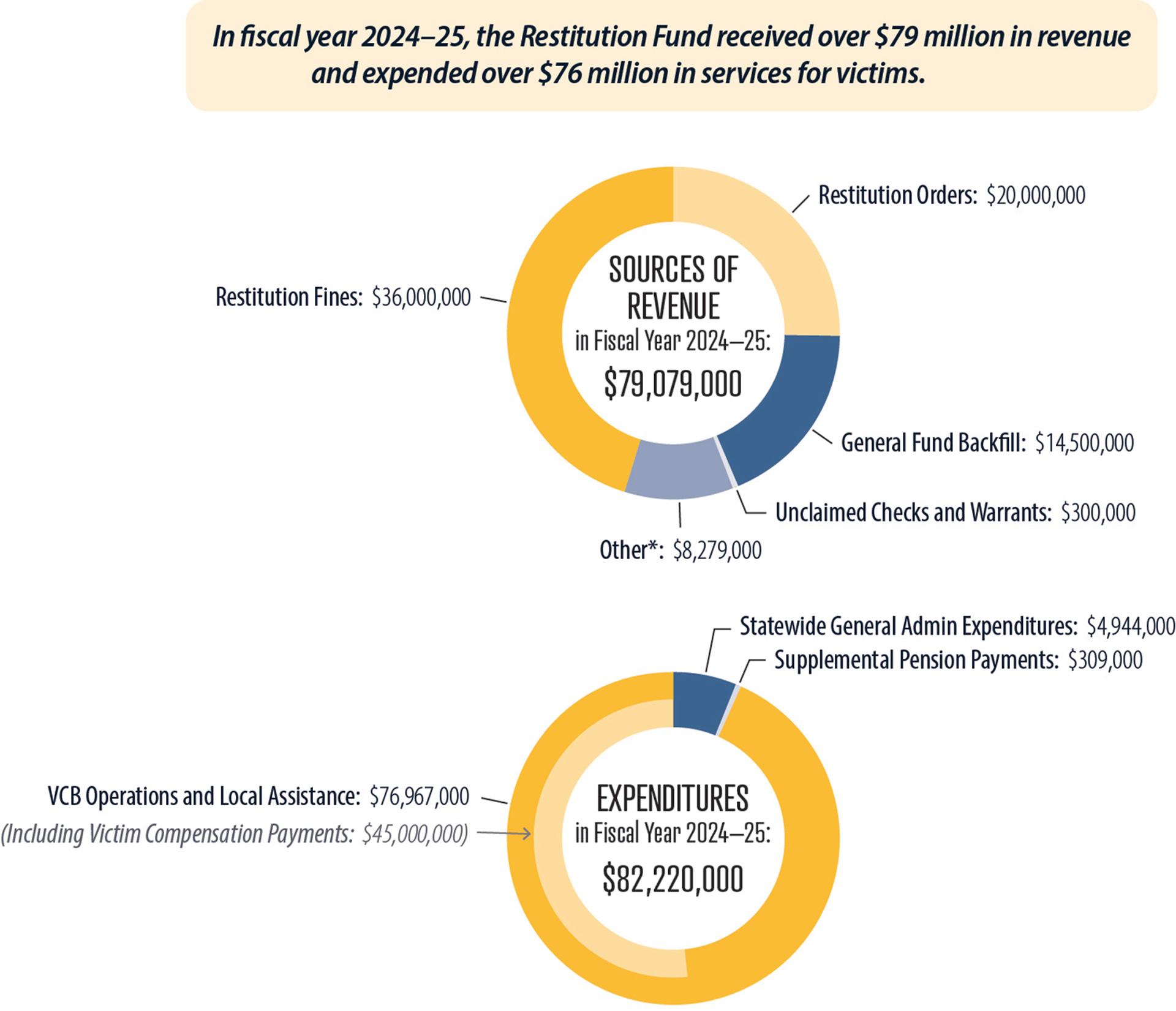
Source: CalVCB Fund Condition statements, restitution order pass-through data, victims’ compensation payment data, and administrative expenses data.
* Other sources of revenue include investments, fines from DUIs, and transfers from other funds.
Figure 13 shows that the Restitution Fund had $79,079,000 in total revenue and $82,220,000 in total expenditures in fiscal year 2024–25. The figure presents separate summaries of revenue sources and spending categories.
The revenue sources include $36,000,000 from restitution fines, $20,000,000 from restitution orders, $14,500,000 from a General Fund backfill, $8,279,000 from other miscellaneous sources such as investments, DUI‑related fines, and transfers from other funds, and $300,000 from unclaimed checks and warrants.
The expenditure categories include $76,967,000 for VCB operations and local assistance, which itself includes $45,000,000 in victim compensation payments. Additional spending includes $4,944,000 for statewide general administrative expenditures and $309,000 for supplemental pension payments.
The figure highlights that although the Restitution Fund received over $79 million that year, it spent more than $76 million on direct services and support for victims.
In addition, in fiscal year 2024–25, the Restitution Fund also received a $14.5 million transfer from the State’s General Fund. The Legislature has provided the Restitution Fund with an annual average of $30 million in General Fund support to backfill its declining revenue since fiscal year 2020–21, as Figure 14 shows. According to staff at CalVCB, the agency received less funding in fiscal year 2024–25 because it had sufficient reserves at the time. Staff at CalVCB noted that without continued funding from the State’s General Fund, the Restitution Fund would become insolvent; consequently, these transfers will need to continue into the future, as Figure 15 illustrates.
Figure 14
The Restitution Fund Has Received More Than $150 Million in Transfers From the State General Fund From Fiscal Year 2020–21 Through 2024–25
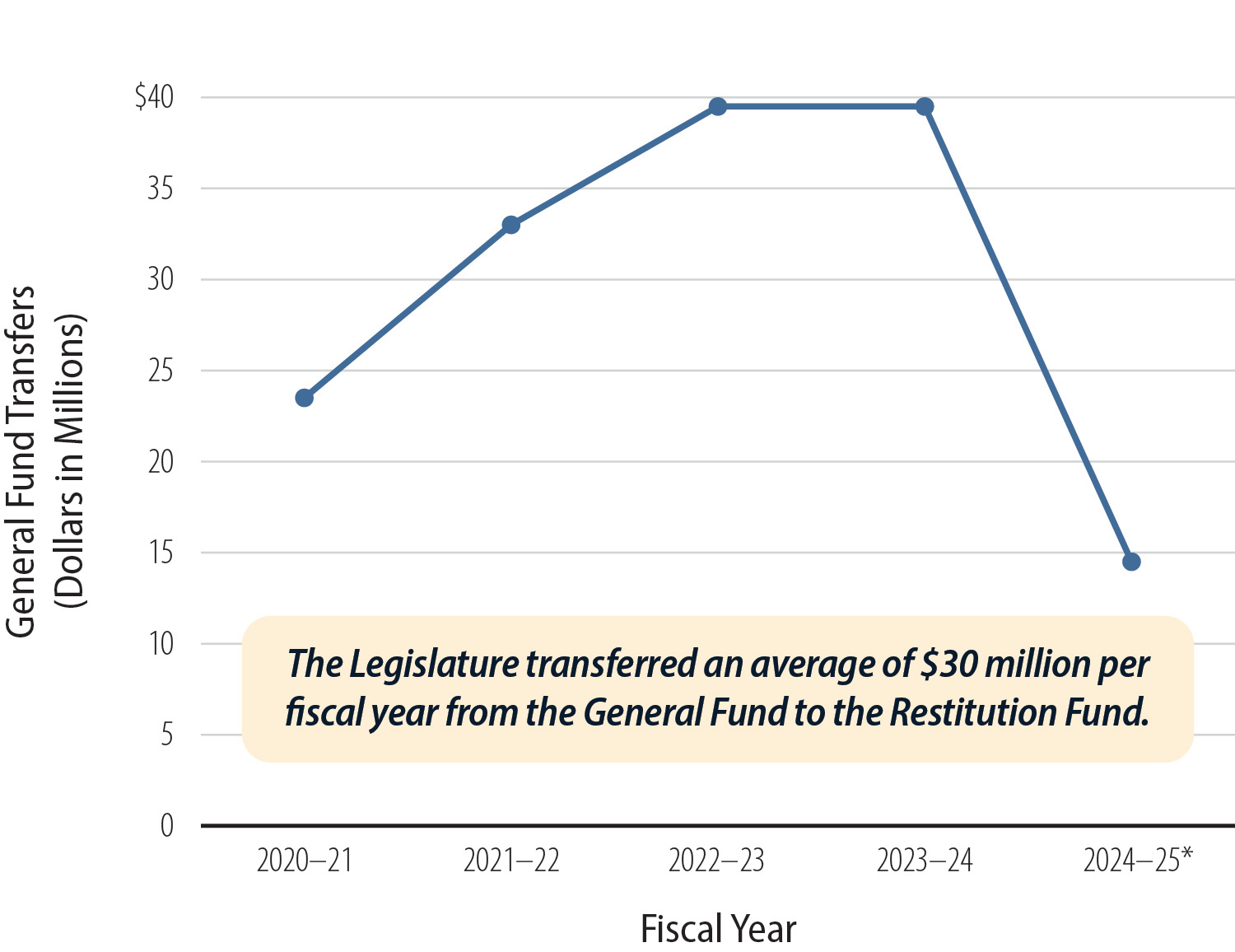
Source: CalVCB Fund Condition statements.
* In fiscal year 2024–25, the transfer from the General Fund was less than in previous fiscal years. According to CalVCB staff, this was due to having sufficient reserves.
Figure 14 displays General Fund transfers to the Restitution Fund for fiscal years 2020–21 through 2024–25. The chart shows that annual transfers generally ranged around $30 million per year. The figure notes that the Legislature transferred an average of $30 million each fiscal year during this period. It also indicates that the transfer in fiscal year 2024–25 was lower than in prior years because CalVCB had sufficient reserves. This information is based on CalVCB Fund Condition statements.
Figure 15
Without Backfill From the General Fund, the Restitution Fund Would Not Be Able to Cover Its Expenditures
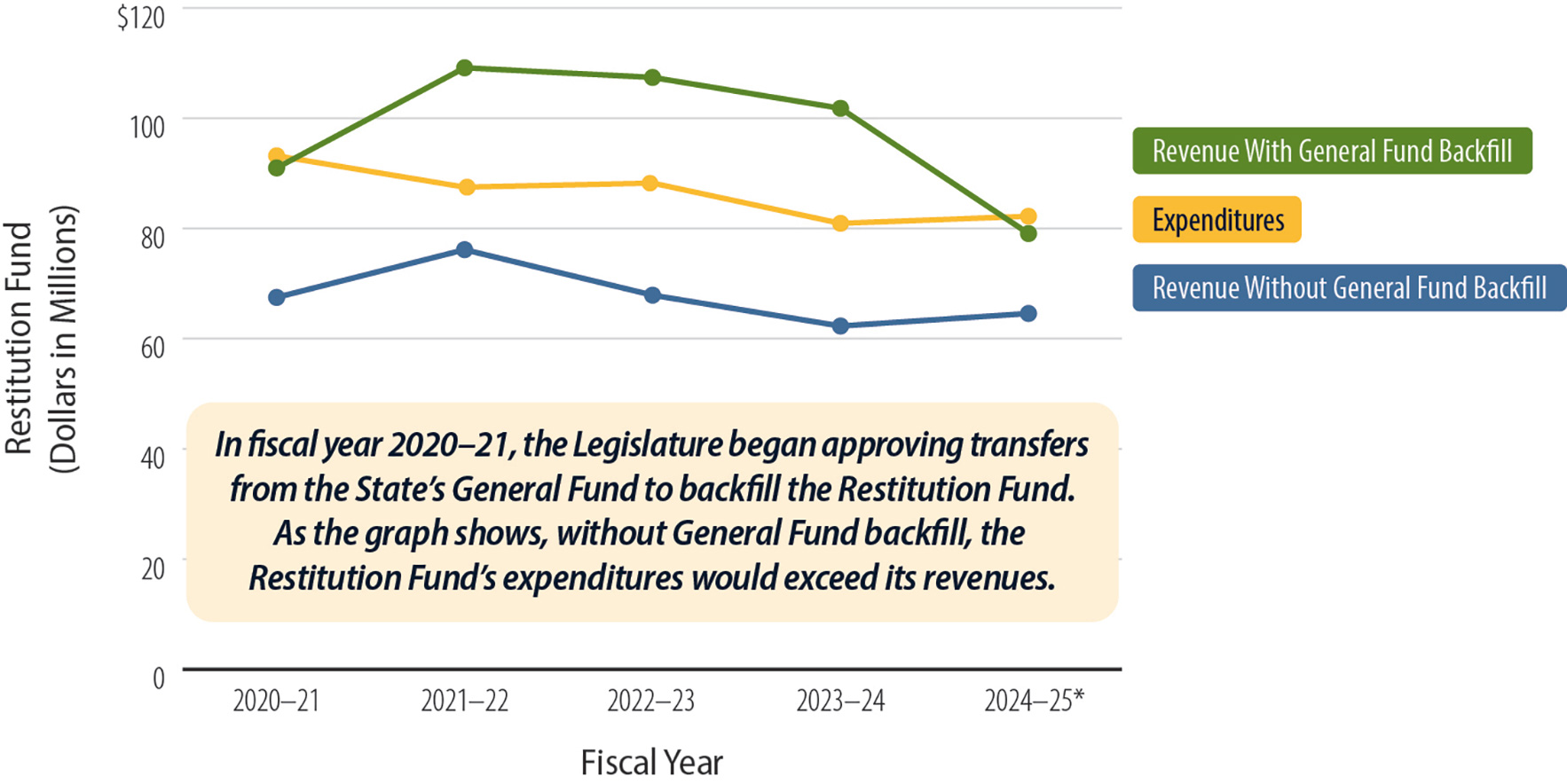
Source: Fund condition statements.
* In fiscal year 2024–25, the transfer from the General Fund was less than in previous fiscal years. According to CalVCB staff, this was due to having sufficient reserves.
Figure 15 shows the Restitution Fund’s annual revenues and expenses from fiscal years 2020–21 through 2024–25 and illustrates the impact of General Fund backfill. The figure compares revenue levels with and without backfill alongside total expenditures. It shows that beginning in fiscal year 2020–21, the Legislature started approving transfers from the State’s General Fund to supplement the Restitution Fund. The chart indicates that in every year shown, revenues without backfill would have been insufficient to cover the fund’s expenditures, whereas revenues with backfill enabled the fund to meet or exceed its costs.
The figure also notes that the General Fund transfer in fiscal year 2024–25 was smaller than in earlier years because CalVCB reported having sufficient reserves. This information is based on fund condition statements.
Restitution Fund Expenditures
In fiscal year 2024–25, CalVCB spent $45 million from the Restitution Fund on victim compensation payments out of a total of $79.3 million it had budgeted for those payments that year. In that same fiscal year, CalVCB disbursed about $5.6 million in restitution order payments to victims.
The Restitution Fund covers administrative costs for CalVCB’s Victim Compensation Division, which handles claims for victims’ compensation, as well as for CalVCB’s Restitution Recovery Unit, which is responsible for handling restitution order pass‑through payments. The Victim Compensation Division estimates that it spent about $16 million on administrative costs for more than 100 employees in fiscal year 2024–25. The Restitution Recovery Unit’s records show that in that same year, it spent about $1.1 million on administrative expenses. In total, the administrative costs for both of these divisions accounted for 11.5 percent of the Restitution Fund’s expenditures in fiscal year 2024–25, which is comparable to FTB’s administrative spending that same fiscal year. The total administrative costs for CalVCB’s divisions were similar in fiscal years 2022–23 and 2023–24—12 percent and 11.4 percent, respectively.
Because the Legislature has appropriated money from the General Fund to backfill the Restitution Fund, CalVCB’s administrative costs have not affected whether victims received compensation or the amount of compensation that CalVCB approved for victims.
CalVCB Has Generally Complied With State Law When Denying Claims
According to state law, a victim eligible for CalVCB’s victim compensation program is a person who sustains injury or death as a direct result of specified crimes, which the text box outlines. Compensation may also be paid to a derivative victim, who is a person that sustained a financial loss as a result of the direct victim’s injury or death, such as family members or caretakers. When submitting a claim, victims must supply supporting information to CalVCB, such as medical bills and police reports, to prove that an injury or qualifying crime occurred. CalVCB then verifies this information with hospitals, medical professionals, and law enforcement officials. According to CalVCB, it relies on state law for guidance and does not have its own eligibility requirements.
Victims of Qualifying Crimes, Such as Those Listed Below, May Be Eligible for Compensation
- Assault
- Murder
- Human trafficking
- Child abandonment
Source: State law.
When we reviewed a selection of denied claims for victims’ compensation, we found that CalVCB cited valid legal reasons for its denial of those claims. We selected 40 denied claims for victims’ compensation from fiscal years 2021–22 through 2023–24 and found that CalVCB denied all of them for reasons listed in statute. CalVCB denied most rejected claims because they did not provide evidence of injury or qualifying crime. According to state law, a claimant is eligible for compensation only if he or she is a victim or a derivative victim of a crime that directly resulted in physical injury or, for certain crimes, emotional injury or injury to a guide, signal, or service dog.
We also reviewed claims data from fiscal years 2014–15 through 2023–24 to determine how many claims CalVCB denied in each year. From fiscal years 2016–17 through 2019–20, CalVCB denied from 7 percent to 10 percent of claims each year, for an average of about 5,000 denials per fiscal year. From fiscal years 2020–21 through 2023–24, its denial rates increased each year: in fiscal year 2023–24, it denied almost 23 percent of claims, or about 9,300. Appendix A details the reasons for denial from fiscal years 2016–17 through 2023–24.
CalVCB explained that this increase was the result of its renewed emphasis on processing applications within its established time frames. For example, law enforcement agencies have 10 days to provide information CalVCB requests about a claimant’s police report. However, according to the deputy executive officer of the Victim Compensation Division, CalVCB analysts in the past sometimes waited much longer than the statutorily required 10 days to receive the police report before denying the claim, creating a backlog of claims over several years. To decrease its backlog, CalVCB is now denying claims if it does not receive the documentation in the required time frame. The deputy executive director of the Victim Compensation Division stated that this backlog was the result of law enforcement agencies not providing documentation to CalVCB. We observed evidence that CalVCB followed up with law enforcement agencies before denying the claims for compensation. The deputy executive officer for external affairs and compliance also mentioned that CalVCB launched an ad campaign in 2024 to increase awareness of its services and that this ad campaign may have contributed to it receiving an increased number of ineligible claims.
CalVCB’s data did not include a denial reason for almost half of the denied claims we reviewed; however, we confirmed that for a selection of 40 of those claims, the denial letters that CalVCB sent to the claimants did contain the denial reason. When we asked about the absence of denial reasons in the data, the deputy executive officer of CalVCB’s Victim Compensation Division stated that the denial letters are sent to each claimant and that these letters list the denial reason, but sometimes the denial reason does not get entered into the data system. The deputy also stated that CalVCB would enter the information in a more consistent manner in the future.
Other Areas We Reviewed
To address the audit objectives approved by the Joint Legislative Audit Committee (Audit Committee), we also reviewed the practices of other states to identify policies that could improve the efficiency and equity of restitution collection.
Unlike California, Other States Require or Permit Courts to Consider an Individual’s Ability to Pay When Setting the Amount of a Restitution Order
Other states have policies that aim to make the debt burden more manageable for individuals who owe restitution but have no ability to pay. To identify additional best practices, we reviewed the laws and policies of 30 other states. Our analysis found an emphasis on mitigating the burden of restitution debt for individuals without the means to pay. Of the 30 states we selected for review, 17 explicitly require or permit the court to consider an individual’s ability to pay. For example, Vermont, Georgia, and Washington state laws require the consideration of an individual’s ability to pay when ordering restitution. Eight states strictly prohibit doing so in statute, like California. Moreover, recent academic research has shown that legal financial obligation reductions may increase the amount of revenue collected from highly disadvantaged individuals by making the debt burden manageable.15 California state law, though, explicitly prohibits the consideration of an individual’s ability in determining the amount of a restitution order.
Data on Individuals Who Owe Restitution Orders and Fines Often Lack the Demographic Information Necessary for Further Analysis
Audit Objective 4 directed us to identify the demographic breakdown of individuals who owe restitution orders and fines and, to the extent possible, determine the effects of restitution‑related garnishments on reentry, family financial stability, and mental health. It also asks us to determine the extent that formerly incarcerated individuals are barred from parole, expungement, or employment because of unpaid restitution.16 When we reviewed the data at CDCR, and the local collection entities of Contra Costa and San Diego, we found that the data lacked some detail, such as economic status of individuals convicted of crimes or types of offense.17 Additionally, the data CDCR and these local collection entities provided us related to individuals owing restitution did not contain information related to parole or reentry from prison, expungement, employment, financial stability, or mental health conditions. Despite these limitations, we described in the first section of the report how the restitution process has impacted some victims and individuals who owe restitution. In Appendix B, for informational purposes, we present demographic breakdowns by race, age, education level, marital status, and language for restitution fines and orders as available for each entity.
We conducted this performance audit in accordance with generally accepted government auditing standards and under the authority vested in the California State Auditor by Government Code section 8543 et seq. Those standards require that we plan and perform the audit to obtain sufficient, appropriate evidence to provide a reasonable basis for our findings and conclusions based on the audit objectives. We believe that the evidence obtained provides a reasonable basis for our findings and conclusions based on our audit objectives.
Respectfully submitted,
GRANT PARKS
California State Auditor
April 16, 2026
Staff:
John Lewis, Audit Principal
Aaron Fellner, Senior Auditor
Rachel D’Agui, MA
Parris Lee
Casey Lurtz, PhD
Stephen McDaniel
Nicole Menas, MA
Emily Wilburn
Data Analytics:
R. Wade Fry, MPA
Sarah Rachael Black, MBA, CISA
Aren Knighton, MPA
Lily Nuñez, MPP
Shauna Pellman, MPPA, CIA
Legal Counsel:
Natalie Moore
Appendices
Appendix A
Application Denial Reasons, Fiscal Years 2016–17 Through 2023–24
We reviewed data for denied applications for victims’ compensation for fiscal years 2016–17 through 2023–24. We identified the reasons for denial and identified how many applications were denied for each reason per fiscal year, as shown in Table A. The majority of applications were denied for not being a qualified crime or not having evidence of injury.
Appendix B
Restitution Orders and Fines by Demographic Breakdown, Fiscal Years 2014–15 Through 2024–25
The Audit Committee directed our office to identify the demographic breakdown of individuals ordered to pay restitution by race, income level, age, and education for fiscal years 2014–15 through 2024–25. We are unable to provide a breakdown by income level because the CDCR and the audited counties do not collect this information. However, we present available demographic breakdowns for each entity in tables B.1 through B.8.
Appendix C
Payment Status and Repayment Rates for Restitution Ordered to Victims by Fiscal Year From 2014–15 Through 2024–25
The Audit Committee directed our office to determine the average length of time it takes for victims to receive restitution payment after it has been ordered. Tables C.1 through C.4 provide restitution order and payment information through fiscal year 2024–25.
Note: The tables do not reflect the entire incarcerated population, but only those individuals with restitution orders.
Appendix D
Scope and Methodology
The Joint Legislative Audit Committee directed the California State Auditor to conduct an audit of CDCR, CalVCB, FTB, and a selection of local collection entities to evaluate state and local oversight of victim restitution programs. Specifically, we examined the collection processes, fiscal efficiency, and outcomes for those involved in the restitution process. Table D lists the objectives that the Audit Committee approved and the methods we used to address them. Unless otherwise stated in the table or elsewhere in the report, statements and conclusions about items selected for review should not be projected to the population.
Assessment of Data Reliability
The U.S. Government Accountability Office, whose standards we are statutorily obligated to follow, requires us to assess the sufficiency and appropriateness of computer-processed information we use to support our findings, conclusions, or recommendations. In performing this audit, we relied on electronic data files that we obtained from San Diego Revenue, CDCR, Contra Costa Superior Court, and FTB. To evaluate these data, we reviewed information about the data, interviewed staff knowledgeable about the data, and conducted electronic testing of key data elements. As a result of our work, we found that these data were of undetermined reliability for the purposes of calculating statistics for the number and amount of restitution ordered and collected and associated fees. Although we recognize that these limitations may affect the precision of the numbers we present, there is sufficient evidence in total to support our audit findings, conclusions, and recommendations.
Response
California Government Operations Agency
DATE: March 26,2026
TO: Grant Parks, California State Auditor
FROM: Nick Maduros, Secretary
SUBJECT: California State Auditor Draft Audit Report 2025-117
Franchise Tax Board’s Victim Restitution
Pursuant to the above audit report, enclosed are the Franchise Tax Board’s comments pertaining to the results of the audit.
The Government Operations Agency would like to thank the California State Auditors for its comprehensive review. The results provide us with the opportunity to better serve our clients and protect the public.
Franchise Tax Board
03.26.2026
GRANT PARKS
CALIFORNIA STATE AUDITOR
621 CAPITOL MALL, SUITE 1200
SACRAMENTO, CA 95814
Re: Response to California State Auditor’s Report 2025-117 Victim Restitution
Thank you for the opportunity to respond to the California State Auditor’s (state auditor) Report No. 2025-117. There were no recommendations for Franchise Tax Board (FTB). However, there are recommendations to the Legislature that will have an impact on FTB should they be executed.
FTB’s Response:
RECOMMENDATIONS:
RECOMMENDATION #1: Require CDCR and local collection entities to refer delinquent restitution orders and fines to FTB.
FTB’s Response #1: FTB does not have a response.
RECOMMENDATION #2: Determine whether state and local collection entities should address FTB’s costs in one of the following ways:
- By passing costs to the individual who owes restitution by increasing the amount of the restitution order to cover FTB’s administrative fee.
- By passing costs to the victim- with the victim’s consent- by allowing FTB’s administrative fee to be paid from the restitution order amount.
- By paying FTB’s administrative fee from its own funds.
FTB’s Response #2: The proposed option “c” may shift funding responsibilities, require system updates, and create operational and financial impacts for FTB/COD, as well as increased administrative duties for participating agencies. If the proposal advances as scoped, additional funding may be required to implement necessary system changes and address these impacts.
CONCLUSION
In closing, FTB appreciates the efforts of the auditor, and the opportunity to partner with you to complete this review.
Sincerely,
Selvi Stanislaus, Executive Officer
cc: Nick Maduros
Tel 916.845.4543
Fax 916.845.3191
ftb.ca.gov
Footnotes
- Some individuals who have been victims of criminal activity prefer the term survivor. However, we use victim in this report to align with the language used in state law and by the California Victim Compensation Board. State law defines victims as people who suffer physical, psychological, or financial harm as the result of a crime or an attempted crime. The term victim may encompass both the crime’s direct victim and the direct victim’s spouse, parent, child, sibling, or guardian. ↩︎
- San Diego Superior Court can provide the total amount of restitution collected each year, but that total would include restitution on orders from all years prior. ↩︎
- Some individuals who have been victims of criminal activity prefer the term survivor. However, we use victim in this report to align with the language most commonly used in state law and by CalVCB. State law defines victims as people who suffer physical, psychological, or financial harm as the result of a crime or an attempted crime. The term victim may encompass both the crime’s direct victim and the direct victim’s spouse, parent, child, sibling, or guardian. ↩︎
- In 2019, the California Legislature passed, and the Governor vetoed, Assembly Bill 927, which would have required courts to find that a defendant had the ability to pay before imposing criminal fines, fees, and assessments, including restitution fines but excluding restitution orders. ↩︎
- This report focuses on the restitution process for adults. The Legislature eliminated restitution fines for juveniles commencing in January 2025. ↩︎
- State law also mandates that CDCR collect payment for restitution orders and fines from any individuals who are or were formerly under its jurisdiction that received monies awarded by trial or settlement as a result of successful civil action against CDCR. ↩︎
- These legislative changes do not impact FTB’s ability to withhold its administrative fee. ↩︎
- CDCR noted that the legislation did not provide funding for CDCR. ↩︎
- Although courts are required to make payment of restitution orders a condition of probation, state law provides that probation can be revoked for nonpayment only if an individual has the ability to pay and willfully fails to do so. ↩︎
- Due to the outdated nature of Kern Probation’s data system, it is not possible to know the percentage collected out of the amount imposed in a given year. ↩︎
- Postrelease Community Supervision (PRCS) is a community supervision program, established by the Postrelease Community Supervision Act of 2011, that places individuals released from CDCR institutions—after serving a term in prison for certain offenses, such as non‑serious or non‑violent felonies—under the supervision of county probation instead of state parole. It aims to reduce recidivism through community‑based supervision for up to three years. ↩︎
- State law requires the victim’s consent for the probation department to send the victim’s contact information to CDCR but generally allows district attorneys to send this information if the victim does not object. ↩︎
- When the Kern Probation Department receives a rare court order that includes interest, they calculate 10 percent interest on the outstanding balance annually and add the resulting interest charge to that balance. This results in interest compounding across the years it takes an individual to pay off their restitution order. Staff at Kern Probation stated that they only receive orders that include interest once a year or so. ↩︎
- This section concerns referral specifically to FTB’s court‑ordered debt collection service and does not include any other FTB collection programs. ↩︎
- Samuel Norris and Evan K. Rose, “Laffer’s Day in Court: The Revenue Effects of Criminal Justice Fees and Fines,” University of Chicago, Becker Friedman Institute for Economics, Working Paper No. 2023‑137, October 23, 2023, accessed October 16, 2025. ↩︎
- According to state law that went into effect on January 1, 2023, courts must not deny individuals’ petitions for relief, including expungement, on the grounds of an unpaid order of restitution or restitution fine. ↩︎
- The limitations of Kern Probation’s data system prohibit us from presenting the demographics of individuals who owe restitution fines and orders. ↩︎