

2024-109 California Department of Housing and Community Development
Increased Support Is Critical for Local Jurisdictions to Complete Timely Housing Plans
Published: January 15, 2026Report Number: 2024-109
January 15, 2026
2024‑109
The Governor of California
President pro Tempore of the Senate
Speaker of the Assembly
State Capitol
Sacramento, California 95814
Dear Governor and Legislative Leaders:
As directed by the Joint Legislative Audit Committee, my office conducted an audit of the California Department of Housing and Community Development (HCD) to evaluate its oversight of cities’ and counties’ (local jurisdictions) submissions of housing elements and HCD’s procedures for reviewing housing elements. HCD interprets the housing element law and determines whether local jurisdictions’ housing elements substantially comply with it. HCD then issues findings letters to local jurisdictions to notify them of its compliance determination, but the law does not require these letters to provide prescriptive instruction for achieving compliance.
We found that HCD’s findings letters generally provide valuable feedback to local jurisdictions; however, jurisdictions that are struggling to develop compliant housing elements also require individualized assistance. The complexity of new legal requirements, increased housing allocations, and community resistance to new development, mean that most local jurisdictions required multiple submissions and significant time to achieve compliance during the sixth housing element cycle. HCD met legal deadlines for reviewing submissions for 10 selected local jurisdictions, but those jurisdictions told us that individualized assistance from HCD was important to help them understand and address the department’s findings. Although HCD offers detailed online guidance to help jurisdictions, it did not always release this guidance in a timely manner.
Staff availability during its peak workload constrained HCD’s ability to provide important individualized assistance to local jurisdictions. Even with HCD’s comprehensive training program for new reviewers and reliance on experienced secondary reviewers to ensure consistency, turnover and overlapping submission deadlines have strained its capacity. To improve the housing element review process, we recommended that HCD conduct a workforce analysis and implement more consistent communication practices, and the Legislature could consider staggering submission deadlines to reduce HCD’s workload surges.
Respectfully submitted,
GRANT PARKS
California State Auditor
Selected Abbreviations Used in This Report
| ABAG | Association of Bay Area Governments |
| AFFH | Affirmatively Furthering Fair Housing |
| COG | Councils of Governments |
| HCD | California Department of Housing and Community Development |
| PLHA | Permanent Local Housing Allocation |
| SCAG | Southern California Association of Governments |
Summary
Results in Brief
Over the course of the past decade, California has experienced a housing supply crisis. The consequences for the State’s residents have been significant: many are struggling with financial vulnerability and homelessness. Cities and counties—which this report refers to as local jurisdictions—play a critical role in responding to this crisis. Since 1969, state law has required local jurisdictions to develop and implement strategies to address their housing needs across all income levels through housing elements. These housing elements are a part of the jurisdictions’ general plans, which are blueprints for growth that also address issues such as transportation, noise, and safety. Housing element law provides broad requirements that accommodate all the diverse local jurisdictions throughout the State. The California Department of Housing and Community Development (HCD) interprets, applies, and determines whether housing elements comply with the housing element law but cannot dictate to local jurisdictions how they specifically choose to achieve compliance. The broad requirements that maintain local discretion create a dynamic of power sharing between the State and local jurisdictions that necessitates a dialogue during the review process.
Most local jurisdictions must revise their housing elements at least every eight years—a length of time referred to as a cycle. Most local jurisdictions are currently either in the process of completing or recently completed their sixth-cycle update. During each cycle, HCD is responsible for reviewing the local jurisdictions’ revisions to determine whether they comply with state law requirements, which we discuss in the Introduction. Local jurisdictions that fail to adopt HCD-approved, revised housing elements can face significant consequences, such as legal challenges, condensed rezoning timelines, and ineligibility for some sources of funding.
Given the complexity of the process for housing development planning, most local jurisdictions must submit two or more drafts to HCD during each cycle before the department is able to determine that the drafts comply with state law and the local jurisdiction adopts its compliant housing element. This submission and approval process was particularly lengthy during the sixth cycle. During this cycle, the median time from which a jurisdiction submitted its initial draft housing element until it received HCD’s approval was more than one year, a 126 percent increase in duration compared to the fifth cycle. Nevertheless, we found that HCD met its statutory deadlines for reviewing and providing its determinations to the 10 jurisdictions we selected for review. Instead, the longer approval process was generally due to the time local jurisdictions needed to revise their housing elements because of factors such as new legal requirements, community opposition to building new housing, and the increase in new housing unit allocations from the State that local jurisdictions must plan for in their housing elements.
To help local jurisdictions develop compliant housing elements, HCD provides three types of assistance: formal letters in response to local jurisdictions’ draft housing elements that detail the department’s findings (findings letters); one-on-one meetings and correspondence directly with local jurisdictions (individualized assistance); and online guidance and resources. Although the housing element law requires HCD to report its findings to local jurisdictions in writing, it does not require these findings letters to provide local jurisdictions with guidance or prescriptive instruction on how to achieve compliance. HCD’s findings letters typically include a citation to the relevant section of state law, an explanation of the requirements of that section, and some additional examples and suggestions for how the local jurisdiction might meet the requirements. We determined that the HCD findings letters we reviewed are precise, measurable, and based on criteria—that is, supported by law or online guidance. However, we identified one instance in which HCD did not use consistent language to indicate to a local jurisdiction what was a requirement and what was a suggestion. Nevertheless, we found that HCD generally used consistent feedback between jurisdictions for similar findings. Although we determined that HCD’s findings letters provide meaningful, precise feedback that is supported in law or guidance, HCD should also provide individualized assistance to jurisdictions who are struggling to develop compliant housing elements. Specifically, eight of the 10 local jurisdictions expressed the sentiment that the letters alone were not sufficient to allow them to understand how to address HCD’s findings and develop a compliant housing element. Both HCD and many of the local jurisdictions emphasized the importance of individualized assistance. This assistance provides the opportunity for local jurisdictions to work with HCD to resolve complex findings. Nine of the local jurisdictions we interviewed indicated that individualized assistance, in combination with the findings letters, helped them address HCD’s findings. However, HCD’s high workload prevents it from always providing such support.
HCD also publicly provides detailed online guidance but did not always issue timely guidance. HCD currently provides many different forms of online help to local jurisdictions, including requirements for each section of the housing element, explanations of state law, sample analyses, templates, and checklists. However, HCD did not issue comprehensive guidance for two significant changes in law in a timely manner. In these cases, guidance was not issued until after some local jurisdictions had already passed their deadlines for addressing those changes. HCD management explained that the timelines for releasing guidance vary greatly depending on the significance and complexity of the changes in law.
HCD’s data indicate that from 2021 through 2023—when local jurisdictions submitted the majority of their draft housing elements for the sixth cycle—HCD’s turnover rate for reviewers ranged from 11 percent to 48 percent. This inconsistent turnover, driven in part by increased workload and housing element complexity, can strain HCD’s ability to provide sufficient support to local jurisdictions.
Although it has developed a comprehensive, multiphase training program for new housing element reviewers, HCD relies heavily on experienced secondary reviewers to ensure consistent feedback. Although the five reviewers we interviewed reported having completed the initial training phase, four of them did not participate in the cohort training that HCD identifies as the second phase. HCD indicated that all new housing element reviewers are, at minimum, expected to watch the training videos—phase one of initial training—and to receive training with their supervisors before beginning to conduct reviews. HCD requires that a secondary reviewer review all findings letters before they are sent to their respective jurisdictions, which helps ensure consistency in its findings letters, including those written by primary reviewers who have not completed cohort training before they begin performing reviews.
To address these findings, we have made recommendations to the Legislature to better stagger the deadlines for jurisdictions to submit housing elements, reducing spikes in HCD’s workload so it is able to give local jurisdictions the individualized assistance they need. We also recommended that HCD develop or revise its policies to ensure that it offers regularly scheduled meetings to local jurisdictions after they have received findings letters and that it publishes guidance in a timely manner.
Agency Comments
HCD agreed with our recommendations but indicated that it would only be feasible to provide guidance on new laws before they take effect if the Legislature implements our recommendation to include a transition period for new housing element law—such as delaying the effective date of a law enacted during a planning cycle.
Introduction
Background
In a 2016 report1, California ranked 49th out of 50 states in housing units per capita. The report further estimated that the State was losing $140 billion per year in output from missing construction investment and other missing consumption because of its housing shortage. The State’s shortage of housing has had significant consequences for residents of California. As Figure 1 shows, this housing crisis has contributed to Californians’ growing financial vulnerability, has increased homelessness, and has led some individuals to leave the State.
Figure 1
California’s Housing Crisis Has Widespread Consequences

Source: HCD, the U.S. Department of Housing and Urban Development, and the Public Policy Institute of California.
Figure 1 is a graphic with three sections depicting the consequences of California’s housing crisis: homelessness, financial vulnerability, and departure from the State. The first section discusses homelessness and indicates that, in 2023, an estimated 28 percent of all people experiencing homelessness in the U.S. and 49 percent of the nation’s unsheltered population lived in California. The second section indicates that the majority of Californian renters—more than 3 million households—pay more than 30 percent of their income toward rent, and nearly one-third—more than 1.5 million households—pay more than 50 percent of their income toward rent. Finally, the third section discusses departure from the State and indicates that housing has become a major reason Californians the State. The third section states that housing has become a major reason Californians leave the state; that approximately 34 percent of Californians responding to a survey indicated they have seriously considered leaving the State because of high housing costs.
To address these ongoing problems, the Legislature passed the Housing Crisis Act of 2019, declaring that the State is experiencing a housing supply crisis. The act asserted that the State needed an estimated 180,000 new homes each year to keep up with population growth. However, the State has fallen short of the Legislature’s estimated need for new housing construction. HCD reported that from 2019 through 2024, local jurisdictions issued permits for a total of only about 754,000 new units, or about 126,000 new units per year. Of these permitted homes, about 571,000 homes were built, or approximately 95,100 per year.
Since 1969, the State has required that all local jurisdictions work to meet the housing needs of their community members. Local jurisdictions accomplish this goal by adopting and periodically revising housing plans—also known as housing elements—as part of their general plan. The general plan is a local jurisdiction’s state-mandated plan that serves as a local jurisdiction’s blueprint for how it intends to grow and develop; in addition to housing, it also addresses issues such as transportation, land use, and safety. Specifically, cities’ housing elements focus on areas within city limits and counties’ housing elements focus on the unincorporated areas in the county. The text box shows key components of housing elements.
Key Components of Housing Elements
- Identification and analysis of existing and projected housing needs.
- Statement of goals, policies, quantified objectives, financial resources, and scheduled programs for the preservation, improvement, and development of housing.
- Identification of adequate sites for housing.
- Plan for the existing and projected needs of all economic segments of the community.
Source: State law.
History of Housing Element Updates
State law requires local jurisdictions to make periodic revisions to their housing elements. With few exceptions, the law sets deadlines for local jurisdictions that depend on the region in which the local jurisdiction lies. Voluntary organizations of local governments within a region are called Councils of Governments (COG)—a single or multicounty council created by a joint powers agreement under state statute. Following the 2008 enactment of Senate Bill (SB) 375—which sought to reduce statewide greenhouse gas emissions by integrating transportation, land use, and housing planning—housing element update cycles have been linked to each COG’s periodic, federally-mandated updates to their regional transportation plans. According to HCD, most major COGs currently follow eight-year update cycles, although some still use five-year cycles. Housing elements for the sixth cycle were due starting in June 2019, with the last local jurisdictions having due dates in January 2024. The earliest due dates for the seventh cycle were in June 2024.
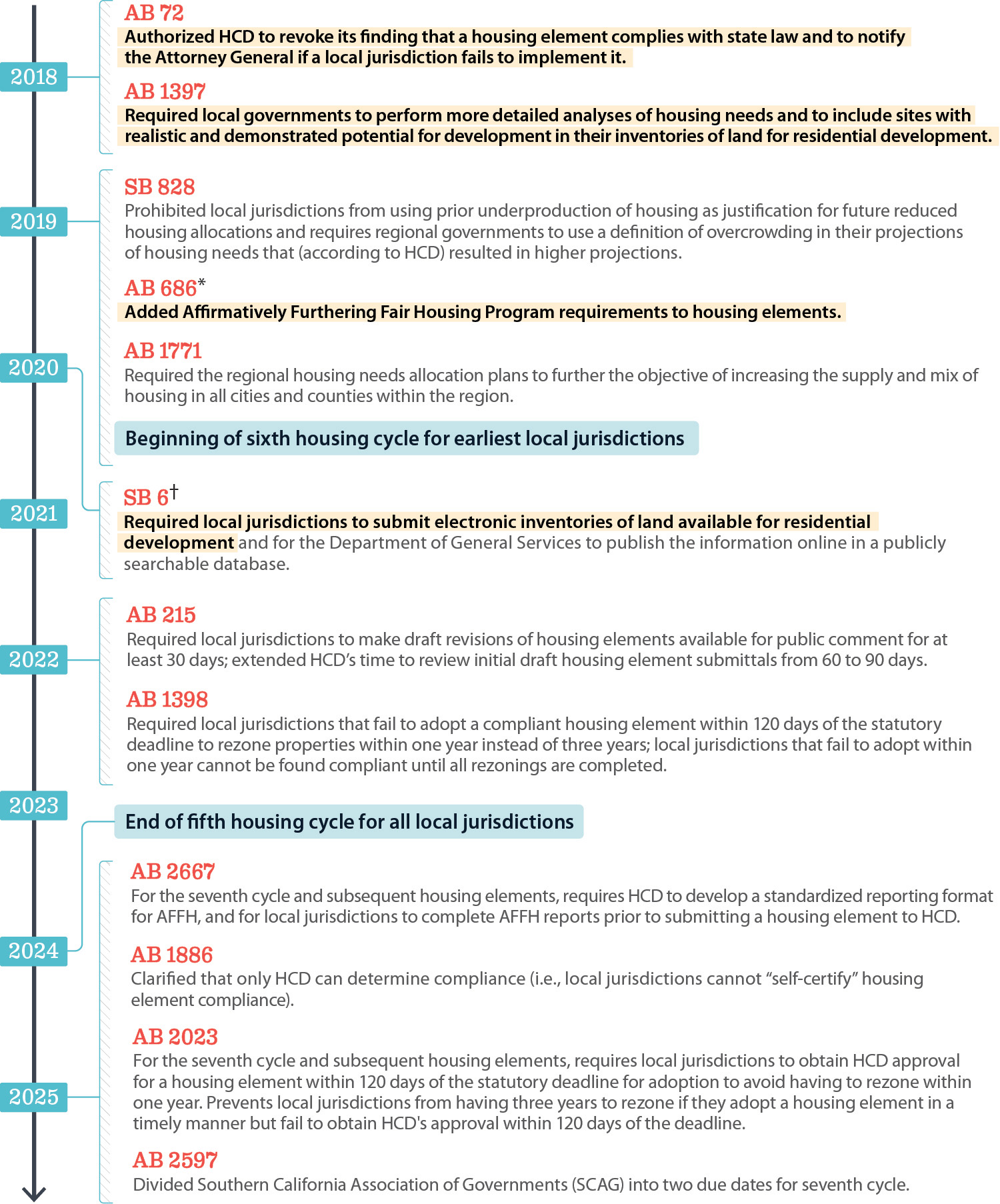
As Figure 2 shows, the Legislature passed a number of significant changes in law that affected the content of housing element updates for the sixth cycle. For example, state law requires local jurisdictions whose housing element updates were due on or after January 1, 2021, to complete an Assessment of Fair Housing—an analysis that included a summary of the jurisdiction’s fair housing issues, integration and segregation patterns, and future fair housing priorities. We discuss the effect of these changes on the local jurisdictions’ housing element updates in the Audit Results.
Figure 2
The Legislature Made Significant Changes to the Housing Element Law for the Sixth Cycle
Source: State law and HCD documentation.
Note: Dates listed reflect the year each law became effective. Unless stated otherwise, laws became effective on January 1 of the listed year.
* AB 686 also required all local jurisdictions whose housing elements were due on or after January 1, 2021, to conduct an Assessment of Fair Housing as part of their housing element submittals.
† SB 6 came into effect on January 1, 2020, but the specific requirement for electronic submittals of sites inventory did not come into effect until January 1, 2021.
Figure 2 is a vertically oriented timeline that depicts major changes made to housing element law from 2018 to 2025. For 2018, the timeline lists two changes: AB 72, which authorized HCD to revoke its finding that a housing element complies with state law and to notify the Attorney General if a local jurisdiction fails to implement it; and AB 1397, which required local governments to perform more detailed analyses of housing needs and to include sites with realistic and demonstrated potential for development in their inventories of land for residential development. The timeline highlights both AB 72 and AB 1397 as particularly significant changes to housing element law.
For 2019, the timeline lists three changes: SB 828, which prohibited local jurisdictions from using prior underproduction of housing as justification for future reduced housing allocations and required regional governments to use a definition of overcrowding in their projections of housing needs that (according to HCD) resulted in higher projections; AB 686, which added Affirmatively Furthering Fair Housing Program requirements to housing elements; AB 1771, which required the regional housing need allocation plans to further the objective of increasing the supply and mix of housing in all cities and counties within the region. The timeline highlights AB 686 as a particularly significant change, and notes that 2019 also marked the beginning of the 6th housing cycle for the earliest local jurisdictions.
For 2020, the timeline lists one major change: SB 6, which required local jurisdictions to submit electronic inventories of land available for residential development and for the Department of General Services to publish the information online in a publicly searchable database.
For 2021, the timeline lists no changes.
For 2022, the timeline lists two changes: AB 215, which required local jurisdictions to make draft revisions of housing elements available for public comment for at least 30 days and extended HCD’s time to review initial draft housing elements from 60 to 90 days; and AB 1398, which required local jurisdictions that fail to adopt a compliant housing element within 120 days of the statutory deadline to rezone properties within one year instead of three years. The timeline further notes under AB 1398 that jurisdictions that fail to adopt within one year cannot be found compliant until all rezonings are completed.
For 2023, the timeline lists no changes.
For 2024, the timeline lists no changes, but indicates that 2024 marked the end of the fifth housing cycle for all local jurisdictions.
For 2025, the timeline lists four changes: AB 2667, which, for the seventh cycle and subsequent housing elements, requires HCD to develop a standardized reporting format for AFFH, and for local jurisdictions to complete AFFH reports before prior to submitting their housing elements to HCD; AB 1886, which clarified that only HCD can determine compliance (i.e. that local jurisdictions cannot “self-certify” housing element compliance); AB 2023, which, for the seventh cycle and subsequent housing elements, requires local jurisdictions to obtain HCD approval for a housing element within 120 days of the statutory deadline for adoption to avoid having to rezone within one year and prevents local jurisdictions from having three years to rezone if they adopt a housing element timeline but fail to obtain HCD’s approval within 120 days of the deadline; and AB 2597, which divided the Southern California Association of Governments (SCAG) into two due dates for the seventh cycle.
Finally, the Governor vetoed Assembly Bill (AB) 650 in October 2025, which would have—among other things—required HCD to provide local jurisdictions with specific analysis or text to remedy each identified deficiency in a findings letter. In a notification to members of the California State Assembly about why he did not sign the bill, the Governor stated that the bill would inappropriately shift responsibility for preparing housing elements from local jurisdictions to HCD and indicated that the fundamental responsibility of planning for housing needs falls on local governments.
HCD’s Responsibilities Related to Housing Elements
As the department primarily responsible for California’s housing policy, HCD has a number of significant responsibilities related to the local jurisdictions’ development of their housing elements. Most critically, it is responsible for assigning new housing units to COGs through the Regional Housing Needs Allocation (housing needs allocation) process, determining whether each local jurisdiction’s revised housing element complies with state law, and addressing local jurisdictions’ violations related to their housing elements.
Housing Needs Allocation Process
In consultation with each COG, HCD determines how much housing at a variety of affordability levels is necessary in each region of the State and assigns a number of new units to each COG as part of the housing needs allocation process. These units encompass housing at all income levels. Using their own methodologies, each COG subsequently allocates those projected housing units among their member local jurisdictions. Finally, local jurisdictions plan for how to meet their allocated housing need in their housing element updates.2
HCD explained that in the fifth housing element cycle, which began in 2013, allocations for new housing units tended to be lower, according to HCD, because of a downturn in the housing market. In contrast, the housing needs allocations process for the sixth cycle resulted in significantly higher allocations for several jurisdictions. In fact, some jurisdictions had their allocations triple. Beverly Hills—one of the 10 jurisdictions we selected for our review—saw its allocation increase from three housing units for the fifth cycle to 3,104 for the sixth cycle.
The Housing Element Review Process
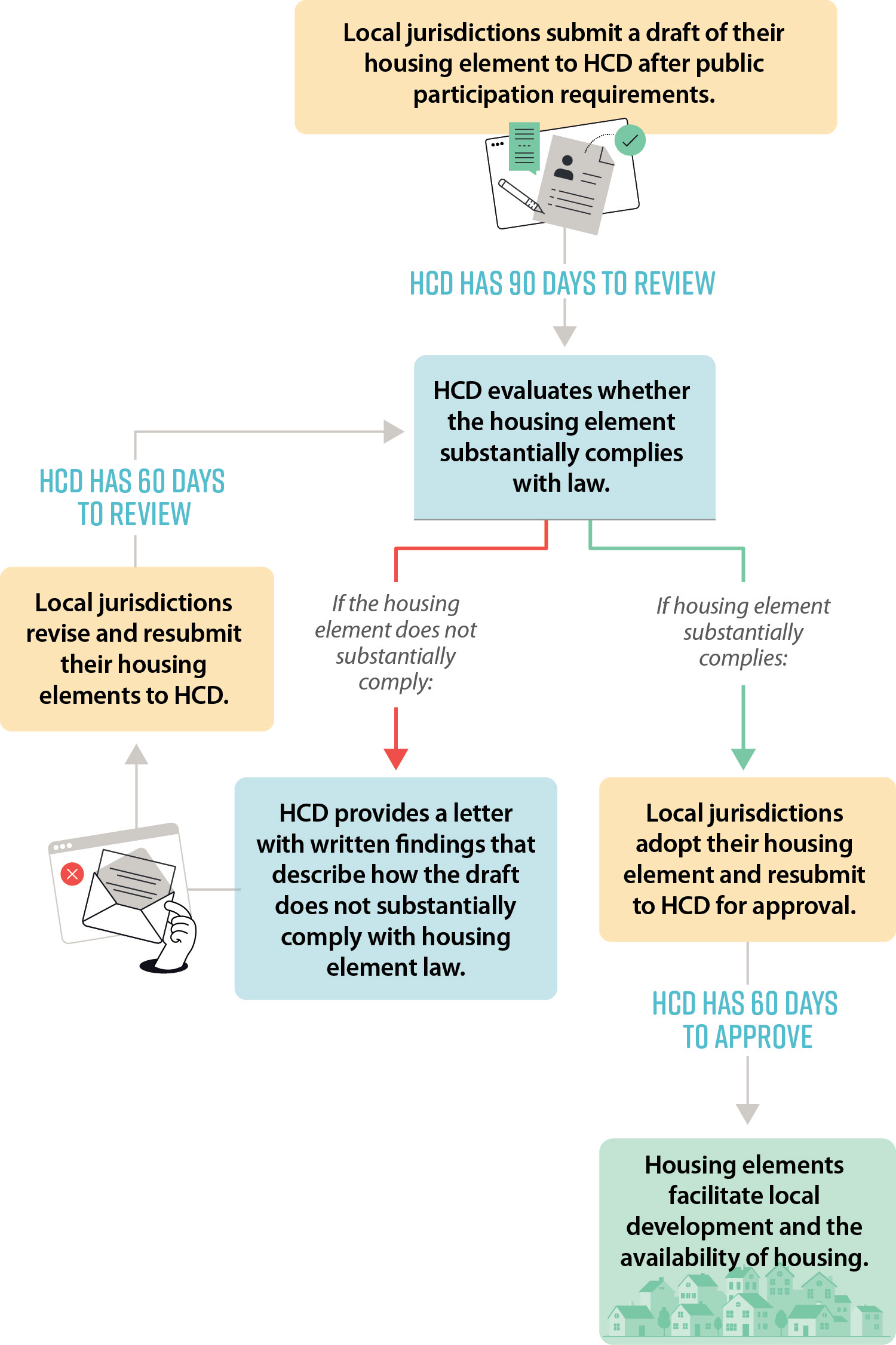
State law requires HCD to review local jurisdictions’ housing elements, determine whether they substantially comply with state law, and report its written findings to the local jurisdiction. We refer to HCD’s determination that a revised housing element substantially complies with state law as approving the housing element. Figure 3 illustrates the housing element review process. Housing element law establishes that HCD has 90 days after a local jurisdiction’s first submission and 60 days after subsequent submissions to complete its review. It does not establish how quickly local jurisdictions must resubmit after receiving HCD’s findings letters.
Figure 3
The Housing Element Approval Process Requires Involvement From Local Jurisdictions, HCD, and the Public
Source: State law.
Figure 3 is a flowchart that describes the housing element approval process and the roles of various local and State agencies in the process. The flowchart indicates that the process begins when local jurisdictions submit a draft of their housing element to HCD after public participation requirements. Once this occurs, HCD has 90 days to review. Then, the chart indicates that HCD evaluates whether the housing element substantially complies with law, indicating two potential options: the housing element does not substantially comply, or the housing element substantially complies.
If the housing element does not substantially comply, HCD provides a letter with written findings that describe how the draft does not substantially comply with housing element law. Local jurisdictions, upon receipt of this letter, revise and resubmit their housing elements to HCD. HCD then has 60 days to review, and the graphic indicates that we return to the step where HCD evaluates whether the housing element substantially complies with law. If the housing element substantially complies, local jurisdictions adopt their housing element and resubmit to HCD for approval. HCD then has 60 days to approve, and the final step indicates that housing elements facilitate local development and the availability of housing.
HCD reports its determination of whether a draft housing element substantially complies with state law in a findings letter. In this letter, HCD identifies any requirements that the housing element did not meet. It typically includes a citation to the relevant section of state law, an explanation of the requirements of that section, and some additional examples and suggestions for how the local jurisdiction might meet the requirements. As part of its review of housing elements, state law requires HCD to consider public comments from any public agency, group, or person.
State law also authorizes HCD to provide guidance to local jurisdictions regarding the updating of their housing elements but establishes that this guidance is advisory. HCD currently provides such guidance through online resources and tools, webinars and presentations, and direct, individualized assistance. We discuss HCD’s guidance in more detail later in the report.
HCD’s Enforcement Authority
Changes in law in 2017 expanded HCD’s enforcement authority over the housing element law and the implementation of housing elements. These changes allow HCD to review any action a jurisdiction takes that is inconsistent with its housing element. After HCD identifies an issue, it first attempts to work with the local jurisdiction to implement a remedy. If the potential violation is not resolved, it then gives the local jurisdiction 30 days to take appropriate action. If the local jurisdiction continues to fail to correct the issue, HCD is authorized to revoke its finding that a housing element is compliant and to refer the issue to the attorney general. There are several consequences to having a housing element that is out of compliance, including legal challenges, condensed rezoning, potential funding losses, and the builder’s remedy—a provision of state law that allows developers to bypass certain local zoning rules. We discuss these consequences in further detail later in the report. HCD’s enforcement authority helps to ensure that jurisdictions appropriately adopt and implement the programs in their housing elements.
Our Selection of Local Jurisdictions
The Joint Legislative Audit Committee (Audit Committee) directed us to select and review 10 of the State’s 539 local jurisdictions according to their population, geography, and compliance with HCD’s standards. The Audit Committee asked us to assess HCD’s responsiveness in reviewing these 10 local jurisdictions’ housing elements during the fifth and sixth cycles, to evaluate HCD’s comments and feedback during the sixth cycle, and to determine the number of reviewers that worked on HCD’s housing element reviews.
In making our selection, we considered the characteristics that the Audit Committee had identified, as well as the number of sixth-cycle draft housing elements the local jurisdictions submitted to HCD, the duration of their sixth-cycle review process, and any differences from the fifth to the sixth cycle in their number of drafts and the length of their review process. We generally selected local jurisdictions that took longer than typical to complete the process, and our selection does not reflect local jurisdictions’ typical experiences with the review process.
According to these considerations, we selected the 10 local jurisdictions listed in the text box. The local jurisdictions are located in 10 different counties and have populations that range from about 4,000 to 440,000. Some were in compliance with housing element law during our audit, and others were not. Some submitted a low number of draft housing elements, and others submitted a high number of drafts. The duration of each of their reviews also differed.
Ten Selected Local Jurisdictions
- Anaheim
- Beverly Hills
- Canyon Lake
- Clovis
- Del Mar
- Eureka
- Oakland
- Rialto
- Santa Barbara
- Saratoga
Source: Auditor analysis.
Audit Results
For Most Local Jurisdictions, the Housing Element Approval Process for the Sixth Cycle Was Longer Than for the Fifth Cycle
The local jurisdictions’ timely adoption and implementation of their housing element updates is critical to meeting the State’s goal of increasing the housing supply. As we discuss in the Introduction, state law requires local jurisdictions to revise and adopt a compliant housing element at least every eight years, although the exact dates by which the local jurisdictions must adopt their plans vary, based on their Council of Governments (COG). For example, jurisdictions within the Southern California Association of Governments (SCAG), a COG with 197 member jurisdictions, were required to adopt their sixth-cycle housing elements by October 15, 2021, but the deadline for the 109 member jurisdictions of the Association of Bay Area Governments (ABAG) was January 31, 2023.
Jurisdictions that fail to adopt a compliant housing element timely face several possible consequences, including ineligibility for state funding. We describe these consequences in more detail later in the report. On average, local jurisdictions submitted their initial draft housing element for the sixth cycle to the California Department of Housing and Community Development (HCD) just 23 days before the statutory deadline. Although state law allows HCD up to 90 days to review the initial drafts, fewer than 40 percent of local jurisdictions submitted these drafts at least 90 days in advance. Additionally, 30 percent of local jurisdictions submitted their initial draft after the deadline had already passed.3
Overall, local jurisdictions’ housing element review process for the sixth cycle was significantly longer than it was for the fifth cycle. As Table 1 shows, as of November 2024, the median review process time was 387 days—or more than one year—in the sixth cycle.4 In contrast, the median length of the review process in the fifth cycle was 171 days, less than half as long.
More than half of this increase in the length of the review process is attributable to the time the local jurisdictions spent revising their plans, in large part caused by new requirements in state law, which we discuss in the next section. Housing element law requires HCD to complete its review of initial drafts within 90 days and subsequent drafts within 60 days. It does not establish any similar requirements related to how quickly local jurisdictions must respond after receiving HCD’s findings letters, which summarize the results of the department’s reviews. As Table 1 shows, HCD spent a median of 177 cumulative days completing its review of all drafts submitted, whereas local jurisdictions spent a median of 210 cumulative days with the drafts between HCD’s review periods. When we reviewed all 51 sixth-cycle housing elements that the 10 selected local jurisdictions submitted, we found that HCD met its statutory deadlines in each instance.
Both the median and the total number of drafts that local jurisdictions submitted to HCD for review also increased from the fifth to the sixth cycle. The total number of drafts these jurisdictions submitted to HCD rose from approximately 1,300 to nearly 1,800, and the median number of drafts grew from two to three submissions. According to HCD, it generally anticipates local jurisdictions will submit at least three draft housing elements: two drafts prior to the jurisdiction adopting it, and after HCD’s review, a third draft adopted by the local jurisdiction for HCD’s final determination. HCD also noted that it had anticipated that the number of draft housing elements would increase in the sixth cycle because of the new laws that introduced new complexity into the requirements for compliance. As Table 2 shows, 427 jurisdictions, or 81 percent, achieved a compliant, adopted housing element within two or fewer drafts in the fifth cycle compared to only 92 jurisdictions, or 22 percent of the jurisdictions that achieved a compliant, adopted housing element in the sixth cycle. However, across both cycles, most of the local jurisdictions that achieved a compliant, adopted housing element did so within three or fewer drafts: 93 percent for the fifth cycle and 55 percent for the sixth cycle.
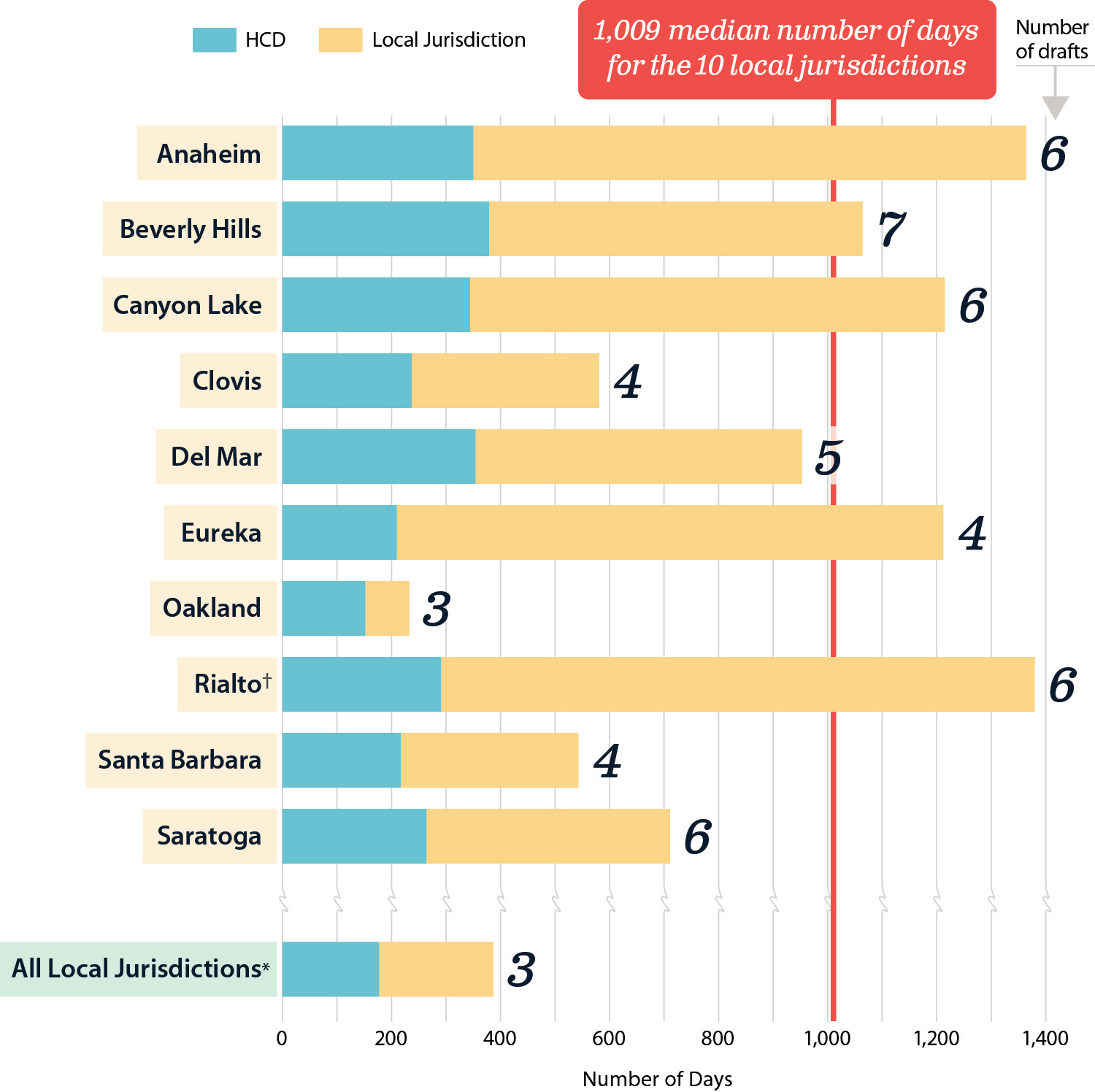
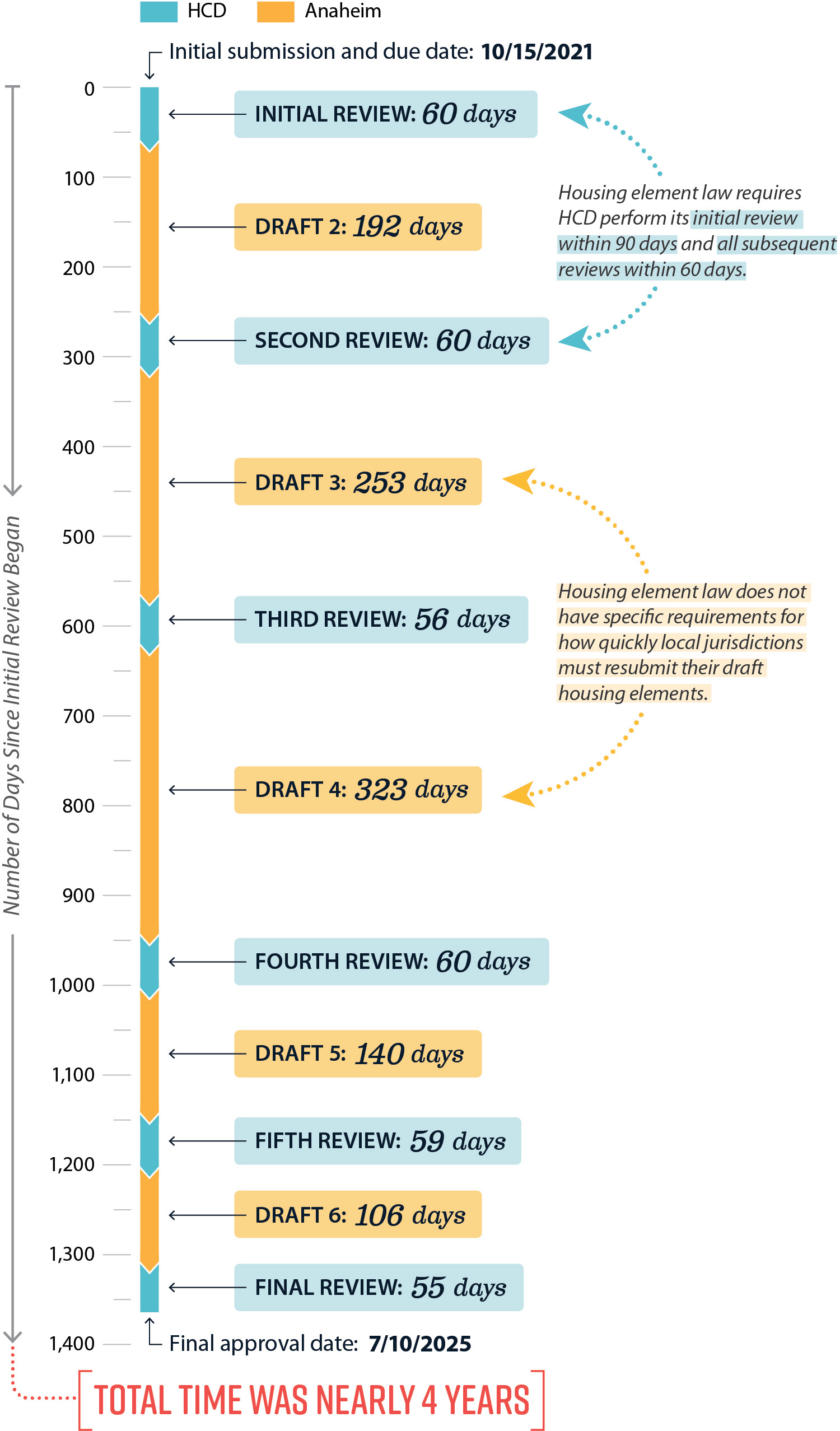
The median sixth-cycle review process for the 10 local jurisdictions we selected was significantly longer than the median for all local jurisdictions, largely because of the time the local jurisdictions spent revising their drafts between HCD’s reviews. As Figure 4 shows, the process for these 10 jurisdictions took a median of 1,009 days, or 2.8 years,5 and they submitted a median of 5.5 drafts. HCD reviews accounted for 30 percent of that time, and local jurisdictions accounted for the remaining 70 percent. For example, Anaheim was responsible for nearly three-quarters of the total time to complete the housing element, as Figure 5 shows. According to Anaheim, these delays were due in part to the new complex analyses required for the sixth cycle, and in part to the fact that the city was involved in a lawsuit with HCD unrelated to housing elements.
Figure 4
The 10 Local Jurisdictions We Reviewed Took a Median of Nearly Three Years to Complete an Approved Housing Element
Source: HCD documentation and auditor analysis of HCD’s housing element tracking system data as of November 2024.
*The median number of days and drafts for all local jurisdictions is as of November 2024 and includes local jurisdictions that had not yet completed their approved housing element as of November 2024.
† As of November 2025, Rialto was not yet in compliance with a completed and adopted housing element.
Figure 4 is a horizontal bar chart depicting the number of days each jurisdiction took to complete an approved housing element and the number of drafts each jurisdiction completed. The jurisdictions are listed vertically along the vertical axis in descending alphabetical order, beginning with Anaheim at the top and Saratoga at the bottom, with an additional item at the bottom listing the median number of days and drafts for all local jurisdictions within the State. Each of the ten jurisdictions is depicted with a bar to its right, with a blue shaded component that depicts the amount of time HCD spent reviewing the draft and the amount of time the jurisdiction spent revising it.
First, the chart lists Anaheim, which submitted six drafts over the course of approximately 1,350 days. HCD was responsible for roughly 350 days, and Anaheim was responsible for the rest.
Second, the chart lists Beverly Hills, which submitted seven drafts over the course of approximately 1,050 days. HCD was responsible for roughly 375 days, and Beverly Hills was responsible for the rest.
Third, the chart lists Canyon Lake, which submitted six drafts over the course of approximately 1,200 days. HCD was responsible for roughly 350 days, and Canyon Lake was responsible for the rest.
Fourth, the chart lists Clovis, which submitted four drafts over the course of approximately 600 days. HCD was responsible for roughly 250 days, and Clovis was responsible for the rest.
Fifth, the chart lists Del Mar, which submitted five drafts over the course of approximately 950 days. HCD was responsible for roughly 350 days, and Del Mar was responsible for the rest.
Sixth, the chart lists Eureka, which submitted four drafts over the course of approximately 1200 days. HCD was responsible for roughly 200 days, and Eureka was responsible for the rest.
Seventh, the chart lists Oakland, which submitted three drafts over the course of approximately 225 days. HCD was responsible for roughly 150 days, and Oakland was responsible for the rest.
Eighth, the chart lists Rialto, which submitted six drafts over the course of approximately 1,400 days. HCD was responsible for approximately 300 days, and Rialto was responsible for the rest. The chart additionally notes that, as of November 2025, Rialto was not yet in compliance with an adopted housing element.
Ninth, the chart lists Santa Barbara, which submitted four drafts over the course of approximately 425 days. HCD was responsible for approximately 200 days, and Santa Barbara was responsible for the rest.
Tenth, the chart lists Saratoga, which submitted six drafts over the course of approximately 700 days. HCD was responsible for approximately 250 days, and Saratoga was responsible for the rest.
Finally, the chart includes a bar indicating the median number of days and drafts for all local jurisdictions—including those that had not yet completed their approved housing element—as of November 2024. All local jurisdictions submitted a median of 3 drafts over the course of approximately 375 days. HCD was responsible for approximately 175 days, and the local jurisdictions were responsible for the rest. To the right of each bar, the chart lists the number of drafts each jurisdiction submitted. Finally, the chart includes a vertical line indicating the median number of days—1,001 days—the 10 local jurisdictions we reviewed took to complete an approved housing element; the statewide median depicted at the bottom is slightly below 500 days.
Figure 5
Anaheim Accounted for 74 Percent of the Total Time Spent Completing Its Housing Element
Source: HCD documentation.
Figure 5 is a modified vertical timeline depicting the total amount of time Anaheim took to complete its housing element. The timeline indicates that, in total, Anaheim submitted six drafts before receiving its final approval on July 10, 2025—a process which took nearly four years—and accounted for 74 percent of the total time spent completing its housing element.
The timeline is composed of alternating blue and yellow segments representing the number of days HCD and Anaheim took spent on the housing element, respectively. To the left, the timeline lists a series of numbers indicating the number of days since HCD’s initial review began. The timeline begins with HCD’s initial review of Anaheim’s draft housing element, which took HCD 60 days to complete after Anaheim submitted its housing element draft on October 15, 2021. Next, Anaheim took 192 days to complete its second draft, and HCD took 60 days to complete its second review. The timeline additionally notes that housing element law requires HCD to perform its initial review within 90 days and all subsequent reviews within 60 days.
Next, Anaheim took 253 days to complete its third draft, and HCD took 56 days to complete its third review. To the right of these segments of the timeline, the graphic indicates that housing element law does not have specific requirements for how quickly local jurisdictions must resubmit their draft housing elements after HCD has completed its review.
Next, Anaheim took 323 days to complete its fourth draft, and HCD took 60 days to complete its review. For its fifth draft, Anaheim took 140 days, and HCD took 59 days to review., For its sixth and final draft, Anaheim took 106 days, and HCD took 55 days in its final review. Anaheim’s final approval date was July 10, 2025, nearly four years after it submitted its first draft. The timeline also indicates that HCD never spent more than 60 days reviewing Anaheim’s draft housing element, indicating that HCD met all its statutory review deadlines.
Many Factors Contribute to the Length of the Housing Element Approval Process
Our conversations with local jurisdictions and HCD led us to identify multiple factors that contributed to the length of the housing element approval process, as Figure 6 shows. Although aspects of these factors may have been present in prior cycles, they collectively had a significant effect on the process in the sixth cycle.
Figure 6
Many Factors Contributed to the Length of the Sixth Cycle Approval Process
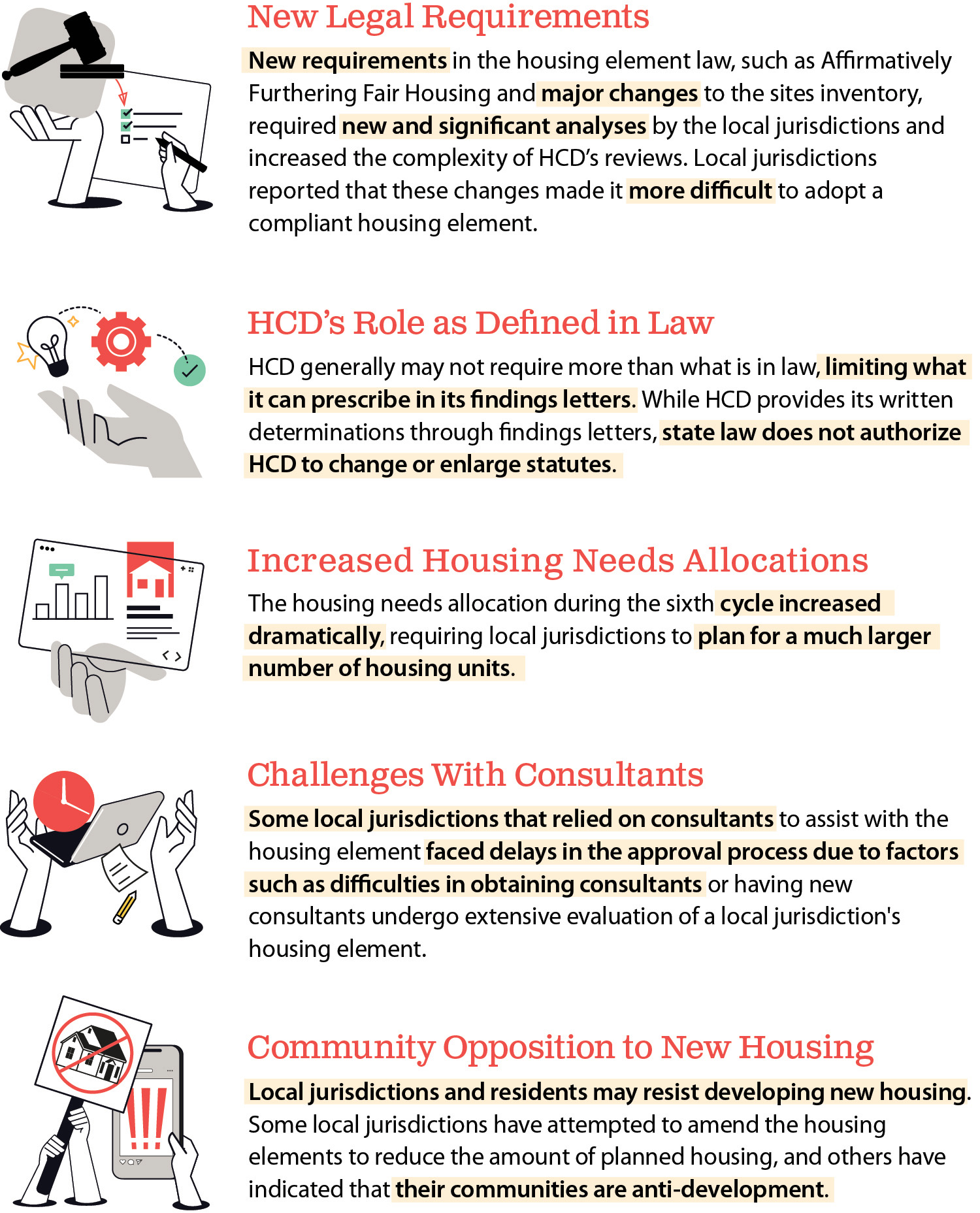
Source: State law, HCD documentation, interviews with local jurisdictions, and other documentation.
Figure 6 is an organization chart that depicts the various factors that contributed to the length of the sixth cycle approval process: new legal requirements; HCD’s role as defined in law; increased housing needs allocations; challenges with consultants; and community opposition to new housing. The chart contains five rows, each of which describes one of the previously-listed factors.
The factor described is new legal requirements. This row indicates new requirements in the housing element law such as Affirmatively Furthering Fair Housing and major changes to the sites inventory required new and significant analyses by the local jurisdictions and increased the complexity of HCD’s reviews. The row also indicates that local jurisdictions reported that these changes made it more difficult to adopt a compliant housing element.
The second factor described is HCD’s role as defined in law. This row indicates that HCD generally may not require more than what is in law, limiting what it can prescribe in its finding letters. Further, the row states that while HCD provides its written determinations through findings letters, state law does not authorize HCD to change or enlarge statues.
The third factor described is increased housing needs allocations. This row indicates that the housing needs allocations during the sixth cycle increased dramatically, requiring local jurisdictions to plan for a much larger number of housing units.
The fourth factor described is challenges with consultants. This row indicates that some local jurisdictions that relied on consultants to assist with the housing element faced delays in the approval process due to factors such as difficulties in obtaining consultants or having new consultants go extensive evaluation of a local jurisdiction’s housing element. Finally, the fifth factor described is community opposition to the housing element. This row indicates that local jurisdictions and residents may resist developing new housing. The row further states that some local jurisdictions have attempted to amend the housing elements to reduce the amount of planned housing, and others have indicated that their communities are anti-development.
Housing element law provides broad requirements to maintain local discretion. Given its size, scope, and complexity, it is reasonable to conclude that the Legislature makes the housing element law provisions broad, which necessitates interpretations by HCD and an ongoing dialogue with local jurisdictions during the review process. Originally enacted in 1969 and amended dozens of times since, the housing element law spans nearly 50,000 words and accommodates the diverse needs of the 539 local jurisdictions across the state—each with its own geography, demographics, economic conditions, political climate, and resource constraints. The housing elements that local jurisdictions prepare are often extensive, frequently running hundreds of pages and sometimes exceeding a thousand. Courts have recognized that most statutes contain some degree of ambiguity. In fact, the Legislature purposefully makes some statutes broad as a tool to preserve flexibility in addressing unforeseen circumstances. Courts have affirmed that legislation does not need to achieve mathematical precision, nor must it anticipate every possible scenario to which it might apply. Importantly, the housing element law acknowledges that each local jurisdiction is best positioned to determine the specific actions it must take to contribute to the state’s housing goals. As HCD interprets and applies the law during its housing element review, it cannot dictate to local jurisdictions how they specifically choose to achieve compliance. As Figure 7 shows, the statute preserves room for local discretion while still providing a framework for statewide accountability. Additionally, as we note in a later section, according to HCD, it cannot dictate what local jurisdictions must do to achieve compliance because the local jurisdictions are the most knowledgeable about what housing plans work best for their community. Consequently, we concluded that the Legislature drafted the housing element requirements broadly to provide local discretion and to allow local jurisdictions to design programs that meet local needs while meeting state goals and targets. This dynamic of power sharing between the State and local jurisdictions—against the backdrop of a complex and broad legal framework—can create frustration among local jurisdictions as they seek to develop a housing element that HCD deems “compliant” or risk losing their control over local zoning rules.
Figure 7
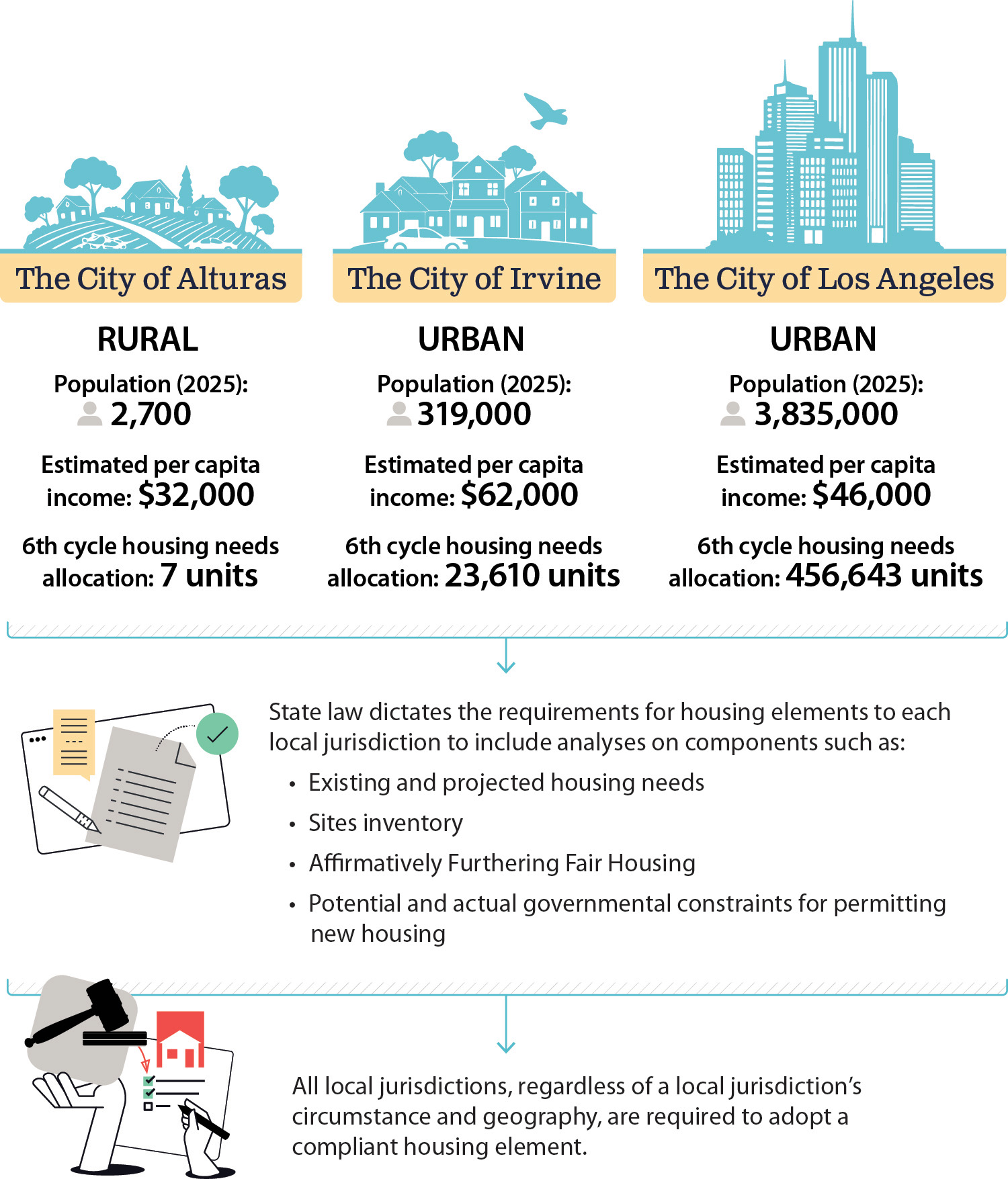
All Local Jurisdictions in the State Must Adopt Compliant Housing Elements Regardless of Local Differences
Source: State law, HCD, and Department of Finance.
Figure 7 is a flow chart depicting how three very different jurisdictions—Alturas, Irvine, and Los Angeles—must all adopt compliant housing elements regardless of their local differences. The flowchart consists of three sections: the topmost section describes the differences between the three jurisdictions; the second section describes state law requirements for the content of housing elements; and the third section summarizes the requirement for all jurisdictions to adopt compliant housing elements.
The topmost section of the flowchart contains three columns depicting each jurisdiction’s differences. On the left, the chart describes the city of Alturas as a rural jurisdiction with a population of 2,700 as of 2025, an estimated per capita income of $32,000, and a sixth cycle housing allocation of seven units. In the middle, the chart describes the city of Irvine as an urban jurisdiction with a population of 319,000, an estimated per capita income of $62,000, and a sixth cycle housing allocation of 23,610. On the right, the chart describes the city of Los Angeles as an urban jurisdiction with a population of 3,835,000, an estimated per capita income of $46,000, and a sixth cycle housing allocation of 456,643 units. The top section ends with a modified funnel leading to the next section, indicating that all three jurisdictions—despite their differences—must follow state law requirements for their housing elements.
The middle section of the flowchart describes several state law requirements for housing elements. Specifically, the middle section shows that state law dictates the requirements for housing elements to each local jurisdiction to each local jurisdiction to include analyses on components such as:
Existing and projected housing needs
Sites inventory
Affirmatively Furthering Fair Housing
Potential and actual governmental constraints for permitting new housing.
The middle section also ends with a modified funnel leading to the next section. The final section of the chart states that all local jurisdictions, regardless of a local jurisdiction’s circumstance and geography, are required to adopt a compliant housing element.
New Legal Requirements
Two substantial changes in the housing element law took effect before the sixth cycle. First, in 2017, the Legislature amended the housing element law to add new sites inventory requirements that increased the complexity of jurisdictions’ analyses. This amendment included the requirement that local jurisdictions develop an inventory of land suitable and available for residential development, including both vacant sites and sites having realistic potential for redevelopment during the planning period. In 2019, the Legislature added to the requirement for nonvacant sites, stating that local jurisdictions are required to provide a description of the existing use of each property and, if owned by the jurisdiction, whether there are plans to dispose of—or to transfer the control or ownership of—the property during the planning period. As a result, during the sixth cycle, local jurisdictions needed to explain the methodology they used for determining the realistic build-out potential of the nonvacant sites within the planning period.
Second, in 2018, the Legislature added the Affirmatively Furthering Fair Housing (AFFH) requirements to ensure that programs and policies in the housing elements are consistent with the principles of affirmatively furthering fair housing. These principles involve taking meaningful actions to facilitate deliberate action to explicitly address, combat, and relieve disparities from past patterns of segregation to foster more inclusive communities. For instance, AFFH requires housing elements to include an analysis of available federal, state, and local data and knowledge to identify integration and segregation patterns and trends, racially or ethnically concentrated areas of poverty and affluence, disparities in access to opportunity, and disproportionate housing needs, including displacement risk.
All 10 of the local jurisdictions we interviewed stated that these changes in state law were significantly more challenging than the requirements from the fifth cycle and that these changes made it more difficult for them to adopt a compliant housing element during the sixth cycle. HCD acknowledged in its budget request to increase its staffing levels for the impending housing element workload that the changes in state law increased the complexity of housing elements. HCD explained that these changes constituted significant additions to the housing elements, which also led to a more time-consuming review and analysis by HCD and more effort in revisions by local jurisdictions.
HCD’s Role as Defined in Law
Housing element law requires HCD to review local jurisdictions’ housing elements and give them a written determination on whether the housing element substantially complies with state law, but it does not expressly authorize HCD to change or enlarge statutes. HCD provides its written determinations on the housing elements to the local jurisdictions through findings letters. The determinations in findings letters state whether the local jurisdiction’s housing elements meet compliance; and, if the housing elements do not meet compliance, the letter includes information on what requirements the jurisdiction must address. The findings letters also include additional details, such as suggestions and recommendations for local jurisdictions that are advisory in nature and which HCD intends to guide jurisdictions toward compliance, rather than mandate specific actions. Some local jurisdictions indicated that the letters alone did not provide sufficient information for them to understand how to address HCD’s findings. For example, according to Anaheim staff, the feedback did not show them how to reach compliance, and they could not progress with the city’s housing element with the feedback in the letters alone. However, local jurisdictions have significant discretion to determine how best to satisfy statutory requirements. Attempts by HCD to impose requirements beyond its statutory authority could prompt legal challenges. Therefore, although HCD plays a critical role in approving the housing elements, the responsibility for crafting compliant elements ultimately rests with the local jurisdictions.
Increased Housing Allocations
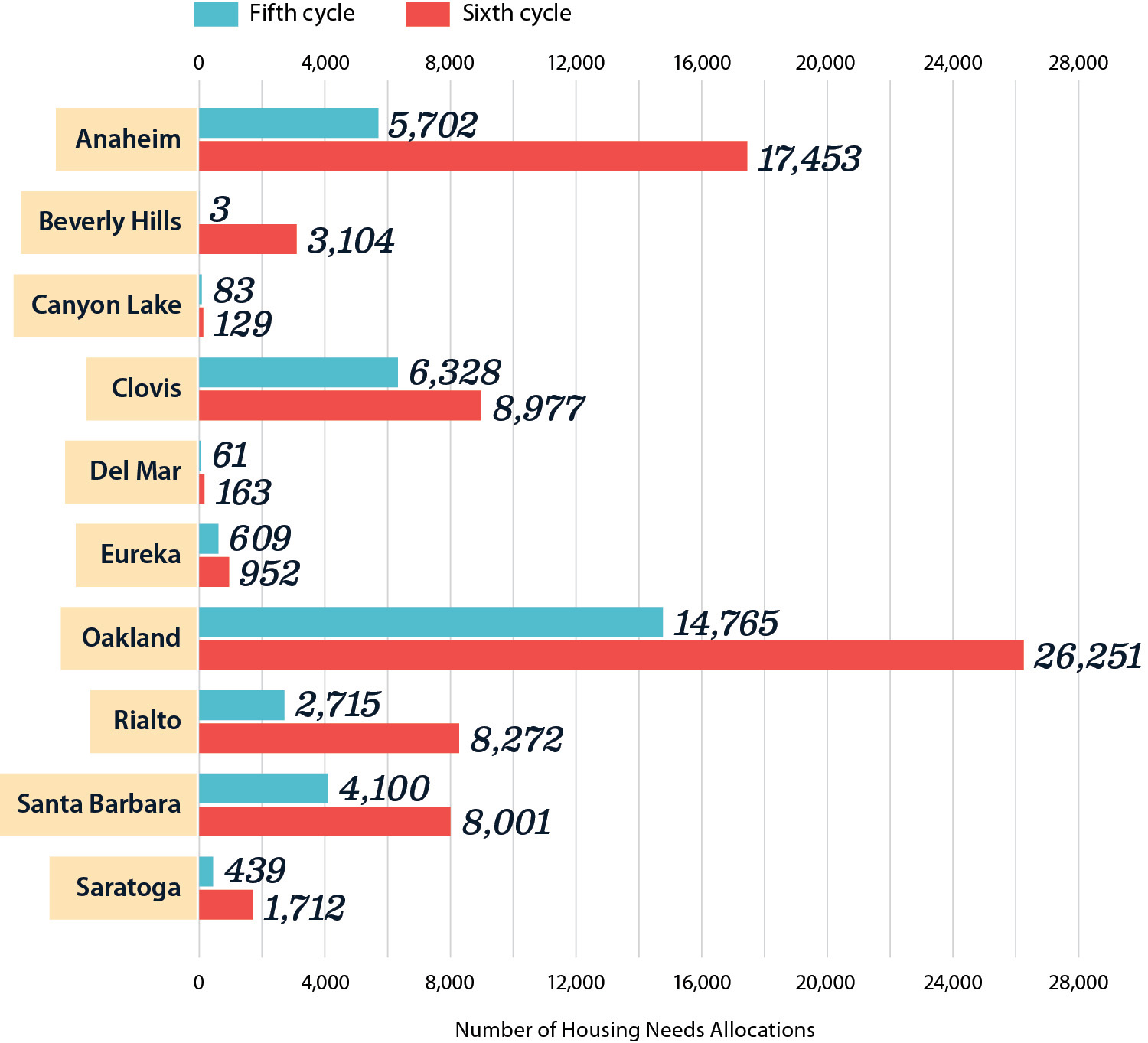
As the Introduction explains, local jurisdictions experienced significant increases in their Regional Housing Needs Allocation (housing needs allocation) in the sixth cycle. All 10 of the local jurisdictions we selected stated that they had experienced an increase in required housing needs allocations in the sixth cycle, with some having been doubled or even tripled since the fifth cycle. The local jurisdictions stated that these increases made it more difficult for them to plan for housing and, ultimately, adopt a compliant housing element. For instance, Anaheim’s housing needs allocation jumped from 5,702 housing units in the fifth cycle to 17,453 housing units in the sixth cycle. Figure 8 illustrates the increases in the housing needs allocation for each of the 10 selected jurisdictions from the fifth cycle to the sixth cycle.
Figure 8
Local Jurisdictions Had to Plan for More New Housing in the Sixth Cycle
Source: HCD’s housing needs allocations website.
Figure 8 is a modified horizontal bar chart depicting how local jurisdictions had to account for more new housing in the sixth cycle. To the left of the Y-Axis, the chart lists each of our ten selected jurisdictions in descending alphabetical order, beginning with Anaheim at the top and ending with Saratoga at the bottom. To the right of each listed jurisdiction, there are two stacked bars: a blue bar on top representing the fifth cycle housing allocation, and a red bar on the bottom representing the sixth cycle allocation.
First, the chart indicates that Anaheim had a fifth cycle allocation of 5,702 units, and a sixth cycle allocation of 17,453.
Second, the chart indicates that Beverly Hills had a fifth cycle allocation of 3 units, and a sixth cycle allocation of 3,104.
Third, the chart indicates that Canyon Lake had a fifth cycle allocation of 83 units, and a sixth cycle allocation of 129.
Fourth, the chart indicates that Clovis had a fifth cycle allocation of 6,328 units, and a sixth cycle allocation of 8,977.
Fifth, the chart indicates that Del Mar had a fifth cycle allocation of 61 units, and a sixth cycle allocation of 163.
Sixth, the chart indicates that Eureka had a fifth cycle allocation of 609 units, and a sixth cycle allocation of 952.
Seventh, the chart indicates that Oakland had a fifth cycle allocation of 14,765 and a sixth cycle allocation of 26,251.
Eighth, the chart indicates that Rialto had a fifth cycle allocation of 2,715 and a sixth cycle allocation of 8,272.
Ninth, the chart indicates that Santa Barbara had a fifth cycle allocation of 4,100 and a sixth cycle allocation of 8,001. Finally, the chart indicates that Saratoga had a fifth cycle allocation of 439, and a sixth cycle allocation of 1,712.
Challenges With Consultants
Some local jurisdictions also noted a reliance on an external consultant for revising the housing element, which added delays for some of the jurisdictions we selected. Specifically, Canyon Lake stated that it had to hire a new consultant midway through the sixth cycle and that it had to distribute multiple rounds of requests to find one. Further, its new consultant undertook an extensive evaluation to determine the necessary changes to the city’s housing element. This evaluation contributed to a long gap of more than 1.5 years between Canyon Lake receiving HCD’s review and the city resubmitting the next draft. Beverly Hills also experienced challenges with its consultant, which contributed to delays in the approval process. Beverly Hills explained that its initial consultant would try to push back against HCD on its findings instead of incorporating them, which resulted in the city not resolving many of HCD’s findings. The city stated it was able to work through HCD’s findings once it began working with a different consultant who had more recent experience working with HCD. Similarly, Santa Barbara stated that after six months of searching, it was unable to hire a consultant to work on the city’s housing element, which resulted in staff putting other projects on hold so they could work on the housing element. HCD explained that because two-thirds of all local jurisdictions have housing element deadlines within the same two-year period, local jurisdictions may struggle to find available consultants.
Community Opposition to New Housing
Local jurisdictions’ social and political environments, and their proclivity—or lack thereof—toward developing housing can contribute to the lengthy approval process. Saratoga explained that the city was originally planned and designed to be a low‑density, single-family area, and that its community is anti-development. Saratoga further indicated that residents had numerous issues with the affordable housing requirements within housing elements, and that even building a two-story building could take more than a year to develop. Canyon Lake similarly explained that nearly all of its housing is within gated areas and that all residential properties are subject to rules and regulations of the same property owner’s association. Canyon Lake further stated that the area was originally intended as a senior and retirement area, with predominately small single-family lots.
Some news articles have reported on other local jurisdictions that disagree with or are resistant to developing housing. For instance, one news article reported multiple instances in which local jurisdictions attempted to make changes to their housing elements to reduce the amount of planned housing within them. Another news article indicated that even though the city of Piedmont—a local jurisdiction we did not review—has an approved housing element, residents are fighting the plan to add a minimum of 132 residential units, with 60 units of affordable housing, claiming that the development may conflict with evacuation routes. When local jurisdictions have residents that oppose residential development, those jurisdictions may have a more difficult time developing, adopting, and implementing an approved housing element.
Local Jurisdictions Face Consequences When They Delay Adopting Compliant Housing Elements
Although state law requires each local jurisdiction to adopt a revised housing element by a specific deadline, many local jurisdictions failed to do so during the most recent cycle. In fact, as of November 2024, 128 of the 539 local jurisdictions—or 24 percent—had not adopted a revised, HCD-approved housing element for the sixth cycle.6 Further, only six of the 411 jurisdictions that had adopted revised, HCD‑approved housing elements did so by their statutory deadline.7 As the text box describes, adopting a revised housing element late can lead to significant consequences for local jurisdictions.
Consequences of Late Housing Elements
Builder’s remedy: A legal tool in state law that allows developers of low- to moderate-income housing projects to bypass certain local zoning rules if a local jurisdiction has not adopted an HCD-approved housing element.
Legal challenges: Local jurisdictions can face lawsuits from private parties or the state attorney general, which can result in court orders and restrictions on permitting.
Condensed rezoning: Local jurisdictions that adopt housing elements late must complete mandatory rezoning more quickly than those that meet deadlines, which can create administrative pressure.
Potential loss of funding: Local jurisdictions risk losing eligibility or scoring advantages for state housing programs and grants.
Source: State law, HCD’s website, and interviews with local jurisdictions.
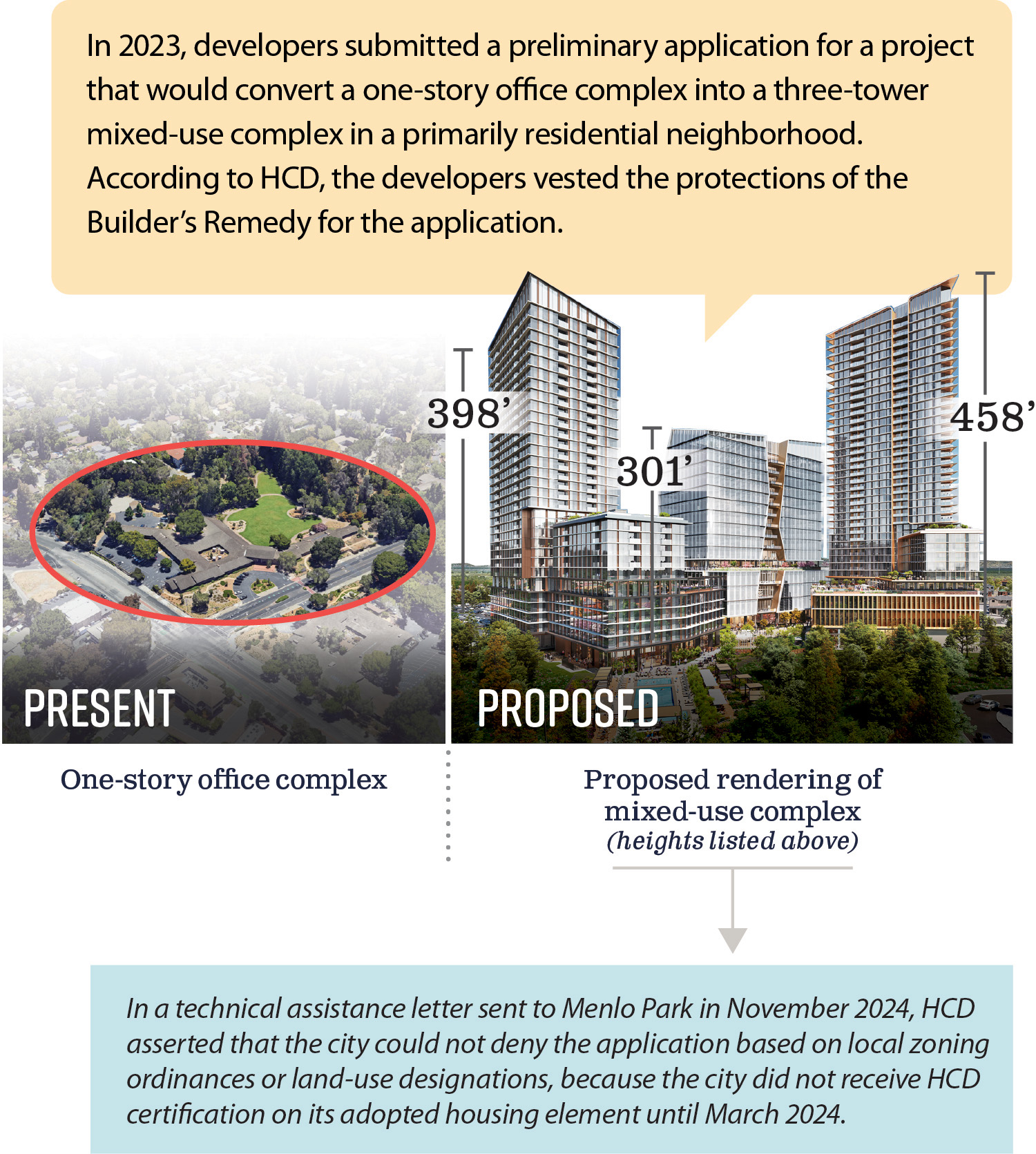
One possible consequence of a late housing element is the builder’s remedy. The builder’s remedy refers to a provision of state law that prevents a local jurisdiction from denying proposed housing projects based on local zoning ordinances if the local jurisdiction has not adopted a revised housing element that is substantially compliant with housing element law, if the proposed development is for very low, low, or moderate-income households8 and if it meets certain other requirements. In practice, the builder’s remedy allows developers to obtain approval for projects that a local jurisdiction might otherwise deny, even if the projects significantly exceed local height density, and other land-use restrictions. Figure 9 shows an example of a potential builder’s remedy consequence in Menlo Park. Three of the local jurisdictions we interviewed have faced applications by developers for a builder’s remedy.
Figure 9
Builder’s Remedy Presents a Significant Consequence for Noncompliant Local Jurisdictions
Source: HCD documentation, state law, City of Menlo Park website, and news articles.
Figure 9 is a graphic depicting how the builder’s remedy presents a significant consequence for noncompliant local jurisdictions, using the example of Menlo Park. The graphic indicates via a text box that, in 2023, developers submitted a preliminary application for a project that would convert a one-story office complex into a three-tower mixed-use complex in a primarily residential neighborhood. The graphic states in the text box that, according to HCD, the developers vested the protections of the builder’s remedy for the application.
Below the text box, the graphic depicts two images. On the left, the graphic shows the present-day one-story office complex of the proposed development. On the right, the graphic shows the proposed rendering of the mixed-use complex with three towers of 398, 301, and 458 feet in height.
Finally, at the bottom, the graphic indicates via a text box that, in a technical assistance letter sent to Menlo Park in November 2024, HCD asserted that the city could not deny the application based on local zoning ordinances or land use designations, because the city did not receive HCD certification on its adopted housing element until March 2024.
In addition, state law establishes that any interested party may bring legal action against a local jurisdiction that is not in compliance with certain provisions of the housing element law. A news article9 from September 2022 reported that the nonprofit housing interest group Californians for Homeownership, Inc., had independently sued nine local jurisdictions in Southern California for noncompliance with housing element law. The article reported that the nonprofit specifically singled out these jurisdictions because it determined that they were unlikely to adopt housing elements within the next six to 12 months without litigation forcing them to do so. One of the lawsuits resulted in a December 2023 court order that suspended Beverly Hills’s authority to issue all building permits that did not effectively create new housing units, with limited exceptions, until the city adopted a compliant housing element.
Since 2018, state law has also authorized HCD to recommend that the Office of the Attorney General pursue legal action against local jurisdictions that do not adopt a compliant revised housing element. However, HCD staff stated that the department’s preference is to provide individualized assistance to help jurisdictions come into compliance before it pursues punitive measures. We identified six instances from 2018 through 2025 in which legal action enabled HCD and a local jurisdiction to stipulate to a resolution, and we found one instance in which the Office of the Attorney General pursued litigation because HCD and the local jurisdiction were unable to reach such an agreement.10 In general, these court-approved agreements outlined paths for the jurisdictions to come into compliance with housing element law and included deadlines for submission of draft housing elements by the local jurisdictions, dates by which HCD had to provide its findings letters to the local jurisdictions, and requirements for HCD to make itself available for video conferences for a least an hour in the month following each findings letter.
Further, local jurisdictions that do not adopt compliant housing elements by the statutory deadlines have a shortened timeline for completing their rezoning—the process of changing how a piece of land can legally be used. Normally, if a local jurisdiction adopts an HCD-approved housing element within 120 days of the required statutory deadline, the jurisdiction has three years to complete rezoning.11 However, if a local jurisdiction adopts its housing element more than 120 days after its statutory deadline, the jurisdiction has one year instead of three years to complete rezoning. If a local jurisdiction adopts its housing element more than one year after the required statutory deadline, it may not be considered in compliance with housing element law until it has completed all rezoning.
Finally, local jurisdictions risk being less competitive or losing eligibility for housing-related funding opportunities when they fail to adopt a compliant housing element revision by the required deadline. Local jurisdictions with compliant housing element revisions coupled with a prohousing designation under the State’s Prohousing Designation Program gain advantages in scoring for some state housing programs. HCD lists some of these programs on its website, and state law also provides examples of such programs that offer incentives for housing element compliance. For example, one program that requires a compliant housing element is the Permanent Local Housing Allocation (PLHA). PLHA provided more than $326 million in funding in 2023, and Oakland, one of our 10 selected jurisdictions, had received nearly $12.1 million from the PLHA program as of May 16, 2023.
Increased Individualized Support From HCD Is Critical to Shortening the Approval Process
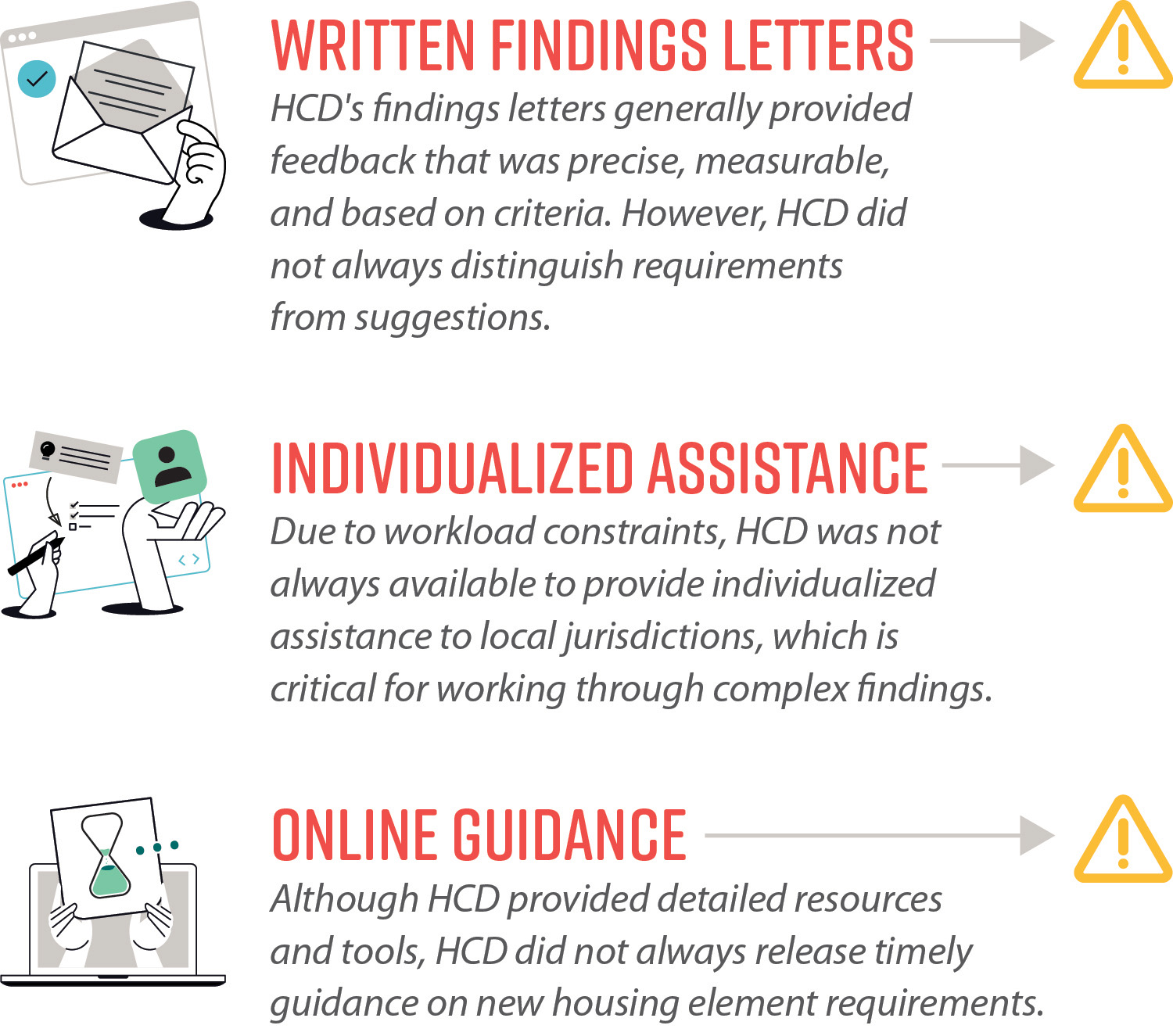
HCD provides three types of assistance to local jurisdictions: findings letters, individualized assistance, and online guidance and resources. However, as Figure 10 describes, HCD could improve all three types of assistance to better support local jurisdictions in achieving housing element compliance. For instance, although the individualized assistance that HCD provides helps local jurisdictions to understand how to address its findings, HCD’s workload challenges prevent it from always providing such support. Additionally, although HCD’s online guidance is detailed, HCD has not always issued some guidance in a timely manner.
Figure 10
HCD Could Improve All Three of the Types of Assistance It Provides to Local Jurisdictions
Source: Audit testing results.
Figure 10 is an organization chart describing how HCD could improve all three types of assistance it provides to local jurisdictions: written findings letters, individualized assistance, and online guidance. The graphic depicts three sections, and each section describes one of the previously-mentioned types of assistance.
In the first section, the graphic describes the findings letters. The graphic indicates that HCD’s findings letters generally provided feedback that was precise, measurable, and based on criteria, but that HCD did not always distinguish requirements from suggestions.
In the second section, the graphic describes individualized assistance. The graphic indicates that, due to workload constraints, HCD was not always available to provide individualized assistance to local jurisdictions, which is critical for working through complex findings. In the third section, the graphic describes online guidance. The graphic indicates that, although HCD provided detailed resources and tools, HCD did not always release timely guidance on new housing element requirements.
HCD Delivers Valuable Written Feedback to Local Jurisdictions, but Individualized Assistance Would Provide Additional Clarity
As the Introduction explains, HCD reviews local jurisdictions’ draft housing element updates, determines whether they comply with state law, and reports its determination to the local jurisdiction through a findings letter. Although the housing element law requires HCD to report its findings to local jurisdictions in writing, it does not require these letters to provide local jurisdictions with guidance or prescriptive instruction on how to achieve compliance. The text box lists the information that HCD includes in its findings letters.
HCD Includes the Following in Its Findings Letters:
- Feedback for each topic area HCD determined was not compliant with details of the relevant statute.
- An explanation of why the housing element does not comply.
- Suggestions and recommendations for how local jurisdictions can become compliant.
Source: HCD findings letters and court cases.
Note: State agencies, like HCD, generally may not impose mandates that are not found in statute unless the Legislature authorizes them to do so.
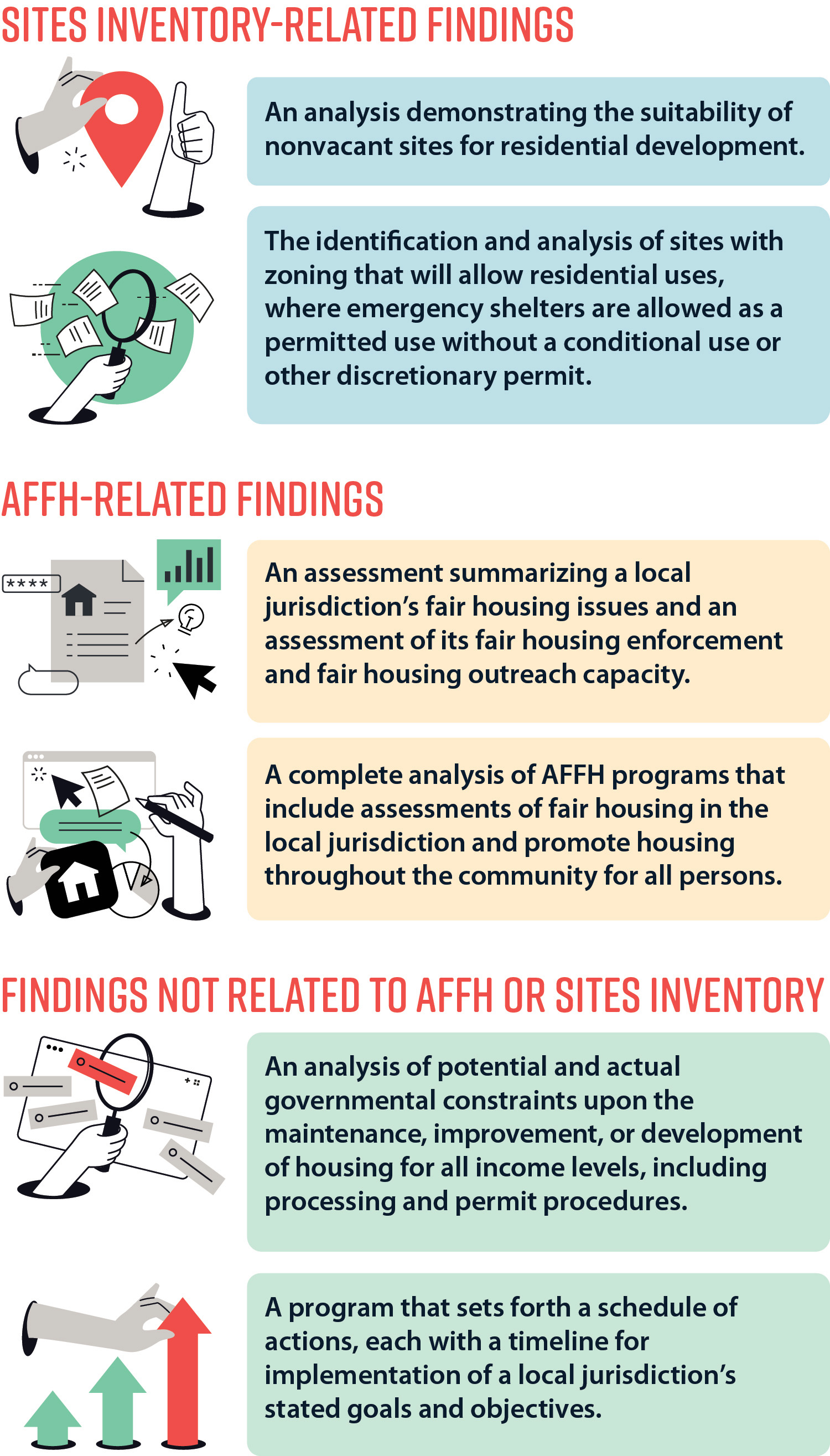
The Audit Committee asked us to determine whether HCD’s reviewers provided local jurisdictions with feedback and comments that were precise, measurable, and based on criteria. To make this determination, we reviewed six commonly occurring findings, which Figure 11 lists, in the letters HCD provided to each of the 10 selected local jurisdictions for a total of 60 findings. Four findings topics we reviewed addressed two key areas that local jurisdictions reported as challenging during the sixth cycle—the AFFH analysis and the sites inventory.
Figure 11
We Reviewed HCD’s Findings Letters Provided to Local Jurisdictions for Six Findings Topics
Source: Findings letters, state law, and HCD’s website.
Note: Some local jurisdictions’ letters did not include all of these findings categories and topics. In such cases, we judgmentally selected a similar finding from the same category.
Figure 11 is an organization chart depicting three findings categories we reviewed from HCD’s findings letters sent to local jurisdictions: sites inventory-related findings; AFFH-related findings; and findings not related to AFFH or sites inventory. The chart has three sections, one for each findings category we reviewed.
The first section summarizes the two sites inventory-related findings we reviewed: first, an analysis of demonstrating the suitability of nonvacant sites for residential development; second, the identification and analysis of sites with zoning that will allow residential uses, where emergency shelters are allowed as a permitted use without a conditional use or other discretionary permit.
The second section summarizes the two Affirmatively Furthering Fair Housing findings we reviewed: first, an assessment summarizing a local jurisdiction’s fair housing issues and an assessment of its fair housing enforcement and fair housing outreach capacity; second, a complete analysis of AFFH programs that include assessments of fair housing in the local jurisdiction and promote housing throughout the community for all persons. The third section summarizes the two findings we reviewed not related to AFFH or sites inventory: first, an analysis of potential and actual governmental constraints upon the maintenance, improvement, or development of housing for all income levels, including processing and permit procedures; second, a program that sets forth a schedule of actions, each with a timeline for implementation of a local jurisdiction’s stated goals and objectives.
Our testing found that HCD’s findings letters were generally precise, measurable, and based on criteria, terms that we define in the text box. Specifically, 59 of the 60 findings we tested were precise and measurable. For example, as Figure 12 illustrates, HCD gave Santa Barbara specific instruction to add discrete timelines with dates to its programs. HCD also listed examples of programs Santa Barbara needed to revise.
Attributes We Reviewed in HCD’s Findings:
- Precise: The finding is clear, unambiguous, and specific and it refers to actionable items at a more granular level rather than a higher level.
- Measurable: The finding is quantifiable, objective, or contains concrete/finite feedback for addressing the issue. The finding is also actionable and provides an identified pathway toward achieving compliance.
- Based on Criteria: The finding is supported by state law and/or HCD guidance.
Source: U.S. Office of Personnel Management, U.S. Government Accountability Office, and U.S. Department of Agriculture.
Figure 12
HCD Provided Santa Barbara With Meaningful Instruction for Its Housing Program

Source: HCD findings letter for Santa Barbara.
Figure 12 is a graphic depicting how HCD provided Santa Barbara with meaningful instruction for its housing program. The graphic depicts a page from HCD’s review letter sent to Santa Barbara on November 16, 2022, providing feedback on the city’s housing programs. The graphic indicates that, at the top of the page, HCD provided the statute related to its finding. Next, the graphic indicates where HCD detailed that the programs should have discrete timelines. Finally, the graphic indicates where HCD listed examples of programs that should be revised and provided guidance on how they could be revised.
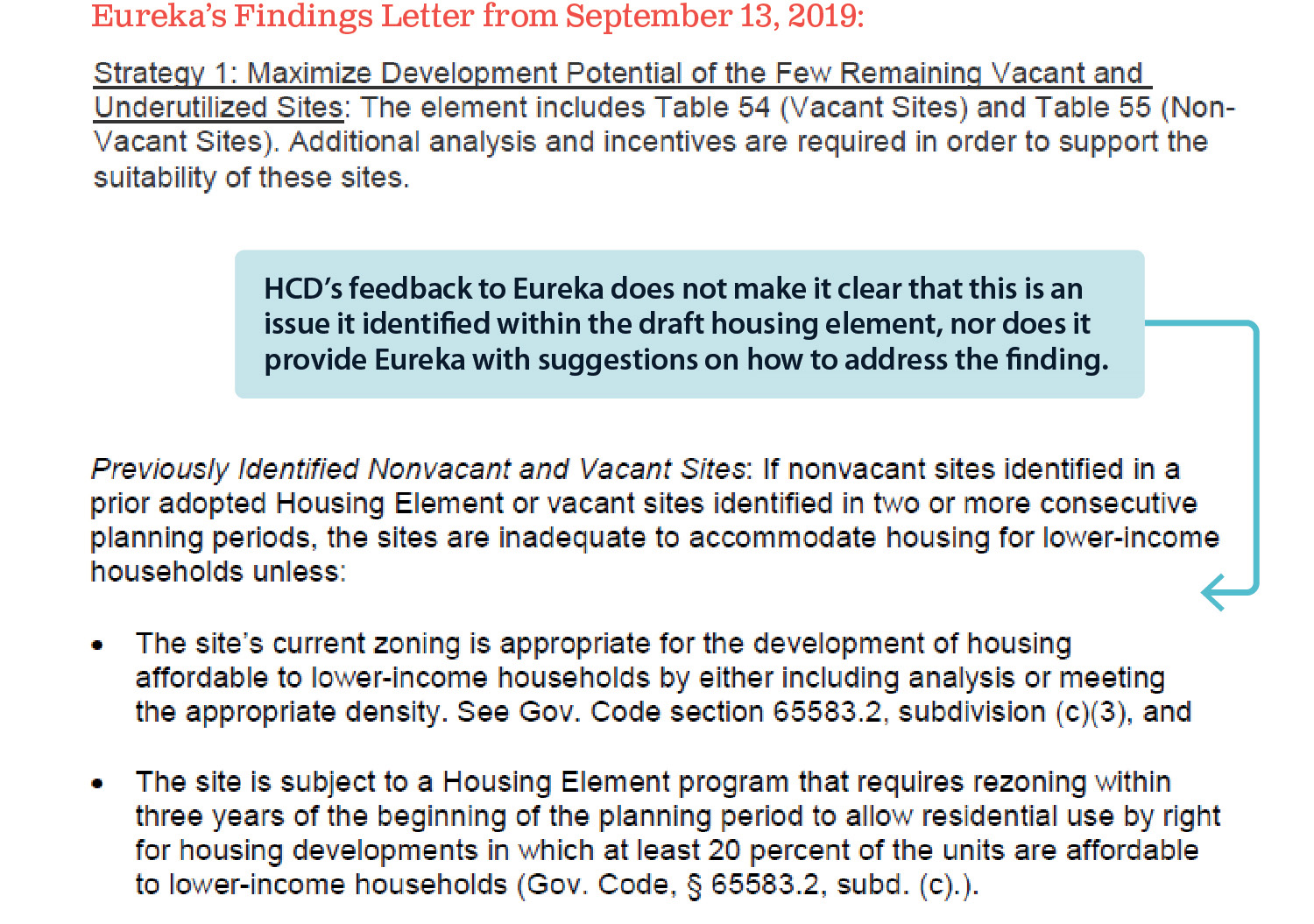
We identified only one finding that was not precise and measurable. In HCD’s findings letter to Eureka, HCD discussed the finding about previously identified nonvacant and vacant sites, as Figure 13 shows. The finding does not clearly identify the issue within Eureka’s draft housing element, and it does not present possible solutions to remedy the finding. When we met with HCD to discuss our determination that this finding was not precise and measurable, an HCD manager disagreed and expressed the belief that the finding was sufficiently precise and specific for Eureka to apply to their housing element. The findings letter in question was from September 2019—the oldest letter we reviewed. Given the letter’s age and the fact that we did not identify similar issues in the other letters in our selection, we determined that this finding was not a significant concern.
Figure 13
In the Finding We Reviewed, HCD Did Not Provide Precise and Measurable Feedback to Eureka
Source: HCD’s findings letter to Eureka.
Figure 13 is a graphic depicting a finding from HCD’s findings letter to Eureka dated September 13, 2019, where HCD did not provide precise and measurable feedback. The graphic focuses on a finding related to Previously Identified Vacant and Nonvacant Sites, where HCD stated that if nonvacant sites identified in a prior adopted Housing Element or vacant sites identified in two or more consecutive planning periods, the sites are inadequate to accommodate housing for lower-income households unless they meet certain specific criteria. The graphic indicates that this feedback HCD sent to Eureka does not make it clear that the finding was an issue identified with the housing element draft, nor does it provide Eureka with suggestions on how to address the finding.
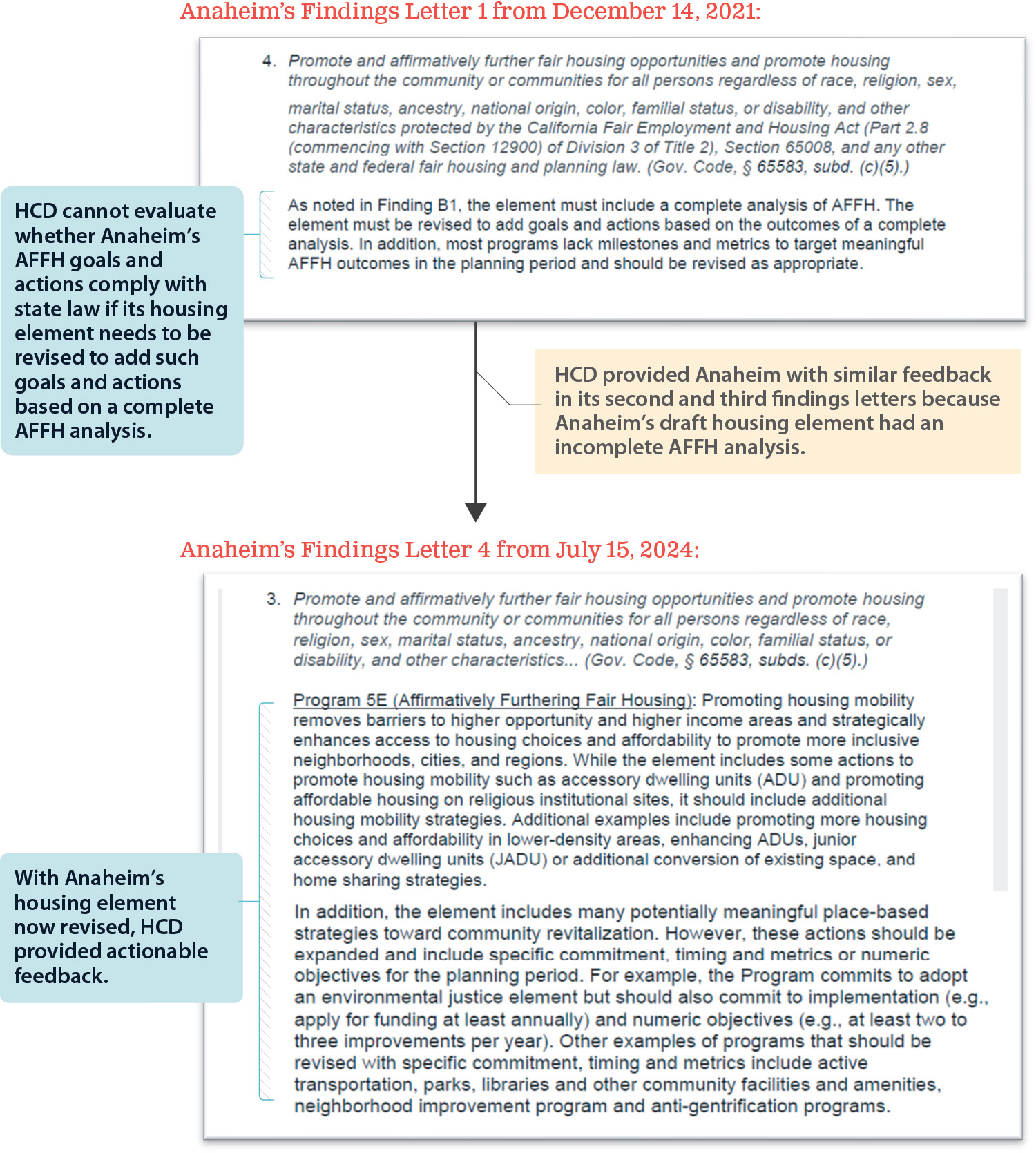
Further, when a local jurisdiction’s housing element was either substantially or entirely lacking required analyses, HCD offered general feedback to complete the missing sections. In one example that Figure 14 shows, HCD offered only general feedback to Anaheim about its AFFH programs because the AFFH section of Anaheim’s draft element was incomplete. In subsequent drafts, when Anaheim provided HCD with additional information, HCD gave more specific feedback that included precise guidance on how Anaheim should modify its programs.
Figure 14
HCD Offered General Feedback When Local Jurisdictions Provided Incomplete Draft Housing Elements
Source: HCD’s findings letters for Anaheim.
Figure 14 is a graphic depicting two examples from findings letters sent to Anaheim where HCD offered general feedback because Anaheim provided incomplete draft housing elements. The graphic took the first example from Anaheim’s first findings letter from HCD, dated December 14, 2021. In the findings letter, HCD provides a brief paragraph stating that the housing element must include a complete analysis of AFFH. The graphic indicates via a textbox that HCD cannot evaluate whether Anaheim’s AFFH goals and actions comply with state law if its housing element needs to be revised to add such goals and actions based on a complete AFFH analysis. The graphic also indicates via a separate textbox that HCD provided Anaheim with similar feedback in its second and third findings letters because Anaheim’s draft housing element had an incomplete AFFH analysis. The graphic then provides the second example from Anaheim’s fourth findings letter from HCD dated July 15, 2024. In the letter, HCD provides multiple detailed paragraphs with specific feedback on Anaheim’s AFFH programs. The graphic indicates via a textbox that, with Anaheim’s housing element now revised, HCD provided actionable feedback.
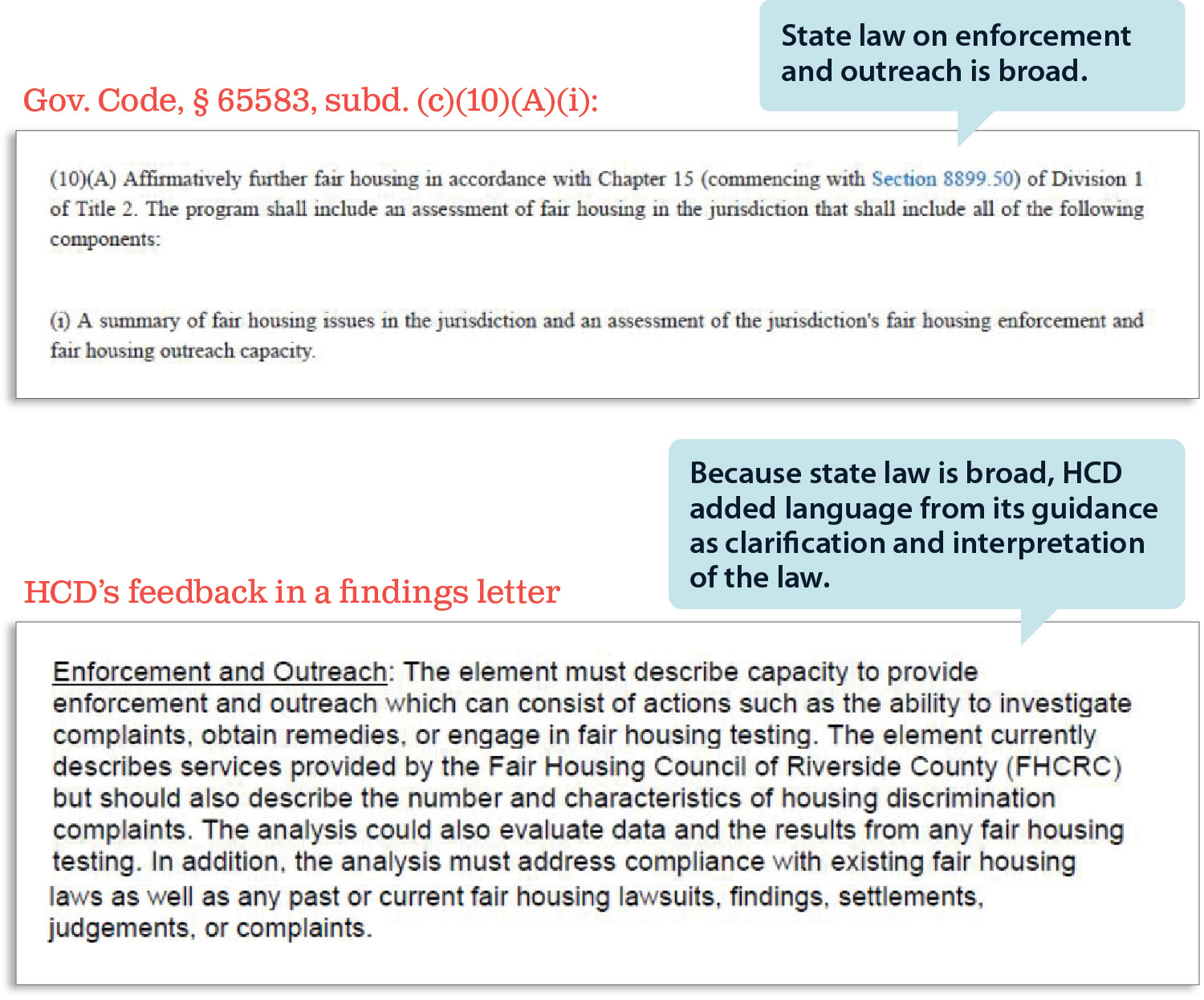
HCD provided feedback based on criteria—feedback that is supported by law or online guidance—to local jurisdictions in its findings letters. We reviewed the same 60 findings to determine whether the feedback was based on criteria and whether the language in these findings aligned with state law. Specifically, 50 of the 60 findings we reviewed included language that directly aligned with state law. The remaining 10 findings had some language that was not clearly based in law but was based on HCD’s online guidance. We therefore determined that all 60 findings were based on criteria. For these 10 findings, the requirements in state law are broad, and HCD’s online guidance provides additional clarity and direction for jurisdictions. Figure 15 is an example of one finding in which HCD added language from its online guidance to provide additional clarity on the law. This finding is based on the state law requirement that a local jurisdiction shall include in its AFFH analysis an assessment of a local jurisdiction’s fair housing enforcement and outreach capacity; however, as Figure 15 demonstrates, state law does not describe what this assessment should look like or contain. To address this gap, HCD’s findings letters include information from its online guidance that details what these assessments should include.
Figure 15
HCD’s Feedback in Some Cases Contained Language That Was Not Clearly Supported in Law but Was Clearly Supported in HCD Guidance
Source: State law and HCD’s written findings letter to Canyon Lake.
Figure 15 is a graphic depicting how HCD’s feedback, in some cases, contained language that was not clearly supported in law, but was clearly supported in HCD’s guidance. The graphic focuses on an AFFH finding related to outreach and enforcement. First, the graphic provides an excerpt from Government Code section 65583, subdivision (c)(10)(A)(i), which details AFFH outreach and enforcement. The graphic indicates that state law on enforcement and outreach is broad. Next, the graphic provides an excerpt from HCD’s written findings letter to Canyon Lake, where it provides feedback to Canyon Lake on its AFFH enforcement and outreach programs. The graphic indicates that because state law is broad, HCD added language from its guidance as clarification and interpretation of the law.
However, our review of the finding in Figure 15 also revealed an instance when HCD used inconsistent language when providing its interpretation of the law. HCD’s feedback includes statements like “The element must describe capacity,” “The element…should also describe the number…,” and “The analysis could also evaluate data.” In each of these instances, HCD does not clarify whether the feedback is from state law or is a suggestion from HCD. HCD stated that it uses the terms must, should, and could to convey different types of requirements and suggestions in its housing element findings letters. According to HCD, it uses must when referring to requirements in statute; could when referring to suggestions or examples of how a jurisdiction might bolster its analysis; and should when referring to information that local jurisdictions are likely to need in order to have a sufficient analysis. It also stated that its usages of must and should sometimes overlap and are not always consistent because it does not want to restrict local jurisdictions from implementing an alternative approach to addressing a finding. Nonetheless, HCD should ensure that it uses consistent language to indicate to local jurisdictions what is a requirement and what is a suggestion.
We also found that HCD generally used consistent feedback between jurisdictions for similar findings. When we reviewed the content and language of HCD’s feedback for three of the six findings topics in Figure 11, we found that HCD’s findings used similar language and phrasing, and similar key points between jurisdictions. For example, in its letters to seven local jurisdictions that had findings related to AFFH outreach and enforcement, HCD consistently stated that the local jurisdictions must address their compliance with existing fair housing laws as well as any past or current fair housing lawsuits, findings, settlements, judgments, or complaints. HCD’s feedback was similarly consistent for the other two findings topics we reviewed.
Although we determined that HCD’s findings letters provide meaningful, precise feedback that is supported in law or guidance, HCD also needs to provide individualized assistance to jurisdictions who are struggling to develop compliant housing elements. Specifically, eight of the 10 local jurisdictions expressed the sentiment that the letters alone were not sufficient to allow them to understand how to address HCD’s findings and develop a compliant housing element. However, as we show in Figure 4, the statewide median for number of drafts during the sixth cycle was three, fewer than that of most of the 10 local jurisdictions we selected for our review. Additionally, according to HCD, it cannot dictate what local jurisdictions must do to achieve compliance because the local jurisdictions are the most knowledgeable about which housing plans work best in their respective communities. However, through individualized assistance, it can answer the jurisdictions’ questions and collaborate on various approaches that the jurisdictions may choose to take. In fact, nine of the 10 selected local jurisdictions reported that a combination of the feedback from the written findings letters and individualized assistance with HCD had allowed them to understand and address HCD’s findings, as we discuss in the next section.
Staffing and Workload Constraints Limit HCD’s Ability to Offer Individualized Assistance
In addition to meeting its statutory obligations to formally review revised housing elements and to provide its findings in writing to local jurisdictions, HCD also offers local jurisdictions various forms of individualized assistance to help ensure their ability to submit compliant housing elements. This individualized assistance—which may include video meetings, phone calls, and written feedback—allows HCD staff to respond directly to the local jurisdictions’ questions and suggest alternatives for meeting requirements. For example, staff may meet with local jurisdictions to discuss HCD’s formal findings letters and to provide informal feedback on a paragraph, a section, or an entire draft of a housing element. HCD managers noted that in these meetings, they sometimes provide sample ordinances, analyses, or examples.
This type of individualized assistance plays a critical role in helping local jurisdictions develop compliant housing elements. In fact, agreements between HCD and jurisdictions approved by state courts frequently require meetings to resolve issues in the housing element review process. For example, after the city of Malibu did not develop a compliant housing element before its deadline, the city and HCD entered into a stipulated judgment requiring HCD to meet with the city by video conference for at least one hour after receiving HCD’s findings letter and for HCD to commit at least 2.5 hours in assistance over the telephone per month to Malibu. The court’s decision to approve the agreement demonstrates the value of individualized assistance in resolving difficult issues in the housing element review process.
HCD managers emphasized that individualized assistance is especially important for resolving certain complex findings that may be difficult to address through written communication alone—a sentiment that eight of the 10 local jurisdictions we interviewed echoed. For example, Santa Barbara staff stated that they met with HCD staff every two weeks for a three-month period and that these meetings helped the jurisdiction make progress toward compliance. Santa Barbara explained that during these meetings, HCD staff provided clarification about the department’s written guidance, workshopped solutions, and offered additional direction regarding the State’s expectations. In fact, even the two local jurisdictions—Eureka and Del Mar—that said the individualized assistance they received was not sufficient to help them develop a compliant housing element stated that HCD’s assistance had provided additional clarification beyond its findings letters.
One form of individualized assistance that HCD offers is what it calls informal reviews. During informal reviews, local jurisdictions may submit draft housing elements or specific questions to HCD. In response, HCD provides feedback either in writing, during meetings, or both. These informal reviews may include a worksheet that HCD completes to evaluate whether the local jurisdiction has met the numerous housing element requirements. In one example, HCD’s documentation for its informal review of Oakland’s housing element included evaluations of specific sections, such as the Affirmatively Furthering Fair Housing (AFFH) section—which involves taking meaningful actions to facilitate deliberate action to explicitly address, combat, and relieve disparities from past patterns of segregation—and the sites inventory. The documentation shows that HCD included several questions and comments for Oakland, organized by section. In another example, Canyon Lake submitted a list of questions to HCD related to its housing needs obligation, and HCD met with the local jurisdiction to discuss possible answers.
Although the Audit Committee instructed us to determine how long local jurisdictions generally waited for assistance from HCD, the department does not consistently track the individualized assistance it provides, limiting its ability to demonstrate the frequency or consistency of such support. However, HCD’s housing element tracking system records the date that a local jurisdiction submitted a portion or all of its draft housing element to HCD for informal review and the date when HCD completed that review. As of November 2024, the housing element tracking system indicates that during the sixth cycle, HCD conducted eight informal reviews among our 10 selected local jurisdictions and that the length of these reviews ranged from six to 51 days, as Table 3 shows. Because this review duration is less than the 60-day review period mandated by state law for reviewing revised housing elements, we believe that this is reasonable. However, HCD did not maintain consistent supporting documentation for these informal reviews; as a result, we were able to independently verify the time it took for only four out of the eight reviews.
Although both HCD and local jurisdictions expressed the importance of individualized assistance, HCD explained that it does not always have the capacity to provide such help. HCD’s internal procedures indicate that during a typical housing element review process, staff should reach out to a local jurisdiction to schedule a call around the middle of the review window. However, according to HCD managers, reviewers often deviate from this procedure during peak workload. Similarly, HCD’s internal procedures state that the department’s decisions on whether to accommodate requests for informal reviews depend on its current workload. HCD managers explained that they cannot always offer the level of assistance they would like or that local jurisdictions request because of workload challenges—an issue we discuss in a later section. Nonetheless, HCD agreed that if it had the staffing capacity, implementing more specific procedures to offer meetings after sending each findings letter would improve the housing element review process.
Although HCD Provides Detailed Guidance on Certain Requirements, It Does Not Always Issue Such Guidance in a Timely Manner
HCD’s website offers many resources that local jurisdictions can access online. These include HCD’s Building Blocks—comprehensive online guides to assist local jurisdictions in creating compliant housing elements. In the Building Blocks, HCD provides the requirements for each component of the housing element, an explanation of the relevant state law, and other details, such as helpful tips and sample analyses and tables. HCD also publishes on its website memos, ranging from a few pages in length to nearly 100 pages, which serve as guides to updates in housing law or to certain sections of the housing element. In addition, HCD’s website contains resources such as checklists, sample analyses, templates, and local examples.
HCD has also worked with COGs to provide other types of assistance to local jurisdictions. For example, during the sixth cycle, HCD offered numerous presentations and webinars for the local jurisdictions in different COGs. According to HCD, webinars are the primary way that HCD reaches out to all local jurisdictions before their deadlines. HCD also stated that during the sixth cycle, it worked with COGs to develop regional assistance plans that allowed local jurisdictions to request tailored assistance based on their specific needs. HCD provided examples of these plans, which demonstrate that HCD offered resources such as monthly office hours and specific tools to certain COGs. For example, according to the assistance plan for the Association of Bay Area Governments (ABAG), HCD held webinars every two weeks from February through August 2022. According to HCD, every local jurisdiction receives the same baseline level of technical assistance through the webinars and the general presentations, but the regional plans allowed local jurisdictions to receive extra assistance as requested.
When we evaluated the available guidance for the six findings topics shown in Figure 11, we determined that HCD’s Building Blocks, memos, and other guidance available online are sufficiently detailed for jurisdictions to apply to their housing element. These resources explain the requirements local jurisdictions have to meet, and they also provide examples and suggestions for how they might address them. For example, HCD covers the topic of the required analysis of the suitability of nonvacant sites in two forms: on its website as part of its Building Blocks and as a memo guidebook. The guidance identifies the analysis that local jurisdictions must include and provides examples of approaches jurisdictions can use. For instance, for the required analysis of existing uses and their potential for redevelopment, HCD explains that a 1960 strip commercial center with few tenants and expiring leases would be a good candidate for residential redevelopment, and a newly opened retail center with active businesses would be unlikely to be available for this purpose.
While jurisdictions reported that HCD’s online guidance alone was not sufficient, we found that individualized assistance helped address this issue. Of the 10 local jurisdictions we interviewed, eight stated that using HCD’s online tools alone did not allow them to create compliant housing elements. Four local jurisdictions noted that templates that provide specific examples of what HCD expects from the jurisdictions would be useful. Although HCD provides some templates, it indicated that sample analyses tend to be more effective. However, it added that templates can also be effective if they are designed so they can be adapted to unique circumstances. HCD also stated that individualized assistance allows it to offer tailored assistance and create a dialogue with local jurisdictions that may assist them in developing compliant housing elements.
Two of the 10 local jurisdictions we reviewed—Oakland and Beverly Hills—raised concerns about HCD’s lack of timely guidance about new requirements. As we previously described, the Legislature made two significant changes to state law for the sixth cycle: the first added new sites inventory requirements and the second created the AFFH requirements. There were 39 local jurisdictions with a compliance deadline before April 2020, when HCD released the AFFH guidance, and 43 with a deadline before June 2020, when HCD released the updated sites inventory guidance. However, as Figure 16 shows, HCD did not release timely guidance for these changes in law. Although HCD provided some high-level guidance for the new sites inventory requirements through frequently asked questions and offered in-person presentations to two COGs that had earlier compliance deadlines in 2019 and 2021, the general guidance was not detailed enough for jurisdictions to apply to their housing elements. Additionally, the in-person presentations offered did not guarantee that all the jurisdictions within the COGs were able to attend. Furthermore, jurisdictions with earlier compliance deadlines outside of the two COGs did not receive access to the detailed, in-person guidance.
Figure 16
HCD Did Not Release Guidance Following Two Changes in State Law Until After Some Local Jurisdictions’ Deadlines for Adopting Housing Elements
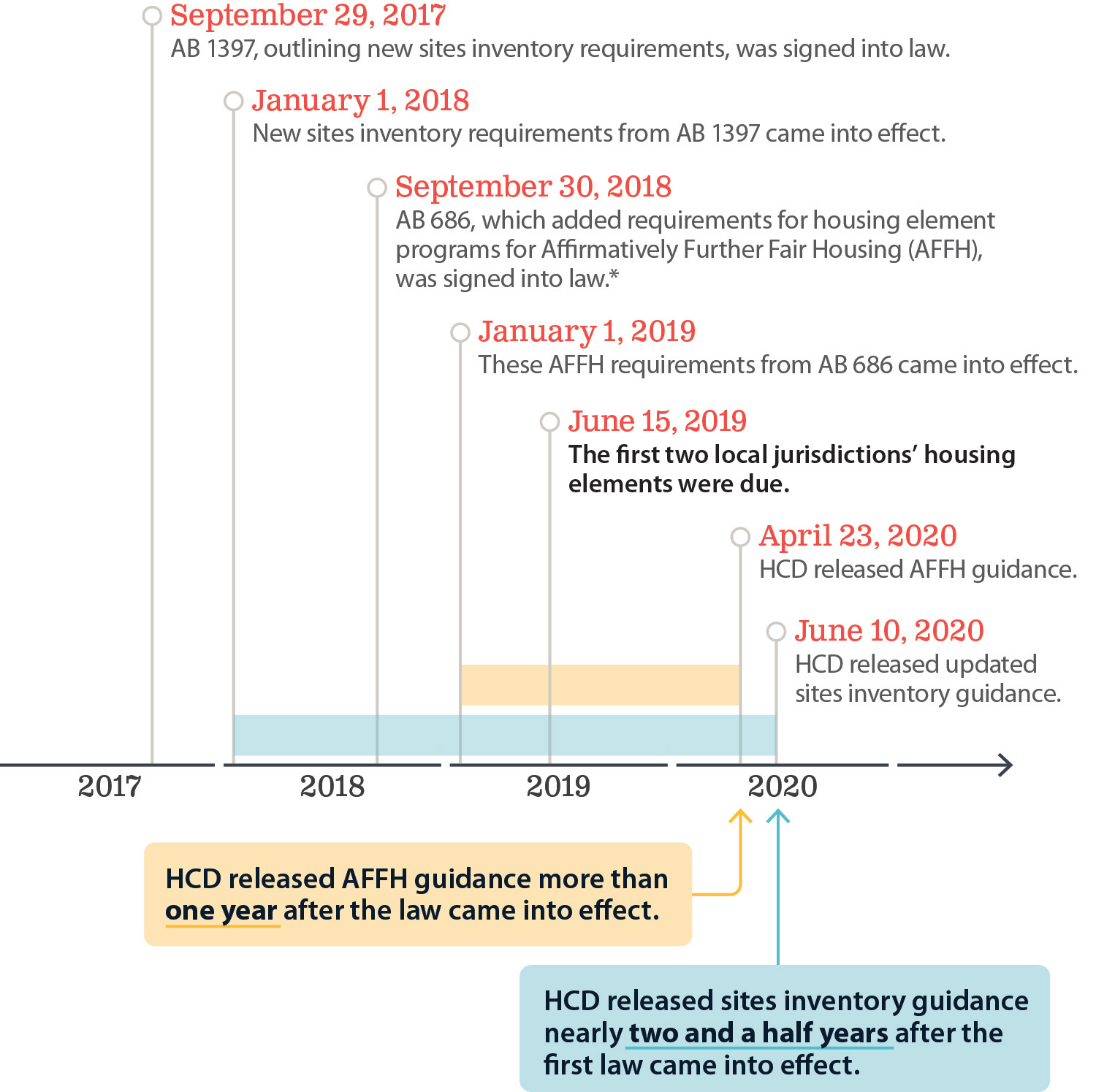
Source: State law and HCD documentation.
*AB 686 also introduced requirements for housing elements to include an assessment of AFFH that came into effect for all local jurisdictions with a compliance deadline on or after January 1, 2021.
Figure 16 is a timeline depicting how HCD did not release guidance following two significant changes in state law until after some local jurisdictions’ deadlines for adopting housing elements had already passed. The timeline begins in 2017 and ends in 2020 and indicates that HCD released AFFH guidance more than one year after the law came into effect, and that HCD released sites inventory guidance nearly two and a half years after the first law came into effect.
The beginning of the timeline indicates that on September 29, 2017, AB 1397, outlining new sites inventory requirements, was signed into law.
Next, the timeline indicates on January 1, 2018, new sites inventory requirements from AB 1397 came into effect. Then, the timeline indicates on September 30, 2018, AB 686, which added requirements for housing element programs for Affirmatively Furthering Fair Housing (AFFH), was signed into law. A footnote additionally indicates that AB 686 also introduced requirements for housing elements to include an assessment of AFFH that came into effect for all local jurisdictions with a compliance deadline on or after January 1, 2021.
Next, the timeline indicates that on January 1, 2019, these AFFH requirements from AB 686 came into effect. The timeline also indicates that on June 15, 2019, the first set of housing elements were due.
Next, the timeline indicates that on April 23, 2020, HCD released AFFH guidance, and the timeline states via textbox that HCD released this AFFH guidance more than one year after the law came into effect. Finally, the timeline indicates that on June 10, 2020, HCD released updated sites inventory guidance, and the timeline states via textbox that HCD released this sites inventory guidance nearly two and a half years after the first law came into effect.
HCD did not release detailed comprehensive guidance until nearly two and a half years after the law came into effect for sites inventory requirements, leaving the jurisdictions with an early compliance deadline without comprehensive guidance. Furthermore, HCD did not release guidance for AFFH requirements for housing element programs until more than one year after the law came into effect. These requirements address significant disparities in housing needs and access to opportunity, including integration and segregation patterns and racially concentrated areas of affluence and poverty. As a result, 37 local jurisdictions were required to adopt compliant housing elements in August 2019, as the text box shows, or eight months before HCD’s release of the AFFH guidance and 10 months before its release of sites inventory guidance. HCD stated that for the 39 local jurisdictions that were required to submit their housing element updates before HCD released the AFFH guidance, it provided sample language to help these jurisdictions address the requirement in their findings letters. However, the late guidance also does not allow other local jurisdictions with later deadlines to prepare their housing element updates by the compliance deadlines given that it took local jurisdictions a median of three submissions and more than one year to gain compliance during the sixth cycle.
The Number of Local Jurisdictions With Earlier Compliance Deadlines
June 2019:……………………………….2 Local Jurisdictions
August 2019:…………………………..37 Local Jurisdictions
April 2020:………………………………4 Local Jurisdictions
December 2020:………………………11 Local Jurisdictions
Source: HCD documentation.
We identified two reasons that explain why HCD did not publish timely guidance: the State allowed for only three months from signing the law to the effective date, and HCD does not have a documented process for developing guidance, which can take a long time. For both examples of untimely guidance, there was only a three-month period between when the new housing element requirements were signed into law and when they came into effect, indicating that there was very little time for HCD to develop comprehensive guidance; although we do note that the local jurisdictions’ due dates provided HCD with some additional time beyond the three months. In addition, HCD management stated that its process for developing new guidance includes several steps before it can begin drafting guidance and that its timelines for releasing guidance vary from a few months to a year and a half, depending on the significance of the changes in law. However, HCD does not have written policies governing its process for developing guidance, such as establishing timelines to ensure that it publishes guidance before those requirements take effect. According to HCD, when local jurisdictions work on new housing element components before it has created the relevant guidance, its goal is to provide more individualized assistance. In fact, it stated that its conversations with local jurisdictions related to the sites inventory and AFFH requirements shaped the guidance that it eventually produced. However, until it has published resources that set standards for how local jurisdictions should address new requirements, HCD lacks controls to ensure that local jurisdictions receive consistent feedback and guidance that will enable them to develop compliant housing elements in a timely manner.
HCD Needs to Perform a Workforce Analysis to Ensure That It Can Manage Workload Spikes
HCD experienced inconsistent staffing levels among its housing element primary reviewers during both the fifth and the sixth housing element cycles. Although HCD lacks documentation—such as detailed time allocation records specific to housing element reviews—that would allow us to determine the turnover of housing element reviewers, we reviewed information on reviewers assigned in the housing element tracking system as a method to determine the number of primary reviewers who worked on housing elements each year. Staff turnover in this section refers to the rate at which housing element primary reviewers are no longer assigned to housing element reviews in HCD’s housing element tracking system, including when staff leave the organization, are promoted to other positions, or are assigned to other duties outside of housing element reviews, relative to the number of primary reviewers assigned in the system. According to several studies on employee turnover, high employee turnover can negatively affect operational efficiency by increasing recruitment and training costs, disrupting institutional knowledge, and making it more difficult to maintain consistent services over time. As Figure 17 shows, HCD’s data indicate that from 2021 through 2023—when local jurisdictions submitted the majority of their draft housing elements for the sixth cycle—HCD’s turnover rate for these reviewers ranged from 11 percent to 48 percent.12
Figure 17
HCD’s Housing Element Reviewer Staffing Has Been Inconsistent
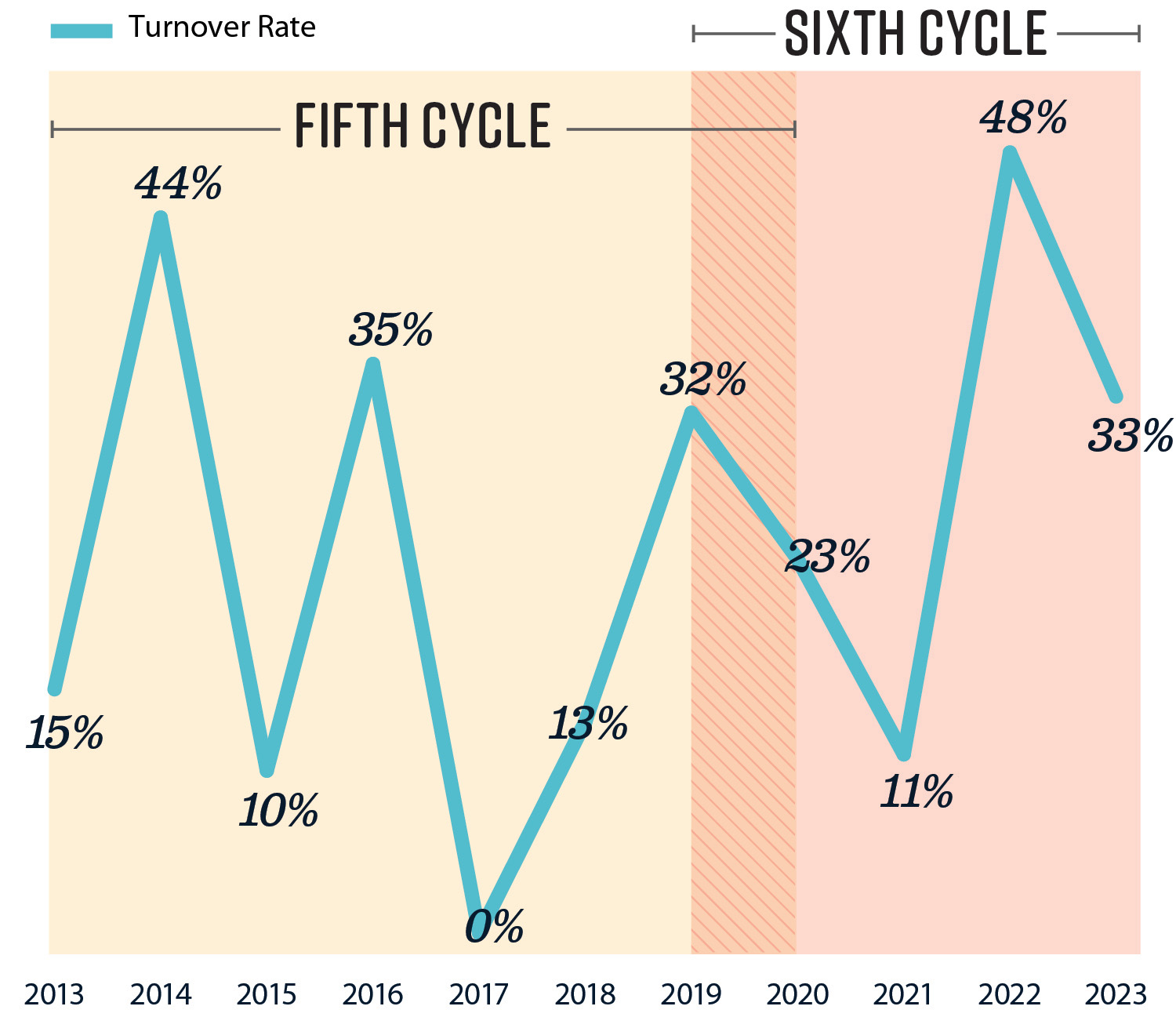
Source: Auditor analysis of HCD’s housing element tracking system data as of November 2024.
Notes: HCD’s housing element tracking system only records the primary reviewer assigned to each housing element and does not capture other reviewers. Therefore, we present the minimum number of reviewers assigned during each year.
HCD does not track the exact dates or have supporting documentation for when staff stopped working on housing elements; therefore, we could not verify the accuracy of this information.
The cycles overlap in some years because some local jurisdictions began submitting their sixth-cycle draft housing elements early, while other local jurisdictions were still submitting their fifth-cycle housing elements.
Figure 17 is a modified line graph depicting that HCD’s housing element reviewer staffing levels have been inconsistent from 2013 to 2024, between the fifth and sixth cycles. The graph contains a blue line depicting turnover rates beginning in 2013 during the fifth cycle, which began in 2013 and ended in 2020, and extending into the sixth cycle, which began in 2019 and continued past 2023.
In 2013, the graph indicates that the turnover rate was 15%.
In 2014, the graph indicates that the turnover rate was 44%.
In 2015, the graph indicates that the turnover rate was 10%.
In 2016, the graph indicates that the turnover rate was 35%.
In 2017, the graph indicates that the turnover rate was 0%.
In 2018, the graph indicates that the turnover rate was 13%.
In 2019, the graphic indicates that the turnover rate was 32%.
In 2020, the graphic indicates that the turnover rate was 23%.
In 2021, the graphic indicates that the turnover rate was 11%.
In 2022, the graphic indicates that the turnover rate was 48%. In 2023, the graphic indicates that the turnover rate was 33%.
During these three years, HCD had an average of 30 staff who worked on housing elements each year as primary reviewers. However, HCD had 16 positions for housing element reviewers, so not all of these reviewers worked on housing elements full time. In addition to reviewing housing elements, these primary reviewers perform other duties, including providing assistance to local jurisdictions and reviewing annual progress reports from jurisdictions with compliant housing elements. According to HCD, some of the fluctuations in staff assigned to housing elements can be attributed in part to reallocating resources to housing elements during peak review times. However, the rate of turnover may also indicate staff burnout during peak submissions. HCD’s data shows that for the 13-year period from 2012 to 2024, on average its primary reviewers worked on housing elements during three of those 13 years, with a median between two and three years.
Although the Audit Committee asked us to determine how long a housing element reviewer remained assigned to the same local jurisdiction, HCD’s data system does not track the duration of time that a reviewer was assigned to a housing element or identify the total number of reviewers assigned to each local jurisdiction. According to HCD, it generally assigns one primary housing element reviewer to a local jurisdiction, but other reviewers may assist in a supporting role. Nevertheless, we present the information available in HCD’s data about the minimum number of reviewers that worked on each of the 10 selected local jurisdictions’ housing elements. As shown in Table 4, for the 10 local jurisdictions that we reviewed, each had between one and four primary reviewers work on their sixth-cycle housing element, with a median and average of two primary reviewers. Only Anaheim and Rialto had four reviewers work on their housing elements. However, according to HCD, although Anaheim and Rialto had four housing element reviewers, they each had one consistent person involved in each review for continuity. Further, as Table 4 shows, HCD had a statewide median of one primary housing element reviewer, and an average of 1.4 and 1.5 primary reviewers in the fifth and sixth cycles, respectively.
HCD acknowledged that it faced retention challenges during the sixth cycle, attributing the housing element reviewer turnover, in part, to the significant workload associated with the increased volume and complexity of housing element submissions. Specifically, local jurisdictions submitted more drafts during the sixth cycle than during the fifth cycle, adding to HCD’s workload. As Figure 18 shows, during the fifth cycle, local jurisdictions submitted the majority of draft housing elements from 2013 through 2015, with a peak of 344 submitted in 2014. However, local jurisdictions submitted more drafts for the sixth cycle, with a peak of 485 in 2023. The increase in the number of drafts that local jurisdictions submitted caused an increase in the workload for HCD reviewers, which made it more challenging to provide individualized assistance to jurisdictions.
Figure 18
Local Jurisdictions Submitted More Housing Elements for the Sixth Cycle
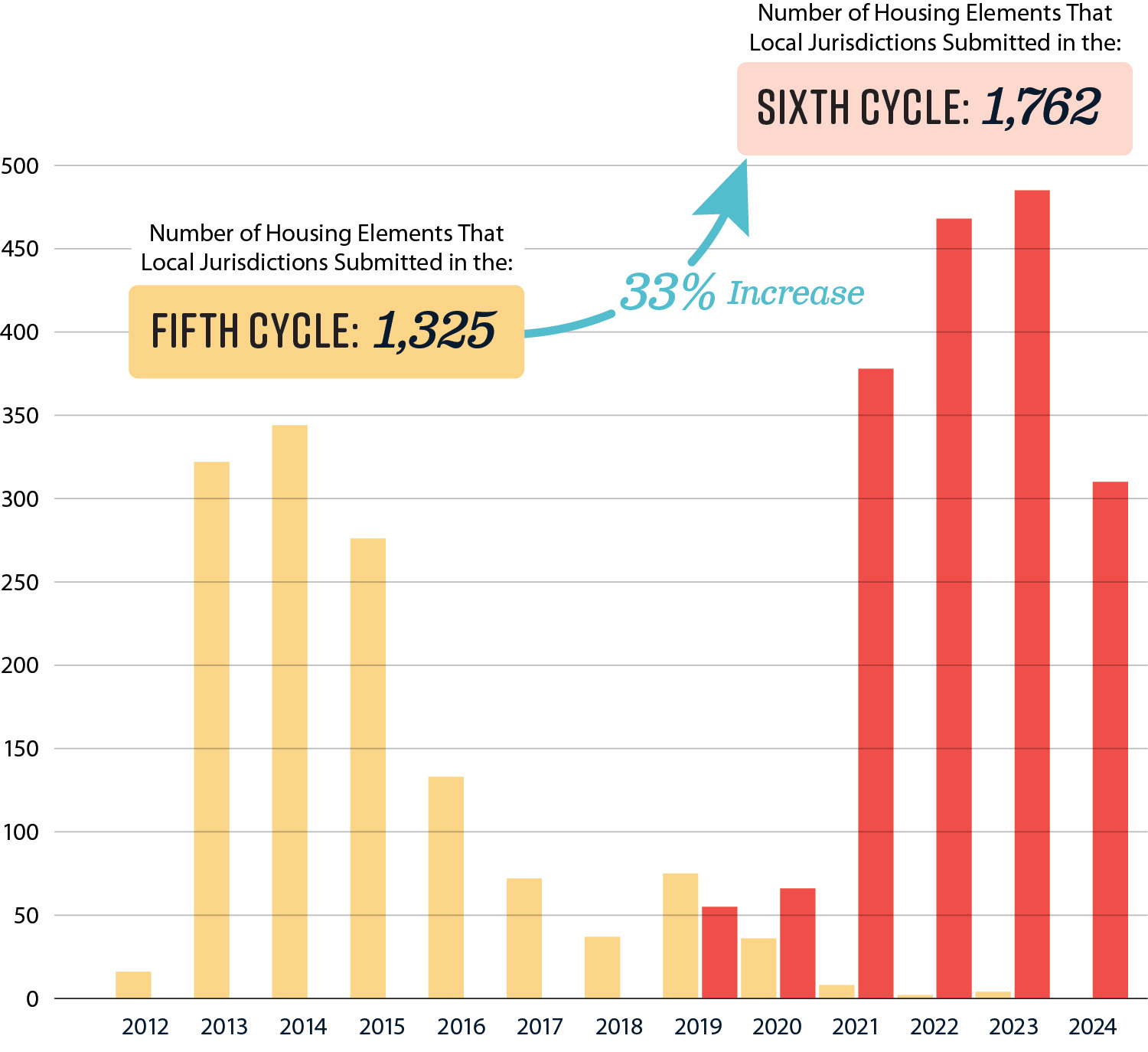
Source: Auditor analysis of HCD’s housing element tracking system data as of November 2024.
Note: The total number of housing elements increased in the sixth cycle because local jurisdictions submitted, on average, more housing elements before completing the approval process.
Figure 18 is a vertical bar chart indicting the increase in housing elements local jurisdictions submitted from the fifth to the sixth cycle, depicting a 33 percent increase between the fifth and sixth cycles. The chart depicts the fifth cycle totals using yellow bars, and the sixth cycle totals using red bars, with the fifth cycle beginning in 2012 and the sixth in 2019, with an overlap between the fifth and sixth cycles from 2019 to 2023. The chart further indicates that local jurisdictions submitted a total of 1,325 drafts for the fifth cycle, with peaks in the number of drafts submitted in 2013, 2014, and 2015. In 2013, jurisdictions submitted 322 drafts; in 2014, jurisdictions submitted 344 drafts; and in 2015, jurisdictions submitted 276 drafts. The chart also indicates that local jurisdictions submitted a total of 1,762 drafts for the sixth cycle, with peaks in the number of drafts submitted in 2021, 2022, and 2023. In 2021, jurisdictions submitted 378 drafts; in 2022, jurisdictions submitted 468 drafts; and in 2023, jurisdictions submitted 485 drafts. Finally, the graphic also indicates via a footnote that the total number of housing elements increased in the sixth cycle because local jurisdictions submitted, on average, more housing elements before completing the approval process.
HCD also noted other factors that contributed to primary reviewer turnover. These factors include the overlap of housing elements from SCAG and ABAG—the two largest COGs. As Figure 19 shows, having all SCAG and ABAG jurisdictions’ housing elements due within 15 months can create bottlenecks of draft housing elements for HCD to review. According to HCD, this overlap created a stressful work environment. In addition, HCD stated that the salaries its housing element reviewers receive are not competitive with those offered by other employers in similar fields, but it had not conducted a salary analysis to demonstrate this. The increased complexity of the sixth cycle housing element resulted in local jurisdictions revising and resubmitting drafts multiple times.
Figure 19
The Legislature Could Help Reduce Workload Bottlenecks by Further Staggering the Housing Element Due Dates of Some Local Jurisdictions
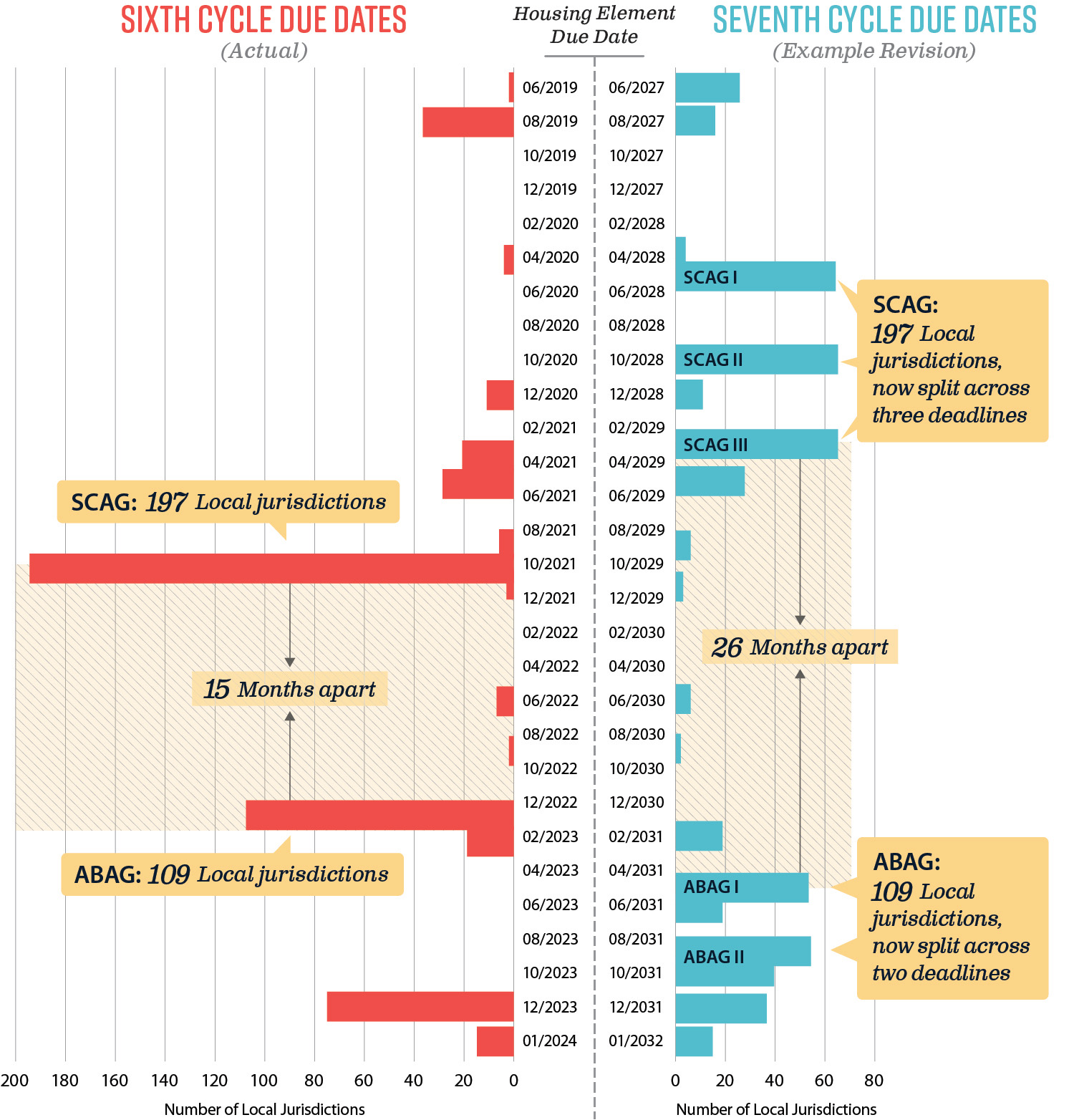
Source: Auditor analysis of HCD data.
Note: The seventh cycle deadlines here are only example deadlines and do not represent a precise count for all local jurisdictions.
Figure 19 is a modified bar chart depicting how the Legislature could help reduce workload bottlenecks by further staggering the housing element due dates of some local jurisdictions. The chart demonstrates this by comparing the current, sixth cycle due dates to proposed example revision of seventh cycle due dates.
On the left side of the bar chart, the chart depicts the current, sixth cycle due dates, with numbers on the X-axis indicating the number of local jurisdictions that share a due date for adopting a compliant housing element. This side of the chart highlights a potential bottleneck between October 2021, when the 197 local jurisdictions that comprise SCAG must adopt their housing elements, 15 months apart from when the 109 ABAG jurisdictions must adopt their housing elements in January 2023. On the right side, the bar chart depicts a potential revision to seventh cycle due dates, which splits the 197 SCAG jurisdictions across three deadlines (May 2028, October 2028, and March 2029) and also splits the 109 ABAG jurisdictions across two deadlines (May 2031 and September 2031), and further increases the time between ABAG and SCAG deadlines to 26 months. The graphic also notes that the seventh cycle deadlines depicted are only example deadlines, and do not represent a precise count for all local jurisdictions.
Further impacting its workload, HCD significantly altered its housing element review process following the fifth cycle to better address evolving legal requirements and increased housing targets. According to HCD, the fifth cycle was less demanding because of relatively low housing needs allocations, and most fourth-cycle housing elements were still relevant for the fifth cycle, which allowed HCD to implement a streamlined review process. Under this approach, HCD conducted a limited review if a local jurisdiction’s fifth-cycle housing element had not changed significantly from the fourth cycle. HCD stated that this streamlined approach was a key strategy for managing workload spikes when HCD reviewed housing elements from two-thirds of the State’s local jurisdictions in a short span.
However, substantial legal and policy changes in the sixth cycle prevented HCD from using the same streamlined approach from the fifth cycle. According to HCD, some local jurisdictions experienced a three-fold increase in their housing needs allocations. Further, the new legal requirements necessitated more comprehensive and time-intensive reviews. In response to its anticipated workload increases for the sixth cycle, HCD submitted a budget change proposal for fiscal year 2019–20. This proposal resulted in a $1.4 million budget increase and an ongoing $1.2 million increase to fund eight additional positions for housing element review and enforcement.13
Since fiscal year 2019–20, HCD has not submitted any additional budget requests or conducted a workforce analysis for its housing element reviewers. Conducting a workforce analysis would allow HCD to better understand and manage its staffing needs. Specifically, according to the U.S. Government Accountability Office, such an analysis could help an organization determine the skills it needs to achieve program goals and develop long-term strategies for acquiring, developing, and retaining staff. Additionally, it would provide data-driven justification for future budget requests and support long-term planning by identifying trends in submission timing and workload spikes. According to HCD, it does not have a policy for when to conduct a workforce analysis on staffing for housing element reviews, but it tentatively plans on conducting one around fiscal year 2026–27 as the seventh cycle approaches. Without such analysis, HCD cannot ensure that it has sufficient staffing to manage workload spikes, such as the increase in drafts during the sixth cycle, or provide adequate support to local jurisdictions.
Given the significant increase in complexity, volume, and legal requirements during the sixth housing element cycle, it is clear that a more robust workforce analysis is essential to ensure timely and effective support for local jurisdictions. The current situation, which results in overlapping deadlines for hundreds of jurisdictions, has led to bottlenecks, stressful review periods, and inconsistent levels of assistance. Breaking up the deadlines into staggered phases would help distribute the workload more evenly across time, allowing both HCD and local jurisdictions to manage resources more efficiently and improve the quality of housing element submissions and reviews. This approach would also help mitigate staff burnout by reducing workload surges and enabling more consistent, manageable review timelines.
HCD Provides Comprehensive Training to New Reviewers, but It Relies Heavily on Experienced Secondary Reviewers to Ensure Consistent Feedback
Training for New Primary Reviewers
As Figure 20 shows, HCD’s comprehensive initial training for housing element primary reviewers consists of four phases: reviewing videos and accompanying documentation; cohort training; shadowing; and independent reviews. To evaluate this training, we reviewed materials that HCD provided, including prerecorded training videos, corresponding presentations, and the syllabus for HCD’s cohort. We found that HCD’s materials—which covered the topics listed in the text box—were detailed enough to provide primary reviewers with core foundational knowledge of the housing element review process.
Topics Covered in HCD’s Housing Element Reviewer Training
- Initial background on housing elements
- Public participation
- Demographics, housing needs, and other requirements
- Constraints analysis
- Sites inventory
- Affirmatively Furthering Fair Housing
- Initial draft reviews
- Subsequent draft reviews
Source: HCD training materials.
Figure 20
HCD’s Training for New Reviewers Consists of Four Stages
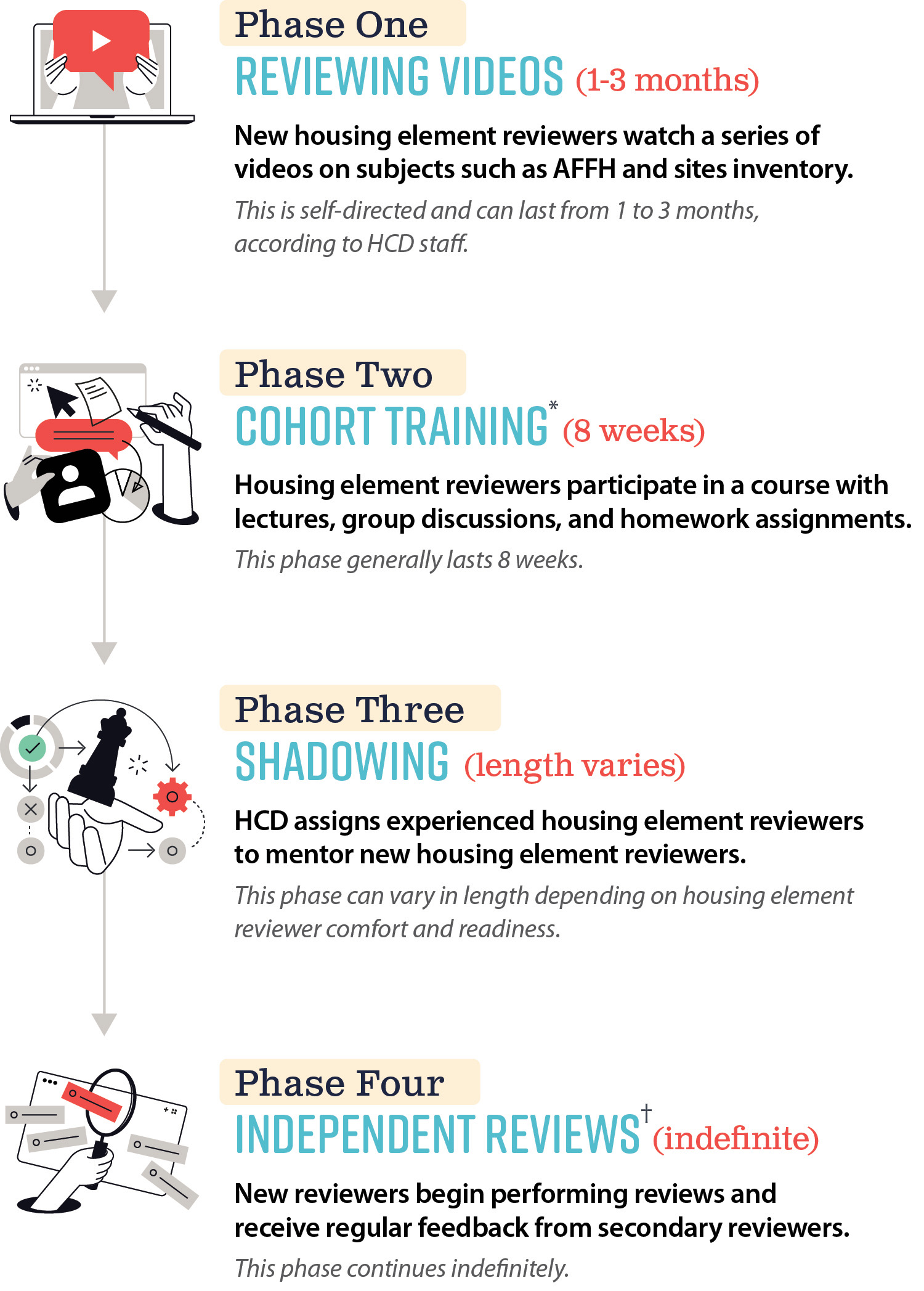
Source: Cohort training syllabus, training presentations and videos, and interviews with HCD staff.
* In practice, this phase does not always immediately occur after Phase One.
† HCD considers this phase—and ongoing feedback from second reviewers in particular—to be part of its training for new reviewers.
Figure 20 is a flowchart depicting the four phases that comprise HCD’s training for new housing element reviewers: reviewing videos, cohort training, shadowing, and independent reviews.
At the top, the chart describes phase one: reviewing videos. The chart indicates that, in this phase, new housing element reviewers watch a series of videos on subjects such as AFFH and sites inventory. The chart further indicates that this phase is self-directed and can last from 1 to 3 months, according to HCD staff.
Next, the chart describes phase two: cohort training. The chart indicates that in this phase, housing element reviewers participate in a course with lectures, group discussions, and homework assignments. The chart further indicates that this phase generally lasts eight weeks, and also indicates via footnote that, in practice, this phase does not always immediately occur after phase one.
Next, the chart describes phase three: shadowing. The chart indicates that in this phase, HCD assigns experienced housing element reviewers to mentor new housing element reviewers. The chart further indicates that this phase can vary in length depending on housing element reviewer comfort and readiness.
Finally, the chart describes phase four: independent reviews. The chart indicates that in this phase, new reviewers begin performing reviews and receive regular feedback from secondary reviewers. The chart further states that this phase continues indefinitely and also notes that HCD considers this phase to be part of its ongoing training for new reviewers.
Furthermore, when we reviewed the training materials that corresponded to the six findings topics we describe in Figure 11, we found that the materials included explanations of state law as well as examples of frequent findings. For example, HCD used a two‑hour training video and supporting materials to provide detailed training about the Affirmatively Furthering Fair Housing (AFFH) finding on missing or incomplete programs. Specifically, HCD introduced AFFH and its background, discussed multiple examples of AFFH programs, introduced reviewers to an internal review sheet, which HCD uses to track and report on AFFH-related findings, and provided tips for reviewing such programs. We show an example of one of HCD’s training slides covering the adequacy of AFFH programs in Figure 21. HCD’s training materials also provided primary reviewers with standardized template language to report their findings, including an internal review worksheet that contains a section for AFFH-related evaluations. HCD also makes available on its website a corresponding Housing Element Completeness Checklist, which contains similar elements to HCD’s internal review checklist. Overall, we concluded that the training and internal guidance—coupled with HCD’s internal review processes described below—is detailed enough to ensure that primary reviewers provide clear comments in the housing element findings letters.
Figure 21
HCD’s Training Slides Include Clear Explanations and Exercises
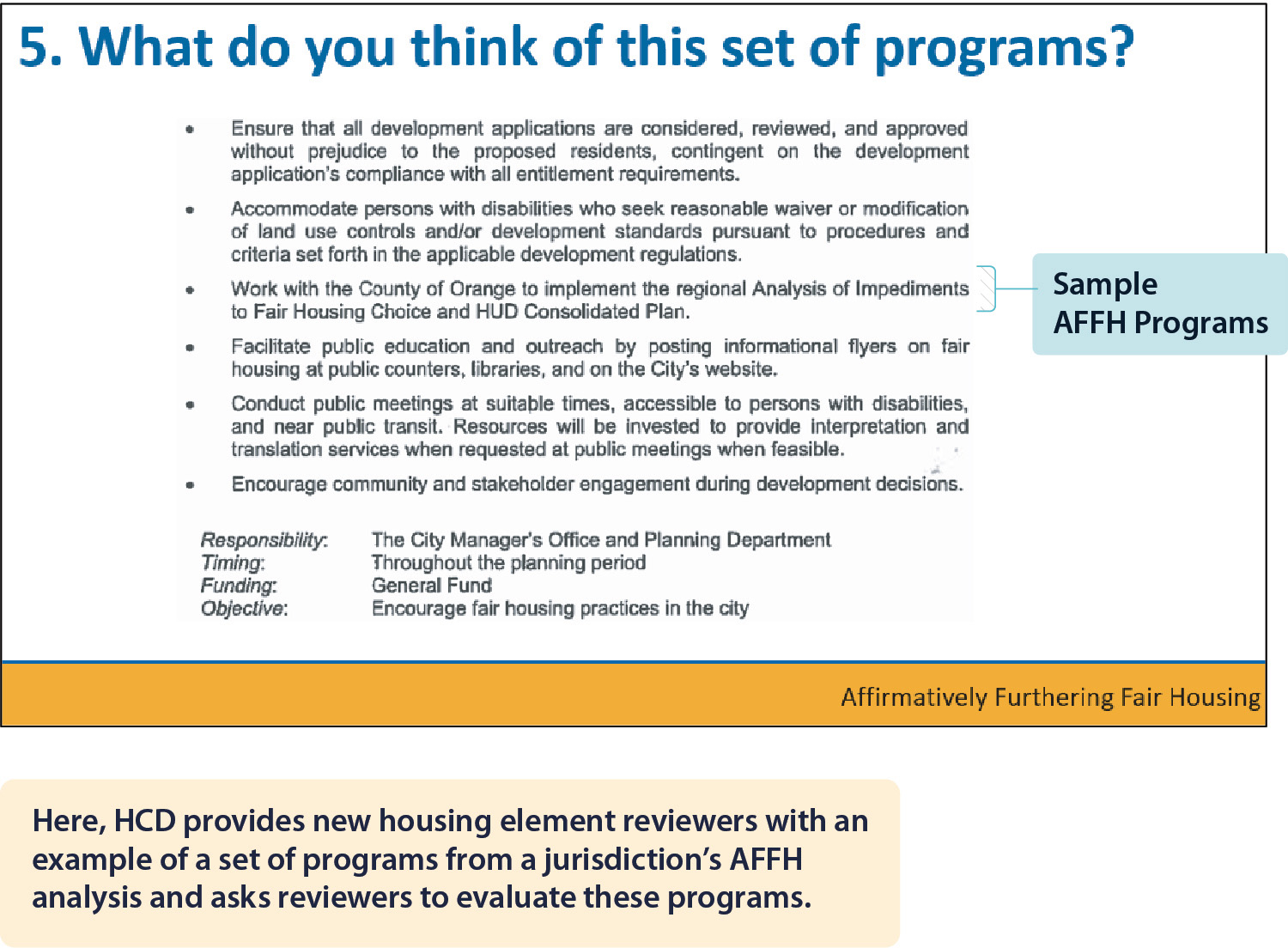
Source: HCD training materials.
Figure 21 is a graphic depicting a slide from HCD’s training that indicates clear explanations and exercises, using an example from HCD’s training related to AFFH programs. The graphic focuses on a slide that depicts six sample AFFH programs and lists the responsibility, timing, funding, and objective of these programs. The graphic contains a textbox indicating where to find the sample AFFH programs, and also states in a separate textbox that here, HCD provides new housing element reviewers with an example set of programs from a jurisdiction’s AFFH analysis and asks reviewers to evaluate these programs
We could not determine the average length of time it takes HCD reviewers to train new staff as the Audit Committee asked because HCD does not track this information. However, to estimate the duration of HCD’s training process, we interviewed a selection of six HCD housing element reviewers, two HCD managers who worked directly on housing element reviews, and one manager who oversaw secondary reviewers in the sixth cycle. Our interviews with HCD management indicated that all new housing element reviewers are, at a minimum, expected to watch the training videos—phase one of initial training—and to receive training with their supervisors before beginning to conduct reviews. Two reviewers told us that phase one took from one to three months; the others did not specify a length of time. All five of the reviewers who were hired during the sixth cycle stated that they completed phase one of training before beginning reviews of housing elements. However, four of the five reviewers also indicated that they did not participate in the cohort training before beginning to conduct housing element reviews.14
Secondary Review Oversight Process
HCD has developed internal review processes that help to ensure consistency in its findings letters, including those written by primary reviewers who have not completed cohort training before they begin performing reviews. Most importantly, HCD’s internal written procedures indicate that all letters written by primary reviewers—including those who completed training—undergo review by a secondary reviewer before they are sent to their respective jurisdictions. For example, after a primary reviewer assessed a draft of Pacific Grove’s housing element, the secondary reviewer left comments on the primary reviewer’s feedback regarding different requirements.
According to HCD, secondary reviewers will also sometimes meet with a primary reviewer to discuss their written feedback if it is confusing or unclear. HCD management indicated that it considers this process to be a component of ongoing training for new primary reviewers. In our interviews, two primary reviewers indicated that they worked closely with secondary reviewers in their initial reviews of housing elements.
However, even though the oversight role of secondary reviewers helps to ensure that HCD provides jurisdictions with clear comments, HCD had only three secondary reviewers as of August 2025. During peak workload spikes—such as those shown in Figure 19—HCD risks overburdening its secondary reviewers; in interviews, several HCD reviewers discussed workload spikes, and management also acknowledged that both primary and secondary reviewers faced workload issues in the sixth cycle.
Ongoing Training
The Audit Committee asked us to review whether HCD offers additional training to existing staff. Although HCD does provide ongoing staff training, it does not track the number of hours of training each staff member has completed. Further, neither the State’s housing element law nor HCD’s authorizing statute establish a legal requirement for housing element reviewers to complete a set amount of training each year. HCD management stated that the primary channel it uses to provide ongoing training to housing element staff is weekly meetings, called housing element open forums, that all reviewers are expected to attend. In the forums, HCD updates staff on changes in housing element requirements.
In addition, HCD stated that it provides ongoing training for its reviewers through feedback on findings letters and by allowing all reviewers, regardless of experience, to enroll in the annual cohort training. HCD indicated that other internal presentations and external trainings are more impromptu in nature. Although HCD does not track the impromptu trainings that its housing element reviewers complete, we reviewed travel itineraries and meeting invitations indicating that housing element reviewers participated in some ongoing training. Nevertheless, we discussed with HCD the importance of keeping reviewers up-to-date, and its management acknowledged the importance of providing ongoing training to reviewers.
Recommendations
Many of our recommendations to the Legislature and HCD should be implemented in combination to effectively address the issues identified in this report. Some recommendations are interdependent and will need to be implemented sequentially. For example, to ensure that HCD can provide individualized assistance to local jurisdictions, certain actions—such as conducting a workforce analysis—should follow any legislative changes to housing element due dates.
Legislature
To reduce the spike in HCD’s workload that occurs when many local jurisdictions submit their revised housing elements contemporaneously, the Legislature should consider amending the housing element law to further stagger these submissions by doing the following:
- Assigning housing element due dates based on smaller regional groupings and local jurisdiction size. Such an amendment should allow local jurisdictions within larger COGs to have different due dates, such as separating ABAG and SCAG deadlines by three years.
- Establishing incentives, such as priority access to housing-related grants or streamlined review by HCD, for local jurisdictions that submit their housing element revisions, including subsequent submittals, ahead of schedule.
To ensure that local jurisdictions and HCD have time to adjust to any new or updated housing element laws without disrupting current planning cycles, the Legislature should consider including a transition period, such as a delay in the effective date of a law passed during a planning cycle.
HCD
To ensure that local jurisdictions have the assistance and guidance necessary to update their revised housing elements, HCD should immediately create or revise polices to do the following:
- Ensure that it offers scheduled meetings to local jurisdictions following their receipt of a findings letter.
- Ensure that it uses consistent language in its findings letters to distinguish between a requirement and a suggestion.
- Establish timelines to ensure that it issues guidance for new legal requirements before those requirements take effect.
- Provide each local jurisdiction or group of local jurisdictions within a COG with a proposed timeline that identifies significant milestones such as expected dates for the submission of initial and revised draft housing elements and that allows adequate time for the department’s review and feedback.
To ensure that it has sufficient staffing to conduct timely and thorough housing element reviews and to provide local jurisdictions with individualized assistance as necessary, HCD should complete a comprehensive workforce analysis. This analysis should assess current and projected workload, include both primary and secondary reviewers, and specifically address times of significantly increased workload. This analysis should also include a review of the compensation offered to primary and secondary reviewers and their competitiveness to other, comparable positions.
We conducted this performance audit in accordance with generally accepted government auditing standards and under the authority vested in the California State Auditor by Government Code section 8543 et seq. Those standards require that we plan and perform the audit to obtain sufficient, appropriate evidence to provide a reasonable basis for our findings and conclusions based on the audit objectives. We believe that the evidence obtained provides a reasonable basis for our findings and conclusions based on our audit objectives
Respectfully submitted,
GRANT PARKS
California State Auditor
January 15, 2026
Staff:
Michelle Sanders, PMP, Audit Principal
Chris Bellows, Senior Auditor
Salma Healy
Michael Henson
Hannah Hillers
Kyle Wang
Data Analytics:
R. Wade Fry, MPA
Sarah Rachael Black, MBA, CISA
Legal Counsel:
Joe Porche
Appendix
Scope and Methodology
The Audit Committee directed the California State Auditor to conduct an audit of HCD to evaluate the procedures it uses and oversight it provides when conducting housing element reviews. The table lists the objectives that the Audit Committee approved and the methods we used to address them. Unless otherwise stated in the table or elsewhere in the report, statements and conclusions about items selected for review should not be projected to the population.
Assessment of Data Reliability
The U.S. Government Accountability Office, whose standards we are statutorily obligated to follow, requires us to assess the sufficiency and appropriateness of computer-processed information we use to support our findings, conclusions, or recommendations. In performing this audit, we relied on electronic data files that we obtained from HCD’s housing element tracking system. To evaluate these data, we reviewed information about the data, interviewed staff knowledgeable about the data, conducted electronic testing of key data elements, and conducted accuracy testing. As a result of our work, we found the housing element tracking system data to be sufficiently reliable for the purpose of calculating statistics on the number of housing elements that local jurisdictions submitted to HCD for review and the review process time for the fifth and sixth cycles. However, we found the data to be of undetermined reliability for the purpose of calculating statistics on the number of reviewers who participated in housing element reviews. As we discussed in Table 4, the housing element tracking system does not record all reviewers that HCD assigns to each local jurisdiction. Accordingly, we could only identify the minimum number of reviewers that worked on housing elements. Although we recognize that this limitation may affect the precision of the numbers we present, there is sufficient evidence in total to support our audit findings, conclusions, and recommendations.
Response
California Department of Housing and Community Development
December 11, 2025
Grant Parks
California State Auditor
621 Capitol Mall, Suite 1200
Sacramento, CA 95814
Re: Responses to Audit Report 2024-109 – Housing Element Review Process
Dear Grant Parks:
The California Department of Housing and Community Development (HCD) appreciates the opportunity to respond to the California State Auditor’s (CSA) report on the housing element review process. HCD is pleased to see that, among other things, the CSA agrees with the following:
- HCD has met its statutory deadlines for reviewing housing elements and issuing findings, and the longer approval process in the 6th cycle, compared to the 5th cycle, was generally due to the time local jurisdictions needed to revise their housing elements and not due to HCD’s reviews.
- HCD’s findings letters are precise, measurable, and criteria based.
- HCD generally provided consistent feedback among jurisdictions.
- HCD provides many forms of guidance to local jurisdictions, and this guidance, including the building blocks, memos, and other online resources, are sufficiently detailed.
- A combination of HCD’s written findings and individualized assistance allowed local jurisdictions to understand and make necessary revisions.
- HCD’s training materials for housing element reviewers are detailed and comprehensive.
The 6th cycle of the housing element process marked a historic undertaking for HCD and local governments across California. A significant increase in statutory requirements ensured that every housing element found in compliance is more likely than ever to deliver housing results but also added new challenges. Despite these changes, HCD successfully supported jurisdictions in achieving a record level of compliance. As of December 1, 2025, 87.6 percent of jurisdictions have adopted housing elements found in compliance with state law, a significant milestone that reflects both the dedication of local governments and HCD’s commitment to providing timely, consistent, and constructive feedback.
Throughout this cycle, HCD:
- Reviewed 1,049 housing elements for 389 local jurisdictions between August 1, 2021 and August 31, 2023, often managing concurrent reviews for two-thirds of the state. Even during overlapping regional deadlines and surges in housing element submittals, HCD always provided its official findings by its mandated 60-day or 90-day review deadline.
- Delivered extensive technical assistance beyond formal reviews, including check-ins, informal feedback, and regional workshops with local governments, housing consultants, and metropolitan planning organizations/councils of government.
- ① Issued key guidance documents after new legislation passed and early enough to inform the majority of jurisdictions’ planning efforts.
The impacts of this cycle will continue to unfold as jurisdictions complete rezonings and implement housing element programs. However, early indicators are already promising:
- Since 2018, 37 percent of permits for multifamily rentals were for homes affordable to very low-, low-, and moderate-income households.
- Residential construction increased by approximately 58 percent when comparing the 2018-2024 period to the 2011-2017 period.
- ADU permits increased from almost 8,900 in 2018 to more than 30,300 in 2024, a record high.
- Entitlement timelines for multifamily projects fell by over 50 percent since 2018.
In addition, HCD largely agrees with the observations in CSA’s audit results and recommendations and provides additional clarification and context in the addendum below.
Sincerely,
Gustavo Velasquez
Director
ADDENDUM: Responses to Audit Report 2024-109 –
Housing Element Review Process
Audit Result: Many factors contribute to the length of the housing element approval process.
HCD Response: In addition to the factors identified in the report, new requirements related to the consequences of being late in attaining compliance also contributed to longer timelines for some jurisdictions. Specifically, jurisdictions that were not found in compliance within one year after the start of the 6th cycle could not be deemed compliant by HCD until all necessary rezonings were fully completed. This meant that jurisdictions had to finalize all CEQA documentation and adopt new zoning—along with any required amendments to the land use element of the general plan—before HCD could find the jurisdiction in compliance. Completing these actions could take six months or more. As a result, a jurisdiction’s housing element could be found to meet the statutory requirements of Housing Element Law, yet still not achieve compliance until the rezoning process was finished.
Audit Result: Increased individualized support from HCD is critical to shortening the approval process.
HCD Response: The report correctly notes that HCD experienced extreme workload conditions for at least a two-year period (1,049 reviews between August 1, 2021 and August 31, 2023) while simultaneously reviewing the SCAG and ABAG regions. When accounting for overlap with SANDAG and SACOG, approximately two-thirds of local jurisdictions can be actively engaged in the housing element revision process, resulting in 90 or more housing elements in active review by HCD at one time—compared to a healthier workload of 25 or fewer housing elements, under which internal business processes such as preliminary reviews and technical assistance can be met more reliably. Even under these extreme conditions, HCD continued to provide technical assistance to local jurisdictions and their consultants outside of formal reviews, including check-in meetings, informal reviews, and various other forms of feedback.
② Additionally, out of the 60 HCD housing element findings tested, the report indicated that 59 were “precise and measurable.” The only finding that the CSA found was not precise and measurable related to the City of Eureka’s 2019 housing element, and even then, the report found that the issue “was not a significant concern.” However, HCD wishes to clarify that HCD’s finding to the City of Eureka directly cites the language of Government Code section 65583.2, subdivision (c), and clearly instructs the City that if any sites were used in prior housing elements, the updated element must demonstrate the adequacy of zoning densities and include a program ensuring those sites are permitted by right.
Audit Result: Although HCD provides detailed guidance on certain requirements, it does not always issue all guidance in a timely manner.
③ ① HCD Response: HCD appreciates that the CSA references the many resources that local jurisdictions can access on HCD’s website, and the various other types of assistance that HCD provides to local jurisdictions. While some formal guidance memos were not available to jurisdictions with due dates early in the 6th cycle, information was still accessible through preliminary materials posted on HCD’s website in 2018 and through webinars offered in 2019—facts not reflected in the report. Regarding the sites inventory memo, the formal document was released in June 2020—well before 85 percent of jurisdictions’ due dates and early enough to inform housing element development.
The report notes that the AFFH requirements from AB 686 took effect on January 1, 2019. At that point, however, AB 686 only required a program without the full analysis—a more limited, interim requirement compared to the requirements that took effect on January 1, 2021. HCD issued an initial memo a full year before that date and provided significantly expanded technical assistance at least six months before most jurisdictions’ deadlines. HCD also developed a sample program that was shared with and used by rural local governments with due dates during that period.
The report correctly points out that new legislation regarding the sites inventory and AFFH allowed only three months from signing the law to the effective date, which did not provide sufficient time to draft and publish guidance. HCD acknowledges that if new statutory changes included a delayed operative date for new housing element requirements, then that would allow sufficient time for HCD to develop guidance before jurisdictions are required to implement the changes in their housing elements.
Audit Result: HCD needs to perform a workforce analysis to ensure that it can manage workload spikes.
HCD Response: HCD acknowledges that it faced retention challenges during the 6th cycle. Despite this turnover, however, the report acknowledges that HCD maintained a statewide median of one primary reviewer for each local jurisdiction and an average of 1.5 primary reviewers for each local jurisdiction in the 6th cycle, confirming HCD’s commitment to ensuring consistency in housing element reviewers and technical assistance, including assignment methodology that defaults to the prior reviewer. The report also identified that there was a 33-percent increase in housing elements submitted from the 5th to 6th cycle, and that jurisdictions took longer to make revisions to draft. That volume and delay, along with turnover, required that some jurisdictions had more primary reviewers.
HCD agrees that turnover was likely due to, among other factors, the significant workload associated with the increased volume and complexity of housing element submissions, as well as the fact that housing element reviewer salaries were not competitive with those offered by other private employers in related fields. However, another significant factor, not discussed in the report, was the Housing Policy Development Division’s unprecedented growth—from approximately 30 to 150 employees during this period. This rapid expansion created numerous promotional opportunities in areas outside of housing element review, which also contributed to increased staff turnover.
CSA Recommendations to the Legislature: The report makes three recommendations to the Legislature to “reduce the spike in HCD’s workload that occurs when many local jurisdictions submit their revised housing elements contemporaneously” and “to ensure that local jurisdictions and HCD have time to adjust to any new or updated laws without disrupting current planning cycles”:
1) “Assigning housing element due dates based on smaller regional groupings” and “separating ABAG and SCAG deadlines by three years”;
2) “Establishing incentives … for local jurisdictions that submit their housing element revisions … ahead of schedule”; and
3) “[I]ncluding a transition period, such as a delay in the effective date of a law passed during a planning cycle.”
HCD Response: HCD agrees that these recommendations to the Legislature could strengthen the housing element process. In particular, separating ABAG and SCAG deadlines would help distribute workload more evenly. In addition, delaying the operative date of new laws passed during the planning cycle would help HCD by providing time to develop and publish guidance for local jurisdictions before those new requirements apply. It is also crucial that any incentives for early submittals are structured to be effective, measurable, and designed to maintain the quality of submissions.
CSA Recommendations to HCD: The report makes five recommendations to HCD to “ensure that local jurisdictions have the assistance and guidance necessary to update their revised housing elements,” to “ensure that HCD has sufficient staffing to conduct timely and thorough housing element reviews,” and “to provide local jurisdictions with individualized assistance as necessary”:
1) Ensure that it offers scheduled meetings to local jurisdictions following their receipt of a findings letter.
2) Ensure that it uses consistent language in its findings letters to distinguish between a requirement and a suggestion.
3) Establish timelines that ensure it issues guidance for new legal requirements before those requirements take effect.
4) Provide each local jurisdiction or group of local jurisdictions within a COG with a proposed timeline that identifies significant milestones such as expected dates for the submission of initial and revised draft housing elements and that allows adequate time for the department’s review and feedback.
5) Complete a comprehensive workforce analysis. This analysis should assess current and projected workload, include both primary and secondary reviewers, and specifically address times of significantly increased workload. This analysis should also include a review of the compensation offered to primary and secondary reviewers and their competitiveness to other, comparable positions.
HCD Responses: HCD agrees with the CSA that several of the recommendations are “interdependent and will need to be implemented sequentially.” This is particularly true for recommendations #1 and 3, addressed in more detail below.
Response to #1: HCD agrees with this recommendation and will add it to the standard operating procedures. However, implementing the recommendation will be more feasible if the Legislature adopts the CSA’s first recommendation to the Legislature.
Response to #2: As noted in the report, HCD already uses “must,” “should,” and “could” to distinguish between required and suggested changes. However, HCD will continue to ensure internal consistency in the use of these terms in its standard operating procedures.
Response to #3: HCD agrees with the intent and goal of this recommendation. However, it is only feasible for HCD to provide guidance on new laws before their effective date if the Legislature adopts the CSA’s third legislative recommendation to delay the effective dates of implementation. Laws signed in October typically take effect in January, and even with the delayed enactment permitted under Government Code section 65583, subdivision (e), for example, comprehensive guidance—particularly for more complex jurisdictions—cannot realistically be developed within that timeframe. A more workable approach would be to provide initial information on the new laws to affected jurisdictions, followed by more comprehensive guidance later. In addition, HCD can develop a more standardized procedure for publishing guidance.
Response to #4: HCD agrees with this recommendation. HCD will prepare a standardized timeline for each COG that can be shared broadly, including as part of regional technical assistance, to support jurisdictions in preparing for housing element updates and achieving compliance by the statutory deadline. In addition, HCD will evaluate how best to standardize a process for sending reminder emails to jurisdictions at key benchmarks—such as one year, six months, and three months prior to the due date.
Response to #5: HCD will continue to assess its workload needs on an ongoing basis and plans to review its workforce in conjunction with its expected workload in 2026.
California State Auditor’s Comments on the Response From the California Department of Housing and Community Development
To provide clarity and perspective, we are commenting on the response to our audit report from HCD. The numbers below correspond with the numbers we have placed in the margin of the response.
① HCD omits key context from its claim that it issued guidance documents early enough to inform the majority of jurisdictions’ planning efforts. HCD did not release guidance on the new sites inventory requirements—a major change introduced for the sixth cycle—until nearly two and a half years after the law took effect, as we note in Figure 16. HCD’s claim that this guidance was issued early enough to inform the majority of jurisdictions’ planning efforts fails to acknowledge that the late guidance does not allow other local jurisdictions with later deadlines to prepare their housing element updates by their compliance deadlines given that it took local jurisdictions a median of three submissions and more than one year to gain compliance during the sixth cycle, as we note.
② We disagree with HCD that it provided clear instruction to Eureka. Although HCD cited state law in its finding letter to Eureka, as Figure 13 shows, the feedback does not make it clear that the issue it identified was present in Eureka’s draft housing element, nor does it provide Eureka with suggestions on how to address the finding. As noted in the textbox, a finding must be clear, unambiguous, and specific to be considered precise. To be measurable, a finding must be quantifiable, objective, or contain concrete/finite feedback for addressing the issue. Because the finding in the letter to Eureka did not provide an identified pathway toward achieving compliance, we stand by our conclusion that HCD did not provide a precise and measurable finding to Eureka.
③ HCD’s assertion that our determination regarding the timeliness of its guidance for sites inventory and AFFH did not consider preliminary materials posted on its website or offered through webinars is incorrect. Specifically, we note that although HCD provided some high-level guidance for the new sites inventory requirements through frequently asked questions and offered in-person presentations to two COGs that had earlier compliance deadlines in 2019 and 2021, the general guidance was not detailed enough for jurisdictions to apply to their housing elements. We further describe that the in-person presentations offered did not guarantee that all jurisdictions within the COGs were able to attend, and jurisdictions with earlier compliance deadlines outside of the two COGs did not receive access to the detailed, in-person guidance. Thus, we stand by our conclusion that HCD did not issue timely guidance for sites inventory and AFFH requirements.
Footnotes:
- This report was published by the McKinsey Global Institute. According to its website, its mission is to provide a fact base to aid decision making on the economic and business issues most critical to the world’s companies and policy leaders. ↩︎
- For additional information about the housing needs allocation process, refer to our March 2022 report titled Regional Housing Needs Assessments: The Department of Housing and Community Development Must Improve Its Processes to Ensure That Communities Can Adequately Plan for Housing, Report 2021-125. ↩︎
- In this report, when we refer to submissions or drafts, it includes all instances in which a local jurisdiction submitted a revised housing element to HCD for formal review, including adopted housing elements. ↩︎
- We measured the review process time from when a local jurisdiction submitted its first draft for HCD’s review to when HCD verified that the jurisdiction had achieved a compliant, adopted housing element. However, as of November 2024, 128 jurisdictions in the sixth cycle and 14 jurisdictions in the fifth cycle had submitted plans but had yet to achieve a compliant, adopted housing element for the cycle we reviewed. For these jurisdictions, we used an end date of November 2024 in our calculation. ↩︎
- As of November 2025, Rialto was not yet in compliance with a completed and adopted housing element. ↩︎
- We cite data from November 2024 because it corresponds with the month in which we obtained the data from HCD’s housing element tracking system and subsequently performed an assessment of data reliability, as detailed in the Appendix. As of November 2025, HCD’s website lists 73 jurisdictions that have not adopted an HCD-approved housing element, or 14 percent of all 539 jurisdictions. ↩︎
- Of the 405 jurisdictions that adopted a revised, HCD-approved housing element after their statutory deadline for the sixth cycle had passed, 73 adopted the housing element within 120 days of their statutory deadline. ↩︎
- State law defines a project as for very low, low, or moderate-income households if that project allocates a certain percentage of its units to extremely low, very low, low, or moderate-income households. ↩︎
- “City sued over noncompliance with housing element law,” Claremont Courier, September 22, 2022. ↩︎
- HCD also sued Huntington Beach in 2019 after the city passed a 2015 amendment that made its adopted 2013 housing element revision noncompliant. ↩︎
- State law explicitly specifies that jurisdictions have three years after either the date they adopt their housing element or 90 days after they receive comments from HCD—whichever falls earlier—to complete rezoning. ↩︎
- HCD does not track the exact dates or have supporting documentation for when staff stopped working on housing elements; therefore, we could not verify the accuracy of this information. ↩︎
- In fiscal year 2013–14, HCD had 12 staff available for housing element reviews, including five limited-term positions provided for the peak of the fifth cycle review workload. HCD’s budget change proposal for fiscal year 2019–20 noted that the department needed 16 total positions for the sixth cycle, including the seven filled housing element positions, one authorized position associated with the implementation of an assembly bill, plus the eight positions requested in the proposal. ↩︎
- One staff member we interviewed was hired earlier than other staff and stated that their onboarding differed substantially from HCD’s current training practices. ↩︎